
What this guide answers
- How long should a club strategic plan be?
One page. A volunteer committee cannot carry more, and length is not the same thing as rigour — the discipline of fitting three-year direction, this year's three priorities and the measures onto a single page is what…
- How many years should a club plan cover?
Three is the practical horizon for a community club — long enough to cover a capital project or a coaching pathway, short enough that the people writing it will still be around.
- Who should write the club's plan?
The committee, in one session, with input from members through a short survey and ideally from someone who recently left.
- How often should a committee review the plan?
Ten minutes at every meeting as a standing item, plus one proper re-choosing of priorities each year.
- What if the club misses its goals?
Say so, at the table, and decide which of three things is true — the priority was wrong, the owner needed help nobody gave them, or the club has changed its mind.
USA edition. This guide is written for volunteer-run clubs in the United States. Where rules differ — grants, tax, incorporation, safeguarding — follow the USA-specific pointers below or check with your national body.
There is a document in almost every club's shared drive called something like "Strategic Plan 2023 to 2027". It runs to thirty or forty pages. It has a vision statement, a mission statement, four pillars, a values acronym and a photograph of the grounds on the cover. Someone spent a weekend on it, or the club paid for a facilitator. It has been opened twice — once when it was finished, and once when a grant application asked whether the club had a strategic plan.
The problem is not that clubs plan badly. It is that they plan in a format built for organisations with staff. A paid manager can carry a forty-page plan because reading it is part of their job. A volunteer committee cannot, because everyone at the table has a day job, a family and a fixture list, and the plan is competing for attention with a broken hot water service and a coach who has just resigned. Any plan that requires more than about ten minutes a meeting will lose that competition every single time.
So this guide takes the opposite approach. It gives you a strategic plan that fits on one page, with three-year direction, this year's priorities, a named owner for every one of them, and a checkpoint every quarter that fits inside your normal meeting. There is a copy-paste template you can put straight into a document, a full worked example, and the meeting mechanics that stop the plan quietly dying in month five. If your club has never had a plan at all, this is a better place to start than a planning day. If your club has a forty-pager, this is how to distil it into the version people will use.
Why club plans fail — four honest diagnoses
Before the template, the four failure modes worth designing against. Every dead club plan died of at least one of them.
- It was too long to hold in your head. If a committee member cannot recite the club's three current priorities in the car park, the plan is not operating. Length is not thoroughness; it is a barrier.
- Nothing had a single owner. Goals assigned to "the committee" or "the club" belong to nobody. Every action needs one name — not two, not a subcommittee, one.
- Nothing had a date. A three-year goal with no ninety-day first move is a wish. The plan's job is to convert direction into something that has to happen before the next meeting but one.
- It never reached the agenda. A plan that is not a standing item is a plan you review annually, which means you review it never. Ten minutes, every meeting, in the same slot.
There is a fifth, subtler one: the plan tried to fix everything. A committee of eight volunteers can genuinely move three things in a year. Choosing three means saying no to eleven, and writing the no down is what makes the yes real.
The one-page club strategic plan template
Copy this straight into a document. The bracketed prompts are the questions to answer, not headings to keep. The whole thing should fit on one page at a readable font size — if it does not, you have too many priorities, not too small a font.
[Club Name] — plan for [year] to [year + 3]
Where we are now. Three honest facts, with numbers.
- Members — [number], compared with [number] three years ago
- Teams, squads or programs — [number], and the ones that are struggling
- Money — [surplus or deficit last year], reserves equal to roughly [number] months of operating cost
- The one thing everyone would fix if they could — [in plain words]
Where we want to be in three years. Three to five statements, each with a number attached so you can tell whether you got there.
- Membership — [number] members, with [number] in the junior or entry pathway
- Participation — [number] teams or squads, fielding without last-minute scrambles
- People — every committee role filled with a named deputy behind it
- Facilities — [the one capital thing that matters], funded and started
- Money — reserves equal to [number] months of operating cost
What we will do this year. Exactly three priorities. Each gets an owner, a first move and a date.
- Priority 1 — [what], owned by [name]. First move — [specific action] by [date].
- Priority 2 — [what], owned by [name]. First move — [specific action] by [date].
- Priority 3 — [what], owned by [name]. First move — [specific action] by [date].
What we are deliberately not doing this year. Two or three things, named. This section is not optional; it is where the plan gets its power.
- [Thing we keep half-starting] — not this year, revisit [when].
- [Thing someone will propose in March] — not this year, because [reason].
How we will know. The three to five numbers reported at every meeting. Keep the list short enough that it fits in one line of a report.
- [Metric], measured [how], reported by [name]
That is the whole plan. Vision statements are optional and mission statements are usually a way of avoiding the harder questions above — if your governing body requires one, write it last and keep it to a sentence.

A worked example
Riverside Swimming Club, a volunteer-run club with a learn-to-swim program, a squad and a masters group. The numbers below are illustrative — use them as a shape, not a benchmark.
Where we are now. 214 members, down from 260 three years ago. Four squads, but the 13 to 15 age squad has eight swimmers and cannot fill a relay. Small deficit last year, reserves around four months of operating cost. Everyone would fix the same thing — the club has one qualified coach and no succession behind her.
Where we want to be in three years. 280 members with 90 in learn-to-swim; five squads with no age group below twelve swimmers; two accredited coaches plus two assistants in training; every committee role with a named deputy; reserves at six months.
This year's three priorities.
| Priority | Owner | First move | By |
|---|---|---|---|
| Stop the 13 to 15 leak | Head coach | Exit conversation with all eleven swimmers who left last season | End of Q1 |
| Build a second coach | President | Fund and enrol two assistants in the entry coaching qualification | End of Q2 |
| Turn learn-to-swim into members | Registrar | Automatic join offer to every family finishing the program | End of Q1 |
Not doing this year. No open-water program, despite three people asking. No clubroom renovation, revisit after the coaching problem is solved. No second carnival — one is already stretching the volunteer base.
How we will know. Members by category, monthly. Swimmers per squad, monthly. Learn-to-swim conversion rate, per term. Volunteer hours rostered versus filled, monthly. Bank balance and reserve months, monthly.
Notice what the example does not contain. No pillars. No values acronym. No initiative that requires someone to be hired. And the priorities are unmistakably connected to the honest facts at the top — which is the whole trick. A plan that does not obviously follow from the diagnosis will not survive contact with a committee.
Turning goals into owners and ninety-day moves
This is where most plans separate from most clubs. A three-year goal is not actionable and never will be. The unit of work that a volunteer committee can actually carry is a ninety-day move with one name against it.
For each priority, write the next move only — not the whole route. You do not need to know how the club gets to two coaches; you need to know what happens before the next meeting but one.
| Field | Rule |
|---|---|
| Owner | One person, by name. If two names appear, the work will not happen |
| Move | Something that can be finished, not maintained. "Ring eleven families" not "improve retention" |
| By | A date inside this quarter. Anything further out is not a move, it is a hope |
| Evidence | How the committee will know it is done — a list, a booking, a signed form, a number |
| Help needed | What the owner needs from the committee, named at the point the move is agreed |
Three rules make this stick.
The owner is not always an officer. A member with no committee role can own a ninety-day move perfectly well, and asking them is often how you find your next treasurer. Give them the authority to go with it — in practice that means access to the systems they need, which is a five-second permission change rather than a favour. Sensible roles and permissions mean you can hand someone the volunteer roster or the events page without handing over the keys to everything.
A move without help named is a move that stalls. When the committee agrees a move, it agrees the support at the same time — a budget, an introduction, two hours from someone else. Otherwise the owner discovers the blocker in week six and quietly stops.
When a move is done, the next one is agreed at that meeting. Not "we will work out the next step offline". The plan advances at the table or it does not advance.
Reviewing the plan without eating the meeting
The review discipline is ten minutes, in the same place on every agenda, using the same four questions. Put it early in the meeting rather than last — items at the end of a committee agenda get the tired half of the room.
The standing item:
- Each priority in one sentence from its owner — done, on track, or stuck. Thirty seconds each, no discussion yet.
- Anything stuck — one question only, "what would unstick it?" If the answer takes longer than two minutes, it becomes an agenda item for next meeting, not a debate now.
- The numbers, read from the standing report, with a note only when something moved unusually.
- Anything new that wants to be a priority — noted, and parked against the "not doing" list unless the committee is prepared to drop an existing priority. Swapping is allowed; adding is not.
Use a traffic light against each priority in the minutes so the trend is visible over a year. Three greens for six months means you under-scoped. Two reds for two quarters running means the priority is wrong, the owner needs help, or the club has changed its mind — all three are fine outcomes, and all three should be minuted as decisions rather than left to drift.
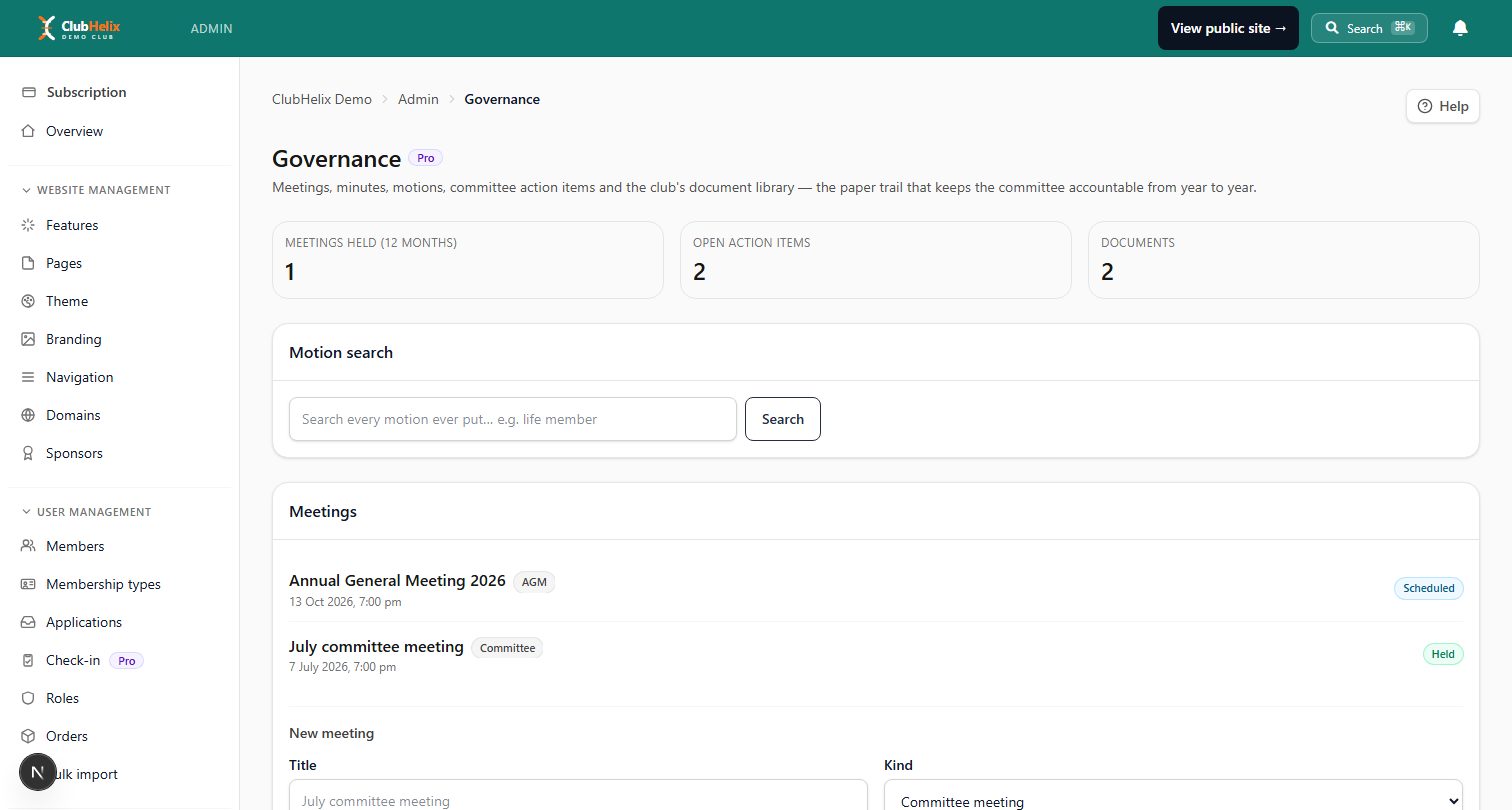
Keeping the plan and its checkpoints with the meeting records rather than in someone's laptop matters more than it sounds. When the committee turns over, the plan and the reasons behind each decision have to travel with the club — governance and meeting records keep the agenda, minutes, documents and decisions in one searchable place, and the standing numbers come straight from the club's own reports rather than being rebuilt in a spreadsheet each month. Our club committee monthly report pack shows what that one-page report looks like, and club KPIs to track covers which numbers earn their place.
Getting the plan agreed in one session
You do not need a weekend retreat. Two and a half hours, once, with the right inputs, produces a better plan than most planning days because nobody has time to drift into vision statements.
Before the session, one person prepares a two-page pack — membership by category for three years, teams or squads by age, financial summary and reserves, volunteer count, and the results of a short member survey. Run the survey two weeks out with five questions and nothing more; forms and surveys will collect it in an evening, and our guide on how to run a member survey covers what to ask. Send the pack three days ahead so the session starts from facts rather than opinions.
The session run sheet:
| Time | What |
|---|---|
| 0.00 | The pack, read out loud in ten minutes. No discussion during the reading |
| 0.10 | Where we are now — everyone writes three honest facts privately, then they go on the wall |
| 0.30 | Where we want to be in three years — five statements maximum, argued down from a longer list |
| 1.00 | Break |
| 1.10 | Everything the club could do about it — a long, uncensored list |
| 1.30 | Choose three. Not four. Three |
| 1.50 | Owners and first moves against each, agreed by the person named, not for them |
| 2.10 | The "not doing" list, written down and read back |
| 2.20 | How we will know — the numbers, and who reports them |
Invite the committee, one or two members who are not on it, and someone who left the club recently if you can face it — that last person will tell you more in twenty minutes than a year of meetings.
If your club is incorporated as a nonprofit, the board carries a duty to set direction rather than just approve invoices, and a one-page plan is the most practical way to discharge it. Community foundations and corporate giving programs almost always ask for a plan or a statement of strategic direction with a grant application, so the document earns its keep beyond your own meetings. Align it with your league or national governing body's participation goals where they exist.
Time the session for the weeks after the season ends and before the annual meeting, while the year is fresh and the incoming board is about to take over. Plan around your fiscal year as well as your season — a plan agreed after the budget is set is a plan with no money behind it, which is the most common reason a first-year priority quietly stalls.
Publishing the plan and reporting against it
A plan the members cannot see is a committee document, not a club plan. Publish the one page on the club website — not the working notes, the finished page — and refer to it whenever you announce something that came from it. Members who see "this came from priority two of the club plan" start to believe the plan is real, and the ones who disagree will tell you, which is useful.
At the annual meeting, report against it directly rather than writing a separate narrative: here were the three priorities, here is what happened to each, here is what we deliberately did not do, and here are next year's three. That single change makes the annual meeting shorter and considerably more interesting — see how to run a club AGM and the sports club annual report template for the surrounding structure.
Keep the plan alongside your incorporation documents and annual filings, so an incoming secretary or board member inherits everything at once. Where the club holds grant funding, note the reporting dates on the same page, because those deadlines have consequences the plan's own milestones do not.
Keeping the plan where the committee already looks
A one-page plan works because it is where the work already happens — on the agenda, in the minutes, next to the numbers. That is also the practical argument for keeping your club's records in one place rather than four: the plan sits with governance and meetings, the standing numbers come out of reports rather than a rebuilt spreadsheet, and the person who owns a priority gets exactly the access they need to act on it without waiting for someone else's login.
ClubHelix is built for volunteer committees rather than clubs with staff, there is a free tier to plan on before you commit to anything, and the pricing is published up front. If your plan currently lives in a document nobody has opened since the planning day, set your club up and put it somewhere the committee will actually see it every month.
Frequently asked questions
How long should a club strategic plan be?
One page. A volunteer committee cannot carry more, and length is not the same thing as rigour — the discipline of fitting three-year direction, this year's three priorities and the measures onto a single page is what forces the choices that make a plan useful. Keep any supporting analysis in a separate pack that gets read once, at the planning session.
How many years should a club plan cover?
Three is the practical horizon for a community club — long enough to cover a capital project or a coaching pathway, short enough that the people writing it will still be around. Set three-year direction, then re-choose this year's three priorities annually rather than rewriting the whole document. A five-year plan in a club with a two-year average committee tenure is mostly fiction.
Who should write the club's plan?
The committee, in one session, with input from members through a short survey and ideally from someone who recently left. Facilitators can help run the room, but a plan written for a club by an outsider rarely survives, because nobody at the table feels they own it. The person named against each priority must agree to it in the room, not be volunteered in their absence.
How often should a committee review the plan?
Ten minutes at every meeting as a standing item, plus one proper re-choosing of priorities each year. Reviewing annually means reviewing never, and quarterly reviews tend to become a separate meeting nobody attends. The short, frequent version keeps the plan attached to the club's actual decisions.
What if the club misses its goals?
Say so, at the table, and decide which of three things is true — the priority was wrong, the owner needed help nobody gave them, or the club has changed its mind. All three are legitimate, and minuting the decision is far healthier than rolling the same unmet goal forward for three years. A plan that never changes is not being used.
Keep reading — club KPIs to track for the numbers worth reporting, and club succession planning for the people side of a three-year plan.

