
What this guide answers
- How many sponsorship tiers should a club have?
Three, plus a bespoke line you do not publish. Three tiers are enough to give a small business an easy entry point, a committed business the package you actually want sold, and an anchor at the top that makes the…
- How do you price a club sponsorship package?
Triangulate with three lenses — what comparable local advertising costs, what audience you can actually evidence, and what the relationship is strategically worth to that particular business.
- What should be in a club sponsorship package?
Deliverables you can name, count and prove — a specific sign in a specific position, a listing on your website, a named slot in the newsletter for the season, presenting rights on an award, a set number of function…
- Should sponsorship prices be published on our website?
Publish the tiers and what is in them. Whether you publish the prices is a judgement call — showing them saves time and filters out businesses that were never going to proceed, while hiding them keeps room to negotiate…
- How do we justify increasing a sponsor's price at renewal?
With evidence from the season just finished. Show growth in the numbers the sponsor cares about — attendance, membership, junior families, website sessions, list size — and pair the increase with an added deliverable…
Ireland edition. This guide is written for volunteer-run clubs in Ireland. Where rules differ — grants, tax, incorporation, safeguarding — follow the Ireland-specific pointers below or check with your national body.
Two documents show up in almost every club's sponsorship folder. The first is a letter, usually beginning "we are writing to ask whether your business would consider supporting our club", and ending with a bank account number. The second is a price list where the fence sign has cost the same since a committee set the figure years ago and nobody has revisited it since, because nobody could think of a defensible reason to change it.
Both documents share a problem: they treat sponsorship as a donation with a logo attached. Businesses that give to your club out of goodwill are lovely, and they are also the first line cut when trade is slow. Businesses that buy something measurable renew. The shift from the first to the second is not about writing a better letter — it is about knowing what you actually own, what it is genuinely worth, and being able to prove at the end of the season that the sponsor got it.
This guide is about the pricing side specifically: how to build a sponsorship inventory, how to value each asset without inventing numbers, how to structure tiers so the middle one is the obvious choice, and what the end-of-season report has to contain to support next year's price. For the approach itself — who to target, the conversation and the close — read how to get sponsors for a sports club. For looking after them once the ink is dry, read how to keep club sponsors happy. This one starts after you have decided to sell and before you have decided what to charge.
Build the inventory before you build the package
You cannot price a package until you know what is in it, and most clubs discover they own more than they thought. Work through your season and list every point at which a business could be visibly attached to your club, with a unit of sale beside it. The unit matters more than the item — "fence signage" is not sellable, "one 2.4m boundary sign, one of twelve, for a full season" is.
| Asset class | Unit of sale | What drives the value |
|---|---|---|
| Perimeter signage | One sign of a fixed size, positioned, for a season | Foot traffic past it, camera angles, whether it faces the crowd |
| Playing apparel | One position — chest, back, sleeve, shorts, socks | Number of players wearing it and how often photographed |
| Training and squad wear | Warm-up tops, bags, water bottles | Visible off-site, at other venues, during the week |
| Website | Sponsor page listing, homepage strip, section sponsorship | Site traffic and how many pages carry the placement |
| Named slot in the club newsletter, all season | List size and how often you actually send | |
| Social and content | Post series, match report presenting rights | Following and posting frequency, not follower count alone |
| Match day | Round naming, ground announcements, half-time activation | Attendance and number of occurrences |
| Events | Presentation night, gala day, quiz night, junior carnival | Attendance and the audience's composition |
| Programs | Junior program naming, come-and-try series, clinics | Participant numbers and the goodwill attached |
| Hospitality | Function tickets, a table, a season pass, bar tab | What it costs you and what it is worth to them |
| Facility | Room naming, scoreboard, honour board, court or lane | Permanence and visibility outside game hours |
| Awards | Player of the round, best and fairest, volunteer award | Repetition — a weekly award is fifty mentions a season |
Count the units in each row. Twelve boundary signs, one newsletter slot, eighteen home fixtures, two events, one junior program: that is your inventory, and it is finite. Finite is the whole point, because scarcity is what lets you say no to an offer below your price.

Value each asset with three lenses, not a guess
There is no formula that produces a correct sponsorship price. There are three ways of triangulating one, and using all three gives you a number you can defend in a meeting.
Lens one: comparable cost. What would this business have to spend to reach the same people another way? Ask a friendly local business owner what they currently pay for a letterbox drop across the suburb, a quarter-page in the local paper, or a month of local digital advertising. You are not trying to match those prices — you are establishing the order of magnitude your sponsorship sits in, and it is a conversation that takes fifteen minutes and immediately tells you whether your fence sign is priced sensibly or is a third of what it should be.
Lens two: countable reach. Add up the exposure you can actually evidence. Not "thousands of people see our ground" — a number with a source behind it.
| Channel | What to count | Where the number comes from | The honest caveat |
|---|---|---|---|
| Home fixtures | Fixtures × average attendance | Gate records, canteen transactions, a manual count on three ordinary days | Attendance varies wildly by round and weather |
| Website | Sessions and page views over a season | Your site's analytics | Sessions are not people, and some are your own committee |
| Newsletter | Recipients × sends, plus open rate | Your email tool's reports | An open is not a read |
| Social | Posts per season and reach per post | Platform insights | Reach figures are platform-defined and not comparable across channels |
| Playing group | Players × training and match occasions | Your member records | Players wearing kit is exposure to each other as much as the public |
| Events | Attendance per event | Ticket sales | Counted heads only, not "expected" |
| Junior families | Junior members × households | Member records | The most valuable audience most clubs undercount |
Write down the caveats and show them to the sponsor. A club that says "we can evidence around 4,000 ground attendances and 30 newsletter sends to 600 addresses, and we cannot reliably measure passing traffic" is far more credible than one claiming a five-figure audience it cannot substantiate. Credibility is what gets you the second year.
Lens three: strategic fit. Some assets are worth more to specific businesses than any reach calculation suggests. The physiotherapist who gets named as the club's provider, the sports shop whose product your members must buy anyway, the real estate agent whose entire market is the postcode your ground sits in — for them, the value is conversion, not impressions. Price those relationships on what the relationship delivers, and be prepared to build a bespoke package rather than squeezing them into a tier.
Where lens one and lens two disagree by more than a factor of two, trust lens one. The market price of reach is a real constraint; your impression count is an estimate.
Three tiers, built so the middle one sells
The tier structure is a pricing instrument, not a filing system. Design it backwards: decide which package you want most businesses to buy, build that one properly, then build one above it that makes it look reasonable and one below it that is genuinely easy to say yes to.
| Tier | Positioning | Typical deliverables | Number available |
|---|---|---|---|
| Community supporter (1×) | The easy yes for a small local business | Website listing with a link, one social mention, name on the sponsor board, two function tickets | Unlimited or 20 |
| Club partner (2.5×) | The tier you actually want sold | Everything above, plus one boundary sign, a named slot in the newsletter all season, presenting rights on one award, four function tickets, a logo on training wear | 8–12 |
| Principal partner (5–6×) | The anchor that frames the tier above it | Everything above, plus front-of-jumper or equivalent premium placement, homepage presence, naming rights on one event or round, category exclusivity, hospitality for eight, a mid-season and end-of-season report | 1–2 |
Expressing the tiers as multiples rather than as fixed prices is deliberate. It keeps the structure intact when you reprice, and it shows you immediately whether the ladder is sensible — a middle tier that costs 1.3× the bottom one gives nobody a reason to step up, and one that costs 4× gives nobody the confidence to.
Beyond the tiers, keep exactly two other things: a bespoke line for naming rights and multi-year deals, which never appears on the public price list, and an in-kind schedule for businesses that would rather supply goods or services. Value in-kind at what you would otherwise have paid, not at their retail price, and write it into the agreement as a deliverable both ways.
Six rules that stop tiers collapsing
- Cap the numbers, and publish the cap. "One of eight" is a reason to decide now. Uncapped tiers become a list, and a list has no price.
- Never discount a tier. If a business cannot afford the middle tier, sell them the bottom one, or build a smaller package by removing deliverables. A discount tells every other sponsor that the price list is fiction.
- Price category exclusivity separately. Exclusivity is a real cost to the club — it removes every other business in that category from your market — so it is a premium on top of a tier, not a courtesy. Only ever grant it in categories you can define and enforce.
- Every deliverable has an owner. Write a name beside each one before you sell it. A package containing "monthly social posts" with nobody assigned is a renewal you have already lost.
- Two-year terms with a review. A two-year agreement with a written mid-point review is easier to sell than an annual renewal and far easier to administer than a handshake.
- Sell nothing you cannot deliver twice. If you can only do the activation for one sponsor, do not put it in a tier that eight businesses can buy.
Indicative bands for a community club with a few hundred members and a modest gate: community supporter around €200 to €450, club partner around €900 to €2,200, principal partner around €4,000 to €9,000. Clubs with a licensed clubhouse and strong weekend attendance run meaningfully higher; small juvenile-only clubs sit lower. Treat these as a sanity check on your own three-lens valuation rather than a price list — the local market and your evidence set the real number.
What you should not sell
A short list, because getting one of these wrong costs more than a season's sponsorship income.
- Member data. Not names, not email addresses, not a "list swap". You can send a sponsor's offer to your own members from your own club address, with your own unsubscribe link. You cannot hand over the list, and nobody should be asking.
- Endorsements your governing body restricts. Many codes have rules about which categories may appear on junior apparel or inside a family-facing program. Check before you sell, not after the jumpers are printed.
- Exclusivity you cannot police. If your governing body already has a category partner that appears on your competition materials, you cannot sell that category exclusively at club level.
- Anything without an owner and a date. An unfulfilled deliverable is worse than never having offered it.
- The whole club to one business, cheaply. A single sponsor covering everything looks efficient until they leave, and takes your entire sponsorship income with them when they do.
Sponsorship is generally treated as a supply of advertising rather than a gift, so VAT-registered clubs charge VAT on it and the sponsor usually treats it as a business expense. That makes it quite different from a donation, which carries its own rules and reliefs. Clubs holding sports body tax exemption should check how trading and sponsorship income interacts with that exemption before the season starts — Revenue publishes guidance, and your accountant will have seen the question before.
The proposal, the agreement and the fulfilment tracker
Your public-facing document is one page. Tiers, deliverables, numbers available, price, and a named human to contact. The long deck is a barrier, not a sales tool — you can send detail after the conversation, and you will need less of it than you think.
The agreement is where you protect both sides. Whatever form yours takes, it should name: the term and the renewal date, the fee and when it is payable, every deliverable as a list, the exclusivity scope if any, how each party's logo may be used, what happens if a season is shortened or cancelled, the tax treatment, and who at the club is responsible. Keep it to two pages and get it signed before anything is printed.
Then track the fulfilment, because delivery is what your pricing has to be backed by:
| Deliverable | Due | Owner | Evidence captured | Done |
|---|---|---|---|---|
| Sponsor page listing live | Within 14 days | Website coordinator | Screenshot with date | |
| Boundary sign installed | Round 1 | Grounds | Photo from the crowd side | |
| Newsletter slot × 8 | Each send | Communications | Copy of each send | |
| Award presenting rights × 18 | Weekly | Match day manager | Match report mentions | |
| Function tickets × 4 | Event date | Social committee | Tickets issued | |
| Mid-season check-in | Mid-season | Sponsorship lead | Meeting note |
Every row in the "evidence captured" column is a row in the end-of-season report. That is not a coincidence — collect the proof as you go, because reconstructing it in October is impossible and obviously reconstructed.
The end-of-season report that justifies next year's price
Most clubs treat the season-end report as a courtesy. It is not. It is the document that determines whether next year's conversation starts at "will you renew" or at "we'd like to move you up a tier, and here's why". Three pages, no more.
| Page | What goes on it | Where it comes from |
|---|---|---|
| Page 1 — the numbers | Fixtures played, attendance, members, website sessions, newsletter sends and list size, event attendance, junior participation | Your own records and analytics — with the same caveats you disclosed when you sold |
| Page 2 — the proof | Photograph of their signage in use, the sponsor page as it appeared, examples of the newsletter slot, award presentations, one member or parent quote | The evidence column of your fulfilment tracker |
| Page 3 — the ask | What they bought, what was delivered, what changes next season, and the renewal price with its reason | The agreement plus your pricing review |
Two things separate a report that renews from one that gets filed. The first is honesty about what you did not deliver — if you promised eight newsletter mentions and managed five, say so and say what you are doing about it. Sponsors already know; naming it yourself is what makes the rest of the document believable. The second is that the price change is argued from the numbers on page one, not announced. "Attendance is up, the junior section grew by forty families, and the newsletter list is a third bigger than when you signed — we're moving the partner tier up accordingly, and adding the season-preview slot" is a completely different conversation from an invoice with a bigger number on it.
Time the report for before the last fixture, not after the AGM. Sponsors set their own budgets on their own calendar, and a club that arrives in November has already missed the decision. Our end-of-season report template covers the club-wide version, and the sponsor report can borrow half its numbers.
Reviewing your prices each year
Raise prices on evidence, in a structured way, and only ever at renewal. Three signals mean you are underpriced: your middle tier sold out in the first fortnight, sponsors renewed without a single question about the number, or you have businesses asking for a category that is already taken. Two signals mean you are overpriced or under-evidenced: nobody moved up a tier all season, and the ones who left could not tell you what they got.
When you do raise, add a deliverable at the same time. A price rise attached to something new reads as growth; the same rise on the same package reads as a levy.
Running the sponsorship side without a shoebox
Sponsorship falls apart in the admin. Agreements in a former treasurer's email account, invoices that go out in June for a deal that started in March, a sponsor page nobody updated when the deal changed, and no record of what was promised. Every one of those is a renewal at risk, and none of them is a hard problem to solve.
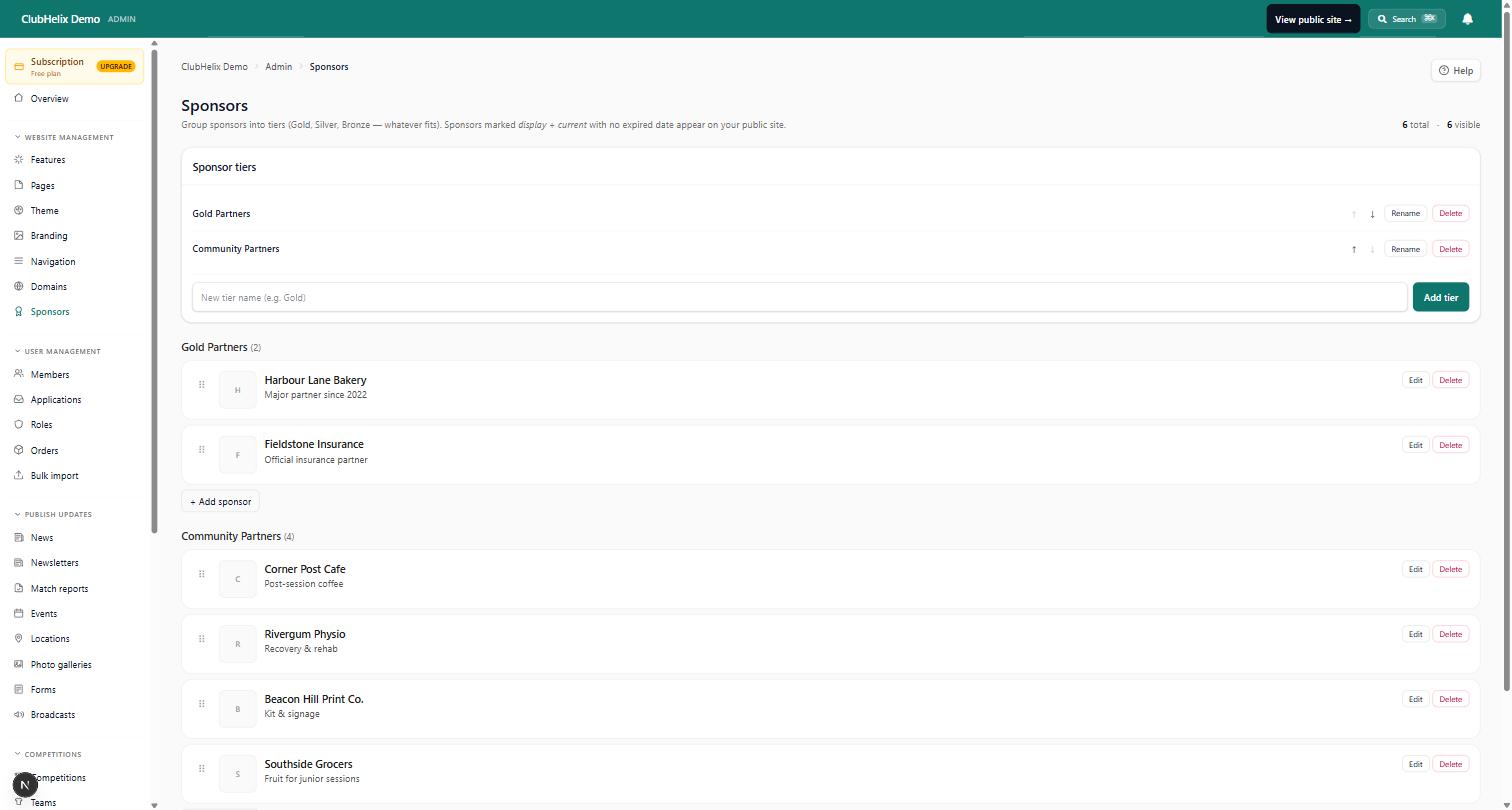
ClubHelix keeps sponsors, agreements and invoicing in the same place as the rest of the club, so the deliverables list, the payment status and the renewal date are visible to whoever holds the portfolio this year rather than to whoever held it last. The sponsor page itself is built in the canvas page editor alongside your other pages, broadcasts send the newsletter slot you sold from your own club address, and reports give you the membership and attendance numbers page one of the report needs.
The free tier costs nothing to trial for a season, the pricing above it is published rather than quoted, and the quickest way to judge it is to start your club site and load this season's sponsor agreements into it while the details are still fresh in someone's memory.
Frequently asked questions
How many sponsorship tiers should a club have?
Three, plus a bespoke line you do not publish. Three tiers are enough to give a small business an easy entry point, a committed business the package you actually want sold, and an anchor at the top that makes the middle look reasonable. Add a fourth and the differences between them stop being obvious to the buyer.
How do you price a club sponsorship package?
Triangulate with three lenses — what comparable local advertising costs, what audience you can actually evidence, and what the relationship is strategically worth to that particular business. Build the middle tier at roughly two and a half times the entry tier and the top at five to six times, cap the numbers in each, and price category exclusivity as a separate premium.
What should be in a club sponsorship package?
Deliverables you can name, count and prove — a specific sign in a specific position, a listing on your website, a named slot in the newsletter for the season, presenting rights on an award, a set number of function tickets. Avoid vague inclusions like "social media exposure" unless you commit to a number of posts and put an owner beside it.
Should sponsorship prices be published on our website?
Publish the tiers and what is in them. Whether you publish the prices is a judgement call — showing them saves time and filters out businesses that were never going to proceed, while hiding them keeps room to negotiate on inclusions. Publishing the number of packages available at each tier is worth doing either way, because scarcity is a genuine reason to decide.
How do we justify increasing a sponsor's price at renewal?
With evidence from the season just finished. Show growth in the numbers the sponsor cares about — attendance, membership, junior families, website sessions, list size — and pair the increase with an added deliverable so the renewal reads as an expanded partnership rather than a levy. Bring the conversation before their budget year closes, not after.
Keep reading: how to keep club sponsors happy for the mid-season relationship, and club marketing plan for the audience numbers your sponsorship pricing depends on.


