
What this guide answers
- What should a club photography policy cover?
Who may take photographs at club activities, what the club publishes and where, how consent is captured and recorded, how a member withdraws consent and what happens when they do, the rules around change areas and…
- How do you get photo consent for children at a club?
Ask a parent or guardian at registration, separately for each type of use rather than as one blanket tick, record the answers against the child's member record, and make it easy to change later.
- Can a member withdraw photo consent later?
Yes, and the policy should say so plainly, with one published contact point and no requirement to give a reason.
- Are club photographs personal information?
Generally, an image from which a person can be identified is treated as their personal information under most data protection frameworks, which is why storage, sharing and retention all matter and not only publication.
- What about team photos when one family has said no?
Decide the default in advance rather than on the steps. The reliable options are to take a second version of the group shot without that member, or to take one photo and restrict it to internal use only.
Canada edition. This guide is written for volunteer-run clubs in Canada. Where rules differ — grants, tax, incorporation, safeguarding — follow the Canada-specific pointers below or check with your national body.
It is team photo morning. Thirty-two under-tens are lined up on the steps in three rows, the photographer is losing the light, and a parent walks over to say quietly that their child should not be in it. Nobody on the committee can remember whether that was recorded anywhere, whether it applies to the team photo or only to social media, or whether the same family said the same thing last season. Someone suggests the child stands at the end so they can be cropped later. Everyone agrees, nobody writes it down, and the photo goes up on the club page eight days later with the child in the middle of the second row.
That is what a photography and consent policy is really for. Not to stop clubs taking pictures — photographs are how a club remembers itself, recruits its next intake and gives sponsors something worth paying for. The policy exists so that a decision made once, by a family, in a form, survives contact with a busy Saturday and a rotating cast of volunteers.
This guide is general information rather than legal advice. It covers how to capture consent when people join, how to record and honour a withdrawal, the practical shooting rules that keep volunteers out of trouble, and where the official guidance for your sport actually lives. Where children are involved, your governing body's safeguarding or member protection policy sits above anything here — read it, and ask your safeguarding officer if you do not have one to hand.
Consent is a record, not a conversation
The failure at the top of this article is not a consent failure. Consent was given — clearly, verbally, to a real person. It failed because it was never a record. Three properties separate a consent you can rely on from one you cannot.
- It is written down somewhere the club owns. Not in a text message on a former registrar's phone. Not in a photographer's memory.
- It is attached to the person, not to the event. Consent recorded against "the 2026 team photo" tells you nothing about the fixture gallery in July. Consent recorded against a member record answers every question that will ever come up about that member.
- It is reversible, and the reversal reaches everyone who needs it. A withdrawal that is acknowledged by email but never passed to the four people who actually post photographs has changed nothing.
Most clubs already collect consent. What most clubs lack is the third property — a chain that carries a change from the family to the person holding the camera before the next match.
Capture it at registration, and capture it granularly
Registration is the only moment in the year when you have every member's attention and a form in front of them. Take consent there, once, and carry it forward. Adding it to your existing membership form costs you nothing and saves a season of asking.
A single yes-or-no tick box is the common approach and the weakest one, because families do not think about photographs in a single yes or no. A parent perfectly happy for their child to appear in a team photo on the noticeboard may feel differently about a close-up on a public social account, and very differently again about a photograph supplied to a newspaper. Ask about the uses separately.
| Use | What it covers | Why families answer differently |
|---|---|---|
| Internal club use | Team photos on the clubroom wall, presentation night slides, the annual report | Almost always fine — the audience is the club |
| Club website and members' area | Match galleries, news posts, program pages on your own site | Usually fine; some families want no public image at all |
| Public social media | Posts and stories on the club's public accounts | The most declined use, because it travels and cannot be recalled |
| Named identification | Naming the person in a caption, results table or match report | Some families accept the image but not the name |
| Media and promotional use | Local press, sponsor material, recruitment campaigns, printed flyers | Often declined even where website use is accepted |
| Live streaming and recorded video | Streamed fixtures, coaching footage, highlight reels | Newer, less understood, and worth asking about explicitly |
Six checkboxes look like a lot until you consider the alternative, which is a volunteer making a judgement call about a stranger's child at half-time. Ask once, store the answers, and the judgement calls disappear.
The fields worth having
Keep the form itself short. For each member you want — who is answering (the member, or a parent or guardian for a junior), the uses they agree to, whether the person may be named, any specific restriction in free text, and the date. The free-text box matters more than it looks: it is where you catch the situations a checkbox cannot express, such as a family who prefer no images at all for safety reasons, or a member who is happy to appear in group shots but not alone.
Two things to avoid. Do not bundle photography consent into a general terms acceptance where nobody sees it, because a consent nobody noticed is a consent that will be disputed. And do not treat silence as agreement — an unanswered question is a no until someone asks.

Recording a withdrawal so it actually takes effect
Consent that cannot be withdrawn easily is not consent, and a withdrawal that stops at the inbox is worse than no policy at all — it creates an expectation the club then breaks. Build a chain with named steps.
- Publish one contact point. One email address, on the website, in the welcome pack and on the consent form itself. Not "speak to your team manager", which produces six different outcomes.
- Acknowledge without asking why. Families do not owe the club a reason, and asking for one is the fastest way to make a routine request feel adversarial. Acknowledge, confirm what will change, and say by when.
- Change the record, not just the inbox. Update the member's stored consent immediately, so the answer is correct for anyone who looks it up later.
- Tell the people holding cameras. The comms officer, the team manager, and anyone rostered to shoot that weekend. This is the step that gets skipped.
- Deal with what is already published. Search your own site and accounts for existing images of that member and remove or crop them. Set an expectation — same week is realistic for a volunteer club, and saying so is better than promising immediate action you cannot deliver.
- Note the date and who actioned it. If the question comes up next season, you want a record, not a memory.
The team photo problem deserves its own answer, because it is where the chain most often breaks. A group photograph is not solved by cropping — crops fail, the original gets reposted, and the child knows they were the one cut out. The workable options are to take a second version of the shot without the member, to take the photo with the member present but never publish it beyond internal use, or to talk to the family about what they would actually be comfortable with. Decide the club's default in the policy so a photographer is not negotiating it on the steps.
Practical rules for the people holding the camera
Most club photography is done by a parent with a phone, not a professional, and rules that assume otherwise get ignored. Keep them short enough to fit on a card.
During play. Shoot the action, not the sideline. Photograph from public areas rather than from inside a team's space. Prefer wide and mid shots of play to close-ups of individual juniors. Do not photograph a player receiving first aid, being spoken to by an official, or in obvious distress — the moment always feels newsworthy and never is.
Around the ground. No photography in or from change rooms, toilets, showers or any area where people change, without exception and regardless of who is present. This includes phones on benches and includes adults. Pools, beaches and gymnastics venues need extra care because participants are in minimal clothing, and many venues have their own rules that are stricter than yours.
Team photos and presentation night. Announce that photography is happening before it starts, so anyone with a concern can raise it then rather than afterwards. Have the consent list checked before the shutter, not after. For award photos, remember that a named caption is a separate consent from the image itself.
Video, streams and long lenses. A streamed fixture reaches an audience the club cannot see and cannot recall, so treat it as a distinct use with its own consent. If you livestream, publish where and when in advance, and make sure the stream does not linger on individual juniors or capture the crowd for long periods. Our guide on how to livestream local sport covers the practical setup.
Storage and sharing. Photos are member information, not just files. Keep the originals in one club-controlled location rather than on volunteers' personal devices, delete what you will never use, and do not hand a full memory card to a sponsor. If you engage a paid photographer, put it in writing that the club decides what is published, that the photographer does not post images independently, and that images are not licensed on to anyone else.
A briefing card you can print
Photographing at [Club]
Check with the club before you start — some members have asked not to be photographed. Shoot from public areas, not from inside team spaces. Wide and mid shots of play, not close-ups of individual juniors. No cameras or phones in or near change areas at any time. Nothing of a player who is injured, upset or being disciplined. Do not post anything yourself — send images to [email] and the club will publish. If anyone asks you to stop, stop, and tell [role] afterwards.
Pin it inside the clubroom door. It answers most of the questions a volunteer will have, and it stops the rest being answered by guesswork. If you want the images to be worth publishing as well as safe to publish, how to take good club photos covers the craft side.
Where the official guidance sits
The club is rarely the top of this pyramid. Your governing body almost certainly has a safeguarding or member protection policy with a photography section, the facility you play at may have its own rules, and there is usually a national information regulator publishing guidance in plain language. Read those before drafting, and cite them in your policy so members can see the club is following a framework rather than inventing one.
In Canada, start with your provincial or territorial sport organisation's safe sport policy, which will normally cover photography and filming of minors, and check whether your national body's rule set applies to you through affiliation. Privacy obligations come from a mix of federal and provincial statutes depending on the club's activities, and the Office of the Privacy Commissioner publishes guidance for small organisations that treats photographs as personal information.
Whose venue, whose rules
The second layer people forget is the facility. Photography rules at the ground you play at may be stricter than yours, and they apply regardless of what your members have consented to — particularly at shared venues, schools and aquatic centres.
Many clubs in Canada play at municipal facilities, school board sites or private complexes, and each commonly imposes its own photography conditions through the facility permit. School board rules about images of students can be stricter than the club's own policy and may require separate approval. Read the permit conditions at the start of the season, and pass anything unusual to your communications volunteer rather than filing the paperwork unread.
Shooting conditions worth planning around
The competitive calendar makes light your main constraint. Fall and winter fixtures finish in poor light, and in the colder months an afternoon game can be effectively unphotographable by the closing period without a fast lens. Late spring and summer evenings give you long, soft light that flatters everything, which is why club photo days belong in that window rather than mid-season. Snow and bright turf both fool automatic exposure, so expect to compensate rather than trusting the phone.
When an image is already out there
Sometimes the horse has bolted — a photo went up, a family objects, and it has already been shared. Handle it in this order. Take it down from everything the club controls, first and without debating whether the objection is reasonable. Ask any account that reshared it to remove their copy. Tell the family what you have done and what you cannot control, honestly, because a club that overpromises here loses trust twice. Then work out how it happened and fix that, because it is almost always a broken link in the chain in the previous section rather than a bad decision by a person.
If the image involves a child and has ended up somewhere concerning, that is no longer a communications problem — escalate it to your safeguarding officer and follow your governing body's reporting process, and where the platform has a reporting mechanism for images of minors, use it. Anything that becomes a formal grievance should move into your complaints and disputes process rather than being handled ad hoc in a comment thread.
Consent that lives with the member record
The reason consent chains break is almost never bad intent — it is that the consent lives in one system and the photographs live in another, and the people holding cameras have access to neither. ClubHelix closes the gap by keeping consent on the member's own record. Ask the questions once through online registration or a form at sign-up, let members update their own answers, use digital waivers where a signed acknowledgement is needed, and publish galleries and match reports through club news on your own site rather than a platform you do not control.
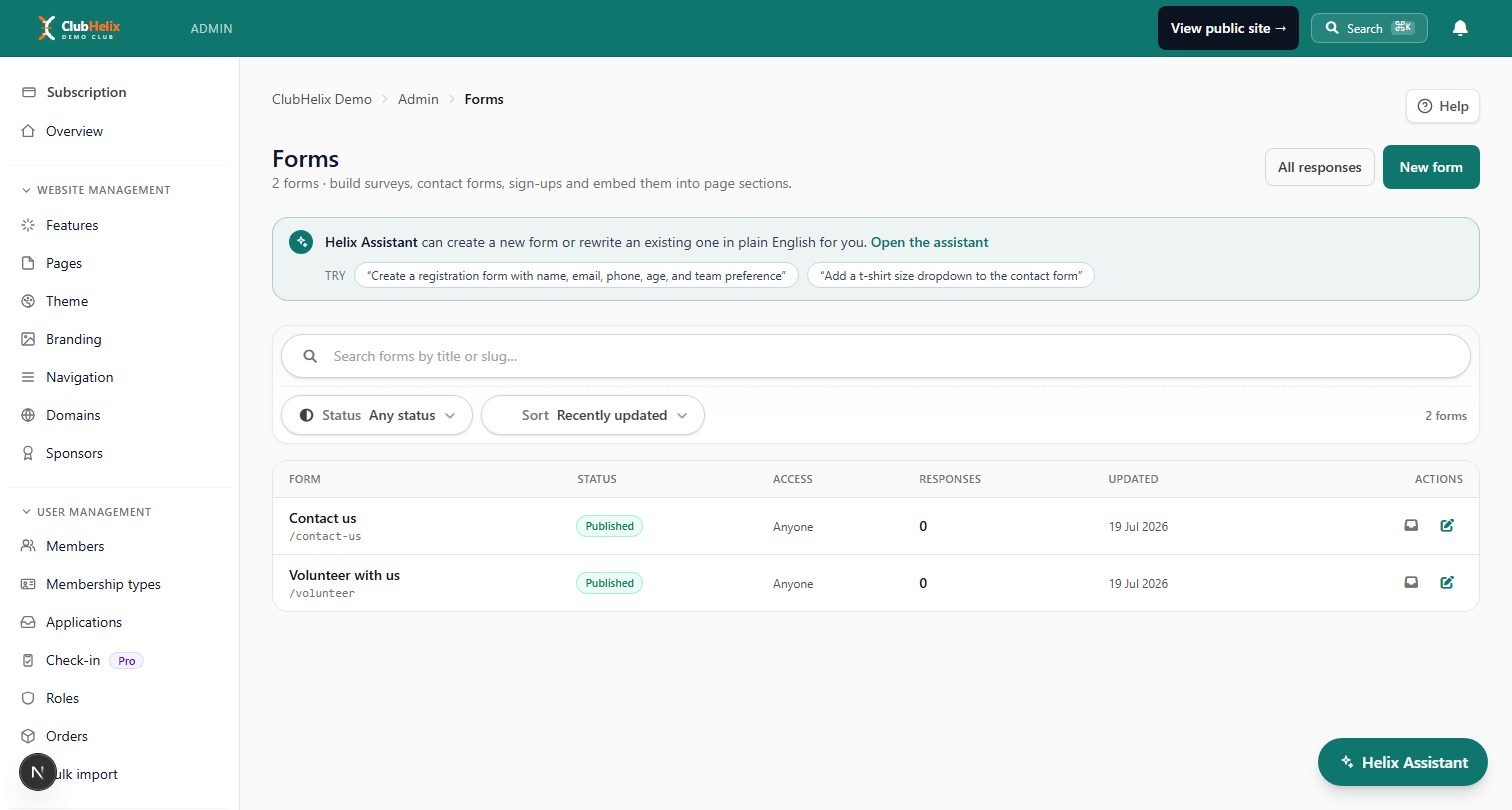
The free tier is genuinely usable for a small club, and the pricing is on the website rather than behind a sales call. If your club's consent answers currently live on paper in a folder, moving them onto member records before next registration day is the single highest-value hour you will spend — start your club site and build the form once.
Frequently asked questions
What should a club photography policy cover?
Who may take photographs at club activities, what the club publishes and where, how consent is captured and recorded, how a member withdraws consent and what happens when they do, the rules around change areas and vulnerable moments, how images are stored, and what a paid photographer may and may not do with the files. Keep it to two pages, give it an adoption date and a review date, and publish it on your website so members can read it without asking.
How do you get photo consent for children at a club?
Ask a parent or guardian at registration, separately for each type of use rather than as one blanket tick, record the answers against the child's member record, and make it easy to change later. Your governing body's safeguarding or member protection policy will usually specify what it expects, and its requirements sit above your own — check them first and mirror the language rather than writing something that conflicts.
Can a member withdraw photo consent later?
Yes, and the policy should say so plainly, with one published contact point and no requirement to give a reason. A withdrawal means updating the stored record, telling everyone who takes or publishes photographs, and removing existing images from anything the club controls. Set a realistic timeframe rather than promising immediate removal, and note the date it was actioned.
Are club photographs personal information?
Generally, an image from which a person can be identified is treated as their personal information under most data protection frameworks, which is why storage, sharing and retention all matter and not only publication. That does not make club photography risky by default — it means being deliberate about where originals are kept, who can access them, how long you keep what you never use, and what a third-party photographer is permitted to do with the files.
What about team photos when one family has said no?
Decide the default in advance rather than on the steps. The reliable options are to take a second version of the group shot without that member, or to take one photo and restrict it to internal use only. Cropping is not a solution — crops fail, originals get reposted, and the person being cropped knows exactly what happened. Check the consent list before the shutter, not after.
Keep reading — how to take good club photos covers the craft, and the club social media policy template sets the rules for where those photos end up.


