
What this guide answers
- Should a club use a newsletter or social media?
Both, for different jobs. Social is how people who do not yet belong discover you and how members feel connected week to week; email is how you reliably reach the people who have actually joined.
- How often should a club send a newsletter?
Fortnightly or monthly suits most clubs outside peak periods, moving to weekly during the season if you genuinely have something worth saying.
- Where should urgent club news go?
Not into a feed. Anything time-critical — a cancellation, a venue change, a safety notice — needs a channel where delivery does not depend on an algorithm or on somebody opening an app that day.
- Is it worth writing a newsletter if only some members read it?
Yes, provided you measure the right thing. A newsletter that drives thirty registrations, fills a volunteer roster and reminds people about a deadline has done its job even if plenty of recipients skimmed it.
- How do we stop writing the same thing three times?
Publish the full version once as a page or news post on your own site, then let every other channel be a two-sentence pointer to it.
USA edition. This guide is written for volunteer-run clubs in the United States. Where rules differ — grants, tax, incorporation, safeguarding — follow the USA-specific pointers below or check with your national body.
The special general meeting needed a quorum of forty. Twenty-six turned up. Afterwards the secretary said, reasonably, that it had been announced three times — a post on the Tuesday, a reminder on the Sunday, and a story on the morning itself. All of that was true. It was also, for most of the membership, invisible.
That meeting is the whole argument in miniature. The committee measured effort; the members experienced delivery. Between the two sits a question most clubs never actually decide: which of your channels is for reaching people who have chosen to belong, and which is for being seen by people who are merely interested. Get that division wrong and you will spend the season posting diligently into a room your members are not standing in.
This guide is for the person who ends up writing everything — secretary, communications volunteer, or the committee member with the best spelling. It covers how far a post travels compared with an email and how long each stays alive, a workflow that lets you write once and distribute everywhere instead of retyping the same notice three ways, and the slow-burning problem nobody notices until handover week: a feed cannot be an archive.
Three channels, three genuinely different jobs
Most club communication problems are really a mislabelling problem. Each channel has one job it does better than the others, and asking it to do a second job is where the effort goes.
| Channel | Who it reaches | The job it is best at | What it cannot do |
|---|---|---|---|
| Social post | Followers, plus whoever the feed chooses | Attention, warmth, reaching beyond your members | Guarantee delivery to any particular person |
| Email newsletter | People who gave you an address | Reaching the enrolled — one message, one inbox | Move fast, or reach non-members |
| Website page or news post | Anyone who searches or clicks a link | Being the permanent, findable answer | Reach anybody on its own |
| Push notification or app alert | Members who installed the club app | Short, time-critical interruption | Carry detail or nuance |
| Text message | Almost everyone, almost immediately | The genuine emergency only | Be used often without irritating people |
The sentence worth writing on the whiteboard: social is discovery, email is delivery, the website is the record. Once that is agreed, most weekly arguments about where something should go answer themselves. If you have not written a channel plan at all, the club communication plan guide has the matrix version, including who is allowed to send what.
Half-life — how long a message stays alive
Reach is the number everyone quotes. Half-life is the number that actually explains why people miss things.
A message's half-life is roughly the time in which it does half of the work it will ever do. A social post does most of its work in the first few hours and is effectively finished within a day or two; it does not stop existing, it stops being shown. An email sits in an inbox until it is opened, deleted or buried — its work is mostly done within two or three days, but a member who opens their email on Thursday still gets Monday's message intact. A page on your own site has no half-life at all in that sense: it answers the same question in March that it answered in February, and it can still be found in October by somebody who searches.
| Message type | Where it belongs first | Practical half-life | What that means for you |
|---|---|---|---|
| Saturday photos | Social | Hours | Post immediately or do not bother |
| Match result | Website, then social | Hours socially, forever on a page | The page is what someone finds next season |
| Registration opening | Email, echoed socially | Days, and needs repeating | One send is never enough for a deadline |
| AGM or meeting notice | Email plus website | Days, but legally it must persist | It has to exist somewhere permanent |
| Venue change this weekend | Push or text | Minutes | Do not rely on anything with an algorithm |
| Sponsor thank-you | Website, then social | Permanent on the site | Sponsors want a page, not a post that scrolls away |
| Volunteer call-out | Email, repeated | Days | Personal ask beats broadcast every time |
The reach arithmetic, done honestly
Do not take anyone's word for reach, including ours. Run the two funnels with your own club's numbers. As an illustration only, take a club with 300 members and 800 social followers.
The social funnel. Of those 800 followers, some are past members, rival clubs, suppliers and the coach's aunt. Of your actual members, some have no account on that platform, some never followed the club page because nobody asked, and of those who did, the feed shows the post to a fraction decided by software you cannot appeal to. Of the people shown it, only those who open the app that day see it, and some of those scroll past because it looks like Tuesday's post. Five filters, none of them visible to you.
The email funnel. Of your 300 members, you hold addresses for however many actually gave you one — start by checking, because most clubs are missing more than they think. Of those addresses, a portion are stale, mistyped or belong to a shared family account. Of the messages sent, some land in a promotions folder or spam. Of those delivered, a portion get opened, and a smaller portion get read past the first heading. Four filters — but crucially, you can see and fix every one of them. You can find the missing addresses, correct the typos, improve your sending reputation, and rewrite a subject line that failed.
That is the real difference. Both channels leak. Only one of them lets you plug the holes. If your emails are the ones disappearing, why club emails go to spam is the fix list.

Seasonal timing matters more than the calendar suggests. The heaviest communication weeks fall either side of the season opening and around the winter holidays, when families are travelling, inboxes are stuffed with retail mail and social feeds are at their noisiest. Plan registration and renewal campaigns to run longer and repeat more than feels comfortable, and put deadline reminders on channels you control rather than ones you hope will be seen.
Publish once, distribute everywhere
The reason clubs burn out on communications is not writing. It is writing the same thing three times, in three formats, with three sets of slightly different details, and then fielding questions from people who got the version that was already out of date.
The fix is a hierarchy. One canonical artefact, several derivatives, no exceptions.
The canonical artefact is a page or news post on your own site. It holds the full detail: date, time, venue, cost, who it is for, what to bring, the link to book. Everything else is a pointer to it — shorter, punchier, differently worded, but never containing a fact that is not on the page.
| Step | Artefact | Where | Effort | Rule |
|---|---|---|---|---|
| 1 | The full item | News post on your site | 10-15 min | Written once, in full, with the booking link |
| 2 | The newsletter paragraph | Email to members | 2 min | Two sentences plus the link — never the full text |
| 3 | The social post | Social channels | 2 min | A photo, a hook, the link |
| 4 | The reminder | Push or app alert | 30 sec | Only for a deadline or a change |
| 5 | The noticeboard version | Printed, at the venue | 5 min | A headline and a code that opens the page |
Two rules make this hold together under pressure.
Never let a derivative carry unique information. The moment a detail exists only in a social post, you have created a second source of truth and guaranteed that someone will act on the wrong one. If a question comes in that the page does not answer, update the page, then reply with the link.
Correct upstream, not downstream. When the venue changes, edit the page first. Then push the change. Editing four copies in four places is how the third one gets missed.
A weekly run sheet you can hand to a volunteer
- Sunday evening — results and one short write-up go onto the site as a news post. Ten minutes.
- Monday morning — the newsletter goes out, with three items, each two sentences and a link. Fifteen minutes.
- Monday afternoon — the same three items become three social posts across the week, scheduled, each linking back.
- Thursday — one reminder for whatever has a deadline, sent to the people it applies to rather than everyone.
- Saturday — photos, live, on social, where they belong. No links needed.
- Anything urgent, any time — push or text first, page updated within minutes, post afterwards.
That is roughly forty minutes a week if the site and the sending live in the same system. It is closer to two hours if the newsletter lives in one tool, the site in another, and the member list in a spreadsheet that only the registrar can open. How to promote a club event is the campaign-scale version of the same sequence.
The archive problem
This is the cost nobody budgets for, because it arrives years after the decision.
A club that has published everything into a feed for five seasons has no archive. It has a scroll. Ask any of these questions and you will feel it immediately:
- What exactly did we tell members about the fee increase in the year before last?
- When did we last thank that sponsor publicly, and can we show them?
- Who won the junior award three years ago, and what did we say about them?
- What did the previous committee promise about the clubroom project?
- Can the new secretary find the announcement that explains the current uniform policy?
In a feed the answers are technically present and practically unreachable. There is no search worth the name, no export you can hand over, no structure, and — if the account is ever lost or the platform changes its rules — no guarantee any of it survives. A club's institutional memory ends up living in the head of whoever has been on the committee longest, which is exactly the failure mode that makes handovers painful.
A website news archive solves it almost by accident. Every post has a date, a title, a permanent address and a paragraph of context. It is searchable, it is linkable, it can be exported, and it can be read by a new committee member in an afternoon. If your club is trying to do this properly, how to record your club's history covers what is worth keeping and what is not.
A quarterly archive habit
Four times a year, spend twenty minutes doing this and the problem never accumulates:
- Check that every significant announcement of the quarter exists as a dated page, not only as a post.
- Save the season's best photos into a gallery on your own site, with names and dates in the captions.
- Export the minutes and the treasurer's reports into the club's own storage, not a personal drive.
- Note anything that changed policy — fees, codes of conduct, uniform, selection — with a link to where it was announced.
- Check that the sponsor pages are current, and screenshot the acknowledgements you have published for their renewal conversation.
Funders and sponsors ask for exactly this material. A grant report or an end-of-year acquittal that can point to dated announcements, participation photos and a public acknowledgement page is far easier to assemble than one reconstructed from memory, and a sponsor renewal conversation goes better when you can show a permanent page rather than scroll a feed on a phone.
The permission asymmetry
Here is the trade nobody spells out at a committee meeting. A social post needs nobody's permission and carries no obligation to anyone — and in exchange, it offers no guarantee that any particular person will ever see it. An email needs permission, a record of that permission and a working unsubscribe — and in exchange, it lands in a named person's inbox whether or not an algorithm approves.
That asymmetry is the real reason to run both channels rather than pick one. It is also why the permission side has to be handled properly from the start, because a list assembled carelessly is a list you eventually cannot use.
- Send from the club's own domain, not a committee member's personal address. The message looks legitimate, it survives a change of secretary, and the sending reputation belongs to the club rather than to an individual.
- Ask once, at the point of joining. Consent captured in the registration form with a date against it is worth far more than a list assembled from old emails and a sign-up sheet on the canteen counter.
- One list, kept current. If your member list lives in the same system that takes registrations, addresses update themselves. If it lives in an exported spreadsheet, it decays from the day it left.
- Honour unsubscribes immediately, and keep genuinely operational messages — a game cancellation, a safety notice, an account matter — clearly distinct from general club news.
- Never buy or scrape a list. It costs you standing with members and with mail providers far faster than it grows your reach.
Rules on consent and electronic marketing differ by jurisdiction, and this is general information rather than advice — check the current position with the relevant regulator and your governing body. For the deeper version, covering deliverability and segmenting, read email newsletter tool vs club platform.
In the United States, commercial email is governed federally by the CAN-SPAM rules, which require accurate headers and subject lines, a physical postal address, and a working opt-out honoured promptly — and some states add their own requirements. Rules about collecting information from children online add a further layer for junior programs. Treat this as general information and check your obligations before building a process around it.
Measuring it without kidding yourself
Follower counts and open rates make committees feel good and change nothing. Track the four numbers that connect a message to an outcome instead:
- Address coverage. What percentage of current members do you hold a working email address for? This is the single most improvable number in club communications.
- Click-through to the thing. Not opens — clicks onto the registration page, the ticket page, the roster.
- Completion. Of the people who clicked, how many finished? A high click and low completion is a form problem, not a communications problem.
- Unsubscribe direction. Not the absolute number, the trend. A rise after a particular send tells you something precise about frequency or relevance.
Review them once a quarter at a committee meeting, not weekly. And keep the qualitative signal too — if three people at training say they did not know about something, that is data.
Write it once, send it everywhere
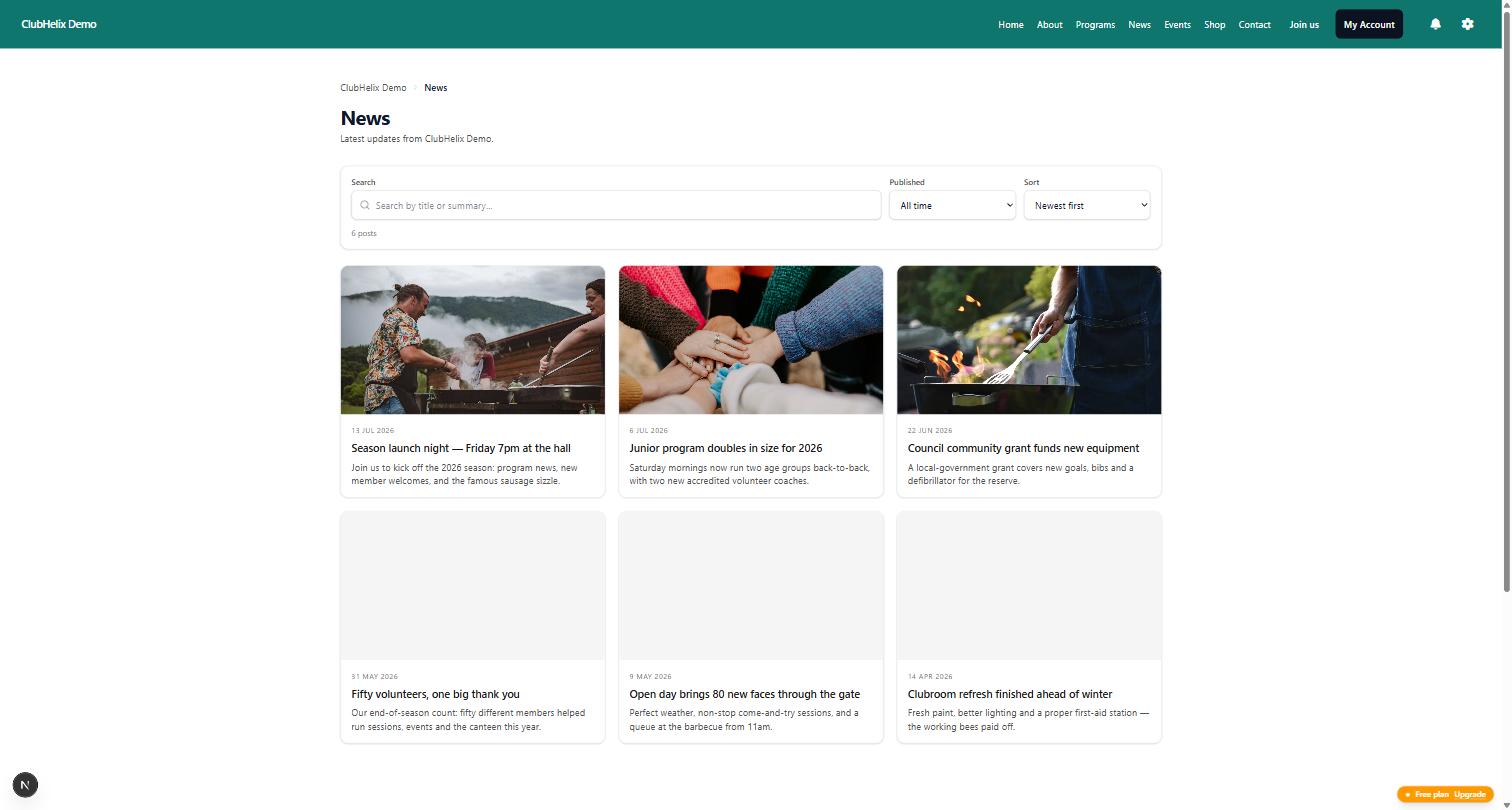
The reason most clubs end up choosing between a newsletter and a feed is that the two live in different tools with different logins, and the member list lives in a third. ClubHelix removes the choice by putting them in the same place — news posts give every announcement a permanent, findable home, email broadcasts send to your live member list rather than an exported copy that is stale by Thursday, and a custom sending domain means the message arrives from your club rather than from a volunteer's personal account. Members who install the club app get the urgent things as a push notification instead of hoping a feed shows them.
There is a free tier to start on, pricing that is published rather than quoted, and it is built for volunteer-run committees. If your club news currently lives in a feed and a personal inbox, you can move it to ground you own in a single evening — create your club site and let this weekend's update be the first thing you publish once and send everywhere.
Frequently asked questions
Should a club use a newsletter or social media?
Both, for different jobs. Social is how people who do not yet belong discover you and how members feel connected week to week; email is how you reliably reach the people who have actually joined. Use social for attention and email for delivery, and make both point at a page on your own site that holds the real detail.
How often should a club send a newsletter?
Fortnightly or monthly suits most clubs outside peak periods, moving to weekly during the season if you genuinely have something worth saying. Consistency beats frequency — a predictable Monday email that members learn to expect outperforms an irregular one that arrives whenever someone has time. Registration and renewal periods are the exception and warrant extra sends.
Where should urgent club news go?
Not into a feed. Anything time-critical — a cancellation, a venue change, a safety notice — needs a channel where delivery does not depend on an algorithm or on somebody opening an app that day. A push notification or a text message, followed immediately by updating the page on your own site so anyone checking later gets the same answer, is the reliable order.
Is it worth writing a newsletter if only some members read it?
Yes, provided you measure the right thing. A newsletter that drives thirty registrations, fills a volunteer roster and reminds people about a deadline has done its job even if plenty of recipients skimmed it. Keep it short, put the action at the top, and judge it on what people did rather than on how many opened it.
How do we stop writing the same thing three times?
Publish the full version once as a page or news post on your own site, then let every other channel be a two-sentence pointer to it. When something changes you edit one place. The discipline that makes this work is refusing to let any detail exist only in an email or a post — if it is worth telling members, it belongs on the page first.
Keep reading — how to write a club newsletter has the structure and a template, and club social media ideas covers what to post once the pointing is sorted.

