
What this guide answers
- What is a club referral program?
It is a structured way of recording and rewarding the recommendations your members already make.
- What should we offer as a referral reward?
Something that costs you margin rather than membership price.
- How do we track referrals without creating more admin?
Capture the referrer on the join form itself, either as a picker of existing members or through a per-member referral code entered at checkout.
- When is the best time to launch a referral program?
Immediately after a high point — a finals run, a presentation night, the end of a beginner program, or the confirmation screen after a member renews.
- Do referral programs actually work for small clubs?
Yes, and often better than for large ones, because small clubs are social and the recommendation carries more weight.
New Zealand edition. This guide is written for volunteer-run clubs in New Zealand. Where rules differ — grants, tax, incorporation, safeguarding — follow the New Zealand-specific pointers below or check with your national body.
Ask a committee where last season's new members came from and you will hear about the sign at the ground entrance, the stall at the school fete, and a post that "did really well". Ask the new members themselves and most of them will say a name. Someone's sister. A colleague who plays midweek. The parent on the sideline who said the juniors here are looked after properly.
That name is already your strongest recruitment channel, and in most clubs it is completely invisible. Nobody records it, nobody thanks the person who did it, and nobody ever asks them to do it again. A referral program is not a marketing campaign bolted onto the side of the club. It is a receipt for something that is already happening, plus a small nudge that makes it happen more often and at a time of year you choose.
This guide is for the committee member who has been told to grow membership with no budget. It covers what to reward and what you should never discount, how to work out what a referred member is genuinely worth before you decide what to give away, how to track referrals without another spreadsheet, when in the season to launch so the ask lands on enthusiasm rather than fatigue, and how to tell afterwards whether the program did anything at all.
Pick one shape, not four
Most referral programs die because the committee tries to run several ideas at once and nobody can explain the rules in a sentence. Choose one of these and commit to it for a full season.
| Shape | How it works | What it costs | Suits |
|---|---|---|---|
| Recognition only | Every referrer is named at presentation night and gets a handwritten thank-you | Almost nothing | Small clubs, and any club running this for the first time |
| Two-sided offer | The new member gets a lowered barrier to entry, the referrer gets a credit or item | A fixed, predictable amount per join | Clubs with a shop, canteen, bar or coaching program to spend it in |
| Season draw | Each qualifying referral becomes one entry in a single end-of-season draw | One prize, regardless of volume | Larger clubs with limited admin capacity |
| Milestone ladder | Rewards unlock at one, three and five referrals, rising in value | Uncapped unless you cap it — always cap it | Clubs with a genuinely social membership base |
The two-sided offer converts best, because it removes the awkwardness. A member forwarding an offer feels like they are doing their mate a favour, not collecting a bounty on them. The recognition-only version is far better than nothing and is the right starting point if your committee has never run one — you can add a reward next season once you know how many referrals actually arrive.
Whichever you pick, write the whole program on one page: who can refer, what counts, what each side gets, when the reward is paid, and when the program ends. If it does not fit on one page, members will not repeat it accurately, and word of mouth is the entire mechanism you are trying to amplify.
Rewards that do not cheapen membership
The instinctive reward is money off the membership fee, and it is the one to be most careful with. Fee discounts teach members that your price is negotiable, they hit the one income line you can least afford to erode, and they arrive at renewal — the moment you most want the price to feel settled. If you have just spent a season justifying a fee rise, a referral discount quietly undoes the argument.
Better rewards cost you margin rather than price integrity, and are things a member can only get by being part of the club.
| Reward | Real cost to the club | Perceived value | Risk to membership pricing |
|---|---|---|---|
| Club shop credit | Wholesale cost of the item | High | None |
| Canteen or bar credit | Cost of goods only | Medium | None |
| A club-branded item (cap, bottle, towel) | Landed unit cost | Medium to high | None |
| Free court, lane or facility hire in an off-peak slot | Close to zero on idle capacity | High | None |
| A place in a paid clinic or coaching session | Marginal — the session runs anyway | High | None |
| Priority booking or early access to a popular session | Nothing | High | None |
| Entry into a season prize draw | One prize across the season | Medium | None |
| Membership fee credit | Full face value | High | Significant |
Two design rules keep the value honest. First, reward the referrer with something that reminds them of the club every time they use it — a hoodie with the crest on it is a better reward than cash, and it costs you less. If you are setting up a shop to supply those rewards, our guide on how to price club merchandise covers the margins so a reward does not quietly become a loss. Second, give the new member a reason to move now rather than in three weeks: a waived joining fee, a free trial session, or a starter pack. The lowered barrier does more work than the referrer's reward does.

Work out what a referred member is worth first
Decide the reward budget from the value of a member, not from what feels generous on a Tuesday night. The arithmetic is simple enough to do on the back of an agenda:
- First-year contribution. Membership fee, less the per-member costs you actually incur — affiliation or registration levies, insurance loading, a share of uniform or equipment.
- Ancillary contribution. What an average member spends across a season on canteen, bar, shop, event tickets and competition entries.
- Expected tenure. Your average member's lifespan in seasons. If you do not know it, calculate your retention rate first — it is the single number that changes this answer most.
- Lifetime value. Multiply the annual contribution by expected tenure, then be conservative and knock a third off.
Now set the reward at a modest share of the first-year contribution — somewhere between a tenth and a fifth is a defensible band for a volunteer club. That keeps the program self-funding in its first season, which is the test your treasurer will apply.
A worked example. Senior membership is $220, of which $60 goes out in affiliation and insurance, so first-year contribution is $160. The average senior spends another $120 or so a year across the canteen and shop, and stays four seasons. Lifetime value comfortably clears $700 even after a conservative haircut. A $30 shop credit costing the club around $14 at wholesale is easy to justify. Above roughly $45 you are effectively discounting the subscription.
The rules that keep it clean
Write these into the one-page program before you launch. Every one of them exists because a club somewhere had an argument about it.
- Who counts as new. A genuinely new member, or someone who has not been a member for at least two full seasons. Without this rule, families refer each other in circles.
- When the reward is earned. After the joiner's payment has cleared and they have attended, say, two sessions — not at sign-up. This kills phantom referrals and means you only pay for members who actually turn up.
- One referrer per joiner. The joiner nominates, and their nomination is final. Committees do not adjudicate competing claims.
- A cap. Per referrer, and across the program. Five rewards per member per season and a total budget line approved by the committee.
- Who is excluded. Committee members and paid coaches referring their own coaching clients is a conflict worth naming out loud.
- Juniors. The referral is credited to the parent or guardian on the account, never to a child, and the reward should not be something a child claims independently.
- What happens on a refund. If the joiner cancels inside the cooling-off window and is refunded, the reward is not paid. Your refund policy should say so in the same words.
- Expiry. Credits expire at the end of the following season, so they do not sit on the books forever.
- Privacy. Do not publish a leaderboard of referrer names without asking, and never hand a member's contact details to another member.
Two areas worth checking before you launch
The two parts of a referral program that touch outside rules are the messages you send and any prize draw you attach to it. Both are general-information territory here, and both are worth a five-minute check rather than an assumption.
Marketing emails and texts sent by the club fall under the Unsolicited Electronic Messages Act, with its consent, sender-identification and unsubscribe requirements, and member details are personal information under the Privacy Act 2020. The practical rule: your member can forward your offer to a friend, but you should not add that friend's address to your list until they opt in themselves. If you attach a prize draw, the Gambling Act sets out classes of gambling with prize-value thresholds, so check where your prize sits with the Department of Internal Affairs before you advertise it.
Tracking referrals without a spreadsheet
Here is where most programs quietly stop. The club adds a free-text box to the join form asking "how did you hear about us", gets 40 answers reading "friend", "a mate", "Sarah?" and "word of mouth", and by August nobody can pay anyone anything. Free text is not a tracking system.
There are only two mechanisms worth using, and both need to live on the join form itself.
A nominated referrer field. The registration form asks the joiner to name the member who referred them, ideally chosen from a list rather than typed. It is the simplest option, it works for the recognition-only and season-draw shapes, and it needs no codes to distribute. Its weakness is name ambiguity in a club with three Sarahs, which a picker solves.
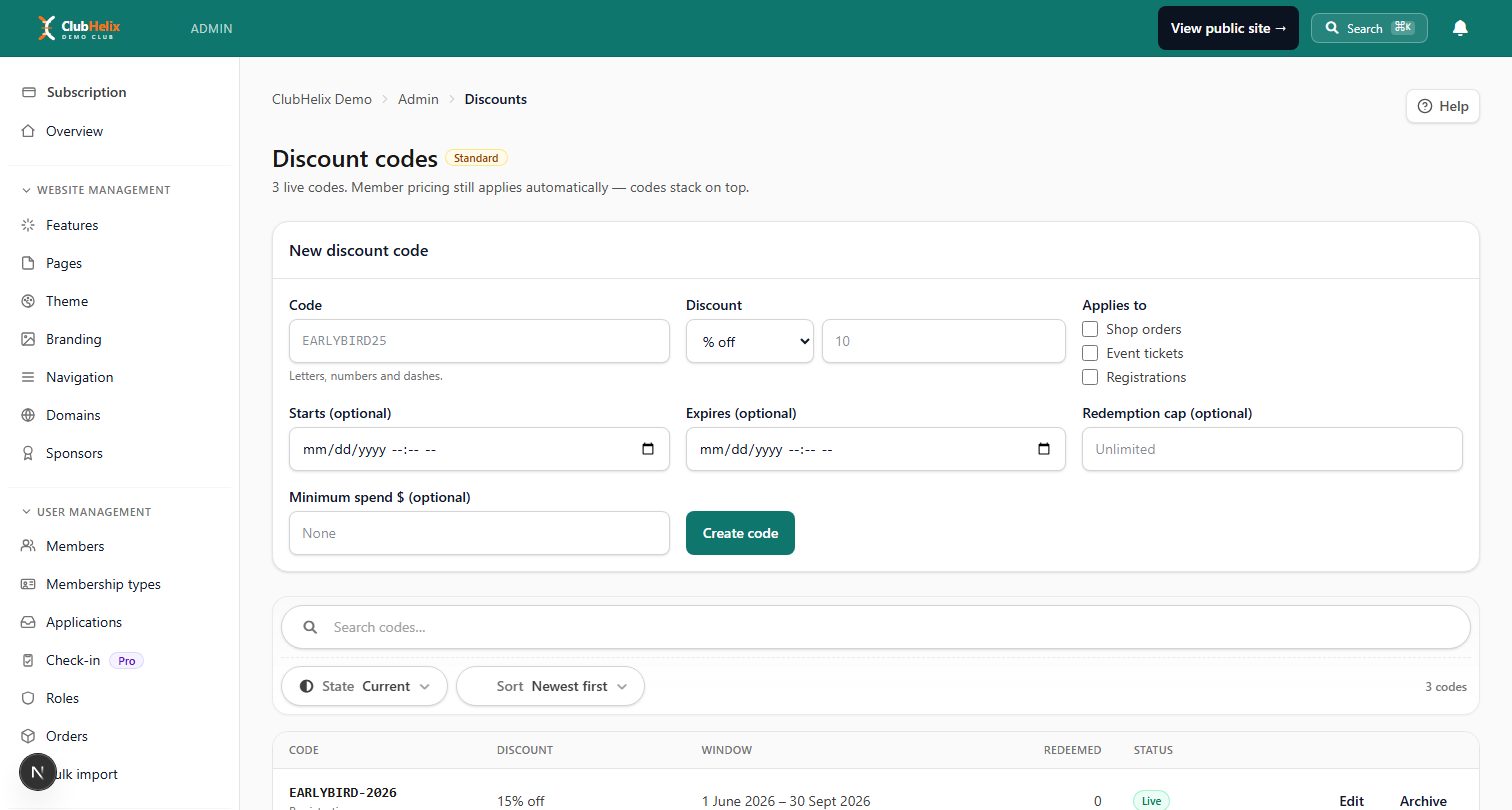
A per-member referral code. Each member gets a code they can share. The joiner enters it at checkout and it applies the joiner-side offer automatically — a waived joining fee or a discounted starter pack — while recording who sent them. This is the version that scales, because the reward on the new member's side is applied by the system rather than by a volunteer processing a request in the evening. In ClubHelix that is discount codes attached to online registration, so the code both discounts the joiner and tells you who to thank.
Whichever mechanism you choose, keep one ledger with these columns and nothing else:
| Column | What goes in it |
|---|---|
| Joiner | New member's name and join date |
| Referrer | Member credited, taken from the form, not from memory |
| Qualified | Yes or no — payment cleared and attendance threshold met |
| Reward | What was promised |
| Issued | Date the credit or item was actually handed over |
| Notes | Anything contested, so the next registrar can see the history |
The "issued" column is the one that gets skipped and the one that causes the damage. A member who was promised a reward in March and still has not received it in July will not refer anyone again, and will tell people why. Set a monthly reminder to clear the qualified-but-unissued rows — it takes ten minutes and it is the difference between a program that compounds and one that burns goodwill.
If your membership records live in a platform rather than a spreadsheet, most of this is a saved view. Membership reports that show join date and join source turn the ledger into something you filter rather than something you maintain.
Launch when members are most enthusiastic
The single biggest lever on a referral program is not the reward. It is the week you ask.
People recommend a club when they have just had a good experience of it, and they ignore you when they are tired, cold, or looking at an invoice. Map the ask onto the high points of your season.
| Moment | Why it works | What to send |
|---|---|---|
| The week after a finals run or a milestone win | Pride is at its annual peak and the club is being talked about anyway | A short email with the code and one photo |
| Presentation night | Everyone is in the room and feeling warm about the place | A slide, a card on each table, and a verbal ask |
| The end of a beginner or come-and-try program | Graduates know exactly who else would enjoy it | A personal message from the coach who ran it |
| The confirmation screen after a renewal | The member has just re-committed — the best possible moment | One line and a share button on the receipt |
| Pre-season, two weeks before registrations open | Their friend has time to organise themselves | The season-launch email, with the offer in it |
| A club social event | New faces are already being brought along | A sign at the door and a mention from the mic |
The moments to avoid are just as important. Do not launch in the week you announce a fee increase, in the middle of a losing streak, or during the mid-season lull when everyone is doing washing and driving to away games. And never make the referral ask the entire content of an email — attach it to news people actually want.
For winter codes the pre-season window is the strongest of the lot: the ask lands in late summer while people are deciding what their year looks like, and it gives a friend enough time to sort out their own registration before round one. Summer sports get the reverse — early spring, as the days lengthen and social play restarts. Both then get a second bite at presentation night, which for most clubs falls just as the next season's committee is forming.
Three asks you can copy
Text or chat message, from the club: "Great win on Saturday. If you know someone who'd fit in here, send them your code — they get their joining fee waived and you get shop credit once they've played twice. Codes are in your member account."
Paragraph for the season-launch email: "Most people who join us were brought by someone already here. If that's you this year, your referral code is in your member account. Send it to one person. If they join and play twice, we'll put credit in your account and you can spend it on the thing you keep meaning to buy from the shop."
In person at training, said by a coach rather than a committee member: "We've got room for two more this year. If you've got someone who'd enjoy this, bring them Thursday — first session's free and there's nothing to fill in."
Note the shape of all three: short, specific, one action, and no begging. Sending these consistently is easier if you already have a communication plan rather than deciding the channel each time.
Measuring whether it actually worked
Four numbers, reviewed once at the end of the season.
| Metric | How to work it out | What good looks like |
|---|---|---|
| Referral share of new joins | Referred joins ÷ all new joins | Rising year on year — the absolute level varies enormously by sport |
| Participation rate | Members who referred at least one person ÷ total members | Even a small fraction is a real result |
| Cost per acquired member | Total rewards issued ÷ referred joins that qualified | Well under the first-year contribution you calculated |
| Retention of referred members | Referred joiners still members next season ÷ referred joiners | Higher than your club-wide rate, usually |
That last row is the one to watch, because it is where referral programs justify themselves. A member who arrives with a friend already inside the club has a social reason to come back, which is the same reason most people give for staying anywhere. If your referred cohort retains better than your general cohort — and it usually does — the program is worth more than the join count alone suggests. Our guide on how to retain club members covers what to do with that advantage.
Add the four numbers to your season report so the next committee inherits the evidence rather than the anecdote. If you track a handful of other measures already, they fit neatly alongside the rest of your club KPIs.
When a referral program is the wrong fix
Be honest about this before you spend a season on it. If people who want to join cannot find your fees, cannot join online at 9pm, or have to wait five days for someone to reply, a referral program simply sends more people into a broken funnel. Fix the funnel first — how to grow club membership walks through the usual leaks, and a bad join experience is nearly always the biggest one.
The same applies if your capacity is genuinely full. Referring friends into a waitlist creates two disappointed people instead of one. In that situation run recognition only, keep a proper waitlist, and spend the effort on the capacity problem instead.
Making the program run itself
The admin is what kills referral programs, not the idea. Codes handed out on paper, credits tracked in someone's notes app, and a registrar manually applying discounts on a Sunday night is a program with a two-month lifespan. When online registration captures the referrer on the join form, discount codes apply the new member's offer automatically at checkout, and broadcasts send the launch email from your own club address, the whole thing becomes a report you read once a month rather than a job somebody has to remember.
Try it against whatever you are using now. Create your club site — join form, referral codes, member records and all — start on the free tier, and read the pricing later, once you know whether the program is worth keeping.
Frequently asked questions
What is a club referral program?
It is a structured way of recording and rewarding the recommendations your members already make. A member tells a friend about the club, the friend names them when they join, and the club gives both sides something — often a lowered joining barrier for the newcomer and a shop or canteen credit for the referrer. The point is to make an existing, invisible recruitment channel countable and repeatable.
What should we offer as a referral reward?
Something that costs you margin rather than membership price. Shop credit, canteen credit, a branded item, a place in a clinic, or off-peak facility hire all feel generous and cost the club a fraction of their face value. Avoid discounting the membership fee itself — it erodes your main income line and teaches members that the price is negotiable.
How do we track referrals without creating more admin?
Capture the referrer on the join form itself, either as a picker of existing members or through a per-member referral code entered at checkout. A free-text "how did you hear about us" box is not a tracking system. Then keep one short ledger with a column for whether the reward has actually been issued, and clear it monthly.
When is the best time to launch a referral program?
Immediately after a high point — a finals run, a presentation night, the end of a beginner program, or the confirmation screen after a member renews. Pre-season, a couple of weeks before registrations open, is the strongest window because the friend still has time to organise themselves. Avoid launching alongside a fee increase or during the mid-season lull.
Do referral programs actually work for small clubs?
Yes, and often better than for large ones, because small clubs are social and the recommendation carries more weight. Start with recognition only — name your referrers at presentation night and thank them properly — then add a modest reward the following season once you know how many referrals a year you are really getting.
Keep reading: how to grow club membership for the rest of the recruitment picture, and how to run a come-and-try day for the event your referral code should point people at.


