
What this guide answers
- How do you promote a sports club with no budget?
In order of impact: make your website's join page excellent, email your current and lapsed members when registration opens, claim your free Google Business Profile, run a bring-a-friend day, and put items in school and…
- When should a club start marketing for the season?
Start eight weeks before your registration deadline, with the heaviest push in the final three weeks — that's when families make decisions.
- What social media should a sports club use?
The one or two platforms where your specific audiences already are — for most community clubs that means a Facebook presence for parents and club news, and possibly Instagram for players and match-day content.
- Who should own the marketing plan on a volunteer committee?
Give the one-page plan a single named owner — a communications or marketing officer if you have one, otherwise typically the secretary or registrar — but assign each calendar item to whoever's closest to it (team…
Ireland edition. This guide is written for volunteer-run clubs in Ireland. Where rules differ — grants, tax, incorporation, safeguarding — follow the Ireland-specific pointers below or check with your national body.
Most clubs don't have a marketing problem — they have a consistency problem. Someone runs a brilliant registration campaign one pre-season, then moves away, and the next committee starts from zero. The fix isn't a bigger budget or a marketing degree on the committee. It's a plan short enough that people actually use it, and simple enough to hand over at the AGM with everything else.
This guide gives you exactly that: a one-page club marketing plan you can write in a single evening, followed by a channel-by-channel playbook of sports club marketing ideas that consistently work for community clubs. None of it requires paid advertising, though we'll cover where a small spend helps.
Why a one-page plan beats a big one
A forty-page marketing strategy is a document. A one-page plan is a tool. The difference shows up in the pre-season rush, when the volunteer coordinating your registration push needs to know what to post this week — they'll glance at one page; they will never open the forty.
A good club marketing plan answers five questions:
- What are we trying to achieve this season? (Goal)
- Who are we talking to? (Audiences)
- What's our message to each of them? (Message)
- Where will we say it? (Channels)
- When, and who's responsible? (Calendar and owner)
Write the answers on a single page, date it, and put it in the committee folder next to the handover checklist. That's the plan. Everything below helps you fill it in well.
Step 1: Pick one goal (maybe two)
Clubs that try to grow everything grow nothing. Choose the single number that matters most this season and put it at the top of the page:
- "Register 40 new junior members by round one."
- "Fill the two senior teams that folded last year."
- "Sell out presentation night and add two new sponsors."
A good goal is a number with a deadline. "Raise our profile in the community" is not a goal — it's a mood. If your committee can't agree on one number, pick the one closest to money or membership, because those keep the club alive.
Step 2: Name your audiences
A club rarely has one audience; it usually has three or four, and they respond to different things:
- Prospective members (or their parents, for junior clubs). They care about cost, times, location, and whether beginners are welcome.
- Current members. Retention is marketing too — a member who re-registers in week one is worth two maybes. They care about feeling informed and valued.
- Lapsed members. The cheapest people to win back. They already liked you once.
- Sponsors and community partners. They care about visibility, association with a well-run club, and an easy yes.
For each audience on your page, write one sentence about what they want. This single exercise fixes the most common club marketing mistake: posting committee-centric announcements ("Reminder: canteen roster is out") to an audience of prospects who need to hear "beginners welcome, first session free".
Step 3: Write the message once, properly
Every club needs three sentences it can reuse everywhere — website, flyers, social bios, the spiel at a school fete:
- What you are and where. "Northside Hockey Club — junior and senior hockey for the city's northern suburbs."
- Who it's for. "Players from age 5 to masters, all abilities — most of our juniors have never held a stick before day one."
- The next step. "Registration for the winter season is open now at our website."
Agree these at a committee meeting, write them into the plan, and stop rewriting them from scratch every time someone makes a poster. Consistency compounds: the tenth time someone sees the same clear message, it finally lands.
Step 4: The channel playbook
You don't need every channel. You need the four or five below done consistently, ranked here roughly by return on volunteer effort.
Your website — the one channel you own
Everything else you do points somewhere, and that somewhere should be a page you control on your own domain — not a social profile that an algorithm decides who sees. Your website is where a prospect converts into a member, so before any campaign, check the landing experience: fees visible, registration online, this season's dates current. Our guide to what to put on a club website covers the content side in detail.
The practical rule: every flyer, post and QR code points at one URL. When people have to search for you instead, you lose a percentage at every step.
Email — the workhorse nobody talks about
Email is unfashionable and absurdly effective for clubs, because it reaches people who already said yes: members, past members, and anyone who ever enquired. Uses that consistently pay off:
- Registration open / closing soon to current and lapsed members — your two highest-converting sends of the year.
- A short monthly newsletter during the season: results, upcoming events, a volunteer thank-you, one sponsor mention.
- A "we miss you" note to lapsed members each pre-season, written like a human, not a campaign.
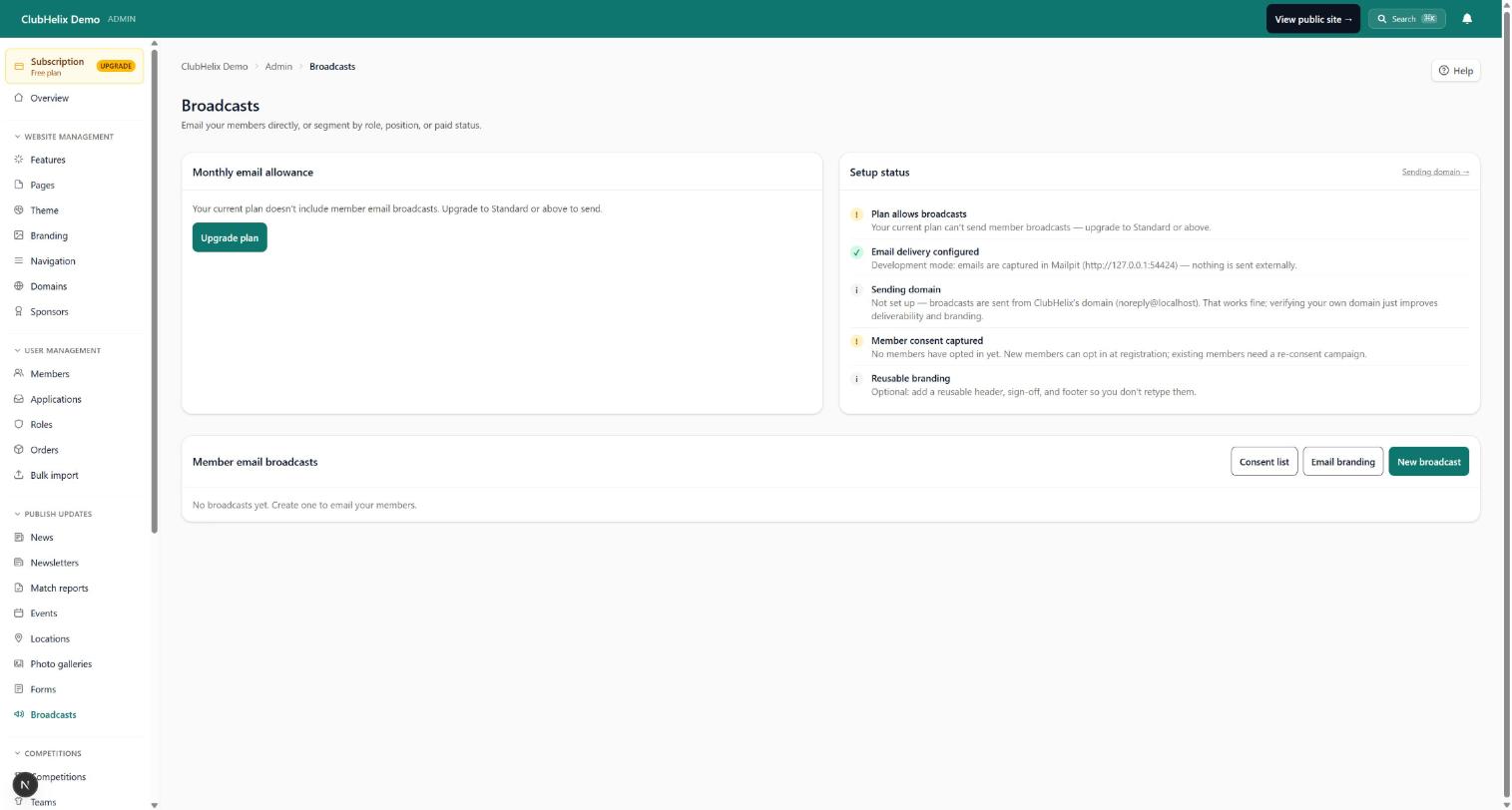
The trap is tooling: mailing from a personal account with fifty addresses in BCC is how clubs end up in spam folders and privacy trouble. A proper member email system sends from your club's own address, tracks who received what, and handles unsubscribes for you.
Local search — be findable at the moment of intent
When a parent types "junior football club near me", the results they see are a marketing channel — one most clubs ignore. Two jobs: keep your website's homepage clear about your sport and suburb, and claim your Google Business Profile so you appear on the map with current details. That second job takes an evening and keeps paying for years; we've written a full walk-through in our Google Business Profile guide.
Social media — amplification, not foundation
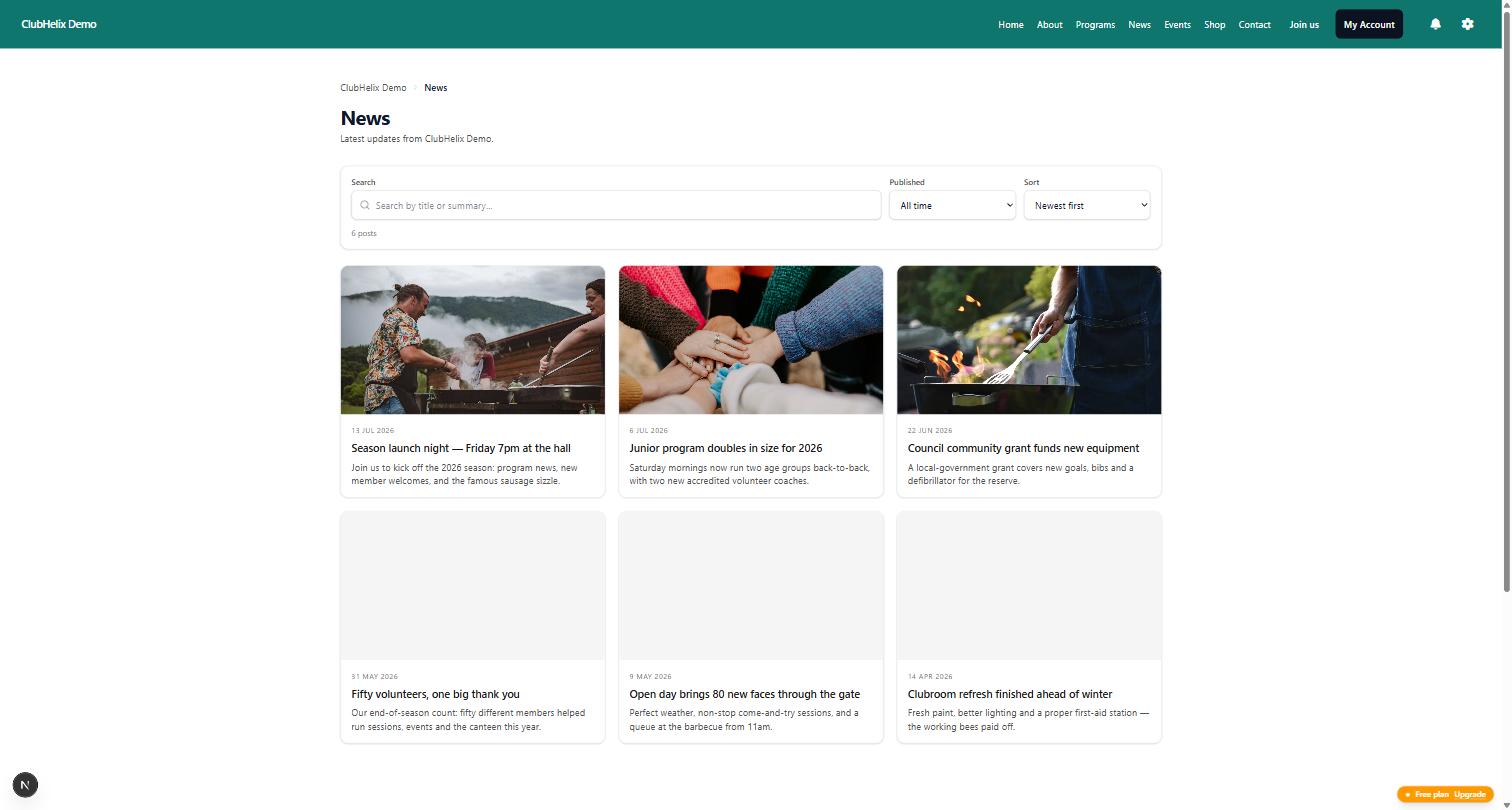
Social is where clubs overspend volunteer energy. It works best as an amplifier: publish properly on your website — news posts, match reports, event pages — then share the link with a photo and two lines. That way the content lives somewhere permanent and searchable, and the social post has somewhere to send people. Pick the one or two platforms your audiences actually use rather than maintaining five badly; our social media setup guide covers accounts, admin handover and safety settings.
What performs, in rough order: photos of people (with consent) beat graphics; graphics beat text; short video of actual club life beats everything. Celebrate members, not announcements.
Word of mouth — engineer it, don't hope for it
Most new members still arrive because someone asked them. You can systematise that:
- Bring-a-friend days twice a season, with a genuinely low-pressure format.
- A referral nudge in your registration confirmation: "Know someone who'd love this? Forward them this link."
- Ask at the moment of joy — after a win, at presentation night — not in a cold July email.
Community presence and local media
School newsletters, parish and community noticeboards, local authority "what's on" listings and local papers are underrated because they're unglamorous.
A short, well-written paragraph with a photo and your web address, sent to the local paper after a title win or a milestone, gets printed more often than you'd think — sports desks are hungry for community content. Likewise, a stall at a school or community fair with a QR code to your registration page routinely out-recruits a month of posting.
Paid advertising — small, targeted, seasonal
If you spend at all, spend small and seasonal: a modest boost on your "registrations open" post targeted to your suburb radius in the three weeks before the season, pointing at your registration page. Set a cap, measure sign-ups, and stop when registration closes. Paid reach with a broken landing page is the fastest way to waste club money — fix the website first.
Step 5: The season calendar
Marketing fails in clubs because it's nobody's job in particular. The calendar section of your one-page plan fixes that — a simple grid of month, activity, and owner:
| When | Activity | Owner |
|---|---|---|
| 8 weeks pre-season | Update website fees/dates; email lapsed members | Secretary |
| 6 weeks pre-season | Registrations-open email + social push; Business Profile updated | Registrar |
| 4 weeks pre-season | School newsletter items; flyers at local shops | Volunteer coordinator |
| 2 weeks pre-season | Boosted local post; bring-a-friend day | Registrar |
| In season, monthly | Newsletter; match report each round on the website | Team managers |
| End of season | Presentation night promotion; sponsor thank-yous; "next season" banner | President |
Names, not roles alone — "Sarah (Registrar)" — and review it at each committee meeting in sixty seconds: what's due this month, is it done?
Measure three numbers, ignore the rest
Volunteer committees drown when they try to track everything. Three numbers, checked monthly, tell you whether the plan is working:
- Registrations / renewals against your goal number.
- Website visits to the join page — the best single proxy for whether promotion is reaching people.
- Email open rate on your member sends — if it slides, your content or frequency needs adjusting.
Likes and follower counts are dessert, not dinner. A post with nine likes that produced two registrations beat the one with two hundred likes that produced none.
Frequently asked questions
How do you promote a sports club with no budget?
In order of impact: make your website's join page excellent, email your current and lapsed members when registration opens, claim your free Google Business Profile, run a bring-a-friend day, and put items in school and community newsletters. All of those cost nothing but volunteer hours, and together they cover the majority of how new members actually find clubs. Paid advertising is an optimisation on top of these, never a substitute for them.
When should a club start marketing for the season?
Start eight weeks before your registration deadline, with the heaviest push in the final three weeks — that's when families make decisions. The biggest wins, though, come from what you do out of season: keeping the website current, capturing photos and stories all year, and emailing members before they've mentally moved on. Clubs that go silent from the last game to the next pre-season are re-introducing themselves every year.
What social media should a sports club use?
The one or two platforms where your specific audiences already are — for most community clubs that means a Facebook presence for parents and club news, and possibly Instagram for players and match-day content. It is far better to run one channel well than four sporadically. Whatever you choose, publish substantial content on your own website first and use social to link to it, so your effort accumulates somewhere you control.
Who should own the marketing plan on a volunteer committee?
Give the one-page plan a single named owner — a communications or marketing officer if you have one, otherwise typically the secretary or registrar — but assign each calendar item to whoever's closest to it (team managers write match reports, the registrar owns registration pushes). The owner's job isn't to do everything; it's to check the calendar at each committee meeting and chase what's slipping. Hand the page over at the AGM like any other club asset.
Ready to run the plan? ClubHelix gives your club the owned channels that make it work — a website on your own domain, club news publishing, and member email broadcasts — all in one admin any committee member can use. See pricing or start free.


