
What this guide answers
- What should a club key register include?
One row per key or credential, not one per person. Record the key ID stamped on the key, exactly which doors it opens, the type of key, who holds it, the role they hold it against, the issue date, who authorised it, a…
- How often should a club audit its keys?
Once a year as a minimum, ideally at the end of the season when roles are changing anyway.
- Should a club switch to keypads or smart locks?
It depends on how often access turns over. Electronic access is worth it where a lot of different people need entry at different times — perimeter gates, main rooms, hired spaces — because it removes the cutting, the…
- What do we do if keys have gone missing?
Do not rekey the whole site by reflex. Work zone by zone and rekey only where an unaccounted key genuinely matters — usually the bar, the office and the safe.
- Who should hold keys to the clubhouse?
Grant by role and by zone rather than by seniority or length of service.
UK edition. This guide is written for volunteer-run clubs in the UK. Where rules differ — grants, tax, incorporation, safeguarding — follow the UK-specific pointers below or check with your national body.
Ask your committee how many keys open the clubrooms. Somebody will give you a number. It will be wrong, and it will be wrong in the same direction every time.
The real number is the one hiding in twenty years of small, sensible decisions. A key cut for the junior coordinator in 2011 who is now a life member and still comes to working bees. Three cut for the canteen when the canteen had three shifts. One that went to a coach who moved away, and one that went to his replacement, who was never asked for the first one back. A spare in an envelope in the safe that nobody has opened since the safe was moved. Keys are not lost dramatically. They accumulate quietly, and every one of them is a permanent, unlogged, unexpiring grant of access to a building full of other people's property.
The good news is that this is not really a security problem or a lock problem. It is a register problem, and the fix is boring in the best possible way. This guide covers the register itself and the annual audit that keeps it honest, what it actually costs to move to codes, fobs or smart locks and where each of those options breaks, and the handover discipline that stops the whole thing unravelling every time your committee turns over. It is general information for volunteer committees — your venue owner, insurer and any licence you hold may set requirements above what is here.
What an unaccounted key actually costs you
The reason to care is not paranoia about theft. It is that "we do not know who has keys" quietly weakens four separate things.
Insurance. After a break-in, one of the first questions is whether there was forced entry. If there was not, the conversation turns to who had legitimate access, and "we are not sure" is a bad answer in a claim. Your policy may also carry conditions about how the premises are secured — worth reading before you need to. Our guide on whether your club needs insurance covers the broader picture.
Any licence you hold. Licensed premises generally come with obligations about who is responsible for the building and who can reach the alcohol store. A key in unlogged circulation is a hole in that.
Safeguarding. If juniors train in your building, the question of who can be inside it unsupervised is not administrative trivia. It sits alongside your screening and supervision policies, and it is one of the first things a governing body asks about after an incident.
The relationship with your landlord. Clubs lose access to grounds over trust far more often than over money. A club that can produce a current key register when the council or land manager asks is a club that gets the next lease renewed without a conversation.
None of that requires new locks. It requires a list.
Think in doors, not keys
The mistake almost every club makes is treating access as one thing — you either have a key or you do not. Break the site into zones instead, and give people the smallest zone that lets them do their job.
| Zone | Typical holders | Risk if it leaks |
|---|---|---|
| Perimeter gate, ground | Wide — coaches, ground staff, hirers | Low, but it is the gate an ambulance uses |
| Changerooms and toilets | Coaches, team managers, duty officers | Low to moderate |
| Clubroom main space | Committee, duty officers, hirers | Moderate — contents and hire income |
| Canteen and kitchen | Canteen coordinator and rostered volunteers | Moderate — stock and food safety |
| Bar or alcohol store | Named licence holders only | High — licence exposure |
| Office, safe, records | President, secretary, treasurer | High — money and personal information |
| Storage shed, gear cage | Gear steward, coaches | Moderate — equipment value |
| Plant, switchboard, roof | Ground staff and contractors only | High — safety |
| Defibrillator cabinet | Deliberately as wide as possible | The opposite risk — restricting it is the danger |
Two rules fall straight out of that table. High-risk zones get the fewest holders and the tightest records. And the defibrillator cabinet is the one place where you want access to be as unrestricted as you can make it — see club first aid and emergency planning for why the round trip to it matters more than the lock on it.
The club key register template
Copy this into a spreadsheet or, better, into whatever system the committee already logs things in. One row per physical key or credential — not one row per person, because people hold several.
| Field | Example | Why it is there |
|---|---|---|
| Key ID | CR-07 | Stamped or tagged on the key itself |
| Zone / what it opens | Clubroom main door, canteen | Doors, not "clubhouse" |
| Type | Restricted key | Tells you whether it can be copied at a hardware shop |
| Issued to | J. Rahman | A person, so you know who to ask |
| Role held | Canteen coordinator | The reason they have it — this is the important column |
| Issued on | 3 March 2026 | Age of the grant |
| Authorised by | Secretary | Somebody approved it |
| Deposit held | Yes / no / amount | Only if your club does deposits |
| Review due | End of season 2026 | Every grant has an expiry |
| Returned on | Blank until it comes back | The column that makes the audit possible |
Three rules make the register work, and clubs that skip any one of them end up back where they started within two seasons.
No key leaves without a row. Not for a weekend. Not for "just the working bee". If it is worth cutting, it is worth thirty seconds of typing.
Every key is issued against a role, not a friendship. Write the role in the register and say it out loud when you hand the key over — "this is the canteen coordinator's key, and it goes with the job." That single sentence makes the return conversation eighteen months later completely unremarkable, because you are asking the job for its key back, not accusing a person of anything.
Every grant has a review date. End of season is the natural one. A key with no expiry is how you end up with a life member holding the bar key because of a role they stopped doing in 2014.
Stamp or tag the keys with their ID. Untagged keys cannot be audited, only counted, and counting is what gave you the wrong number in the first place.

The annual key muster
Once a year — end of season is ideal, because roles are changing anyway — run a muster. Ninety minutes, one agenda item at a committee meeting, and it goes like this.
- Publish an amnesty first. Two weeks out, send a club-wide message. "We are updating the key register. If you have a club key you no longer need, drop it in the box at the clubrooms, no questions and no judgement." You will get keys back you did not know existed. That is the entire point, and it only works if there is genuinely no consequence for handing one in.
- Contact every current row directly. Not a mass email. A short individual message asking the holder to confirm which keys they have, by ID. Confirmations come back fast when the message names the actual key.
- Physically sight the high-risk ones. Bar, office, safe, plant. Ask those holders to bring the key to the next training night and tick it off in person. It takes ten minutes and it is the only column of the register you should treat as certain.
- Reconcile. Every row is now returned, confirmed, or unaccounted.
- Decide about the unaccounted ones, by zone. This is the step where clubs panic and quote the whole site for rekeying. Do not. Rekey only the zones where an unaccounted key is genuinely a problem — usually the bar, the office and the safe. A missing changeroom key is an annoyance. A missing alcohol store key is a licence conversation.
- Minute the outcome. The register's date and the decisions go in the minutes. That is your evidence that the club takes this seriously, and it is what you show a landlord or an insurer.
A useful habit while you are at it — if you are rekeying anything, move that zone to a restricted key system, where blanks are only cut against a signed authority held by the locksmith. Ordinary keys can be copied at any hardware counter, which means a returned key proves nothing at all.
Clubs occupy everything from local authority pavilions to parish council land, school leases and freehold grounds, and what you may change depends entirely on which of those you have. Get the landlord's written consent before altering locks or fitting external cabinets. If the pavilion is a listed building, or sits within a conservation area, even modest external ironmongery can need consent in the UK — check before you drill rather than afterwards. Where you share a site with other user groups, ask who holds the master suite before you introduce a lock outside it.
Codes, fobs and smart locks — what each one really costs
The pitch for electronic access is simple and mostly true — you stop cutting keys, you can remove someone's access in thirty seconds, and you get a record of who went in. The catch is that every option trades one problem for a different one.
| Option | Setup cost | Ongoing cost | Audit trail | Where it breaks |
|---|---|---|---|---|
| Ordinary mechanical keys | Lowest | Cutting and occasional rekey | None | Copied anywhere, never expire |
| Restricted key system | Low | Cutting against authority | Weak | Still a physical key, still needs a register |
| Mechanical keypad (no power) | Low | None | None | One shared code, changed almost never |
| Electronic keypad | Moderate | Batteries | Some models | Codes shared informally, batteries die in the cold |
| Fobs and readers | High | Fobs, service, sometimes a subscription | Yes | Needs power and cabling, fobs get lost like keys |
| App or Bluetooth smart lock | Moderate | Subscription on many models | Yes | Phone battery, reception, and one person's account owning it |
A few hard-won observations from clubs that have made this jump.
A shared code is a key you cannot get back. The whole benefit of a keypad evaporates if forty people know one code. If you go electronic, go per-person or per-role, and rotate the shared codes on a schedule — end of season at minimum.
Keep a mechanical override. Power cuts, flat batteries and dead phones all happen at exactly the wrong time. Every electronic zone should have a physical way in that a named role can use, and that key goes in the register like everything else.
Beware of the account nobody else can reach. Smart locks are frequently set up on one volunteer's personal account with their email and their phone. When that person leaves in a hurry, the club has locked itself out of its own building. Set it up on a club email address that outlives the individual — see how to get a club email address.
Do the maths on hire income, not on security. The strongest financial case for electronic access is usually not theft prevention — it is that time-limited codes let you hire the building out without anyone driving over to unlock it. If your club hires out its rooms, that is real money against a real cost. Our guide on hiring out your clubrooms covers the rest of that arrangement.
The pragmatic answer for most community clubs is a hybrid — electronic access on the doors that turn over constantly (perimeter gate, main clubroom, changerooms) and good mechanical locks with a short register on the doors that almost nobody should open (bar, office, safe, plant).
If your club is licensed to sell alcohol, access to the store is a licensing matter as well as a security one. A premises licence in the UK names a designated premises supervisor, and clubs operating under a club premises certificate have their own rules — either way, secure storage and controlled access are expected. Keep the bar and cellar on their own zone with the shortest holder list you can manage, and align the names on the licence with the names in your key register. Check your own conditions, since they vary by licence type.
Handover discipline, which is where this usually falls apart
Registers do not decay slowly. They fall over in a single week each year — the week your committee changes and four roles move to four new people while everyone is busy and grateful and slightly rushed.
Build the key step into the handover itself rather than treating it as a separate job.
- Outgoing officer returns keys before the handover meeting, not after. Physically, into a box, in front of somebody. The register gets its return date the same day.
- Incoming officer signs for the keys at the handover meeting. New row, new issue date, new review date.
- Rotate shared codes at the same meeting. Every keypad, every gate code. Put the new codes on the emergency action plan and reprint it.
- Reset any electronic access to the club account. Remove the outgoing officer's app access and add the incoming one. If this is not possible in five minutes, that is a finding about your system, not about the person.
- Update the printed emergency and access details wherever they are displayed, including the away bag and the clubroom wall.
None of that takes more than twenty minutes if the register is current, which is the whole argument for keeping it current. Our committee handover checklist covers the full changeover, and club succession planning makes the case for building roles that survive the person doing them.
One more discipline worth naming — hirers and coaches. Anyone outside the club who needs access should get time-bound access tied to their booking, a written condition that access is not to be shared, and a return or expiry that happens automatically. If you are still handing over a physical key for a two-hour hire, the deposit is doing a job the register should be doing.
Most grounds change hands partway through the year as one code's season ends and another tenant moves in, and that changeover is the best possible moment to run the muster because both clubs are already thinking about the site. Agree in writing which keys cross over, who holds shed and store keys through the off-season, and who is responsible for the alarm code in between. Where the ground is closed entirely for part of the winter, confirm who has access for inspections after storms or freezing weather.
Who can hold access at all
Access control and safeguarding meet at one question — who is allowed to be alone in a building where juniors train. Answer it deliberately rather than by accident, and write the answer into the register as a condition on the relevant zones.
The screening regime has a different name in every market — police vetting, criminal record and barred-list checks, or a vulnerable sector check — and the scope of who must hold one varies just as much. The club question is identical wherever you are. Anyone holding access to a building where juniors are present should sit under the same screening rule as your coaches, with the check reference and its expiry recorded beside their key row. Confirm the requirement with your governing body and the relevant authority rather than assuming your neighbour's answer applies.
Keeping the register somewhere it survives the committee
A key register in a spreadsheet on one person's laptop is a key register with a countdown on it. What makes this stick is putting access records in the same place as the rest of the club's admin, tied to roles rather than individuals. ClubHelix helps with exactly that — roles and permissions so what somebody can see and do follows the job they hold and drops away when they hand it over, an audit log that records who changed what and when, and facility booking so the person who has booked the rooms on Thursday night is the person you are granting access to, with a record either side of it.
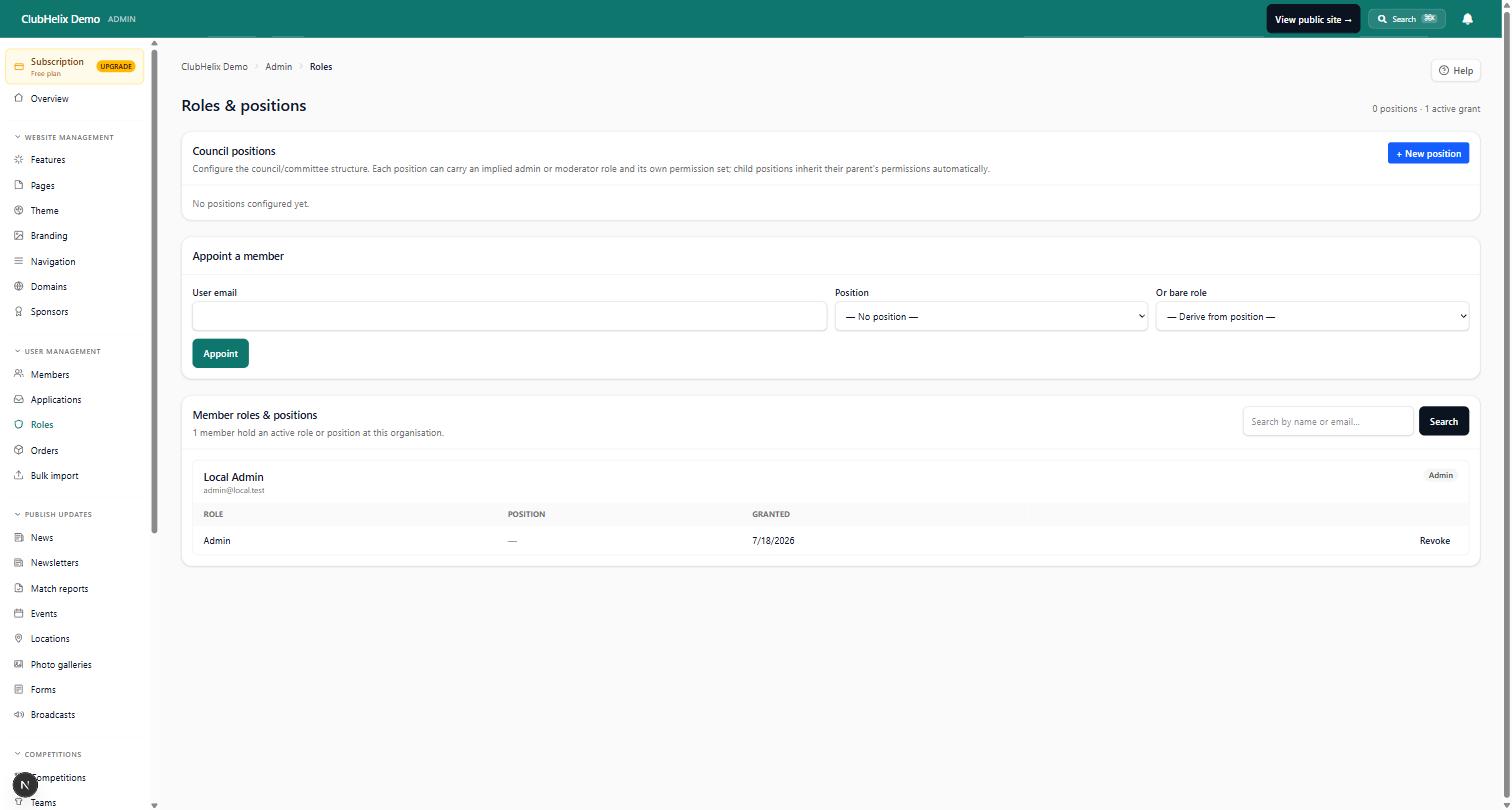
There is a free tier that suits a small club with one ground and a short committee, and the pricing is published rather than quoted. If your access records currently live in a shoebox and a group chat, you can create your club site and have the register, the roles and the bookings sitting in one place before the next handover.
Frequently asked questions
What should a club key register include?
One row per key or credential, not one per person. Record the key ID stamped on the key, exactly which doors it opens, the type of key, who holds it, the role they hold it against, the issue date, who authorised it, a review date, and a returned column that stays blank until it comes back. The role column is the one that makes the annual audit possible, because it turns asking for a key back into a routine step rather than a personal question.
How often should a club audit its keys?
Once a year as a minimum, ideally at the end of the season when roles are changing anyway. Run an amnesty a fortnight beforehand, contact every holder individually by key ID rather than sending a mass message, physically sight the high-risk keys, and minute the outcome. Any time a committee turns over or a keyholder leaves unexpectedly, do a partial audit of the zones they could reach.
Should a club switch to keypads or smart locks?
It depends on how often access turns over. Electronic access is worth it where a lot of different people need entry at different times — perimeter gates, main rooms, hired spaces — because it removes the cutting, the collecting and the guessing. It is rarely worth it for the doors almost nobody should open. Whatever you choose, keep a mechanical way in for flat batteries and power cuts, and set it up on a club account rather than a volunteer's personal one.
What do we do if keys have gone missing?
Do not rekey the whole site by reflex. Work zone by zone and rekey only where an unaccounted key genuinely matters — usually the bar, the office and the safe. Where you do rekey, move that zone to a restricted key system so blanks can only be cut against a signed authority, and record the decision in the minutes. A missing changeroom key is an inconvenience, not an emergency.
Who should hold keys to the clubhouse?
Grant by role and by zone rather than by seniority or length of service. Committee officers need the office, canteen volunteers need the canteen, the gear steward needs the shed, and hardly anyone needs everything. Every grant should have a review date attached so it lapses when the role does, and anyone with access to a building where juniors are present should sit under the same screening rules as your coaches.
Can we charge a key deposit?
Plenty of clubs do, and it modestly improves return rates, but a deposit is a weak substitute for a register. The deposit only helps if you recorded who paid it, against which key, and someone chases it — which is the same discipline the register needs anyway. If your club hires out its rooms, time-limited access tied to the booking removes the need for a deposit on that side entirely.
Keep reading — the committee handover checklist covers the week the register is most at risk, and the club equipment register template is the same discipline applied to everything else your club owns.


