
What this guide answers
- What is a club equipment replacement plan?
It is a short list of the equipment your club would have to fundraise for, with three added columns — how long each item should realistically last, what it would cost to replace at today's prices, and the resulting…
- How do we work out a sinking fund for club equipment?
Divide each item's replacement cost by its expected life in years, then add the results together.
- How long should we expect club equipment to last?
Set your own bands based on how hard your gear is used, then let condition override the calendar.
- Does having a replacement plan really help with grant applications?
It helps a lot, because it answers the questions assessors are actually weighing — why now, how you costed it, what you are contributing, and how you will maintain it afterwards.
- Should the replacement fund be in a separate bank account?
Yes, and this is the rule clubs most often break. A reserve that sits inside the general account gets spent on whatever this season's crisis turns out to be, usually with good intentions and a promise to put it back.
Ireland edition. This guide is written for volunteer-run clubs in Ireland. Where rules differ — grants, tax, incorporation, safeguarding — follow the Ireland-specific pointers below or check with your national body.
The mats are eight years old. Two of them have a split in the vinyl that has been taped since last winter, and the head coach has raised it at three consecutive committee meetings. Everyone agrees. Everyone also knows the club does not have the money, so the item moves to general business and then to the next agenda, and the tape gets replaced instead of the mats.
Here is the uncomfortable part. The club could afford them. It has had eight years to pay for them and has spent none of that time doing so, because nothing in the budget ever said "mats" until the mats were already failing. That is not a fundraising problem or a poverty problem. It is a planning problem, and it is the single most fixable financial weakness in community clubs.
The idea underneath the fix is depreciation, which sounds like an accounting abstraction and is actually just a savings plan wearing a suit. Every piece of gear your club owns is quietly using itself up at a knowable rate. If you write down what you own, how long it will realistically last and what it will cost to replace, you can convert a series of future crises into a modest line in this year's budget. This guide covers how to build that list, how to do the sinking-fund arithmetic in numbers a treasurer can present in five minutes, and how the same document becomes the strongest section of your next capital grant application. It is general information for volunteer committees — your accountant, auditor and governing body may have views on how the numbers are presented in your accounts.
A register tells you what you own. A plan tells you what it will cost you next.
If your club already keeps an equipment register, you are most of the way there and you should not start again. But the two documents answer genuinely different questions, and conflating them is why most registers never turn into money.
| Question | Register | Replacement plan |
|---|---|---|
| What do we own and where is it? | Yes | No |
| What is it worth for insurance? | Yes | Indirectly |
| Who signed it out and has it come back? | Yes | No |
| When will it need replacing? | No | Yes |
| What will it cost at that point? | No | Yes |
| How much should we set aside this year? | No | Yes |
| What is our own contribution to a grant bid? | No | Yes |
The plan is built on top of the register, so if you do not have one yet, start with the club equipment register template and come back. If you do have one, you are adding three columns — expected life, replacement cost today, and annual set-aside — and one habit.
Building the asset list
Do not try to list everything. A plan that includes forty cones and three whistles is a plan nobody maintains. The rule of thumb worth using — include anything you would have to fundraise for, hold a special meeting about, or delay a season over. In practice that is usually somewhere between ten and thirty lines.
For each item, capture six things.
- What it is, in the words your members use, not the supplier's catalogue name.
- How many, because a set of ten replaces differently from one of ten.
- When you got it, which is often the hardest column and the one where the register earns its keep.
- Expected life in years, as a considered judgement rather than a guess you will not remember making.
- Replacement cost at today's prices, for like-for-like or the sensible modern equivalent.
- Annual set-aside, which is simply replacement cost divided by expected life.
Here is a worked example for a mid-sized gymnastics club with around 180 members. The numbers are illustrative and are in whatever currency your club uses — the arithmetic is the point, not the amounts.
| Item | Qty | Acquired | Expected life | Replacement cost today | Annual set-aside |
|---|---|---|---|---|---|
| Sprung floor | 1 | 2019 | 15 years | 60,000 | 4,000 |
| Uneven bars set | 1 | 2017 | 15 years | 11,000 | 733 |
| Landing mats, full set | 1 | 2023 | 6 years | 12,000 | 2,000 |
| Foam pit refill | — | 2022 | 5 years | 6,000 | 1,200 |
| Vault table | 1 | 2021 | 12 years | 9,000 | 750 |
| Competition beams | 2 | 2018 | 15 years | 7,000 | 467 |
| Air track | 1 | 2024 | 5 years | 4,500 | 900 |
| Sound system | 1 | 2020 | 8 years | 2,400 | 300 |
| Office laptop and printer | 2 | 2024 | 4 years | 2,800 | 700 |
| Defibrillator | 1 | 2022 | 10 years | 2,500 | 250 |
| Total | 117,200 | 11,300 |
Two things usually happen when a committee sees a table like that for the first time. Somebody says the total cannot possibly be right, and somebody else says the club cannot possibly find that much a year. Both reactions are useful. The total is almost always right and almost always larger than anyone expected — that is the finding. The affordability problem is real too, and there is a section below on what to do about it. What you must not do is respond by making the numbers smaller.
Where the replacement cost comes from
Three sources, in descending order of reliability.
- A current written quote. Get one for your single biggest item every two or three years. It costs nothing but a phone call, it keeps the whole plan honest, and it is the number a grant assessor wants to see.
- A supplier list price, taken from a catalogue or website with the date you looked it up recorded beside it.
- What you paid, uplifted. The weakest source, and fine for small items. Record the basis so a future treasurer knows it was an estimate rather than a quote.
Whatever you use, write the basis and the date in the row. A plan where nobody knows whether 12,000 came from a quote in March or a memory from four years ago cannot be defended in a grant application or a committee argument.

Expected life is a judgement, so write down the basis
The temptation is to look up an official depreciation schedule and use it. Resist that, at least for the plan — the accounting life of an asset and the day it stops being safe or usable for your members are different things, and yours will be shorter if your gear is used hard.
Use a starting set like this, then argue with it as a committee based on your own conditions. These bands are an example to adapt, not a standard.
| Class | Typical planning life | What actually kills it |
|---|---|---|
| Soft goods — mats, padding, nets, uniforms | 3 to 6 years | Wear, hygiene, and stitching rather than age |
| Portable hard equipment — goals, benches | 8 to 12 years | Corrosion, and being dragged across concrete |
| Fixed apparatus and structures | 12 to 20 years | Standards changing before the metal fails |
| Playing surfaces and courts | 10 to 15 years | Sunlight, drainage, and deferred maintenance |
| Electronics — scoreboards, PA, laptops | 4 to 8 years | Obsolescence, not breakage |
| Safety equipment — defib, first aid kit | 5 to 10 years | Consumable expiry long before the unit itself |
| Vehicles and trailers | 10 to 15 years | Registration, roadworthiness, and rust |
Then add the override that keeps the plan connected to reality. Condition beats calendar. Once a year, someone walks the gear with the list and rates each line green, amber or red. An amber item pulls its replacement year forward regardless of what the arithmetic says, and a green item that has outlived its band gets pushed back a year with a note. Do this at the same time as your end-of-season stocktake and it costs an extra twenty minutes.
Two habits extend life cheaply enough to be worth naming. Maintenance actually works — the club that cleans, dries and stores its soft goods properly gets years more out of them than the club that leaves them in a shed over the wet months. And usage discipline matters more than most committees admit, since almost all premature failure traces back to gear being used for something it was not built for.
The sinking fund, in plain numbers
A sinking fund is a savings account with a job description. You put money in every year against a known future cost, and the money is not available for anything else. That last clause is the whole trick, and it is the one clubs break.
Using the worked example above, the arithmetic a treasurer presents looks like this.
- Total replacement value of tracked assets — 117,200
- Total annual set-aside required — 11,300
- Members — 180
- Cost per member per year — about 63
- Monthly transfer — about 942
Presenting it per member is what converts an intimidating number into a decision. Sixty-three per member per year is a fee conversation, a sponsorship conversation or a fundraising conversation. Eleven thousand three hundred is just a wall. Our guide on how much club membership should cost covers where that kind of increment sits alongside everything else members are being asked for.
What to do when the full number is out of reach
For most clubs it will be, at least in the first year. There are four honest levers, and choosing openly between them is a far better outcome than quietly funding none of it.
Stage it by due date. Fund what is actually due in the next five years properly, and hold the long-dated items at a partial rate. In the example, the near-term list looks like this.
| Due | Item | Cost |
|---|---|---|
| 2027 | Foam pit refill | 6,000 |
| 2028 | Laptop and printer | 2,800 |
| 2029 | Landing mats | 12,000 |
| 2029 | Air track | 4,500 |
| 2030 | Sound system | 2,400 |
| Five-year total | 27,700 |
That is about 6,925 a year, or roughly 38 per member. A far more winnable conversation, and it still means the club never gets caught out inside its own planning horizon.
Extend life deliberately. A maintenance program that adds two years to the mats is worth a third of their annual set-aside. Say that out loud when you are asking for volunteers at the working bee.
Change the specification. The replacement does not have to be identical. Sometimes the sensible modern equivalent is cheaper, sometimes dearer, and deciding that in advance beats deciding it in a panic.
Plan for co-funding. For the largest items, assume a grant will cover part and your fund covers the rest. That is not wishful thinking, provided you write down the split — and as the next section explains, having a fund is often what makes the grant achievable in the first place.
Four rules that keep the fund alive
- A separate account. Not a mental allocation inside the general account. Money that is visible is money that gets spent on the season's crisis.
- A committee resolution, minuted. "The club will transfer X per month to the equipment replacement reserve, and withdrawals require a committee resolution referencing the asset being replaced." Boring, and it survives a change of treasurer.
- A line in the annual budget, every year, forever. Put it in the club budget template alongside insurance and affiliation, not in a discretionary block at the bottom.
- A balance in the treasurer's report. One line each month showing the reserve balance and the next scheduled purchase. See the club treasurer report template for where it sits, and club financial reports explained for how it reads in the annual accounts.
If your club is registered for a consumption tax such as VAT or GST, plan against the cost you actually bear rather than the shelf price, because the treatment of the credit changes the real number on larger purchases significantly. Ask your treasurer or accountant how the reserve should be shown in your accounts as well — presenting it as a designated reserve within members' funds is usually clearer for members reading the annual report than burying it in general cash, and it makes the balance harder to raid.
Turning the plan into a capital grant
This is the part that surprises committees. The replacement plan is not just an internal budgeting tool — it is the single most useful attachment you can put on a capital funding application, because it answers, in advance, most of what an assessor is actually trying to work out.
Assessors are not looking for the neediest club. They are looking for the club most likely to still have the thing working in five years. A plan is evidence of exactly that.
| What the application asks | What your plan already contains |
|---|---|
| Why is this needed now? | Acquisition date, expected life, current condition rating |
| How did you arrive at the cost? | A dated written quote and the supplier |
| What is your club contributing? | The sinking-fund balance earmarked against this item |
| How will you maintain it? | The maintenance schedule and the ongoing annual set-aside |
| How many people benefit? | Participation by program from your membership records |
| What happens if you are only part-funded? | Your staged list, showing what you would do with a partial award |
| What happens to the old equipment? | The disposal or resale note on the row |
The strongest sentence a community club can write in a funding application is some version of "we have already saved 40 per cent of this from a reserve established in 2024, and here is the schedule showing we will fund the maintenance ourselves." It signals that the money is going somewhere organised. Compare it to "our mats are broken and we cannot afford new ones", which is true, sympathetic, and much weaker.
Practical notes for the application itself — attach the plan as a one-page extract covering only the item you are asking for, not the full spreadsheet; make sure the quote date is recent enough to look live; and be explicit about co-contribution, including in-kind volunteer labour if the program counts it. Our guide on how to write a grant application covers structure and tone in detail.
The Sports Capital and Equipment Programme is the significant national route for club equipment, alongside local authority grants and community funds, and it runs in defined rounds rather than continuously. Clubs in Ireland that do well are generally the ones already prepared when a round opens — tax clearance in order, club constitution and bank details current, quotes obtained and a clear statement of own funds. A replacement plan gives you the own-funds evidence and the justification in the same document, so keep it current and be ready to submit within the window.
Who owns the plan, and when it gets reviewed
Assign it, or it will drift. The pattern that works in most clubs is a shared job with one owner.
- Owner — treasurer. Holds the plan, reports the reserve balance monthly, and brings the annual update to committee.
- Contributor — gear steward or facilities officer. Does the annual condition walk and supplies the amber and red ratings.
- Approver — committee. Signs off the annual update and any withdrawal from the reserve, by resolution.
- Audience — members. See a short version at the annual general meeting. One slide, three numbers — reserve balance, what is due in the next three years, and the per-member cost.
Review it once a year, in the same month every year, immediately after the end-of-season stocktake and before the budget is set. That order matters. A plan reviewed after the budget is a plan that gets funded next year, which means never.
Time the review and the buying to your off-season. Ordering large equipment in the quiet months means you are not competing with every other club for the same supplier in the fortnight before the season starts, and lead times on specialised gear are frequently measured in months rather than weeks. Bear in mind that installation of anything fixed or outdoor may be constrained by frozen or waterlogged ground, so build a weather allowance into the schedule rather than assuming a delivery date is a usable date.
Buying well when the year finally arrives
The plan has done its job when the money is there. A few ways clubs stretch it further at that point.
Buy with your neighbours. Two or three clubs ordering together frequently get better pricing and shared freight, and freight on bulky equipment is a bigger share of the total than committees expect. Your association or regional body may already coordinate this — ask before you order alone.
Ask about ex-demonstration and end-of-line stock. Suppliers who attend competitions and trade shows carry demonstration units they need to move, and the discount can be substantial for equipment that has been used for two days.
Time it to the supplier's quiet period, which is usually the opposite of yours.
Plan the disposal at the same time as the purchase. Old gear that is still safe has resale or donation value, and a smaller club or a school will often take it. Gear that is not safe should be destroyed rather than passed on — a mat that failed your condition check should not become somebody else's liability. Record the disposal against the row so your register and your insurance schedule stay accurate.
Think about the sponsorship angle. A specific item with a name attached is one of the easiest sponsorship asks in community sport, because the sponsor can see exactly what their money bought. Our guides on getting sponsors and keeping sponsors happy cover how to structure that so it renews.
Where the numbers live between meetings
A replacement plan only survives if it is somewhere other than one treasurer's laptop, and if the numbers feeding it — member counts, program participation, income — are current rather than reconstructed the night before a grant deadline. That is the part ClubHelix takes off your hands. Reports give you live membership and participation numbers to drop straight into an application, sponsorship and billing tools track who has committed to what against which item, and donations let you run a targeted appeal for a specific piece of gear with the total visible on your own website rather than on somebody else's platform.
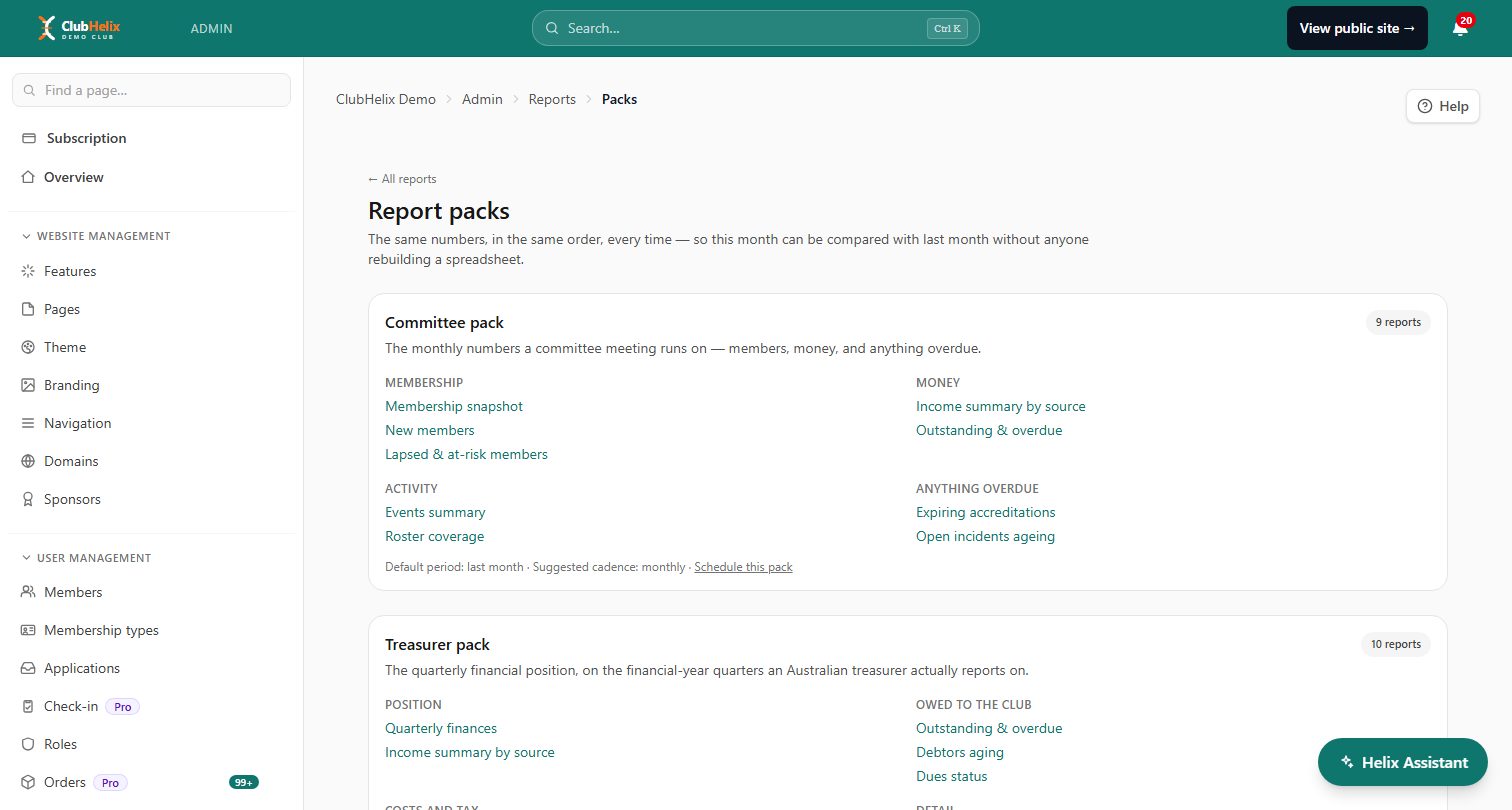
It is a club website and admin platform, with published pricing and a free tier that covers a small club properly rather than teasing one. If your equipment plan currently lives in a spreadsheet three treasurers ago, this is a good week to start your club site and give the committee one place where the numbers and the plan sit together.
Frequently asked questions
What is a club equipment replacement plan?
It is a short list of the equipment your club would have to fundraise for, with three added columns — how long each item should realistically last, what it would cost to replace at today's prices, and the resulting amount you should set aside each year. Adding those columns turns a static inventory into a budget line, so replacement becomes a planned annual cost rather than an occasional emergency.
How do we work out a sinking fund for club equipment?
Divide each item's replacement cost by its expected life in years, then add the results together. That total is your annual set-aside. Divide it by your member count to express it per member per year, which is the number a committee can actually make a decision about. If the full figure is out of reach, fund the items due within the next five years properly and hold the long-dated ones at a partial rate.
How long should we expect club equipment to last?
Set your own bands based on how hard your gear is used, then let condition override the calendar. As a starting point, soft goods like mats and nets tend to run three to six years, portable hard equipment eight to twelve, fixed apparatus twelve to twenty, and electronics four to eight. Walk the gear once a year, rate each line green, amber or red, and pull anything amber forward regardless of what the arithmetic says.
Does having a replacement plan really help with grant applications?
It helps a lot, because it answers the questions assessors are actually weighing — why now, how you costed it, what you are contributing, and how you will maintain it afterwards. Being able to say you have already saved part of the cost from an established reserve is far more persuasive than describing how broken the current equipment is. Attach a one-page extract covering the item you are asking about rather than the whole spreadsheet.
Should the replacement fund be in a separate bank account?
Yes, and this is the rule clubs most often break. A reserve that sits inside the general account gets spent on whatever this season's crisis turns out to be, usually with good intentions and a promise to put it back. Move it to its own account, minute a resolution that withdrawals require committee approval referencing the specific asset, and report the balance monthly so it stays visible.
Who should own the equipment plan on the committee?
The treasurer should hold it and report on the reserve, with the gear steward or facilities officer supplying the annual condition ratings and the committee approving the yearly update and any withdrawal. Review it in the same month each year, after the end-of-season stocktake and before the budget is set — a plan reviewed after the budget is written is a plan that never gets funded.
Keep reading — the club equipment register template is the inventory this plan sits on top of, and the club budget template shows where the annual set-aside belongs.

