
What this guide answers
- What should a club communication plan include?
One page: a statement that the website is the source of truth; a channel matrix saying what email, SMS, push, chat and social each carry; a speaking-rights table mapping roles to message types; an urgent-message…
- When should a club use SMS instead of email?
SMS is for urgent, short, time-critical messages where hours matter: ground closures, cancellations, final-call deadlines.
- How do we stop members saying "nobody told me"?
Three moves: keep one always-current source of truth (the website) that every message links to; use layered delivery for critical messages (email + SMS + push + chat, sent as one fan-out, not four jobs); and publish…
- Who should be allowed to send club-wide messages?
Very few people: typically the secretary or president approves official club-wide messages, a comms volunteer does the sending, and team managers are scoped to their own teams.
Ireland edition. This guide is written for volunteer-run clubs in Ireland. Where rules differ — grants, tax, incorporation, safeguarding — follow the Ireland-specific pointers below or check with your national body.
"Nobody told me" is the most expensive sentence in club sport. It's why players turn up to closed grounds, why fees arrive late, why the volunteer day gets four people, and why volunteers quietly burn out fielding the same question eleven times on a Friday night. Clubs almost never have a communication effort problem — committee members send messages constantly. They have a communication system problem: five channels, no rules about which one carries what, and members who have learnt that anything important will probably be repeated somewhere else, eventually.
A communication plan fixes this in one page. It answers three questions — which channel carries which kind of message, who is allowed to speak for the club, and what happens when time is short — and then everyone, member and committee alike, knows where to look. Here's how to build one.
Start with the one rule members must learn
Every channel decision below flows from a single principle you should write at the top of your plan:
The website is the source of truth. Channels carry the alert; the website carries the answer.
Fixtures, fees, venue addresses, event details, policies — they live on the club website, always current. Emails, texts and posts say "this changed / this is happening" and link there. This stops the death-by-a-thousand-corrections problem where the fixture time was updated in one chat but not the other, and it means anyone who missed every message can still find the truth at 8am Saturday. (No solid website to point at? Fix that first: how to build a sports club website.)
The channel matrix
Each channel is good at exactly one thing. The matrix below is a working default for a community club — copy it, argue about it once at committee, then publish it to members so they know what to expect where.
| Channel | Best for | Reach | Speed | Rules |
|---|---|---|---|---|
| Everything official: newsletters, fees, AGMs, event invites, anything members may need to find again | Whole club, reliably | Hours (people check daily-ish) | The record. If it matters next week, it goes by email — see broadcasts | |
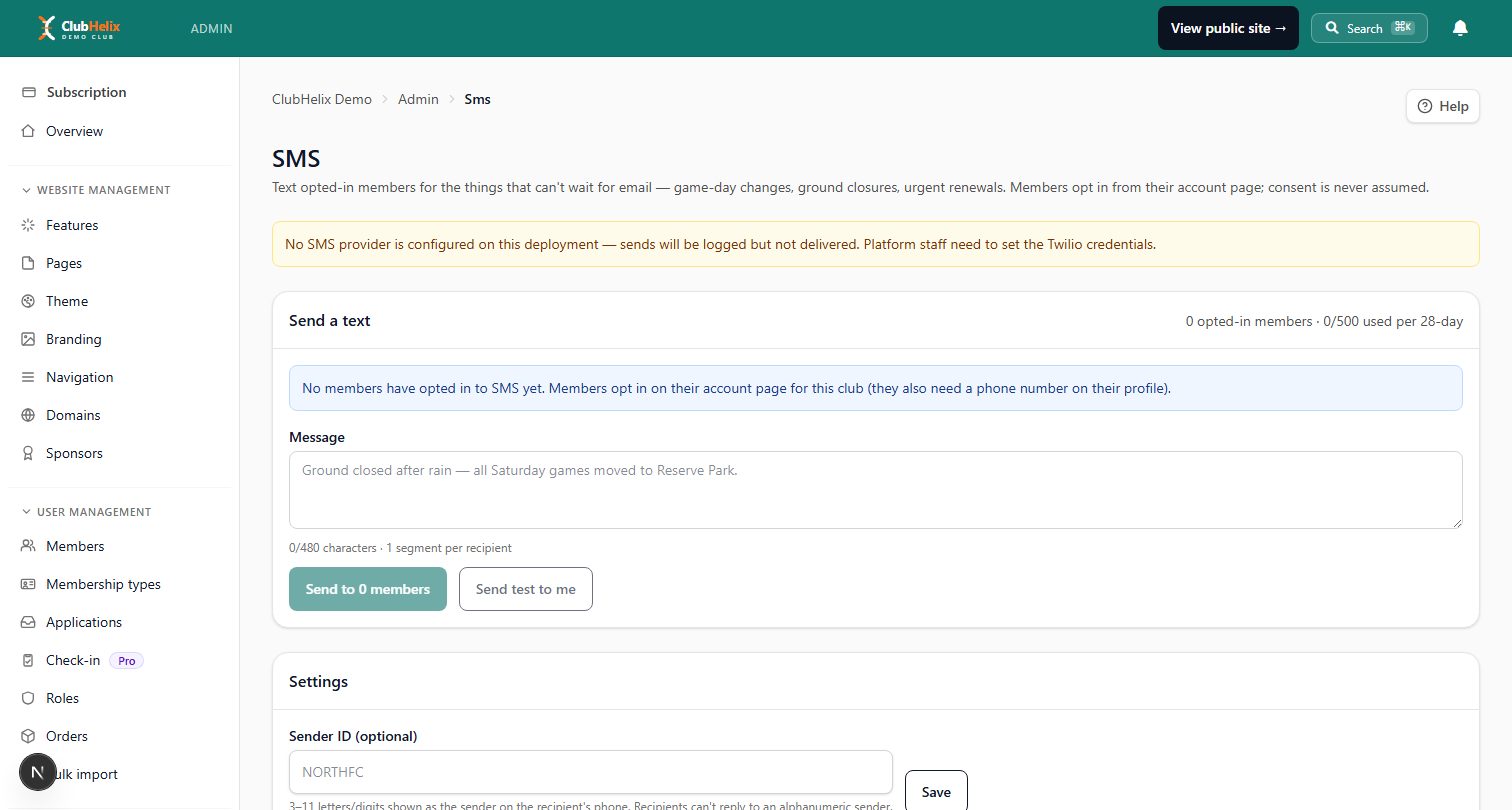
| SMS | Urgent, short, time-critical: ground closures, cancellations, "final call" | Near-total — texts get read | Minutes | Rationed strictly. If members get three texts a week, they'll ignore the one that matters — SMS messaging |
| Push notification | Timely nudges to app users: fixture reminders, results, news alerts | Members with the club app installed | Minutes | Free and fast, but only reaches installers — pair with SMS for anything critical (mobile app) |
| Team chat | Coordination inside a team: availability, carpools, "running 10 min late" | One team | Instant | Two-way by design. Never the only place a club-wide announcement lives — member chat |
| Social media | Celebration and discovery: photos, results, milestones, recruiting | Whoever the algorithm picks | Unreliable | Never the sole channel for anything members must know (why) |
| Website | The permanent answer to every question | Everyone, including non-members | Always on | Source of truth; every other channel links here |
Two structural notes:
- Channels multiply, they don't substitute. A cancellation goes: website updated → SMS to affected teams → push to app users → chat pinned → social post. That sounds like five jobs; on an integrated platform it's one message fanned out, because the member list, teams and channels live in one system.
- Match the audience to the blast radius. Whole-club email for whole-club matters; team-level chat for team-level matters. The fastest way to teach members to ignore you is sending everyone everything.
Who says what: speaking rights
Half of comms chaos is nobody knowing who's allowed to hit send. Put names (roles, not people) against each lane:
-
Club-wide official (fees, AGM, policy, anything legal or financial): secretary or president. One of them approves anything in this lane before it goes.
-
Club-wide operational (events, clubhouse and bar rotas, club workdays): the relevant coordinator drafts, comms volunteer sends.
-
Team-level (training, selection, match logistics): coach or team manager, in the team's own channel. Team managers don't send club-wide messages; the committee doesn't micromanage team chats.
-
Wet weather / ground status: exactly one designated role makes the call and sends it (see the escalation ladder below). Two people with the authority means, eventually, two contradictory messages.
-
Sensitive (injuries, disciplinary, disputes, anything about a child): never broadcast. Direct, private, and via the president or secretary only.
Write this as a table in your plan, and give each role's channel access accordingly — modern platforms let a team manager message their team without being able to text the whole club, which turns the policy into a permission instead of a hope.
The pre-season comms checklist
Pre-season is when the plan earns its keep — it's your highest-stakes comms window (registration revenue) aimed at your least-attentive audience (members still in holiday mode). Work this checklist:
For a winter code that means working backwards from an August or September start, with the heavy sends landing across July while families are away. Summer sports invert it: the sequence runs through March and April. Either way, the calendar constraint is the summer-holiday block immediately before your season — send into it and half your audience is abroad.
Infrastructure (6–8 weeks out)
- Member contact list audited: emails and mobiles current, bounces from last season purged, parent contacts (not just player contacts) captured for juniors
- Sending domain authenticated so the registration emails actually arrive — the fifteen-minute job explained in why club emails go to spam
- Website updated: fees, key dates, training times, committee contacts, FAQs
- Channel roles assigned for the season, access granted, ground rules circulated
The registration sequence (4–6 weeks out)
- "Registrations open" email with fees, dates and a one-click link to register
- Same message adapted for social + a poster/QR for the clubhouse
- Reminder email at two weeks, SMS "final call" in the last 48 hours — reserve SMS for that final push so it lands with full force
- Every reply-generating question noted and turned into a website FAQ (next year's inbox thanks you)
Season launch (1–2 weeks out)
- Welcome email to all registered members: training start, team allocations timeline, where each channel will be used ("texts = urgent only; check email weekly; fixtures live on the site")
- Team chats created and seeded by team managers
- First newsletter of the season scheduled — cadence rules in how to write a club newsletter
The wet-weather escalation ladder
The sternest test of any club's comms is a Saturday-morning washout. Design the ladder in advance, publish it to members, and run it identically every time:
The specific enemy here is the waterlogged or frozen pitch, and the decision often isn't yours alone — a referee's or groundsman's pitch inspection, and in league football the fixture secretary and the opposition, all have to be in the loop before members do. Build that into the ladder: inspection, league notified, then members, in that order, so nobody hears it from the opposition's social account first.
- One decision-maker. The designated role (often ground coordinator or president) makes the call by an advertised deadline — e.g. 7:30am for morning games. Members knowing when the call comes halves the anxious messages.
- Website first (one minute). Ground status updated on the site — the permanent answer, for anyone who missed everything else.
- SMS + push to affected members (five minutes). This is precisely what SMS is rationed for: "Grounds CLOSED today, all games off — details on the club website". Push notification mirrors it to app users at zero cost. Send to affected teams, not the whole club, if only some games are off.
- Team chats (ten minutes). Team managers confirm in their chats and field the two-way traffic ("does this include training?").
- Social last. A post for the broader community — visiting teams, casual supporters. Never first: the algorithm decides who sees it and when.
Rehearse the ladder once in pre-season with a test message. You'll discover the stale phone numbers and the volunteer who didn't know they were step 4 before it's raining.
Write it down, then make it survivable
The plan itself is one page: the source-of-truth rule, the channel matrix, the speaking-rights table, the escalation ladder, and the calendar of regular sends (newsletter fortnightly, committee summary monthly). Store it in the handover pack, review it at the AGM, and hand it — with the logins — to each season's comms volunteer.
Then reduce the number of moving parts. Every separate tool in the comms stack is another login to lose, another export-import of the member list, another place the plan can silently fail. When email, SMS, push, chat and the website all run off the same live member database, a departing member drops out of every channel at once, an urgent message fans out from one screen, and the plan survives the volunteer who wrote it. That consolidation — not any individual message — is what finally kills "nobody told me". See pricing for what an all-in-one setup costs against the stack of separate tools it replaces.

Frequently asked questions
What should a club communication plan include?
One page: a statement that the website is the source of truth; a channel matrix saying what email, SMS, push, chat and social each carry; a speaking-rights table mapping roles to message types; an urgent-message escalation ladder with one named decision-maker; and a calendar of regular sends. Store it in the committee handover pack and review it annually — the plan only works if it survives the person who wrote it.
When should a club use SMS instead of email?
SMS is for urgent, short, time-critical messages where hours matter: ground closures, cancellations, final-call deadlines. Everything else goes by email, which members can search and re-read. The discipline matters — clubs that text weekly train members to ignore texts, which defeats the entire purpose. A good benchmark: if members get more than one or two club SMS a month outside genuine emergencies, the channel is being overused.
How do we stop members saying "nobody told me"?
Three moves: keep one always-current source of truth (the website) that every message links to; use layered delivery for critical messages (email + SMS + push + chat, sent as one fan-out, not four jobs); and publish the plan to members so they know where each kind of news appears. When members know cancellations always arrive by SMS by 7:30am, they stop relying on rumour — and the committee stops fielding the same question eleven times.
Who should be allowed to send club-wide messages?
Very few people: typically the secretary or president approves official club-wide messages, a comms volunteer does the sending, and team managers are scoped to their own teams. One designated role owns urgent ground-status calls. Enforce it with channel permissions rather than trust — platforms that scope messaging by role make the policy automatic instead of aspirational.
ClubHelix runs the whole matrix from one member database — email broadcasts, SMS, push notifications via the club app and team chat, all reaching the right members without a single exported spreadsheet.


