
What this guide answers
- What are the three main roles on a club committee?
President (or chair), secretary and treasurer — most club constitutions and governing documents require these officer positions to be filled.
- Can one person hold two committee roles?
Often legally yes (check your constitution), but treat it as a temporary patch, not a structure.
- What is the difference between the committee and office bearers?
Office bearers are the named positions your constitution requires — typically president, secretary, treasurer, sometimes vice-president.
- How many people should be on a club committee?
Enough that no one is doing more than one real job, few enough that meetings still reach decisions — for most community clubs that's five to nine.
- Are committee members legally liable for the club?
An incorporated or company structure exists precisely to protect individual members — debts and legal liabilities generally sit with the club entity, not the volunteers.
Ireland edition. This guide is written for volunteer-run clubs in Ireland. Where rules differ — grants, tax, incorporation, safeguarding — follow the Ireland-specific pointers below or check with your national body.
Every community club runs on the same small engine: a handful of volunteers who put their hands up at the AGM and spend the next twelve months keeping the whole show on the road. When the committee works, nobody notices. When it doesn't — when one person is doing three jobs, or nobody is sure who was meant to book the courts — the club feels it everywhere.
Most committee problems trace back to one cause: the roles were never written down. New office bearers inherit a title, a vague sense of the job, and a shoebox of history, then spend a season working out what they're actually responsible for. This guide fixes that. It walks through each role — what it genuinely involves, how much time it takes, what makes someone good at it — and finishes with a duties table you can copy into your club's handover documents today.
Why written role descriptions matter
Before the role-by-role breakdown, three reasons to put this on paper rather than carrying it in people's heads:
- Recruitment. "Would you be treasurer?" is terrifying when nobody can say what the treasurer does. A one-paragraph description with an honest hours-per-week estimate turns a scary ask into a considered yes. Clubs with written role descriptions fill positions faster, full stop.
- Handover. When the secretary of six years steps down, a written description plus a season calendar is the difference between a smooth transition and a lost year.
- Boundaries. Volunteers burn out when jobs silently expand. A written scope lets someone say "that's a great idea — but it isn't the treasurer's job" without it being personal.
Whether your club is an unincorporated club or a company registered with the CRO, your constitution or club rules already name the officers and their duties — and if the club holds sports-body tax exemption from Revenue, keeping those rules current matters. Treat them as the legal floor; this guide is the practical layer on top.
President: the direction-setter
The president is not the person who does everything. The president is the person who makes sure everything has an owner.
Core responsibilities:
- Chair committee meetings and the AGM — keep them on time, on agenda, and civil.
- Set the year's priorities with the committee and check progress against them.
- Be the club's public face: welcoming new members, thanking sponsors, speaking at presentation night, representing the club to the association or league.
- Support the other office bearers — the president is usually the first call when the secretary or treasurer hits a problem.
- Cast the deciding vote where the constitution provides for one.
What good looks like: a president who talks less than anyone else at meetings and makes sure quiet members get heard. The classic failure mode is the opposite — a president who treats the committee as an audience.
Time commitment: 2–4 hours a week in season, more around the AGM and registration day.
Secretary: the club's memory
If the president sets direction, the secretary makes the club function as a legal and administrative entity. It is the most underestimated role on any committee.
Core responsibilities:
- Prepare meeting agendas with the president, circulate them beforehand, and record minutes of every committee meeting and general meeting.
- Manage official correspondence — the association, the council, the insurer, the state body — and bring anything needing a decision to the committee.
- Maintain the member register (a statutory requirement for incorporated associations) and the record of committee members.
- Lodge the annual statement or return with the club's regulator or registry and keep the club's registration details current.
- Give proper notice of the AGM and any special general meetings, in the form and timeframe the constitution requires.
- Keep the club's documents — constitution, policies, insurance certificates, leases — somewhere the whole committee can find them.
What good looks like: a secretary who circulates minutes within a week, chases action items between meetings, and can put a hand on any club document in under a minute.
Time commitment: 2–5 hours a week, spiking around the AGM and any regulator deadlines.
Treasurer: the money and the truth
The treasurer's real job is not bookkeeping — it's making sure the committee always knows the club's true financial position, so decisions are made with facts.
Core responsibilities:
- Keep accurate records of all income and expenditure, with receipts and invoices filed.
- Bank all money promptly and pay approved invoices on time.
- Present a treasurer's report at every committee meeting: bank balance, money in, money out, anything unusual.
- Prepare the annual budget with the committee and flag when actuals drift from it.
- Prepare the annual financial statements for the AGM, and arrange review or audit where the constitution or legislation requires it.
- Manage member fee collection and chase arrears — ideally by getting payments online so there's nothing to chase.
- Maintain the register of assets and ensure two-signatory (or two-approver) controls on the club's accounts.
What good looks like: boring reports. A good treasurer makes the finances so transparent that no one ever wonders where the money went. Any resistance to showing the books is a governance red flag, however nice the person.
Time commitment: 2–4 hours a week — dramatically less if fees, shop sales and event payments are collected online with automatic receipts rather than cash tins and bank-transfer spreadsheets.
Vice-president and the supporting roles
Beyond the big three, healthy clubs spread the remaining work across defined supporting roles rather than letting it pool with whoever seems willing:
- Vice-president: steps in when the president is unavailable, and usually owns one concrete portfolio (sponsorship, facilities, or a major event) so the title isn't ceremonial.
- Registrar / membership secretary: runs registrations, keeps member records current, and reports member numbers to the committee. In many clubs this is the busiest role every January.
- Volunteer coordinator: owns rosters and recruitment — see our guide to recruiting club volunteers.
- Canteen / bar manager: stock, rosters, float, food-safety requirements.
- Communications officer: website, newsletter, social media — keeping the public face current.
- Child safety / member protection officer: the contact for concerns, and the person who keeps the club's screening checks and policies up to date. For junior clubs this role is non-negotiable.
For that children's officer role, "screening" means Garda vetting for everyone working with children — the officer keeps a register of who is vetted and when each vetting falls due, alongside the safeguarding training your governing body requires.
Small clubs merge these; large clubs split them further. The rule is the same either way: every recurring task has exactly one named owner.
The duties table
Copy this into your handover pack and adjust to your club. It doubles as your AGM nomination sheet — attach it so nominees know precisely what they're signing up for.
| Role | Key duties | Meets/reports | Est. hours per week |
|---|---|---|---|
| President | Chair meetings; set annual priorities; public face; support office bearers | Chairs every committee meeting + AGM | 2–4 |
| Vice-president | Deputise for president; own one portfolio (sponsorship / facilities / events) | Every committee meeting | 1–3 |
| Secretary | Agendas + minutes; correspondence; member register; regulator lodgements; AGM notices; document custody | Every committee meeting; annual return to regulator | 2–5 |
| Treasurer | Record income/expenditure; pay invoices; monthly report; budget; annual statements; fee collection | Financial report at every meeting; statements at AGM | 2–4 |
| Registrar | Run registrations; member records; membership reporting | Monthly member numbers to committee | 1–3 (heavy in season start) |
| Volunteer coordinator | Recruit volunteers; build and fill rosters; thank-yous | Roster status at each meeting | 1–2 |
| Canteen manager | Stock, float, food safety, canteen roster | Takings summary to treasurer | 2–4 in season |
| Communications officer | Website, newsletter, socials, match-day comms | As needed | 1–3 |
| Member protection officer | Screening checks current; policy custodian; first contact for concerns | Standing agenda item | Under 1, but always on call |
Two honest notes on the table. First, the hours assume reasonable systems — a treasurer reconciling cash tins or a secretary retyping paper forms will double them. Second, if one person's column adds to more than about six hours a week across roles, that's not commitment, that's a resignation being scheduled.
Make the roles real with the right access
Written descriptions only work if your club's systems match them. Two practical steps:
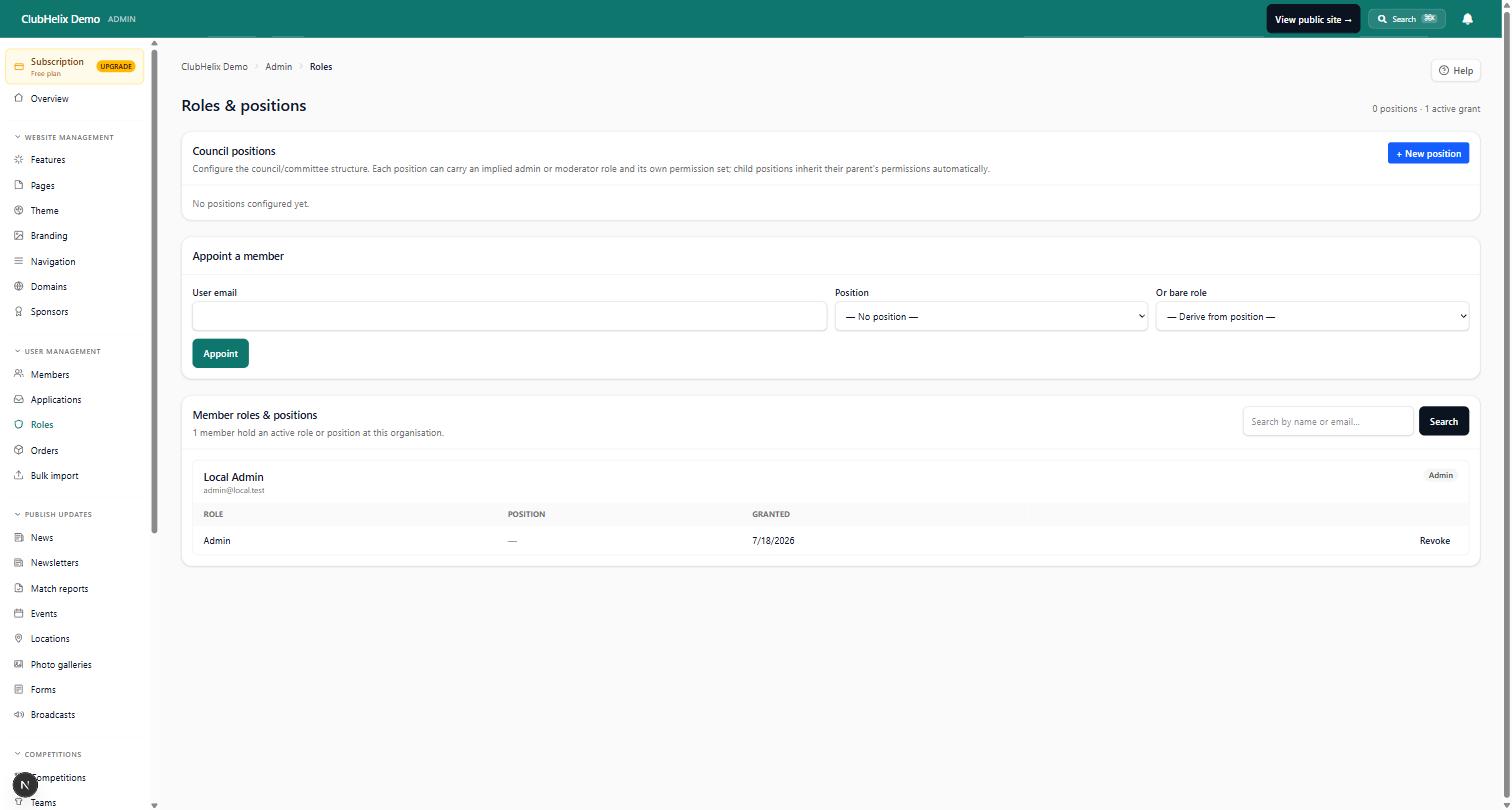
Give every role its own access, not a shared password. The registrar should be able to manage members without seeing finance settings; the canteen manager needs rosters, not the website editor. A platform with role and permission controls lets you grant each committee member exactly the admin access their role needs — and revoke it at handover in one click, instead of changing seven shared passwords every AGM.
Run the committee's paperwork in one place. Agendas, minutes, action items and decisions scattered across personal inboxes die at handover. A governance and meetings tool keeps the whole meeting cycle — agenda, attendance, minutes, resolutions, action items with owners — in the club's own system, visible to incoming committee members from day one.

Splitting the load: three rules that prevent burnout
- No role without a description; no description without an hours estimate. If you can't estimate the hours, you don't understand the role well enough to recruit for it.
- Separate "decides" from "does". The committee decides the canteen prices; the canteen manager runs the canteen. Committees that try to do everything in the monthly meeting do nothing well.
- Recruit for next year all year. Every role should have an understudy — someone helping with part of the job who could step up. That's the heart of succession planning, and it starts twelve months before the AGM, not two weeks.
Frequently asked questions
What are the three main roles on a club committee?
President (or chair), secretary and treasurer — most club constitutions and governing documents require these officer positions to be filled.
The president chairs and leads, the secretary handles records, correspondence and statutory lodgements, and the treasurer manages the money and reports on it. Everything else can be shaped to suit the club, but those three must exist and should never be held by the same person.
Can one person hold two committee roles?
Often legally yes (check your constitution), but treat it as a temporary patch, not a structure. The combination to avoid outright is treasurer plus any role that handles money coming in (registrar, canteen) — separating who collects from who records is your most basic financial control. If someone is holding two roles, the committee's first job is recruiting their replacement for one of them.
What is the difference between the committee and office bearers?
Office bearers are the named positions your constitution requires — typically president, secretary, treasurer, sometimes vice-president. The committee is the full elected group, which also includes ordinary or general committee members without a specific portfolio. Ordinary members share legal responsibility for decisions just the same, so "I was only a general member" is neither a legal nor practical excuse for not reading the treasurer's report.
How many people should be on a club committee?
Enough that no one is doing more than one real job, few enough that meetings still reach decisions — for most community clubs that's five to nine. Under five, you have single points of failure everywhere; over about eleven, meetings drift and accountability blurs. If you have more willing helpers than seats, wonderful: give them defined non-committee roles like team manager, roster helper or photographer.
Are committee members legally liable for the club?
An incorporated or company structure exists precisely to protect individual members — debts and legal liabilities generally sit with the club entity, not the volunteers.
(If your club is an unincorporated association, committee members can carry personal exposure — one of the main reasons growing clubs incorporate.)
But committee members still carry duties: to act honestly, to avoid trading while insolvent, and to meet obligations under the legislation the club is registered under. The practical protection is simple good governance — accurate minutes, real financial reports and decisions recorded — which is exactly what this guide's roles produce when they're done properly.
ClubHelix gives every committee role its own login and permissions, keeps meetings, minutes and resolutions in the club's own system, and makes handover a five-minute job. Start free and set your committee up properly this season.


