
What this guide answers
- What is a quorum for a club AGM?
Whatever your constitution says — commonly a fixed number of members or a percentage of the membership.
- Can members attend online?
Only if your constitution permits it. Many were written before this was contemplated, and some jurisdictions have since made allowances.
- Do we have to present audited accounts?
It depends on your legal structure and your revenue. Many small clubs are below the threshold for a full audit and require only a review or committee certification.
- Can non-members attend?
Usually yes, at the chair's discretion, but they cannot vote.
- What if nobody nominates for a position?
Declare it vacant and let the incoming committee appoint to it later.
New Zealand edition. This guide is written for volunteer-run clubs in New Zealand. Where rules differ — grants, tax, incorporation, safeguarding — follow the New Zealand-specific pointers below or check with your national body.
The annual general meeting is the one meeting of the year where the club is formally accountable to its members. It is also, in a great many clubs, an hour of confusion in a cold clubroom with eleven people present, most of whom are on the committee.
Both of those things can be true and it can still be run well. This guide covers the reports that have to be presented, the running order that keeps it moving, and the numbers to have at hand before someone asks from the floor.
Before the meeting: the notice
Most constitutions specify a minimum notice period for an annual general meeting, along with what must accompany the notice. Check yours — it is usually somewhere between 14 and 28 days, and getting it wrong can invalidate the decisions the meeting makes, including the election.
Send with the notice:
- The date, time, place and, if applicable, the joining link
- The agenda
- The annual report including financial statements
- Nomination forms for committee positions, with the closing date
- Any special resolutions in full — constitutional changes usually must be circulated verbatim in advance
- Proxy forms, if your constitution allows proxies
Send it to every member, not just the ones who come. A member who was not notified has a legitimate grievance even if they would not have attended.
The running order
A well-run annual general meeting takes 45 to 60 minutes. This order works:
- Welcome, acknowledgements and apologies
- Confirmation of a quorum — record the number present. If there is no quorum, your constitution says what happens next; know that before the night.
- Minutes of the previous annual general meeting — accepted, not re-debated
- Business arising from those minutes
- President's report
- Treasurer's report and adoption of the financial statements
- Other portfolio reports — registrar, competitions, coaching, facilities
- Special resolutions — constitutional changes, fee structures where your rules require member approval
- Election of the committee
- Appointment of an auditor or reviewer, if required
- Setting of membership fees, if your constitution puts this to members
- General business
- Close
Two disciplines keep it to the hour. Reports are taken as read — they were circulated with the notice, so the presenter speaks for two minutes on the highlights and takes questions rather than reading the document aloud. And general business is not open-ended: invite items in advance, and take anything raised on the night as notice for the next committee meeting unless it genuinely needs a member vote.
The reports, with templates
President's report
Three to four minutes spoken; one to two pages written.
Structure: The season in three sentences. Two or three highlights, on-field and off. The honest challenge — every club has one, and naming it builds far more confidence than avoiding it. What the club owes to its volunteers, specifically. What next year needs.
Treasurer's report
Five minutes spoken; the statements circulated in advance.
Structure: The headline result — surplus or deficit, and closing funds. What drove the difference from last year. What is owed to the club and what the club owes. Any matter members should know about — a large committed spend, a lost sponsorship, a facility levy. Then the motion: "that the financial statements for the year ended [date] be adopted."
Have the detailed figures ready even though you will not read them. Someone will ask what the club spent on umpires, and answering immediately does more for member confidence than the whole prepared speech.
Registrar's report
Two minutes.
Structure: Members by category, with last year alongside. Growth or decline, and the honest reason. New members and where they came from. Retention if you calculate it. One sentence on next season's outlook.
Competitions and coaching reports
Two minutes each, results-focused, delivered by the coordinator rather than read by the secretary.
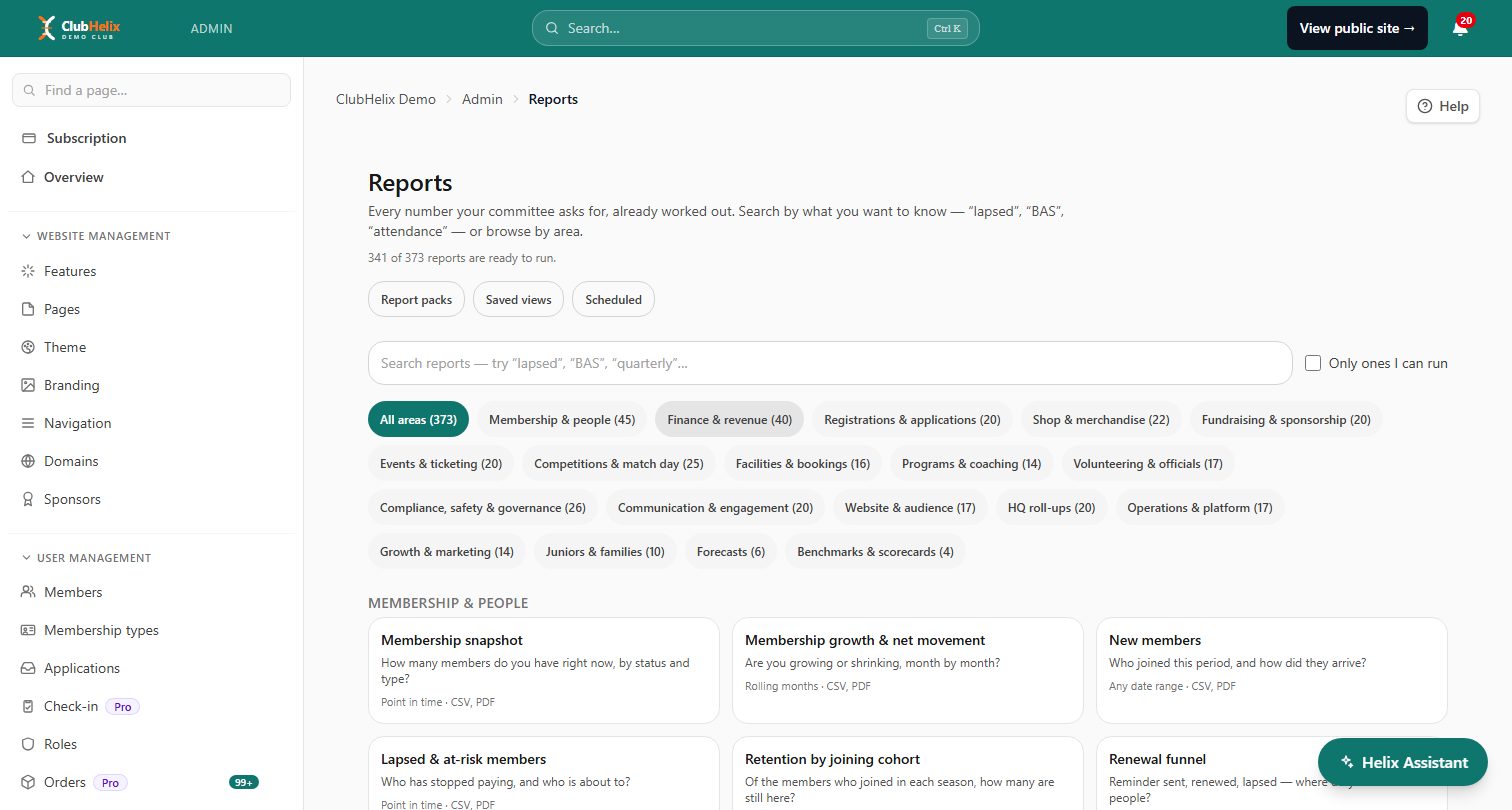
The numbers to have at hand
The prepared reports cover the expected questions. These are the ones that come from the floor, and having them ready is the difference between a committee that looks in control and one that does not:
- Membership by category, this year and last — the single most common question
- The largest three expense lines and what they were
- Total owed to the club, and how much is more than 90 days old
- Number of registered volunteers and, if you have it, hours
- Fixtures, sessions or events delivered
- Fee comparison with the previous two years
- Closing funds for the last three years, so the trend is visible
None of those should require a search. Print one page with all of them, or have the reports open on a laptop at the table. A treasurer who can answer a question in ten seconds ends the question; one who says they will find out invites three more.
The election
The part most likely to go wrong procedurally.
- Nominations close when your constitution says they close. Publish the list before the meeting.
- Each position is filled separately, in the order your rules specify.
- If a position is uncontested, the chair declares it elected. If contested, hold a vote in the manner your constitution requires — a secret ballot if anyone asks for one, and preferably by default for contested positions.
- Vacant positions are announced as vacant and can usually be filled by the incoming committee by appointment. Do not pressure someone into a role at the meeting; a reluctant treasurer is worse than a vacancy.
- Record it precisely in the minutes: position, name, and whether elected or appointed.

After the meeting
Four things, within a fortnight:
- Draft minutes circulated to the committee — accurate on motions, movers, seconders and outcomes. The minutes template covers the shape.
- Regulatory notifications lodged where your structure requires them — many jurisdictions require notice of an office-holder change within a set period after the meeting.
- Access handed over. New office holders get the accounts, the systems and the records; departing ones are removed. This is where clubs are most exposed and least diligent — a former treasurer with live banking access is a genuine risk, and a system where access is a permission rather than a shared password makes it a two-minute job.
- First committee meeting scheduled, ideally within three weeks, while the momentum is still there.
Frequently asked questions
What is a quorum for a club AGM?
Whatever your constitution says — commonly a fixed number of members or a percentage of the membership. It also usually specifies what happens if quorum is not reached, typically an adjournment to a later date at which a lower quorum applies. Know both numbers before the night.
Can members attend online?
Only if your constitution permits it. Many were written before this was contemplated, and some jurisdictions have since made allowances. If your rules are silent, that is a good special resolution to put to this year's meeting.
Do we have to present audited accounts?
It depends on your legal structure and your revenue. Many small clubs are below the threshold for a full audit and require only a review or committee certification. Your constitution may set a stricter standard than the law does — read both, and follow whichever is stricter.
Can non-members attend?
Usually yes, at the chair's discretion, but they cannot vote. Life members, sponsors and parents of junior members are often present. If your constitution restricts attendance, say so on the notice.
What if nobody nominates for a position?
Declare it vacant and let the incoming committee appoint to it later. Extended pressure at the meeting produces short-lived appointments. If a required office cannot be filled at all, your constitution and your incorporation rules will have something to say about it — check before the meeting rather than discovering it on the night.


