
What this guide answers
- We are a small bunch-ride club. Do we need any of this?
Probably not all of it. A club running two weekly bunch rides for a stable group needs a calendar and a waiver, and little else.
- Can one platform handle both road and mountain bike sides?
It should. Look specifically for multiple concurrent membership types on one record and message segmentation by discipline — those two together are what let one club serve both without running parallel systems.
- How do we handle ride-leader accreditation?
Track it on the member record with an expiry date and a warning window.
- Do we have to move our historical results?
No. Bring the member list, the current calendar and active waivers.
- What about club kit orders?
Run them as products with sizes as options so orders reconcile against payments.
Most club management software is built around a season: you register in March, you are put in a team, you play a fixture list, the season ends. A cycling club does not work like that. The calendar is the product, membership is often split across disciplines, riders self-select into grades rather than being picked, and a meaningful share of the committee's year goes on insurance, waivers and ride-leader accreditation rather than on fees.
That mismatch is why cycling clubs so often end up with a ride calendar in one place, a member list in another, waivers in a filing cabinet and grading in somebody's head. This guide covers what a cycling club actually needs, how the realistic product options differ in shape, and what to test before moving — and if you want the category explained before the cycling specifics, start here. We are ClubHelix, an all-in-one club platform, so we are a vendor in this category and we will say plainly where we are not the right answer. Observations are current as at August 2026; verify anything decision-critical with the vendor directly.
What a cycling club actually needs covered
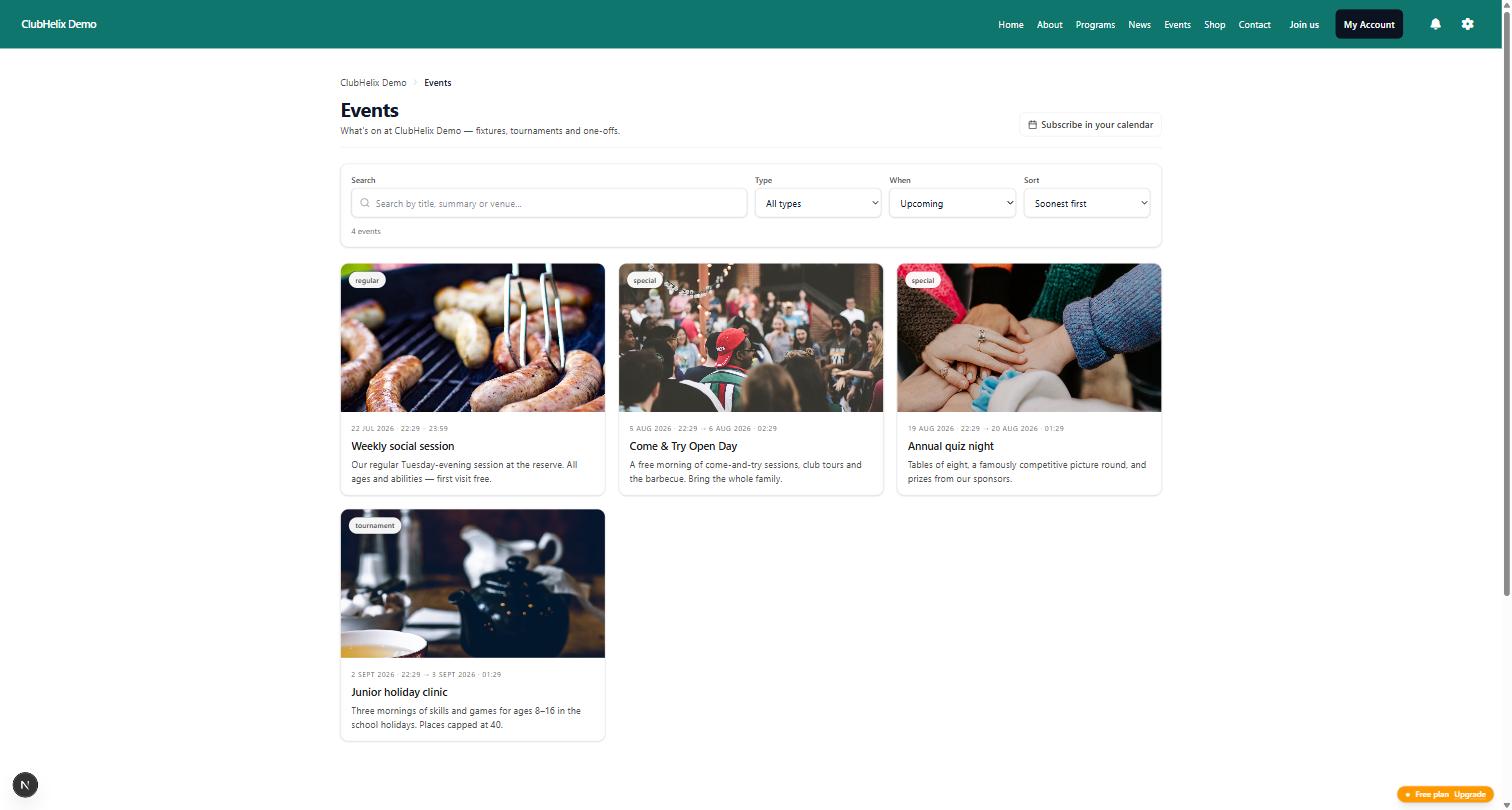
- A ride calendar riders can act on. Not a noticeboard — grade, distance, meeting point, ride leader, and whether it is on.
- Grade and discipline on the member record. A-grade road, C-grade, mountain bike, juniors and social members need different communications. If grade lives in a spreadsheet column, every segmented message is manual.
- Waivers and insurance records that are actually retrievable. A signature on paper in a folder is not a record you can produce when it matters.
- Ride-leader accreditation with expiry. The compliance obligation most likely to be discovered too late.
- Money across subs and levies. Membership once a year, race levies fifteen times a year — a very different transaction profile from a football club.
How the options actually differ
Cycling-specific tools — products such as Cyql and Kananas market directly at cycling clubs, and they generally understand the ride calendar properly: grades, ride leaders, route information and RSVP in one object. That is genuinely the hardest part to get right, and a general club product often does not. The trade-off is usually breadth: membership depth, a real public website, a shop for kit orders and governance tooling tend to be thinner or absent.
Membership-first platforms — Wild Apricot, Join It, TidyHQ and Springly — are strong on the member record, dues, renewals and communication, and they are mature. For cycling the gap is the calendar: an events module is not the same as a ride calendar with grades and leaders, and clubs frequently end up posting the "real" calendar to a group or a separate site anyway.
Team-sport platforms — Spond and similar — are excellent at "are you available for this thing", which maps onto a bunch ride better than it maps onto most sports. Spond is free and very widely used, and for a small club whose only need is ride RSVPs it is a reasonable answer. Where it runs out is club-level substance: membership categories, waivers with expiry, accreditation tracking and financial reporting.
Generic activity platforms — Activity Messenger, Playpass and similar cover class and activity businesses with cycling as one vertical. Worth trialling rather than inferring from the landing page; the depth varies considerably.
Where ClubHelix sits. We are website-and-membership first, with the ride calendar as real events carrying RSVPs and attendance, digital waivers attached to the member and the ride, and accreditations that warn before a ride leader's qualification lapses. Our honest gaps: no native app-store app, no GPS route integration, and no live ride tracking — if route mapping and ride analytics are the core of what you want, a cycling-specific tool or a training platform will serve that better than we will.
The questions that separate the products
| Question to ask | Why it matters for cycling |
|---|---|
| Can I segment a message by grade and discipline without exporting to a spreadsheet? | This is the single most frequent communication task in a cycling club. |
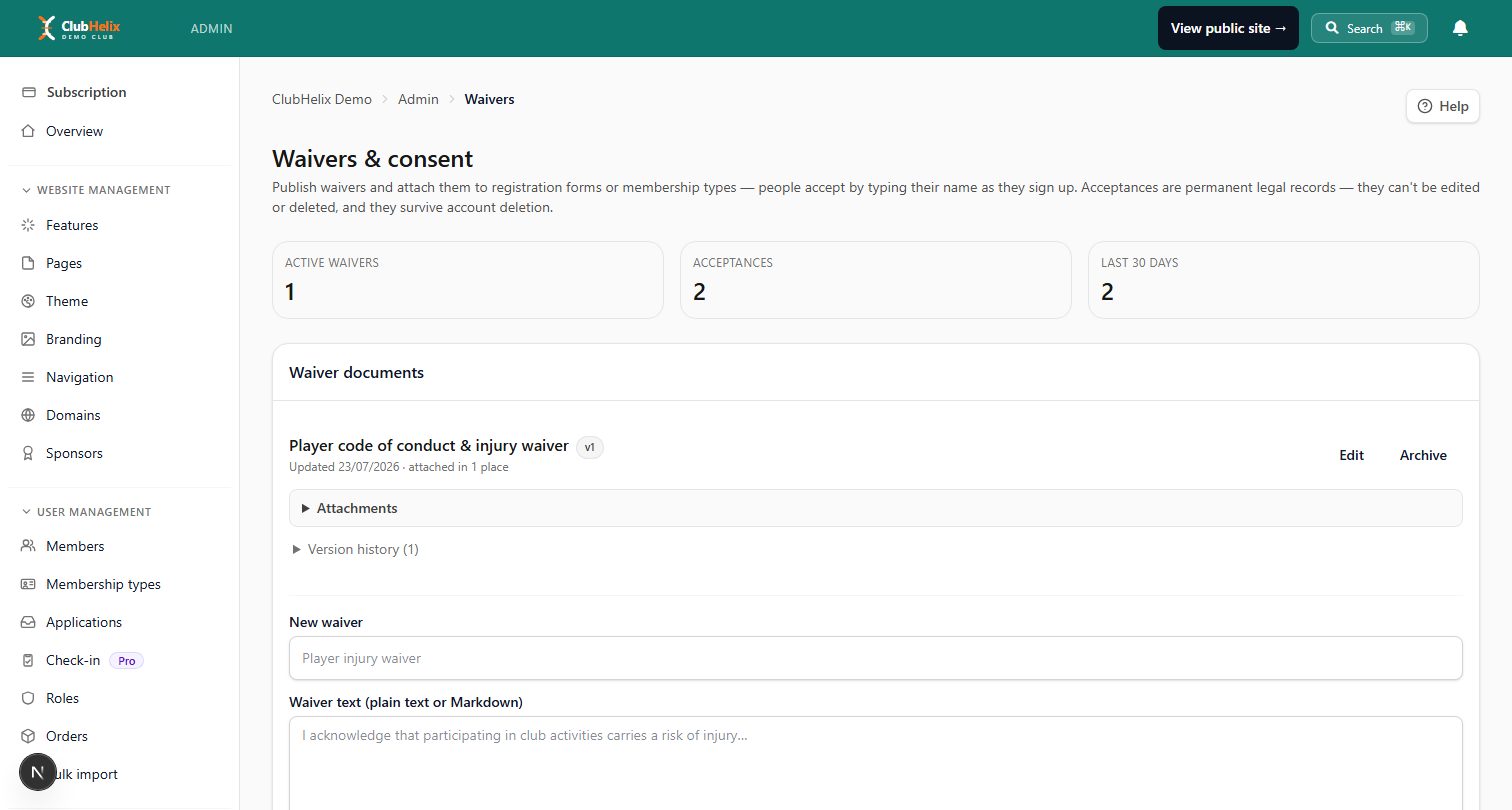
| Do waivers carry an expiry date, and can I see who has lapsed? | A waiver without expiry tracking is a filing cabinet with extra steps. |
| Can a rider hold two membership types (road and MTB) on one record? | Very common, and many products model membership as a single value. |
| Can a non-member pay to attend an open day or come-and-try ride? | This is the recruitment funnel; an account requirement blocks it. |
| Who absorbs the payment fee on a $10 race levy? | On small, frequent transactions the fee model dominates the economics. |
What it costs, realistically
The transaction profile is what to model. A club with 180 members paying a $60 annual subscription and a $10 levy across fifteen races is processing roughly 2,900 transactions a year, most of them small. The percentage fee and who pays it will affect the club's finances far more than the difference between two subscription tiers.
Published pricing as at August 2026 spans free (Spond, monetising through payments) to per-member sliding scales on the membership platforms to unpublished quote-based pricing on several of the cycling-specific tools. Where a vendor does not publish, that is not automatically a red flag — but it does mean you cannot shortlist without a conversation, so start those early.
ClubHelix has a free plan with no time limit; paid plans carry a 14-day free trial, bill on a 28-day cycle, and the platform fee is never surcharged to your riders. Current tiers are on the pricing page.
Frequently asked questions
We are a small bunch-ride club. Do we need any of this?
Probably not all of it. A club running two weekly bunch rides for a stable group needs a calendar and a waiver, and little else. The threshold is usually insurance: once you need to prove that every rider on a club ride was a current member with a signed waiver, informal systems stop being adequate.
Can one platform handle both road and mountain bike sides?
It should. Look specifically for multiple concurrent membership types on one record and message segmentation by discipline — those two together are what let one club serve both without running parallel systems.
How do we handle ride-leader accreditation?
Track it on the member record with an expiry date and a warning window. The failure mode is always the same: a qualification lapses quietly and nobody notices until an incident makes it matter.
Do we have to move our historical results?
No. Bring the member list, the current calendar and active waivers. Historical results can stay where they are — migrations that attempt everything tend to stall and then get abandoned.
What about club kit orders?
Run them as products with sizes as options so orders reconcile against payments. Kit ordering by spreadsheet and bank transfer is one of the most reliably painful jobs in a cycling club, and it is worth weighting in the decision.
For the wider job — grading structures, ride-leader pipelines and the club calendar — see the complete guide to running a cycling club, or the cycling solutions page.

