
What this guide answers
- We are a not-for-profit community gym, not a commercial one. Does that change the answer?
It changes it considerably. Commercial fitness platforms are built around revenue per member and often price accordingly.
- How should we handle medical clearances?
As a record on the member with an expiry date and an automated warning, separate from the general waiver.
- Can we take casual payments without full membership?
You should be able to, and if a shortlisted product cannot, that is disqualifying for most boxing clubs.
- Do we need competition features?
Only if you run interclub events or club shows. Many gyms use the timetable, memberships, waivers and communications and never touch competitions.
- What about under-18 members?
Look for a guardian contact model, so the parent receives communications and pays while the young person is the member.
A boxing club looks like a sports club and runs like a timetable business. There is no season, no fixture list and often no competition at all — just sessions, capacity, and a compliance obligation that is heavier than almost any other community sport. Medical clearances, sparring consent, coach accreditation and attendance records are not administrative nice-to-haves; they are the things that determine whether the club can operate.
Most club management software is built for the season-and-fixture shape, which is why boxing clubs so often find themselves using a gym booking app for classes, a spreadsheet for members, and a folder for the paperwork. This guide covers what a boxing club genuinely needs, how the realistic options differ, and what to test before moving. We are ClubHelix, an all-in-one club platform, so we sell into this market — we will name our own gaps rather than pretend to be neutral. Observations are current as at August 2026.
What a boxing club actually needs covered
- Class capacity that is enforced. A session capped at twenty that accepts twenty-six bookings is a safety problem before it is an admin one.
- Medicals and waivers with expiry. A form signed two years ago is not current cover. You need the expiry date, not just the document.
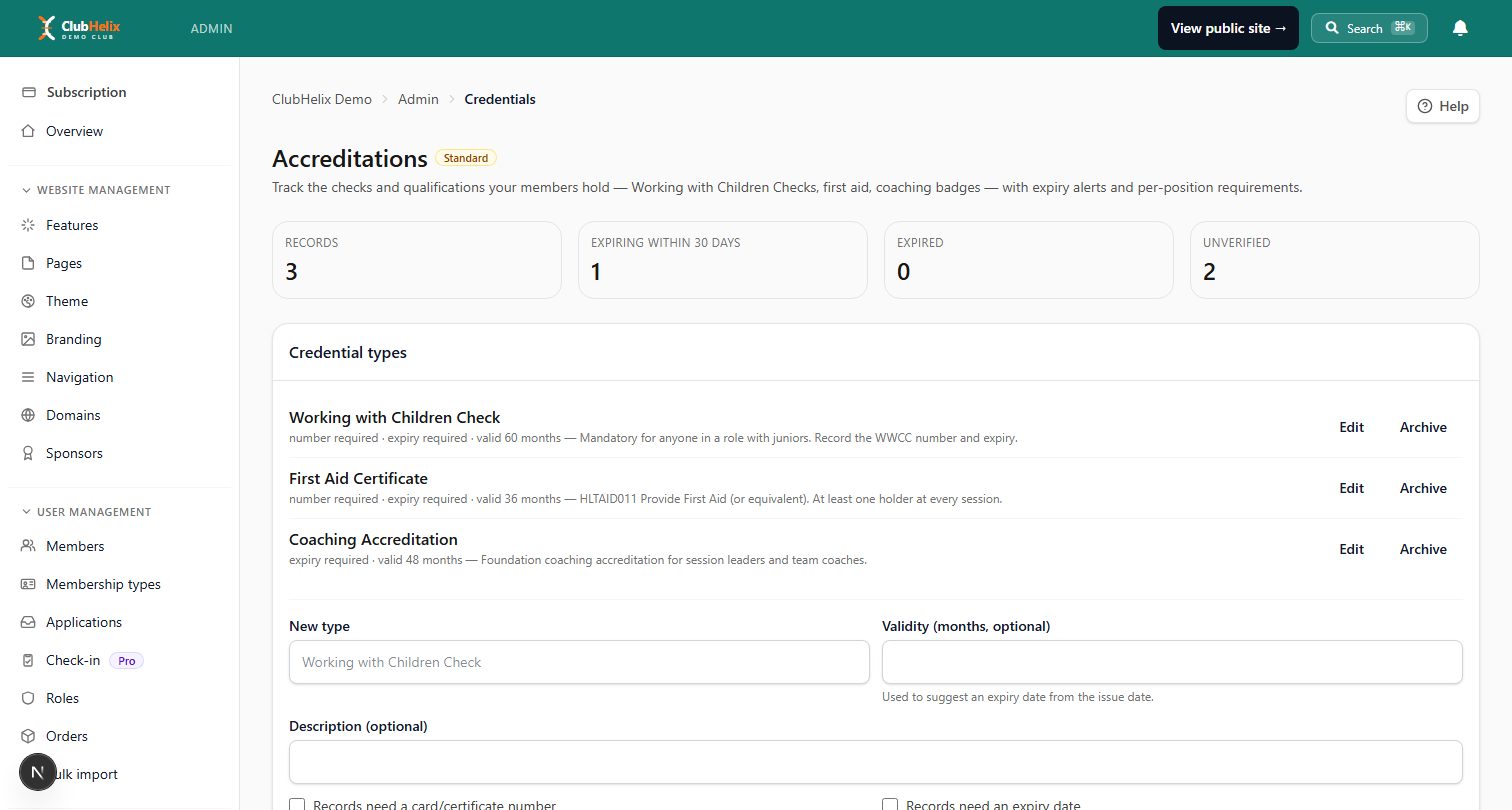
- Coach accreditation tracking. Coaching without current accreditation is the risk that closes clubs.
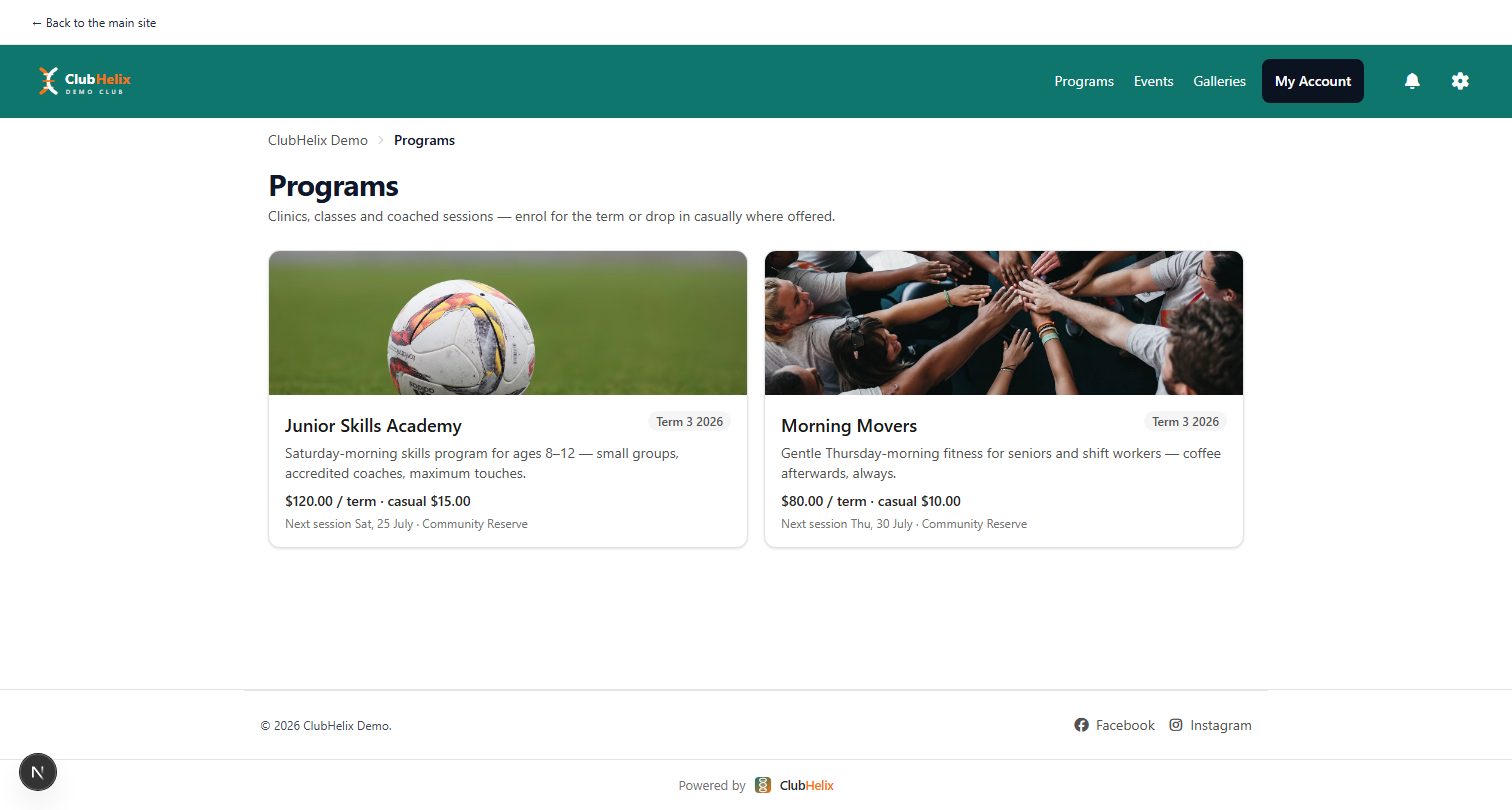
- Casual and concession pricing. Boxing runs heavily on casual attendance. A single annual membership fee leaves money on the table and excludes the people you most want in the room.
- Attendance you can audit. After an incident, "who was in the gym that night" needs a real answer.
How the options actually differ
Gym and fitness platforms — Glofox, Mindbody, TeamUp and similar — are built exactly for the timetable-and-capacity shape, and they are good at it: class booking, memberships, casual passes, waitlists and recurring billing. For a commercially operated boxing gym this is often the right category outright. The trade-offs are cost (these are priced for businesses, not volunteer committees), and a model that assumes a paying customer base rather than a not-for-profit club with a committee, a constitution and a public purpose.
Class-management products — Jackrabbit Class, Coacha and similar — sit between fitness and community sport. Coacha in particular is aimed at UK clubs and handles class registers, medical information and safeguarding, which is closer to what an amateur boxing club needs than a generic fitness platform.
Membership-first club platforms — Wild Apricot, Join It, TidyHQ — will hold the members and the money well, but the timetable is usually the weak point. If most of the club's weekly work is capacity-managed sessions, a strong member database with a weak class booking module is the wrong way round.
Team-sport platforms — Spond, TeamSnap — assume squads and fixtures. They can be pressed into service for session RSVPs, and Spond is free, but the compliance layer that matters most in boxing (medical expiry, accreditation currency, sparring consent) is generally not there.
Where ClubHelix sits. We handle the timetable as programs and enrolment with hard caps and waitlists, digital waivers and accreditations with expiry warnings, and per-session attendance — with a public website, memberships and payments on the same record. Our honest gaps: no native app-store app, no access-control hardware integration for door entry, and no body-composition or training-load tracking. A commercial gym wanting door access and PT scheduling should look at the fitness platforms.
The questions that separate the products
| Question to ask | Why it matters for boxing |
|---|---|
| Can a class have a hard cap with an automatic waitlist? | Coach-to-athlete ratios are a safety limit, not a preference. |
| Do medicals and waivers carry expiry dates with warnings? | The whole point is knowing before the session, not after the incident. |
| Can I sell a 10-session pass and track the drawdown? | Casual attendance is the dominant model; punch cards behind the desk lose money. |
| Can sparring consent be held separately from general membership? | Consent for sparring should never be implied by joining. |
| Can a coach take a register without seeing club finances? | Volunteer coaches need access to exactly one thing. |
What it costs, realistically
Model transaction count, not member count. A gym with 90 members where half attend casually per session is processing several times the transactions of a 90-member sporting club on annual subscriptions. That makes the fee percentage and the ease of casual payment far more important than the subscription tier.
Published pricing as at August 2026: fitness platforms in this space are typically the most expensive option, priced per location and often with a setup fee; UK club and class products sit in the tens of pounds per month; the general membership platforms scale by contact count; and Spond is free. Several vendors quote on request only.
ClubHelix has a free plan with no time limit; paid plans carry a 14-day free trial, bill on a 28-day cycle, and the platform fee is never surcharged to your members. Current tiers are on the pricing page.
Migrating a boxing gym without disrupting classes
The migrations that fail are the ones attempted all at once, usually in the week a new term starts. The order that works is deliberately unexciting:
- Load the member list and the timetable first, with nothing switched on for members. This is the step that surfaces how messy the current records actually are, and it is much better to discover that privately.
- Open online booking for one class only — usually the busiest — and leave everything else exactly as it is. One class is enough to prove the flow and small enough to reverse.
- Move waivers and medicals next. The compliance gain is immediate, it touches no money, and it is the step that most reliably convinces a sceptical committee that the change was worth making.
- Switch on casual payments, because cash handling at the door is where the pain and the losses concentrate.
- Move memberships last, at the renewal boundary. Never mid-cycle: pro-rata arithmetic during a migration is where members lose confidence in the club's admin.
Budget a term, not a weekend, and keep the old system readable — not running, just readable — until a full cycle has completed on the new one.
Frequently asked questions
We are a not-for-profit community gym, not a commercial one. Does that change the answer?
It changes it considerably. Commercial fitness platforms are built around revenue per member and often price accordingly. A community club usually wants the timetable and compliance depth without the business tooling, and is better served by a club platform or a class-management product.
How should we handle medical clearances?
As a record on the member with an expiry date and an automated warning, separate from the general waiver. The common failure is a signed form with no expiry, which tells you somebody once had clearance but not whether they have it now.
Can we take casual payments without full membership?
You should be able to, and if a shortlisted product cannot, that is disqualifying for most boxing clubs. Casual attendance is how people start, and requiring membership up front suppresses exactly the intake you want.
Do we need competition features?
Only if you run interclub events or club shows. Many gyms use the timetable, memberships, waivers and communications and never touch competitions. Do not pay for a competition module you will not open.
What about under-18 members?
Look for a guardian contact model, so the parent receives communications and pays while the young person is the member. Handling juniors as adults with a parent's email in a notes field creates both a communication and a consent problem.
For the wider job — coaching pathways, grading structures and the economics of a small gym — see the complete guide to running a boxing club, or the boxing solutions page.

