
What this guide answers
- What apps does a sports club actually need?
Six jobs need covering: a public website, membership/registration with payments, member communication, design for posters and socials, bookkeeping, and whatever competition platform your sport mandates.
- Are free club apps really free?
Usually yes in dollars, and no in something else — ad-supported apps monetise your members' attention, free tiers cap the features clubs grow into (online payments most commonly), and freemium platforms earn their keep…
- Should our club use one platform or the best app for each job?
Volunteer-run clubs are almost always better served by one platform: the integration work between separate apps (exporting lists, syncing spreadsheets, reconciling payments) is invisible, unpaid labour that lands on…
- Our sport makes us use a governing-body platform — do we still need our own?
You'll use the mandated platform for what it mandates (typically registrations, fixtures and ladders).
- How current is the pricing in this guide?
All pricing and feature claims are as at July 2026, drawn from the products' public pricing pages and listings at that date, converted currencies noted where relevant.
Ireland edition. This guide is written for volunteer-run clubs in Ireland. Where rules differ — grants, tax, incorporation, safeguarding — follow the Ireland-specific pointers below or check with your national body.
Ask five club committees what apps they run on and you'll get five different stacks — usually assembled one crisis at a time: a comms app adopted the week the phone tree collapsed, a spreadsheet that became "the database", a payment link bolted on during a registration rush. The result at most clubs is six tools, four logins nobody wrote down, and a secretary doing the integration work between them by hand.
This guide surveys the club app landscape by category — what each kind of tool is for, the real products clubs actually use, and how to think about assembling (or consolidating) your stack. Two things to know up front: we're ClubHelix, an all-in-one club platform, so we have a horse in this race — we've positioned ourselves honestly below and told you when a rival is the stronger fit. And pricing and features are current as at July 2026 from public sources; these products change constantly, so verify before you commit.
First, a strategy note: stack vs platform
Every category below can be solved two ways: a best-of-breed single-purpose app, or one module of an all-in-one platform. Single-purpose apps are often deeper in their niche; the platform's advantage is that the pieces share one member database, one login and one bill — the membership form feeds the email list feeds the team roster, with no volunteer re-keying between them. Our honest rule of thumb: the more volunteer-run your club, the more the platform approach wins, because integration work is exactly the invisible labour that burns out secretaries. Larger clubs with paid administrators can afford to run a deeper specialist tool or two alongside.
All-in-one club platforms
The category that runs the whole club — website, membership, registrations, payments, comms — from one system.
- ClubHelix (that's us): website builder with your own domain, member registration and payments, events, competitions, shop, email/SMS, governance and volunteer tools in one subscription, with a free tier and transparent pricing. Priced in euro. Honest limits: our mobile experience is an installable web app rather than an app-store download, and our admin, club websites and member accounts are English-only.
- Clubforce: the locally grown club-fundraising and membership platform, best known for running club lotto and online membership at scale — strong where the draw is a core income stream, and widely understood by GAA, soccer and rugby committees.
- ClubZap: club app and communications built around Gaelic games in particular, with fixtures, news and payments in a members' app. App-first, so clubs typically pair it with a separate public website.
- Pitchero: the grassroots standard next door and common in soccer and rugby clubs here — club websites, membership and payments with strong team-stats heritage, on free and paid tiers.
Our take, honestly: if your governing body mandates a platform, you'll likely run it for registrations regardless — the live question is whether your club's public face and day-to-day admin live there too. If you're choosing freely, compare on the website quality, the payment rates against your actual volumes, and whether the admin is something your whole committee can drive.
Team communication and scheduling apps
The "who's coming on Saturday" category — availability, selection, chat and event reminders at team level.
-
Spond: the polished European standard — free with no subscription, genuinely excellent RSVP/availability flows and guardian-safe messaging. It monetises payment processing and its fundraising product (clubs keep 65% of Superdraw ticket sales). It's an app-first tool; a Club Website is now a paid Spond Club add-on (£19 + VAT a month after a free trial, checked October 2026).
-
Teamo: a club-and-team app built for the grassroots game here — availability, selection, subs collection and messaging in one, sold at club level rather than per team. Squad-management first; it is not your public website.
-
Heja: a free, ad-supported team app popular with juniors — quick to adopt because parents install it in a minute, and deliberately narrow. No membership database, no website, and the free model has an advertising layer.
Our take: these apps are genuinely good at the sideline-logistics job, and Spond in particular sets the RSVP bar. The trade-off is fragmentation — a comms app that doesn't share a database with your registrations means duplicated contact lists from day one. ClubHelix covers the same ground with RSVPs and attendance, team chat and push notifications through an installable mobile app experience, tied to the same member records as everything else.
Membership management tools
For clubs whose pain is specifically the member database, renewals and "who has paid".
- membermojo: the budget favourite for small clubs — free up to 50 members, then modest annual pricing (around £75/year at 500 members, per their published pricing). Simple "who's paid" clarity is the whole pitch; expect to outgrow it if you need more than membership.
- LoveAdmin: membership and payment collection with serious Direct Debit machinery, aimed at clubs whose subscription income is worth automating the chase for. Membership-and-money first; the website is not the product.
- Join It: a tidy membership tool built around digital member cards and renewal automation, from US$29/month scaling by member count. Membership only — no sport features, website or events depth.
Our take: if membership records are your only problem, these are lean answers. Most clubs' membership problem is actually a registration-payments-communication problem wearing a membership costume — which is the all-in-one argument again.
Design and content
Every club needs posters, social tiles and programme covers, and one product owns this category in practice: Canva, whose free tier covers typical club needs (templates, club colours, resizing for socials). There is no serious argument for a club paying for heavyweight design software. Pair it with a shared club folder of logos and photos so volunteers aren't designing from screenshots of screenshots. For what to make with it, see our club social media ideas.
Accounting and treasurer tools
Small clubs run happily on a spreadsheet and a clean bank account; incorporated clubs with real turnover generally graduate to proper accounting software.
Here that usually means Xero, QuickBooks or Sage, all of which handle VAT returns and the reporting a registered club needs. Pick whatever your treasurer already knows.
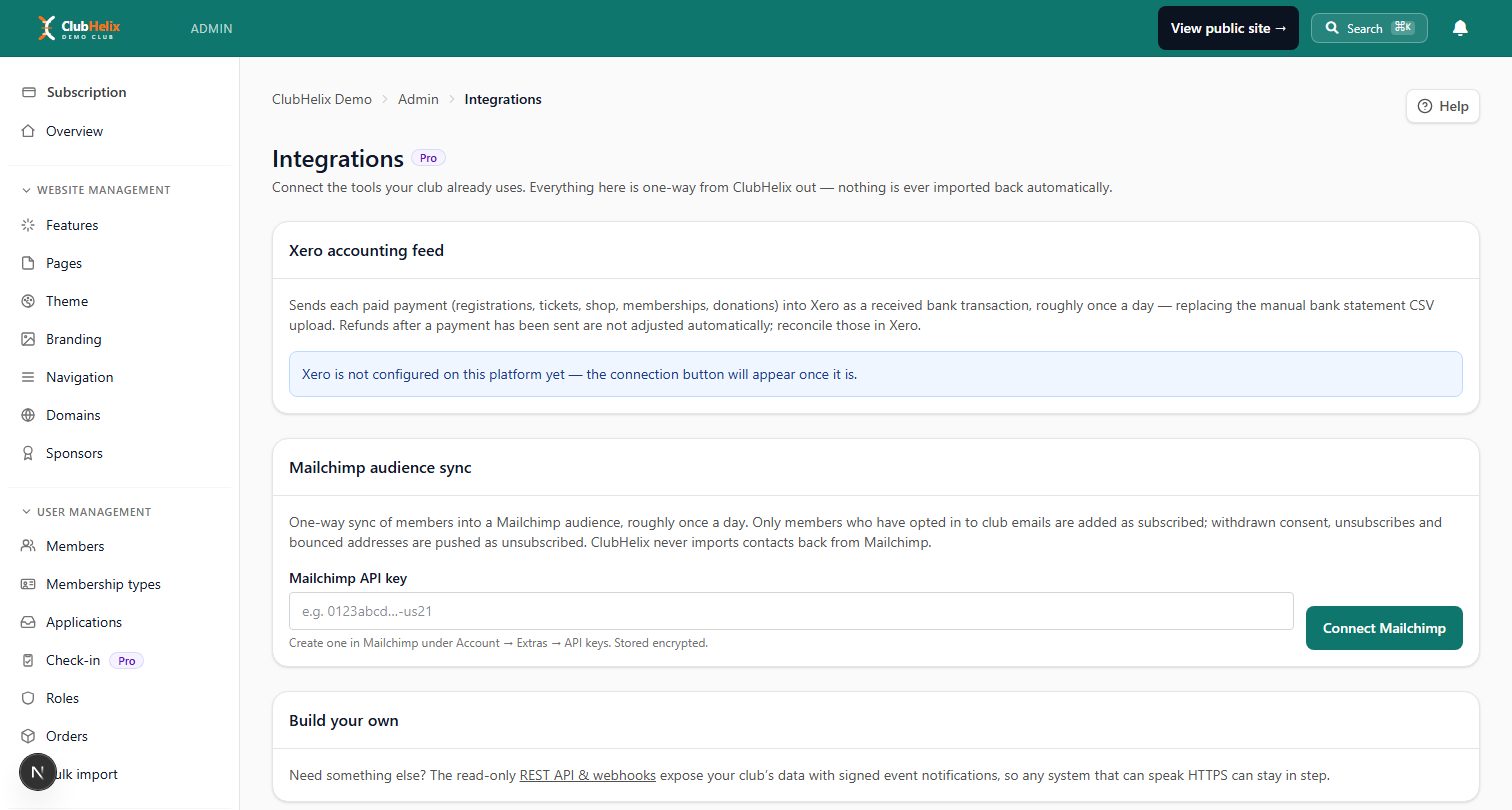
The app-stack question for clubs is less "which ledger" than "how does money data get INTO the ledger" — if your registrations, shop and event payments live in your club platform, you want them flowing to the books without manual re-entry. ClubHelix ships a Xero integration for exactly that reason; whatever stack you choose, insist on that link existing somewhere, or your treasurer becomes the integration.
Email and newsletters
The default habit is Mailchimp — familiar, capable, and where many club newsletters live today. The club-specific friction is the same as every standalone tool: the mailing list drifts out of sync with the actual member database the moment someone joins or lapses. Built-in member broadcasts that read live membership (and respect unsubscribes automatically) remove that whole chore — and if your club is wedded to its existing workflow, ClubHelix's Mailchimp integration keeps the list synced instead of hand-exported. Either way, read our guide on why club emails go to spam before your next big send.
Rostering, volunteers and facilities
- SignUpGenius: the generic free signup-sheet tool many clubs use for canteen and BBQ rosters — quick to start, with a free tier that covers a lot of club use. It knows nothing about your membership, so roster names live in yet another silo.
- Skedda: the venue-scheduling specialist, widely used for court and space bookings by facility operators. Strong scheduling rules; it's a standalone subscription and, again, a separate database from your members.
- The platform alternative: ClubHelix includes volunteer rostering and facility booking as modules tied to member records — a booking or a canteen shift belongs to an actual member, visible in one place.
Fixtures and competition platforms
In many sports this isn't a choice: the national body runs the competition rails and hands clubs a login — Foireann in Gaelic games, the FAI's club and league systems in soccer, provincial systems in rugby. If your sport has one, you'll use it.
The practical insight is the same everywhere: a mandated competition platform is not a club website or club-admin product, so the clubs that look organised run their own site and admin alongside it — publishing their own news, events, shop and sponsors — rather than pointing members at a fixtures page and calling it a web presence.
The sensible stacks, summarised
- Tiny club, no budget: a free club-platform tier (website + registrations) + Canva + a spreadsheet ledger. Two logins, nearly $0.
- Typical volunteer-run club: one all-in-one platform for website/membership/payments/comms/rosters + Canva + Xero (connected, not re-keyed) + whatever competition platform your sport mandates. This is the stack we built ClubHelix to be the centre of, and — bias declared — it's the one we'd recommend even if we weren't.
- Large club with paid admin: the above, plus possibly one deep specialist where you have a genuine edge case (a heavy facility-hire operation, for instance).
Whatever you choose: write every login into the committee handover document, register accounts to role-based club emails rather than personal ones, and count the volunteer hours each tool costs, not just its subscription price. The best app stack for a sports club is the one still running smoothly after the next AGM changes every name on the committee.
Frequently asked questions
What apps does a sports club actually need?
Six jobs need covering: a public website, membership/registration with payments, member communication, design for posters and socials, bookkeeping, and whatever competition platform your sport mandates. That can be six separate apps or mostly one platform plus Canva and accounting software. The test isn't feature counts — it's whether the tools share one member database and whether every committee member can use them after a handover.
Are free club apps really free?
Usually yes in dollars, and no in something else — ad-supported apps monetise your members' attention, free tiers cap the features clubs grow into (online payments most commonly), and freemium platforms earn their keep on payment processing margins. None of that makes them bad choices; a genuinely free tier is the right start for many small clubs. Just read how the product makes money and decide if you're comfortable being that mechanism.
Should our club use one platform or the best app for each job?
Volunteer-run clubs are almost always better served by one platform: the integration work between separate apps (exporting lists, syncing spreadsheets, reconciling payments) is invisible, unpaid labour that lands on the secretary and treasurer, and it breaks at every handover. Clubs with paid administrators can afford a specialist tool where they have a genuinely deep need. If you're consolidating an existing stack, migrate one season boundary at a time — membership first, since everything else hangs off it.
Our sport makes us use a governing-body platform — do we still need our own?
You'll use the mandated platform for what it mandates (typically registrations, fixtures and ladders). What it usually doesn't give you is a real club website, your own news and events, a shop, sponsor presence, email to your members, or governance tools — which is why most well-run clubs operate their own platform alongside the NGB rails. Check what your specific body's system covers and fill only the genuine gaps.
How current is the pricing in this guide?
All pricing and feature claims are as at July 2026, drawn from the products' public pricing pages and listings at that date, converted currencies noted where relevant. Club software pricing changes frequently — treat these figures as a comparison snapshot and confirm current pricing on each product's own site before deciding.
Want the one-platform version of this stack? See everything ClubHelix bundles at /features — website, registrations, payments, comms, the installable club app and Xero/Mailchimp integrations — with a free tier at /pricing.


