
What this guide answers
- Is it cheaper for a club to take bank transfers than card payments?
Only if your treasurer's time is worth nothing. Transfers avoid a processing fee but create matching work that grows with membership — typically several hours per hundred members per season, plus slower collection and…
- How do we make bank transfer references actually work?
Give each member a short code you generate for them, make it copy-and-paste rather than something to assemble, add a unique small amount of change to each total so the payment identifies itself even when the reference…
- Should a club offer both payment methods?
Yes, but not equally. Make online card payment the default everywhere members see, and keep transfer available on request for sponsorship invoices, grants, hardship arrangements and members who cannot use a card.
- Who should chase unpaid membership fees?
Not the same person who does the matching. Reconciliation is a finance task and chasing is a membership one, and splitting them protects the treasurer from a season of awkward conversations.
- What about members who cannot pay by card at all?
Keep a documented alternative and treat it as normal rather than exceptional.
Ireland edition. This guide is written for volunteer-run clubs in Ireland. Where rules differ — grants, tax, incorporation, safeguarding — follow the Ireland-specific pointers below or check with your national body.
Open your club's bank statement for the fortnight after sign-on and look at the credits. There will be a lot of them, and a surprising number will be useless. One says PAYMENT. One says a surname that does not appear anywhere in your membership list, because it is a grandmother's. Two are for exactly the same amount from the same account, and you cannot tell whether that is a family paying for two children or the same person paying twice. Four are short by a small amount, which probably means an old price list is still circulating somewhere. One is for an amount that matches nothing you charge at all.
Somebody has to turn that list into a set of paid members. That somebody is your treasurer, on a Sunday, with two browser tabs and a spreadsheet, and the work does not get easier as the club grows — it gets worse, because the number of ambiguous credits rises with the number of members while the number of people willing to untangle them stays at one.
That is the true comparison here, and it is not really about fees. A bank transfer moves the cost of collection from a line in your accounts to a person on your committee. A card payment moves it back the other way. This guide measures the work honestly per hundred members, explains why the reference-code system your club is about to introduce will not save you, and sets out where a transfer option genuinely earns its place — because for some payments it clearly does.
Two rails, one job
| Bank transfer | Online card payment | |
|---|---|---|
| Fee | None, or negligible | A percentage plus a small fixed amount, published |
| Who links payment to person | Your treasurer, afterwards | The system, at the moment of payment |
| When the club knows they paid | When someone checks the account | Immediately |
| What the member gets | Nothing, unless somebody sends it | A receipt, automatically |
| Partial and wrong amounts | Common, and invisible until reconciliation | Impossible — they pay the amount on the screen |
| Chasing | Manual, and always behind | Automated reminders against a live unpaid list |
| Refunds | A manual outbound payment plus a record | Reversed against the original payment |
| Disputes | Rare, but no structured process | A defined process, and a small risk of a chargeback |
| Grows how | Badly — the work scales with members | Flat — a hundred members is the same work as ten |
| Fails when | The reference is wrong, missing, or someone else's name | A card is declined, or the member has no card |
Every other difference in this article is a consequence of row two. Card payments attach the money to the person at the moment it moves. Transfers attach the money to a string of text that a human typed into their banking app, and humans are bad at that, on purpose, because they are in a hurry.
Reconciliation effort per 100 members, measured honestly
Here is an illustrative model you can re-run with your own numbers. Take a club of 100 members, each paying one subscription, with transfer as the default and a reference code printed on the invoice.
What typically lands:
| Outcome | Members | Minutes each | Total minutes |
|---|---|---|---|
| Paid, reference correct, amount correct — matched at a glance | 62 | 0.5 | 31 |
| Paid, reference readable but non-standard | 14 | 1.5 | 21 |
| Paid, no usable reference — matched by amount and timing | 9 | 5 | 45 |
| Paid from a different name (parent, partner, grandparent) | 6 | 6 | 36 |
| Wrong amount — old price, or a family paying one lump | 5 | 8 | 40 |
| Paid twice, needs a refund | 1 | 15 | 15 |
| Has not paid, but says they have | 3 | 12 | 36 |
| Reconciliation subtotal | 224 minutes |
Add the follow-up: identifying the genuinely unpaid, writing to them, re-checking a week later, and doing the whole cycle a second and third time as the stragglers trickle in. On this model that is another two to three hours across a season, so call the honest total six to seven hours per hundred members per season, concentrated on one volunteer, in unpredictable half-hour chunks that arrive whenever they get around to opening the banking app.
Now the comparison. With card payment at registration, every one of those rows disappears except the refund — the member pays the amount shown, the payment is attached to their record, the receipt sends itself, and the unpaid list is a filter rather than an investigation. The equivalent treasurer task becomes about half an hour per hundred members, which is reading a report.
So the real question is not "do we want to pay a percentage?" It is "what is six hours of the treasurer's season worth, and would we rather spend it on the budget?" For most committees, put like that, the answer is obvious — and it becomes more obvious every year, because the transfer workload compounds with growth while the fee stays a fixed proportion.
In local terms, on an illustrative €18,000 of annual subscriptions, card processing at a published rate of a couple of per cent costs a few hundred euro a year — against six or seven treasurer hours per hundred members. Transfers move on the single euro payments rails using an account identifier and a remittance reference, and instant transfers are increasingly standard, but the reference field is still typed by a person in a hurry.

Reference-code discipline, and why it always fails
Every club that struggles with transfer matching arrives at the same solution: give everyone a unique reference and insist they use it. It is a good idea. It will improve your match rate. It will not fix the problem, and understanding why is what stops you spending three seasons trying harder.
| What you asked for | What arrives | Why |
|---|---|---|
| SMITH-J-2026 | SMITH | The reference field truncated at the bank's limit |
| SMITH-J-2026 | Rego | They typed what it was for, not what you asked |
| SMITH-J-2026 | SMITH-J-2025 | Their banking app reused last season's saved payee |
| SMITH-J-2026 | (blank) | Saved payees do not always carry the reference forward |
| SMITH-J-2026 | NETBALL | A parent paying for two children in different clubs |
| SMITH-J-2026 | The employer's account name | Paid from a business account with no personal identifier |
| Two references, one each | One payment, one reference | A family paid a lump sum for three children |
| The exact amount | A round number | They remembered approximately, and rounded down |
Notice that none of these is carelessness in any meaningful sense. Every one is a person interacting normally with a banking app that was not designed for your club's needs. You are asking a hundred untrained people to enter structured data correctly, once a year, into a field they cannot see the consequences of, and then acting surprised at the error rate.
The mitigations that genuinely help, in order of effectiveness:
- Unique amounts. Add a distinct small amount of small change to each member's total. Ugly, effective, and instantly identifies the payer even when the reference is blank.
- A "tell us you paid" form. One short form — name, amount, date, what it was for. It moves the identification work to the person who has the information, and it takes them thirty seconds.
- Generate the reference for them and make it copyable. A short code, no more than a dozen characters, presented as a single copy-and-paste string rather than three fields to assemble.
- Automatic bank feeds into your accounting package. They will not identify the payer, but they will remove the retyping.
- A cut-off, published in advance. "Transfers must be received by this date, with this reference; after that, please use the online payment link." Consequence beats reminder every time.
Do all five and a good club gets its unmatched rate down substantially. It does not get to zero, and the residue is exactly the awkward cases — the family lump sums, the grandparents, the person who paid a year ago and thinks that covers this year.
What the card fee actually buys
Committees weighing the fee often forget it is not merely a charge for moving money. It bundles several jobs that would otherwise be done by hand:
- Identification. The payment arrives already attached to a member, a category and a season.
- A receipt. Sent automatically, which is one of the top three sources of "did you get my payment?" emails eliminated.
- A live unpaid list. Not a spreadsheet somebody maintains, but a filter that is correct at the moment you look at it.
- Structured chasing. Reminders that go only to the people who have not paid, without a human building the list.
- Refunds with a trail. Reversed against the original transaction rather than paid out as a mysterious debit that next year's treasurer will query. Our guide on refunds for club registrations covers the policy side.
- A clean handover. When your treasurer steps down, the club's payment history lives in a system rather than in their inbox and their memory.
Set against that, the honest downsides of card: the fee itself, a small chargeback risk on disputed transactions, and members without a usable card — a real category, and the reason nobody sensible goes card-only for everything.
When a transfer option still earns its place
Keep bank transfer available, deliberately, for these:
- Sponsorship invoices and large payments. A business paying a sponsorship package will pay from its accounts system, on its own terms, against an invoice. Do not try to route that through a card checkout, and do keep a proper invoice trail — billing and sponsors handles that side of the ledger.
- Grants and other institutional money. It arrives by transfer whether you like it or not.
- Hardship and payment arrangements. When a family is paying what they can, when they can, a rigid checkout is the wrong tool. A named person, a private arrangement and a record is the right one.
- Members who genuinely cannot use a card. Some will not have one, some will not use one online, and a club that insists is a club that loses them.
- Very large one-off amounts where the percentage becomes material — a trip, a tour, an equipment purchase shared between families.
The pattern that works is not "offer both equally". It is card by default, transfer by request. Publish the checkout link everywhere; mention transfer only on the invoice, in the hardship conversation, and on the sponsorship agreement. Clubs that put both options side by side on the registration page get a transfer rate high enough to keep every problem in this article, and none of the savings.
Building the hybrid so it does not eat the savings
Three habits keep a small transfer stream from recreating the whole workload:
One source of truth for paid status. Not the bank statement, not a spreadsheet, not the registrar's memory — the member record. A transfer that is not entered against a member has not been received, as far as the club is concerned. This one rule prevents most of the mess.
A fifteen-minute weekly reconcile, at a fixed time. Open the account, match what is obvious, enter it, list what is not, and send one message to the unclear ones. Weekly and short beats monthly and dreadful, because the memory of who paid what is still fresh and because members answer a question about last Tuesday far more reliably than one about last month.
Somebody other than the treasurer chases. Matching is a finance job; chasing is a membership job. Splitting them means the person who is good with numbers is not also the person having awkward conversations, which is a large part of why treasurers resign. The club treasurer report template shows how to present the resulting position to the committee without either of them writing an essay.
If you are moving from transfers to online payment for the first time, how to collect club membership fees online walks through the setup, and doing it at the same time as your registration form saves a step — see paper forms vs online registration for that side.
When the money actually lands, and when it is final
Reconciliation has a second timing trap that catches new treasurers: "received" and "final" are different dates, and they are different by a different amount on each rail. A payment you have marked as paid can still be reversed, and a payment your member swears they sent may genuinely not have arrived yet. Both facts create phantom problems if your reconciliation happens too close to the payment.
Euro transfers increasingly arrive within seconds, though older standard transfers still settle on the next business day, and card settlements arrive on the payout schedule your provider publishes. Bank holidays shift both. The remittance information field is what carries your reference through, so confirm it survives into whatever export or feed your accounting package reads before you build a matching process that depends on it.
Whatever the local timing, the practical response is the same: reconcile on a fixed weekly rhythm rather than the day a payment is promised, never mark someone paid on the strength of a screenshot alone, and keep a short list of payments seen but not yet settled so nobody is chased for money that is already on its way.
Turning a statement into a members list
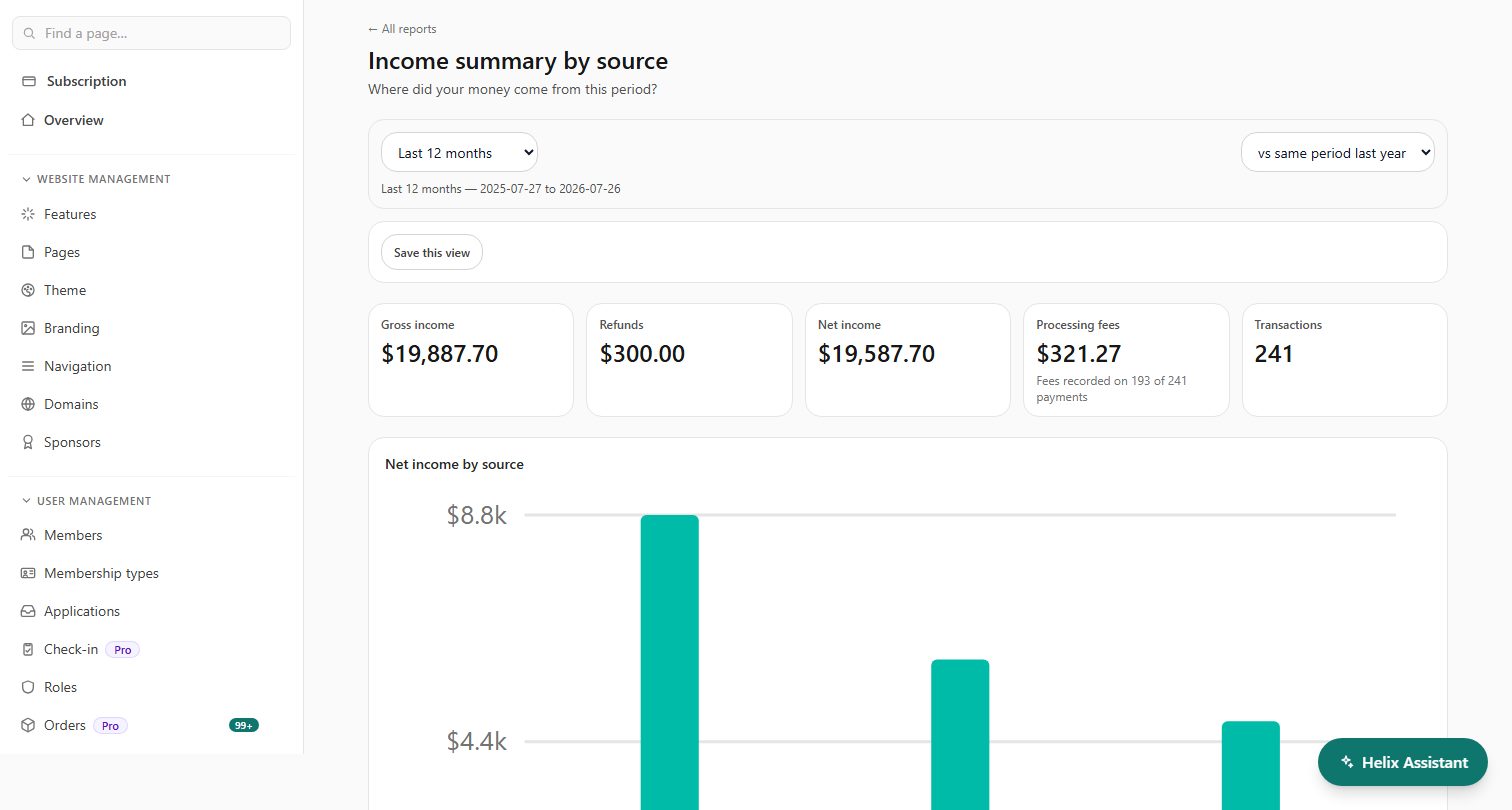
The reason this problem is so stubborn is that a bank statement was never meant to be a membership record, and no amount of discipline will make it one. ClubHelix closes the gap by taking the payment where the member signs up — self-registration attaches the money to the person, the category and the season as it is paid, so the paid list is simply a view rather than a reconstruction. Reports show income by category and by period alongside the rest of the club's money, and integrations push the result into the accounting package your treasurer already uses instead of asking them to key it twice.
Everything here can be tested on the free tier before you commit a cent, what each paid tier costs sits on the pricing page rather than behind a quote request, and a club can be taking online payments the same afternoon it decides to. Set your club up, put the checkout link in your next renewal message, and keep the transfer option quietly available for the sponsors and the handful of members who need it.
Frequently asked questions
Is it cheaper for a club to take bank transfers than card payments?
Only if your treasurer's time is worth nothing. Transfers avoid a processing fee but create matching work that grows with membership — typically several hours per hundred members per season, plus slower collection and members who simply forget. Card payments cost a published percentage and remove nearly all of that work.
How do we make bank transfer references actually work?
Give each member a short code you generate for them, make it copy-and-paste rather than something to assemble, add a unique small amount of change to each total so the payment identifies itself even when the reference is blank, and provide a thirty-second form for members to tell you they have paid. Expect improvement, not perfection.
Should a club offer both payment methods?
Yes, but not equally. Make online card payment the default everywhere members see, and keep transfer available on request for sponsorship invoices, grants, hardship arrangements and members who cannot use a card. Offering both with equal prominence tends to keep all of the reconciliation work and none of the savings.
Who should chase unpaid membership fees?
Not the same person who does the matching. Reconciliation is a finance task and chasing is a membership one, and splitting them protects the treasurer from a season of awkward conversations. Whoever chases needs a live unpaid list they can trust, which is the practical argument for taking payments where the member record lives.
What about members who cannot pay by card at all?
Keep a documented alternative and treat it as normal rather than exceptional. A short, private arrangement handled by one named person — recorded against the member so the rest of the committee can see the status without knowing the details — is both kinder and more reliable than an informal understanding that nobody wrote down.
Keep reading — how to collect club membership fees online covers the setup, and direct debit vs upfront membership fees tackles when the money should arrive rather than how.


