
What this guide answers
- What is affiliation reporting?
Affiliation reporting is the collection of participation, compliance and finance figures from affiliated clubs by the association, region, state or national body above them, and the return that body then files to a…
- How do we get clubs to actually reply?
Publish a collection calendar a year ahead, send the real form eight weeks out rather than a warning, and telephone the clubs still outstanding a week after the deadline — one call beats four emails.
- Should we collect member lists or just counts?
Counts, unless you genuinely need the individual — a national registration number, an accreditation check, a pathway squad or direct contact under a basis you can explain.
- What do we report when a club has not recorded date of birth?
Report those participants in the total and in an explicit "not recorded" column, never as a nought and never spread across the bands.
- How do we count a player registered at two clubs?
Decide once and label both figures: the deduplicated national total counts the person once, while the club-by-club table counts them at each club.
New Zealand edition. This guide is written for volunteer-run clubs in New Zealand. Where rules differ — grants, tax, incorporation, safeguarding — follow the New Zealand-specific pointers below or check with your national body.
The email goes out in February with a spreadsheet attached — three tabs, a subject line ending in "due Friday", ninety recipients. By Friday you have nineteen replies: eleven spreadsheets, four PDFs, three emails with the numbers typed into the body, and one photograph of a handwritten page taken on a phone at an angle.
That is affiliation reporting as most governing bodies actually practise it. The person doing the chasing is usually the one staff member who knows which club is which, and by the time the return is filed they have spent six weeks not doing the job they were hired for. Worse, the number they file cannot really be defended, because eleven of those spreadsheets counted "member" one way and eight counted it another.
This guide is written from the governing body's side of that email. The club's side — what a club should keep so these requests take an afternoon rather than a weekend — is covered in reporting to your governing body. Send that one to your affiliates: a well-prepared club does more for your return than any reminder you can write.
The four reports you actually owe
Almost every association, region, state or national body owes the same four things to four different audiences. Naming them separately matters, because they have different definitions, different deadlines and different tolerances for a rough number.
| Report | Who asks | What it contains | Tolerance for estimates |
|---|---|---|---|
| Participation return | Your government funder or the peak body | Participants, new participants, age bands, gender split, fees, club by club | Low — it is audited and it sets funding |
| Compliance snapshot | Your own board | Affiliated clubs with current insurance, background checks, accredited coaches, office holders | Low — it is a risk document |
| Affiliation status list | Staff, referees' panels, the website | Who is affiliated right now, who has lapsed, who has applied, who has left | None — it must be exactly right |
| Finance roll-up | Board, auditor, the peak body | Affiliation revenue, competition entries, arrears by club | Low — it has to reconcile |
The participation return is the one that pays for your organisation, so it gets the attention. The compliance snapshot is the one that protects it: a board that cannot say how many affiliated clubs hold current insurance has no answer on the morning it matters. The affiliation status list looks trivial until a club that resigned in March appears in a draw in June. The finance roll-up is the only one your treasurer can produce alone, which is exactly why it is often the only one produced on time.
Why the annual spreadsheet chase fails

It is worth being precise about the failure, because the instinct is to blame the clubs and the cause is almost always the request.
Every club counts "member" differently. One counts everyone on the mailing list. One counts paid registrations only. One counts families as one member. One includes the life members who last played in 1998. None of them are wrong, because nobody told them what right looked like.
The person who filled it in last year has left. Club roles turn over roughly every two seasons. The institutional memory of your return lives in one volunteer's sent-items folder, and when they go, the method goes with them — including the workaround they invented for the question your form asks badly.
The numbers arrive in four formats. A spreadsheet you can total. A PDF you cannot, so somebody re-types it, and re-typing ninety returns introduces errors nobody will ever find.
There is no consequence and no reward. The clubs that reply are the ones that always reply. The three that never reply have worked out that nothing happens, and they are usually the three whose numbers would move your total most.
None of that is fixed by a firmer deadline. It is fixed by defining the count, then asking for it the same way every year.
Define the count before you ask for it
This is the single highest-leverage thing a governing body can do, and it costs one afternoon. Write down what each word means, publish it, and never change it mid-cycle. A defined count that is slightly wrong beats an undefined count that happens to be right, because only the first one can be compared to last year.
| Term to pin down | The definition to publish | The trap it closes |
|---|---|---|
| Registered player | Someone with a paid or formally waived playing registration for the current season, recorded against the club on the counting date | Mailing lists, lapsed players, "we think about 200" |
| Social member | A member with no playing registration — counted separately, never inside the player figure | Clubs with a big bar trade reporting 400 "members" |
| Coach | Holds a current coaching accreditation and is named against at least one team, squad or program | Every parent who has ever run a drill |
| Volunteer | An unpaid person in a named role at any point in the season, counted once however many roles they hold | The same three people counted five times |
| Counting date | One date, the same calendar date every year, stated on the form | Clubs answering with today's roster, which is never the date you asked for |
| Dual registration | Counted once in the national total, once at each club in club-by-club tables — and the two totals are labelled differently | A player at two clubs quietly inflating the headline figure |
| New this season | No registration with any affiliated club in the two preceding seasons | Returning players counted as growth, which makes a good year look miraculous |
| Participant | Took part in a session, fixture or program at least once — distinct from registered, and only countable if someone records attendance | Participation reported as a registration figure with no caveat |
Two of these deserve more than a table row. Dual registration is where headline numbers go wrong: if the same person plays at two clubs, both clubs will report them, and if you simply add the columns up you have invented a participant. Decide which total is the honest one — the deduplicated national figure — and publish the club-by-club figures beside it under a different heading, so nobody in a board meeting adds the wrong column.
"New" is the number funders care about most and the one clubs guess at. A two-season look-back is the usual compromise: long enough that a genuine returner is not counted as growth, short enough that clubs can actually answer it. If you cannot answer it at all, say so — see below.
If your affiliates run their own registration alongside yours, our note on club-run registration versus governing body registration explains where the two counts diverge, and the club member census guide is the definitions exercise written for a single club.
Age bands, gender categories, and why "not recorded" beats a nought
Take your age bands from the funder if the funder publishes bands, even if they are not the bands your competitions use. A body that invents its own and maps them later loses a year of comparability and gains an argument. If there is no published set, use bands you can defend for a decade — under 12, 12–17, 18–39, 40–59, 60+ — and calculate them from date of birth on the counting date, not from the age group a player was picked in.
Gender categories need the same discipline and a little more care. Offer the categories your sport actually competes in, plus an option for a person who uses another term and one for a person who would rather not say. Then report all four lines, including the small ones.
Which brings us to the most important rule in the whole return: a blank is data, and a nought is a lie. If forty clubs recorded date of birth and two did not, your age bands cover forty clubs and you have 214 participants whose age is unknown. Reporting those 214 as "under 12" is fabrication; dropping them silently makes your total disagree with your own headline; reporting them as nought says you have no children, which is worse than saying nothing. Give the return an explicit "not recorded" column and let it be as large as it honestly is. Funders are used to it. In our experience a return with an honest gap in it is trusted more than a suspiciously complete one, and next year that column is the specific, small thing you ask two clubs to fix.
The collection calendar
Replace the chase with a calendar, publish it a year ahead, and run it the same way every cycle. Three touches before the deadline and two after is plenty.
| When | What you send | What you expect |
|---|---|---|
| Eight weeks out | The definitions, the counting date, and the form itself — not a warning, the actual form | Nothing. This is so the club can prepare |
| Two weeks out | A reminder naming the club's own outstanding items | The organised half of your network replies |
| Deadline day | A short note listing what is still missing, per club | Most of the rest |
| One week after | A named person telephones the clubs still outstanding | Almost all of the remainder |
| Two weeks after | You file the return with the gaps marked, and tell the board which clubs are in the gap | A defensible number |
Ask right after the season's registration peak, when the club's own numbers are freshest and its volunteers are still in the habit of doing club admin. Asking in the off-season means asking people who have gone camping.
About the three clubs that never reply: they are not being difficult, they are a club with one exhausted secretary. Telephone them — one call answers more returns than four emails. Set a standing rule your board approves in advance, apply it identically to everyone, and state it on the form: an outstanding return is listed in the board pack, and affiliation renewal or competition entry may be held until it arrives. Publish the consequence once and you will rarely have to use it. And if the same club is late every year, the question to ask is which of your questions they cannot answer — usually it is one badly worded field, and fixing it helps ninety clubs at once.
Collect counts, not member lists
The default request is a full member export because that is how it has always been done. Resist it. For all four reports above, counts are enough: you need to know that a club has 214 registered players in five age bands, not who they are.
Ask for the list only where you genuinely need the individual — issuing a national registration number, checking an accreditation against a person, running a pathway squad, or contacting a participant directly under a basis you can explain. Then ask only for those people, only the fields you will use, and say in the request what each field is for.
There is a legal edge to this as well as an ethical one. Wherever you operate, some privacy regime almost certainly applies to a body holding the personal details of members belonging to ninety separate organisations, and many now carry a duty to notify people when that data leaks. Collect counts and you are largely out of that conversation. Collect lists and you are holding ninety clubs' risk in your inbox.
Two practical habits follow. Keep a copy of every return exactly as filed, so when the figure is queried eighteen months later you have the population you counted rather than an argument. And record the definition version against the numbers, so a change of definition shows up as a change of definition rather than a change in participation.
A worked participation return
Here is the shape of a return that can be defended. Numbers are illustrative.
| Club | Registered players | New this season | U12 | 12–17 | 18–39 | 40–59 | 60+ | Age not recorded |
|---|---|---|---|---|---|---|---|---|
| Riverside | 214 | 38 | 44 | 61 | 72 | 31 | 6 | 0 |
| Eastvale | 188 | 22 | 31 | 48 | 66 | 38 | 5 | 0 |
| Hilltop | 96 | 31 | 18 | 22 | 41 | 12 | 3 | 0 |
| Port Quay | 141 | 14 | 0 | 0 | 0 | 0 | 0 | 141 |
| Total (42 clubs) | 6,318 | 1,104 | 912 | 1,507 | 2,178 | 1,204 | 303 | 214 |
Read what that table is doing. Port Quay's row is not a failure, it is an honest statement that one club does not record date of birth, and its 141 players are in the total but not in the bands. The bands add to 6,104, the total is 6,318, and the difference is the "not recorded" column — so the table reconciles and nobody has to guess. Next year, Port Quay is your one improvement target.
The gender split sits beside it, with the same discipline:
| Category | Count | Share |
|---|---|---|
| Women and girls | 2,731 | 43% |
| Men and boys | 3,402 | 54% |
| Another term or prefers not to say | 41 | 1% |
| Not recorded | 144 | 2% |
Then three sentences of notes under both tables: the counting date, the definition of "new", and the deduplicated national figure against the sum of the club rows. Those three sentences are what make it a return rather than a spreadsheet. If you are writing a funding application off the back of these numbers, our guide to writing a grant application covers how to use them without overclaiming.
Close the loop, or next year is worse

Every club that fills in your form is doing unpaid work for a number they will never see. Fix that and your response rate looks after itself.
Send each club its own row back beside the network average, so a secretary can see that their junior numbers grew 12% while the network grew 4%. Publish the aggregate — a one-page network snapshot, every year, same format — so clubs can see where they sit. Name the return's purpose plainly: this is the number that funds the participation program your clubs draw on. And show the money: when a grant lands, say which return won it.
A club that got something back last year replies in week one. A club that got silence replies in week six, if at all.
How this works in ClubHelix
ClubHelix models a governing body and its affiliates as one structure rather than two systems. The hierarchy is multi-level — federation, regions, sub-regions and clubs, each with its own public site and its own admin — on every plan, and every affiliated organisation appears in a public club directory searchable from one place. Clubs apply to join through affiliation applications, where approvals, leaves and removals keep a history, so your affiliation status list is a live consequence of decisions rather than a spreadsheet someone maintains. You can define a standard position once at the governing body and have every affiliate appoint its own people to it, and you can publish network news and events to every affiliate while sharing one canonical venue list. That is the federations and regions surface.
One thing it deliberately does not do: being a club's parent in the hierarchy does not hand you operational control of that club's data. Cross-organisation access needs a role somebody grants. That reads like a limitation for about a minute, until the first committee asks who at the association can see their members' phone numbers — and the answer is nobody, unless they said so. Clubs keep their own house, which is what makes an affiliation worth joining.
On the plans that include the HQ tools, standard forms across your group solve the definitions problem structurally. You publish the questions every affiliated organisation has to ask; they adopt the form and add their own questions after yours, and cannot edit or remove one of yours. You see the answers to your questions added up across the group — and never theirs. That is the difference between ninety clubs answering your question and ninety clubs answering ninety questions.
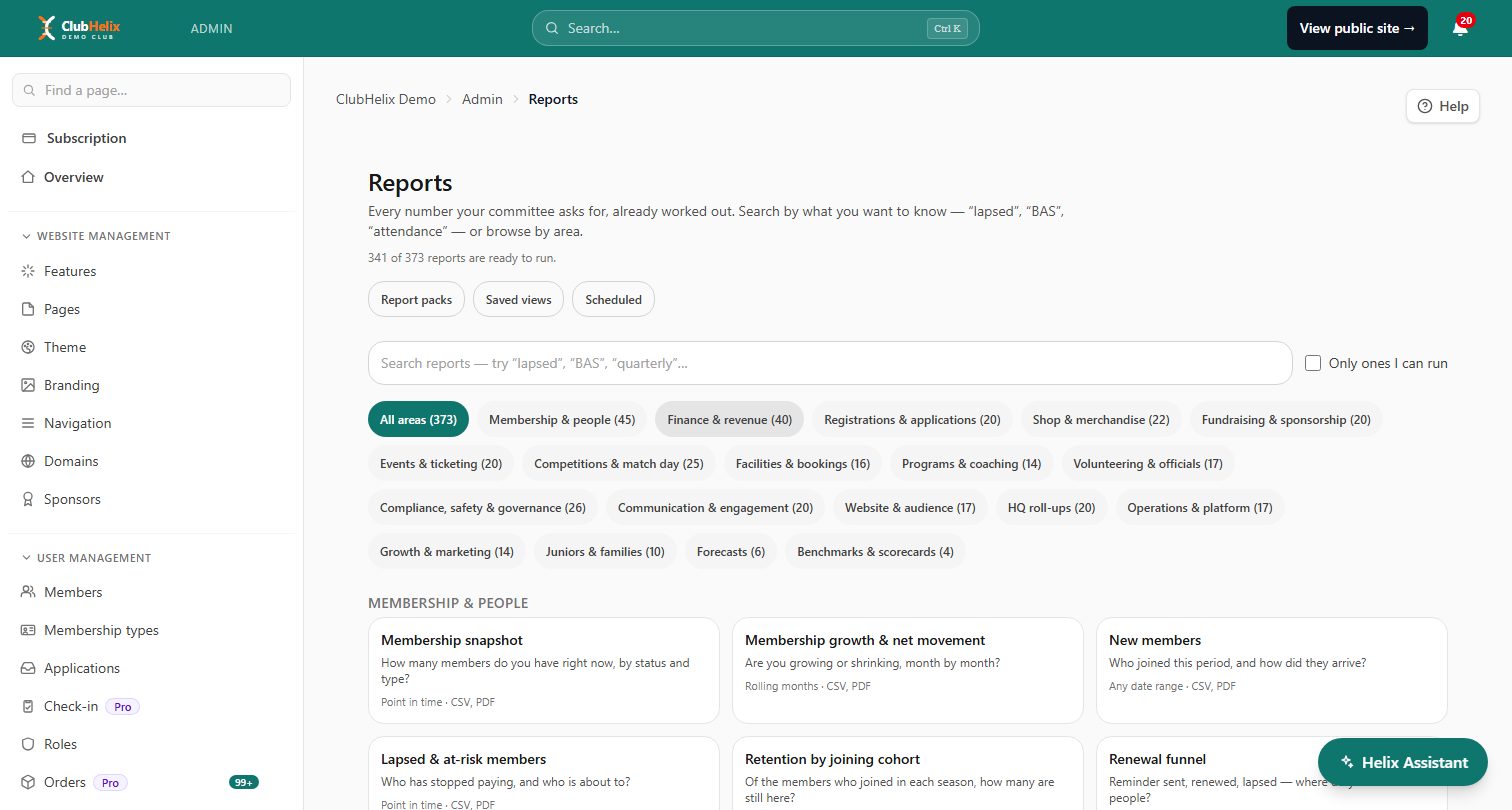
On the reporting side, HQ roll-up reporting — membership and revenue rolled up across all your member organisations — is on the higher plan. The funding body return is on the Enterprise plan: participants, new participants, age bands, gender split and fees, club by club, with an honest "not recorded" column instead of a nought. Age bands and the gender split come from the member record itself, which carries an optional date of birth and gender used for age-group eligibility and funding returns. Optional is the point — a blank stays blank and lands in "not recorded" rather than being quietly rounded to zero. The reports page lists what is in the catalogue.
Be clear about what no software does for you. The return still leaves your hands: there is no automatic submission to a funder's portal and no integration with another governing body's system, so you export it, read it and file it under your own name. Data feeds run the other direction — on the plans that include external competition feeds, a club can display its governing body's ladder and fixtures on its own site. Plans are on the pricing page, and a governing body can start on the free tier with the hierarchy, the directory and affiliation applications before deciding whether the HQ tools earn their keep.
Frequently asked questions
What is affiliation reporting?
Affiliation reporting is the collection of participation, compliance and finance figures from affiliated clubs by the association, region, state or national body above them, and the return that body then files to a funder, its board or a peak body. It is four separate reports with four audiences, not one annual spreadsheet.
How do we get clubs to actually reply?
Publish a collection calendar a year ahead, send the real form eight weeks out rather than a warning, and telephone the clubs still outstanding a week after the deadline — one call beats four emails. Then close the loop by sending each club its own numbers back against the network average, because a club that got something back last year replies in week one.
Should we collect member lists or just counts?
Counts, unless you genuinely need the individual — a national registration number, an accreditation check, a pathway squad or direct contact under a basis you can explain. Collecting ninety clubs' member lists takes on their privacy risk for information you were only ever going to add up.
What do we report when a club has not recorded date of birth?
Report those participants in the total and in an explicit "not recorded" column, never as a nought and never spread across the bands. A return whose bands do not add up to its total, with the difference labelled, is more credible than a suspiciously complete one — and that column tells you exactly which club to help next season.
How do we count a player registered at two clubs?
Decide once and label both figures: the deduplicated national total counts the person once, while the club-by-club table counts them at each club. Publish the two under different headings so nobody in a board meeting adds up the wrong column and invents a participant.


