
What this guide answers
- What's the difference between a team manager and a coach?
The coach owns performance — selection, tactics and training.
- How much time does being a team manager take?
With a settled routine, roughly two hours a week in season — an availability chase, one comms message, match paperwork and match-day setup.
- What should a team manager do about players who don't respond to availability?
Set a mid-week deadline and make non-response mean unavailable, consistently applied.
- Do junior team managers need any checks or training?
In most sports and places, yes — volunteers working with children need the relevant background check, and many leagues ask managers to complete a short online induction.
UK edition. This guide is written for volunteer-run clubs in the UK. Where rules differ — grants, tax, incorporation, safeguarding — follow the UK-specific pointers below or check with your national body.
Every well-run team has one person who isn't picking the side or running the drills, but without whom nothing happens: the team manager. They're the reason eleven players arrive at the right ground at the right time in the right shirts, the match sheet is signed, the oranges are cut, and the coach gets to think about nothing but coaching.
If you've just been handed the job — usually at a pre-season meeting when everyone else looked at their shoes — this guide explains what a team manager actually does, week by week, plus a season checklist you can work from and the tools that take most of the pain out of it.
What is a team manager?
The team manager is the team's organiser and communicator. The coach owns performance — selection, tactics, training content. The team manager owns everything around it: availability, logistics, paperwork, equipment and the flow of information between the club, the coach, the players and (in junior teams) the parents. In a junior club the manager is usually a parent volunteer; in senior teams it's often a non-playing club stalwart or a squad member who's good with a spreadsheet.
It matters because disorganisation, not defeat, is what quietly kills teams. Players tolerate losing; they don't tolerate finding out at 8pm Friday that the ground changed, or turning up to a forfeit because nobody chased availability. A good manager is the difference between a team that runs itself and a coach who burns out doing two jobs. The role sits alongside the club's other key volunteers — see our guides to what a club secretary does and the wider committee roles for how it all fits together.
The weekly rhythm
Most team manager duties compress into a repeatable weekly loop. Master the loop and the job is maybe two focused hours a week.
Early week — availability and selection support
As soon as the fixture is confirmed, send the availability request for the weekend. Chase the stragglers by mid-week — the coach can't pick a side from "seen by 14". Pass the final availability list to the coach, flag anyone injured, suspended or unpaid, and confirm numbers work (enough for a side, plus fill-ins arranged from another grade if not). This is where RSVP and attendance tracking earns its keep: one tap for players, a live list for you, no screenshots of chat threads.
Mid-week — communications
Once the coach settles selection, get the essentials out in one message: opponent, venue with address, arrival time, kick-off/first-bout/first-race time, uniform, who's on duty for oranges/scoring/canteen, and anything unusual (photo day, early start, wet-weather call time). One message, one channel, every week the same — the fastest way to kill "nobody told me" is a predictable format in a dedicated club chat rather than five scattered group threads. Keep an eye on the weather and know your league's wet-weather procedure before you need it (our wet-weather communication plan is worth pinning).
Late week — match sheets and paperwork
Every competition has its version of the match sheet: the team list submitted to the league or entered into the competition system, with shirt numbers, registered players only, and signatures where required. The manager prepares it, checks eligibility (registration, age limits, any grading rules), and has it ready before warm-up — not while the umpire waits. Managers also typically handle interchange/rotation records in junior sport, results submission after the game, and vote or award slips where the league uses them.
Match day

Arrive early enough to own the ground before the team does: kit bag, balls, first-aid kit, ice, match ball, team sheet lodged, and any ground duties (nets, flags, scoreboard) either done or delegated. Greet the opposition manager and the officials — a friendly two-minute conversation prevents most match-day friction. During the game the manager runs the bench: interchange records, injured players looked after, scores confirmed at each break. Afterwards: results submitted, kit collected and washed (or rostered), and a short wrap-up message with next week's basics. In junior sport, the manager is also the safeguarding-minded adult making sure every child is collected before volunteers leave.
That responsibility comes with paperwork: a team manager working with under-18s needs an enhanced DBS check with a barred-list check before their first match, and most governing bodies also require the safeguarding-in-sport course. Your club's designated safeguarding lead is the person to ask, and it is worth knowing who that is on day one rather than in a crisis. Two further habits specific here: never be the last adult alone with a child at pick-up, and route all parent communication through the club's channels rather than your personal phone.
Working with parents and players
In junior sport, the manager is also the team's diplomat. Set expectations once, at the start of the season — a short note covering training times, the availability deadline, duty rosters, sideline behaviour and how selection queries should be handled (privately, with the coach, never at the ground on match day). Most friction in junior teams comes from surprises, not decisions, and a manager who communicates early removes the surprises. Learn names quickly, share the volunteer load deliberately (a roster beats asking for favours every week), and make a point of welcoming new families personally — the first fortnight decides whether they stay. In senior teams the same applies with less ceremony: players respect a manager whose messages are short, consistent and accurate, and who chases them once, not five times.
The season checklist
| When | Team manager tasks |
|---|---|
| Pre-season | Confirm squad list and registrations; collect contact details and medical notes; set up the team chat and comms format; check kit, equipment and first-aid supplies; share the draw; agree duty rosters (scoring, oranges, canteen, kit washing) |
| Weekly in-season | Send availability request; chase responses; brief the coach; send the one match-day message; prepare the match sheet; check weather and ground status |
| Match day | Arrive early; lodge team sheet; run the bench and interchange; confirm score; submit results; collect kit |
| Mid-season | Re-check registrations for new players; audit first-aid kit; rotate duty roster; flag unpaid fees to the registrar or treasurer |
| End of season | Return club equipment; confirm trophies/awards nominations; hand over notes to next year's manager; help the club with presentation day |
Treat the checklist as a handover document too — the best thing a retiring manager can leave is a one-page version of this table with club-specific details filled in. Our volunteer position descriptions template helps you formalise it so the next volunteer says yes faster.
Tools that make the job easier
The old way to manage a team is a spreadsheet, a chat thread and a shoebox of paper. The new way is letting your club's platform do the repetitive parts.
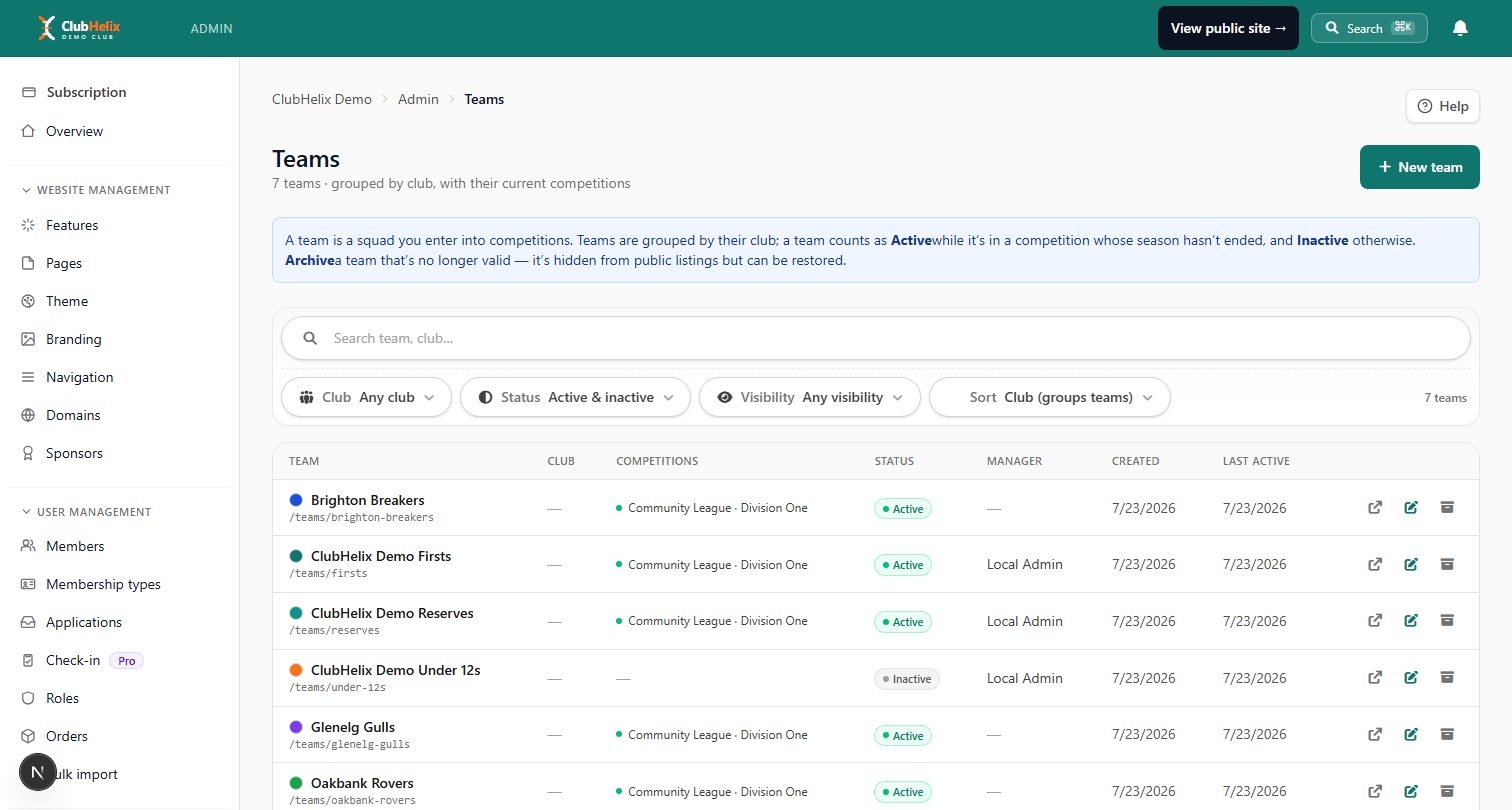
With ClubHelix, team management keeps each squad's list, roles and details in one place tied to the club's member records — so eligibility and paid-up status aren't guesswork. RSVPs and attendance replace the availability chase with one tap per player and a live list for you and the coach. And club chat gives every team a safeguarded channel inside the club's own app, so match-day messages reach everyone without personal numbers being shared around. Fixtures, results and ladders live on the club site, so "what time Saturday?" answers itself.
If your club still runs on paper team sheets and five chat apps, it's worth a look — ClubHelix has a free tier, and you can see what's included or set your club up in an afternoon. The manager's job never disappears, but it can shrink to the parts a human actually needs to do.
Frequently asked questions
What's the difference between a team manager and a coach?
The coach owns performance — selection, tactics and training. The team manager owns organisation — availability, communications, match sheets, equipment and logistics. In small teams one person sometimes does both, but splitting the roles is the single best way to prevent coach burnout.
How much time does being a team manager take?
With a settled routine, roughly two hours a week in season — an availability chase, one comms message, match paperwork and match-day setup. The first few weeks take longer while you build the rhythm.
What should a team manager do about players who don't respond to availability?
Set a mid-week deadline and make non-response mean unavailable, consistently applied. Most managers find one season of a firm deadline trains the whole squad; RSVP tools that show who hasn't answered make the chase far quicker.
Do junior team managers need any checks or training?
In most sports and places, yes — volunteers working with children need the relevant background check, and many leagues ask managers to complete a short online induction. Ask your club secretary what applies before the season starts.


