
What this guide answers
- What are the main responsibilities of a club president?
Five, in rough order: leading the committee — direction, delegation and decisions; chairing meetings so the club's governance actually functions; representing the club to the association, council, sponsors and…
- What is the difference between the president, secretary and treasurer?
Shortest version: the president leads, the secretary administers, the treasurer accounts.
- How much time does being a club president take?
Done with proper delegation: roughly two to four hours a week in season, plus the monthly meeting, with peaks around pre-season, the AGM and anything involving council or the association.
- How long should someone stay club president?
Three to five years is the healthy pattern for most community clubs: long enough to carry a direction through, short enough to stay fresh and keep the succession pipeline honest.
UK edition. This guide is written for volunteer-run clubs in the UK. Where rules differ — grants, tax, incorporation, safeguarding — follow the UK-specific pointers below or check with your national body.
Every club has a story about two kinds of president. One chaired a functional committee, backed the volunteers, faced the association and the council, and left the club stronger with a successor ready. The other did everything — lined the fields, ran the canteen, answered every message — and when they finally burned out, the club discovered nothing worked without them.
Both cared. The difference was understanding what the role actually is. This guide sets out club president responsibilities honestly: the real job, the parts people miss, what the role is not, and the working rhythm that lets a volunteer do it well for three or four years and then hand it on — because the handover is part of the job too.
The role in one paragraph
The president is the club's leader and chief custodian: responsible for the committee functioning as a team, the club's direction beyond this season, its face to the outside world, and the health of its culture.
Legally, the president or chair is one committee member among equals — the constitution gives the committee the power, and the chair runs it. Two local wrinkles worth knowing. Many clubs here separate the ceremonial President (often a long-serving figure or patron) from the working Chair who actually runs the committee; if yours does, be clear which job you have accepted. And if the club is a charity or CIO, the committee are charity trustees with real legal duties, which is a heavier hat than most volunteers realise they are putting on.
That's worth internalising early: the job is to make the committee effective, not to substitute for it.
The responsibilities, broken down
1. Lead the committee — the core of the job
A club is run by its committee; the president's first responsibility is making that group work:
- Set direction. Bring the "why are we doing this season" questions: what does the club want to be in three years? Growing juniors? A second ground? Financial reserves? A president with two or three clear priorities gives every other decision a frame.
- Get the right people in seats — and let them own them. The president's highest-leverage work happens at recruitment time: a strong secretary and treasurer make the presidency a leadership job; weak or vacant ones silently turn it into three jobs. Then delegate genuinely — hand over outcomes, not errands, and don't hover.
- Make decisions land. Debates are fine; what kills committees is deciding the same thing three times. The president's job is to bring discussion to a decision, get it minuted, and defend it once made.
2. Chair meetings well
Unglamorous, and it shapes everything. People quit committees over bad meetings far more often than over hard work. The craft:
- An agenda circulated ahead, built with the secretary — decisions to make, not just reports to endure.
- Start and finish on time. Ninety minutes is a meeting; three hours is a hostage situation that costs you volunteers.
- Draw out the quiet, cap the loud, and land each item with a decision, an owner and a date.
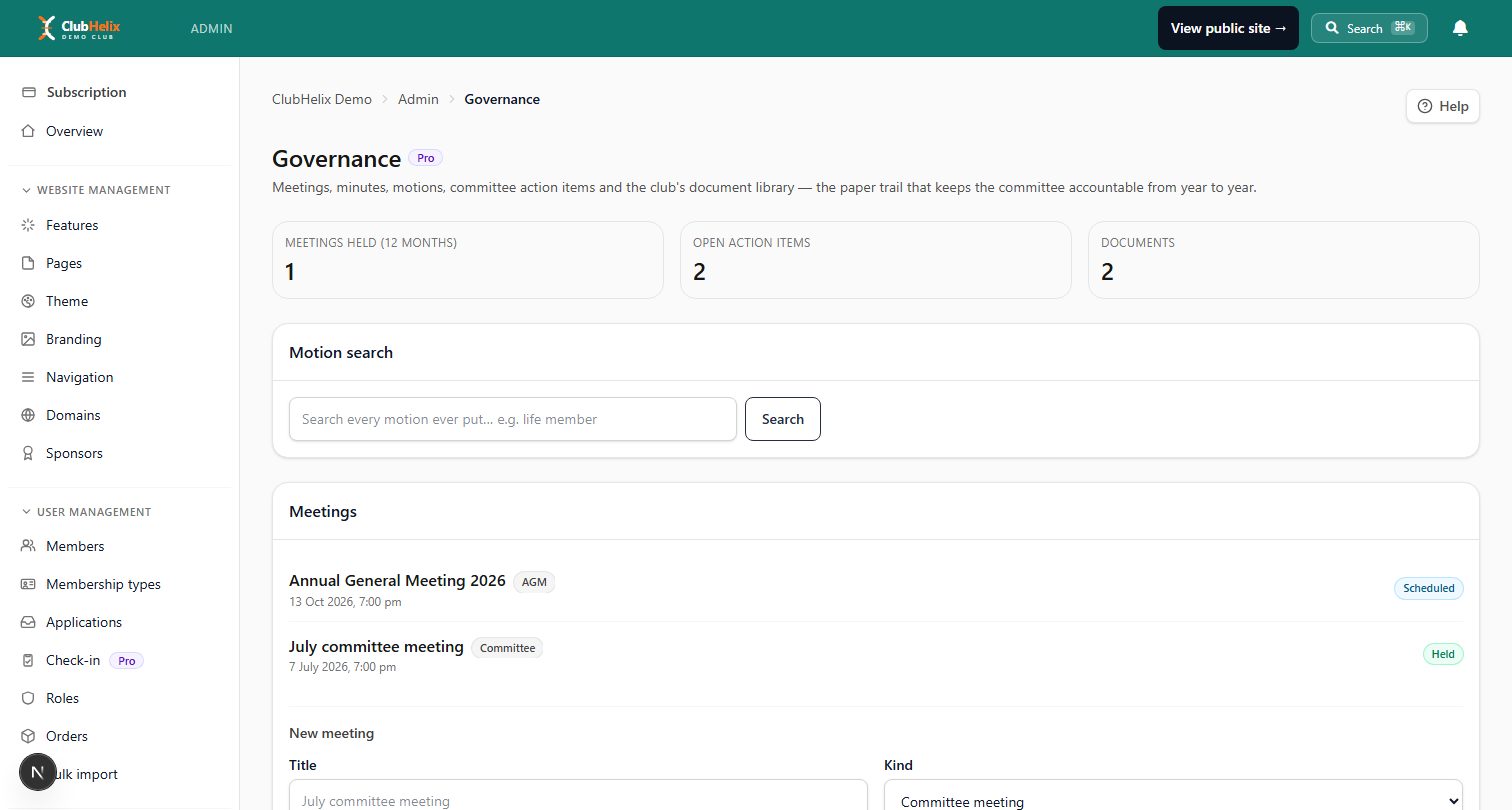
- Keep it minuted. Actions with names and dates, tracked between meetings — a proper meetings and governance tool makes the follow-through visible instead of vanishing into notebooks.
3. Represent the club externally
The president is the club's face and voice:
- To the association and governing body — leagues, fixtures, disputes, votes at association meetings.
- To council — grounds, facilities, leases, capital works. These relationships, built patiently in good times, are what get the clubroom upgrade approved in year four.
- To sponsors and partners — the president often makes the ask and always makes the thank-you.
- At the microphone — presentation night, registration day, the local paper after a premiership. Two minutes of warm, prepared speaking beats twenty of winging it.
A practical note: represent, don't bottleneck. The president speaks for the club on significant matters; routine correspondence still flows through the secretary, and money through the treasurer.
4. Guard the culture
Culture is the president's portfolio because nobody else can enforce it upward. That means being the person who:
- Sets the tone visibly — how the president treats referees, opposition clubs, struggling volunteers and fifteen-year-old canteen helpers is the club's real code of conduct.
- Backs the standards when it's costly — the star player behaving badly, the loud parent, the sponsor who wants a say in team selection. These moments, maybe three a year, are most of what members will remember about a presidency.
- Makes volunteering feel worth it — public thanks, small courtesies, noticing. Volunteer retention is a president's number more than anyone's.
- Takes safeguarding seriously — ensuring the club actually follows its child-safety, complaints and code-of-conduct policies, not just files them.
5. Steward the club's future
The responsibilities nobody sees at the sausage sizzle:
- Financial sustainability — not doing the treasurer's job, but insisting on the budget, reading the monthly report, and asking the uncomfortable question early.
- Succession — the great presidents run a shadow system: a vice-president genuinely involved, committee members rotated through responsibilities, and no role (including their own) held by someone irreplaceable. Aim to hand over a club that runs on systems, not memory; the committee handover checklist is the mechanical half of that promise.
- Institutional assets in institutional hands — club-owned email domain, website, bank access, document archive. A president who lets the club run on personal accounts and one person's laptop is accumulating risk on their watch.

What the president is NOT
Half of doing the job well is refusing the wrong version of it:
- Not the doer of last resort. Every gap the president personally fills becomes invisible — and permanent. The leadership move when the canteen roster fails is recruiting a canteen coordinator, not working the fryer every Saturday (occasionally, sure — culturally it's gold; structurally, it's a trap).
- Not the sole decision-maker. Committee decisions belong to the committee. Presidents who govern by fait accompli end up with a rubber stamp instead of a team — and then with vacancies.
- Not the complaints department of one. Complaints follow the club's process (usually via the secretary, per the constitution). A president who accepts every grievance as a DM at 10pm teaches the club that process is optional and their phone is the process.
- Not permanent. A presidency that can't end without the club wobbling is a presidency that's been done half-right. Three to five focused years with a groomed successor beats a decade of accumulating indispensability.
The rhythm of the role
Weekly in season (2–4 hours): be present at the club; clear president-level messages; unblock whatever a committee member is stuck on; one external touch (council, association, sponsor) as needed.
Monthly: committee meeting chaired well; treasurer's report actually read; one deliberate culture act — a thank-you call, a volunteer shout-out, a junior milestone noticed.
Season cycle: pre-season — priorities set with the committee, key roles filled, budget adopted; mid-season — a temperature check on volunteers and finances; end of season — presentation night, sponsor thank-yous, and honest reflection on what to change.
Annually: AGM (report to members on the year and the direction); post-AGM reset of roles, signatories and access; succession conversation — every year, not just the last one.
Your first 90 days as president
For the newly elected, the opening months set the pattern for the whole term:
- Weeks 1–2: take custody. Work through the handover checklist with your predecessor — bank signatories lodged, digital access transferred, keys accounted for, the live-issues memo read twice. Don't skip the coffee handover; the context that never gets written down transfers there.
- Weeks 3–6: listen before changing. One conversation each with every committee member, the coaches, the association contact and the council officer. Ask the same two questions: what's working, and what would you fix first? You'll hear the same three answers repeatedly — that's your agenda.
- Weeks 7–12: set the frame. Bring the committee two or three priorities for the term, get them agreed and minuted, and match each to an owner who isn't you. Fix one visible small thing early — the broken canteen urn, the out-of-date website fees page — because momentum is cultural proof that things get done now.
- Throughout: resist the urge to impress by doing. The volunteers are watching how you lead, not how many jobs you personally absorb. The presidents who start by taking on tasks spend their whole term unable to put them down.
Frequently asked questions
What are the main responsibilities of a club president?
Five, in rough order: leading the committee — direction, delegation and decisions; chairing meetings so the club's governance actually functions; representing the club to the association, council, sponsors and community; guarding the club's culture and standards, especially when it's uncomfortable; and stewarding the long term — finances, succession and institutional assets. Notably absent: doing everyone else's job. The president's output is a club that works, not a task list completed personally.
What is the difference between the president, secretary and treasurer?
Shortest version: the president leads, the secretary administers, the treasurer accounts. The president owns direction, the committee's effectiveness and external representation; the secretary owns information — meetings, minutes, correspondence, records and compliance lodgements; the treasurer owns money — budget, banking, collection, records and reporting. In healthy clubs the three operate as a tight trio with clear lanes, and the president's most important recruitment decisions are the other two seats.
How much time does being a club president take?
Done with proper delegation: roughly two to four hours a week in season, plus the monthly meeting, with peaks around pre-season, the AGM and anything involving council or the association. Done without delegation, it takes over your life — which is the most common reason presidencies end badly. If the hours keep climbing, the fix is almost never working harder; it's an empty seat on the committee that needs filling, or a task the president should never have absorbed.
How long should someone stay club president?
Three to five years is the healthy pattern for most community clubs: long enough to carry a direction through, short enough to stay fresh and keep the succession pipeline honest. The failure modes sit at both ends — one-year presidencies that reset the club annually, and decade-long ones where institutional knowledge concentrates in a single person until leaving becomes impossible. Whatever the tenure, the measure of a presidency is the handover: a club that barely notices the transition is the finished job.
A president's best tool is a committee that can see what's happening: ClubHelix puts meetings, minutes and action tracking in one club-owned admin, alongside the membership and money the whole committee works from. See what the secretary's side looks like, check pricing, or start free.


