
What this guide answers
- Who should make the wet weather call at a club?
One named owner per decision type, with a deputy: typically the coaching coordinator for training and the grounds officer (informed by the council or curator) for home match days, with association calls simply relayed…
- How early should we cancel training or games?
Publish deadlines and honour them: training calls by mid-afternoon (3pm is common) so families plan their evening, and match-day calls early in the morning — or the night before when the ground is already gone.
- What's the best channel for cancellation messages?
All of them, in a ladder, saying the same thing: website first (the single source of truth), push notification for speed, email for the full detail, SMS reserved for same-day urgent calls because it reliably reaches…
- Should we announce when games are ON?
Yes — on any morning where members might reasonably doubt it.
South Africa edition. This guide is written for volunteer-run clubs in South Africa. Where rules differ — grants, tax, incorporation, safeguarding — follow the South Africa-specific pointers below or check with your national body.
It's 7:40 on a Saturday morning, it's been raining since Thursday, and your club secretary's phone is doing its fortnightly impression of a call centre. Is the ground open? Are the under-9s still on? Why does the website say one thing and the group chat another? Meanwhile a family is already in the car, halfway to a venue where nothing will happen today.
Washouts are the most predictable emergency in community sport — they happen every season, several times, on a schedule set only by the weather. Which means they're also the easiest emergency to be ready for. A wet weather communication plan is a one-page document that answers three questions before the rain arrives: who decides, by when, and how everyone finds out. This guide gives you all three, plus the template messages to send.
The real problem isn't rain — it's ambiguity
Unpack any washout-day chaos and you find the same failures:
- Nobody knew who owned the decision, so three people made three different calls (or nobody made one, which is also a call).
- The decision came too late — after families had left home, after the canteen had been stocked.
- The message went out on one channel — the channel that particular family doesn't use.
- Different channels said different things, because updates were posted by hand in four places.
Notice that none of these is a weather problem. They're all decided in advance by a committee sitting somewhere warm. That's the plan — add it to your pre-season checklist and test it before round one.
Step 1: Name the decision-makers
One named person (plus a deputy for when they're away) per decision type:
| Decision | Owner | Deputy | Deadline |
|---|---|---|---|
| Training cancellation | Coaching coordinator | Club secretary | 3:00pm on training day |
| Home match-day ground call | Grounds officer (with council/curator input) | President | 7:30am match day, or 6:00pm the night before when the ground is already unplayable |
| Away games / association calls | Secretary (relays the association's decision) | Registrar | As received — relay within 15 minutes |
| Club events (BBQs, presentation day) | Event owner | Secretary | 2 hours before start |
Three notes on making this table real:
- The owner decides; the committee doesn't vote. Washout calls are time-critical. Empower the named person, back their call publicly even when the sun comes out at 9am, and review patterns at season's end — never in the moment.
- Deadlines are promises to members. "We announce training calls by 3pm" means parents stop asking at 2:30, because they know an answer is coming. A deadline you publish is worth more than a faster decision you don't.
- Know your ground authority. For council grounds, the council often closes grounds directly — know where that's published, who receives the notification, and relay it verbatim. A club that "reopens" a council-closed ground is uninsured and unwise.
Step 2: The decision tree
Print this, adapt the specifics, and give it to every decision-owner:
For training:
- Has the council/venue closed the ground? → Cancelled. Announce immediately.
- Is there lightning risk or storm warning for the session window? → Cancelled (no discretion on lightning).
- Is the ground waterlogged enough to damage the surface or risk injury? → Grounds officer's call by walking it, not by looking at the radar. Surface damage today costs playing weeks later. → Cancelled or moved.
- Is an indoor/hard-surface alternative available? → Moved — announce the new venue, not just the change.
- Otherwise → Training proceeds. Say so anyway (see below — silence reads as ambiguity).
For home match days:
- Association or council called it off? → Relay within 15 minutes, verbatim, all channels.
- Ground inspection at [6:30am]: standing water, unsafe areas, or forecast making it worse? → Owner makes the call by 7:30am.
- Playable but marginal? → Confirm with the opposition and officials early; agree a final inspection time; communicate the "decision pending — check back at X" state honestly.
- Playing → announce that too. On a grey morning, "games are ON" is the most-read message you'll send all season.
The counterintuitive rule that separates calm clubs from chaotic ones: communicate on good-weather days too. If members only hear from you when things are cancelled, every silent rainy morning is ambiguous and the phone calls start. If "games are ON, ground is fine" reliably lands by 7:45 every wet-looking Saturday, silence never has to be interpreted.
Step 3: The channel escalation ladder
No single channel reaches everyone. The plan is a ladder — each rung adds reach and urgency, and every rung repeats the same message:
- Website banner — always, first. The website is the single source of truth, because it's the one place anyone can check without being in the right chat. Update it first so every other message can end with "details: club website".
- Push notification / app alert. Instant and free, straight to the lock screen of everyone who has your club installed as an app. This is the workhorse rung for routine calls like training cancellations.
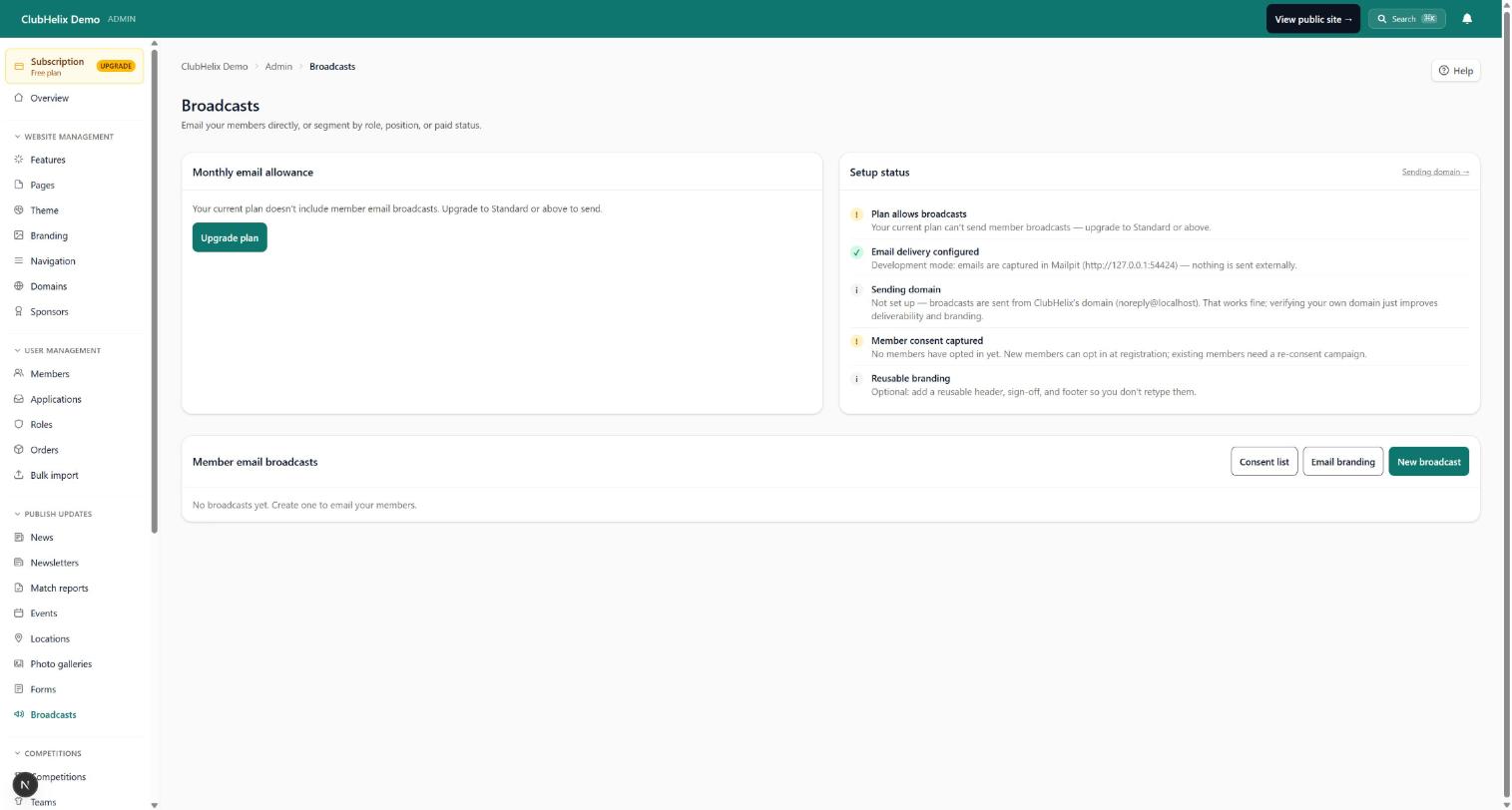
- Email broadcast to affected groups. The formal record with full detail — what's cancelled, what's not, make-up arrangements. Send with a broadcast tool targeted to the affected teams or the whole club, not a BCC list someone maintains by hand.
- SMS — the urgency rung. Texts get read within minutes, by everyone, including the family that ignores email and never joined the chat. Because SMS costs real cents per message, reserve it for time-critical calls: same-morning match cancellations, mid-event evacuations, "the ground changed an hour before kickoff".
- Social media and group chats — last, never only. Post where members already gather, but treat these as amplifiers of the official message, not sources. Team chats are where "I heard it's cancelled" rumours breed; the antidote is managers pasting the official message with the website link.
Escalation rule of thumb: training cancelled tomorrow = rungs 1–3. Games cancelled this morning = rungs 1–5, SMS included. Nothing cancelled on a grey day = rungs 1–2.
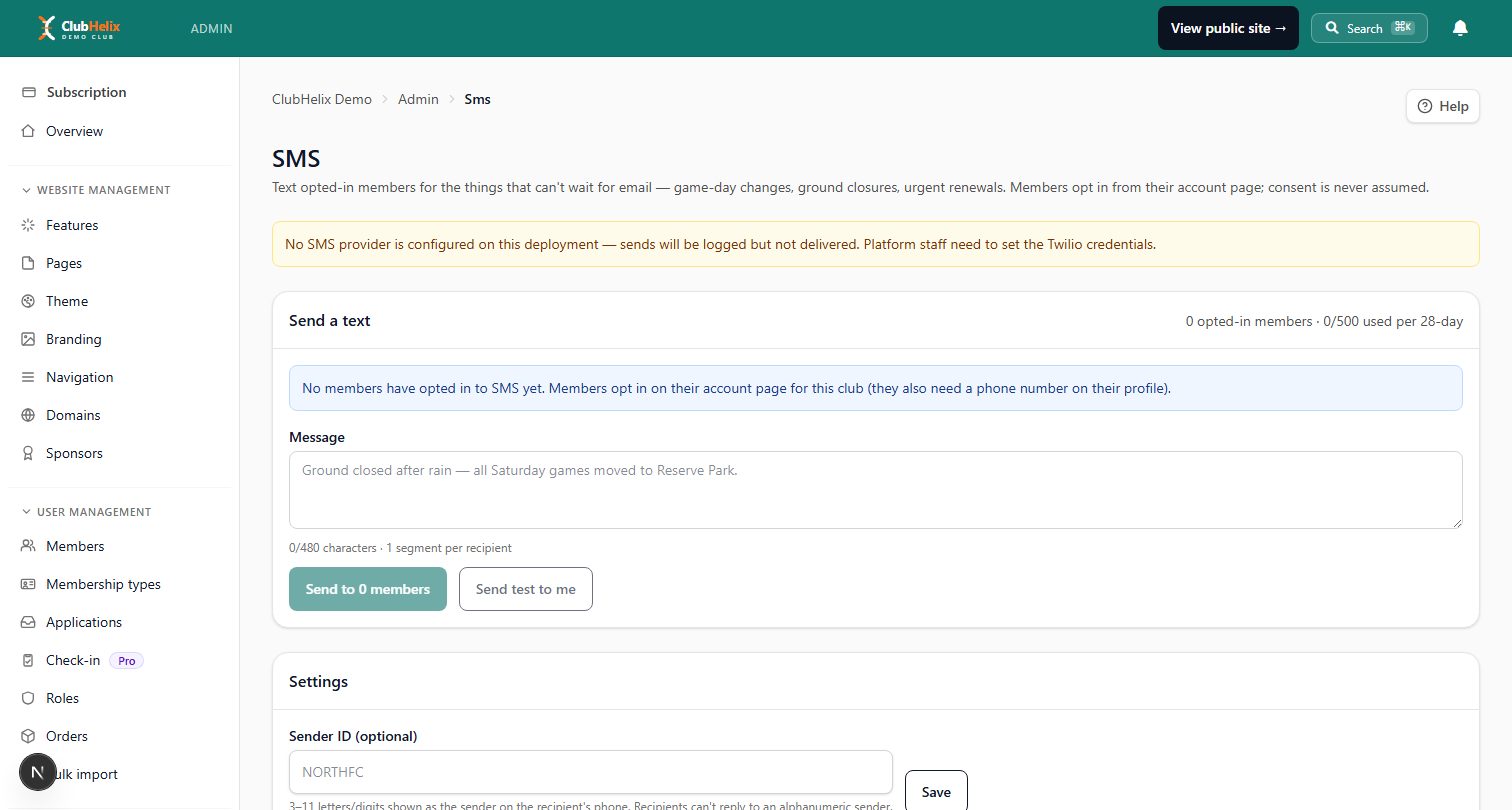
The reason to run this from one system rather than four apps: one composed message goes out on every rung at once, identical, timestamped — no version drift between the website, the email and the chat, and no volunteer copy-pasting into five places at 7am in the rain.
Step 4: Template messages
Pre-write these in the off-season and store them where the decision-owners can fire them in two minutes. Square brackets are the only parts to edit.
Training cancelled (push + email):
⛈ Training cancelled — [Tuesday 14 May] All training at [Memorial Oval] is cancelled today due to [ground closure / weather]. This covers [all teams / U8–U12]. [Seniors train indoors at [venue], usual time.] Next session: [Thursday, as scheduled]. Details: [club website].
Match day cancelled (all channels incl. SMS):
❌ ALL GAMES OFF — [Sat 18 May] [Association/Council] has closed [ground] and all [Club] games today are cancelled, home and away. Do not travel. Make-up round details to come. Info: [club website]
Games ON (push + website, grey-sky mornings):
✅ Games are ON — [Sat 18 May] [Memorial Oval] has been inspected and all games proceed as scheduled. Canteen open from [8am]. See you out there.
Decision pending (push + website):
⏳ Ground inspection [7:15am] — decision by [7:45am] [Ground] is borderline after overnight rain. We'll confirm ON or OFF here and by push notification by [7:45am]. Please don't travel before then.
Partial cancellation (push + email + website):
⚠️ Juniors OFF, Seniors ON — [Sat 18 May] [Council] has closed [Field 2]: all junior games ([U8–U14]) are cancelled. Senior games on [Field 1] proceed as scheduled. Full list: [club website].
Event postponed (email + push):
📅 [Family Day] postponed With [forecast/ground] as it is, [event] on [date] is postponed to [new date] — same time, same place. RSVPs carry over automatically. Questions: [contact].
Keep every message to the same skeleton — status emoji, what, when, who's affected, what happens next, where to check — and members learn to parse them in three seconds.
Step 5: Test it before the season does
A ten-minute pre-season drill: pick a fictional storm, have the decision-owner run the tree, send the "games ON" template through the real channels to the real membership (framed as a season-welcome comms test), and check the numbers — how many push subscribers, how many emails delivered, how many bounced. Broken lists and dead channels are pre-season fixes; discovered mid-washout, they're the whole disaster. Then file the plan with the club's other one-pagers and hand it over with the role each AGM, like everything else in a well-run season.
Frequently asked questions
Who should make the wet weather call at a club?
One named owner per decision type, with a deputy: typically the coaching coordinator for training and the grounds officer (informed by the council or curator) for home match days, with association calls simply relayed by the secretary. The critical part is that it's a named individual with a published deadline — committee votes are too slow for 7am decisions, and "whoever gets asked first" produces contradictory answers.
How early should we cancel training or games?
Publish deadlines and honour them: training calls by mid-afternoon (3pm is common) so families plan their evening, and match-day calls early in the morning — or the night before when the ground is already gone. An early "off" beats a late "maybe": the cost of cancelling a session that turns playable is one lost session, while the cost of a late call is families in transit, a stocked food outlet, and eroded trust in every future announcement.
Note that the call is often not yours alone to make, and that lightning is the trigger that matters most — most codes mandate a fixed suspension after the last strike. Publish that protocol alongside your deadline, and add a separate line for load-shedding, which can take out floodlights on an otherwise perfect evening and needs its own decision rule.
What's the best channel for cancellation messages?
All of them, in a ladder, saying the same thing: website first (the single source of truth), push notification for speed, email for the full detail, SMS reserved for same-day urgent calls because it reliably reaches the people no other channel does, and social/chat last as an amplifier. The failure mode isn't picking the wrong channel — it's relying on any single one, or letting the channels drift out of sync because each is updated by hand.
Should we announce when games are ON?
Yes — on any morning where members might reasonably doubt it. "Games are ON" is the highest-read message a club sends: it stops the phone calls, kills the group-chat rumours, and trains members that official channels always have the answer either way. Clubs that only communicate cancellations turn every silent rainy morning into a hundred individual enquiries.
ClubHelix puts the whole ladder behind one send button — push notifications via your club app, targeted email broadcasts and urgent SMS, all from the member database you already keep. Start free and be ready before the next front comes through.


