
What this guide answers
- How long should a canteen shift be?
Ninety minutes to two hours. It's long enough to be worth the walk over and short enough that a parent can serve either side of watching their own child play.
- How do we stop volunteers not showing up for their shift?
Three fixes, in order of impact: send an automatic reminder the day before (most no-shows are honest forgetting), roster people in pairs (nobody leaves a mate alone in the canteen), and make swaps easy so "can't make…
- Should volunteer rosters be organised by family or by team?
Both, in layers. Allocate baseline duty rounds to teams ("Round 5 canteen is the U14s"), because team managers are your best micro-recruiters and it caps any family's load automatically.
- What's a fair number of volunteer shifts per family per season?
For most clubs the maths lands around three to five short shifts per family per season — count your total slots (shifts × home fixtures + events) and divide by your families to get your own number, then publish it as…
South Africa edition. This guide is written for volunteer-run clubs in South Africa. Where rules differ — grants, tax, incorporation, safeguarding — follow the South Africa-specific pointers below or check with your national body.
Rosters are where club volunteering actually happens — and where it most visibly falls apart.
Somewhere right now, a tuck-shop manager is sending their fourth Friday-night message trying to fill Saturday's 10am shift, a braai is about to be run solo by the same person who ran it last week, and a roster spreadsheet has just been overwritten by someone's cousin.
This guide gives you the templates to fix it: a weekly food-outlet roster, a season-long master roster, an event crew roster, and a match-day duties roster. More importantly, it covers the design decisions — shift length, crew size, job clarity — that decide whether a roster fills itself or eats your Friday nights.
Roster design: the four decisions that matter
Before any template, get these right. They're the difference between a roster that fills and one that gets chased.
1. Short shifts fill; long shifts don't. The single biggest roster mistake is the four-hour canteen shift. Ninety minutes to two hours is the sweet spot: parents can do it around their child's game, and saying yes doesn't cost a whole Saturday. You'll need more slots — that's a feature, because more people doing less is exactly the culture you want (see how to recruit club volunteers).
2. Never roster anyone alone. Two people minimum on every shift, even where one could technically cope. Pairs show up more reliably (nobody wants to leave a mate stranded), the work is safer and more pleasant, and a no-show doesn't close the canteen. Roster friends and car-pool families together deliberately.
3. Name the job, not just the time. "Canteen 10:00–11:30" is vaguer than "Canteen serving 10:00–11:30 (till + counter — we'll show you the till in 2 minutes)". People fear the unknown task more than the time cost.
4. Match shifts to the fixture, not the clock. Parents will happily work the shift before or after their own child's game and hate the one during it. Build the roster off the draw — which is trivial when your fixtures and roster live in the same system, and painful when they're two different spreadsheets.
Weekly canteen roster template
The workhorse. One table per home game day, pinned to the canteen wall and published online.
| Shift | Time | Role | Volunteer 1 | Volunteer 2 | Notes |
|---|---|---|---|---|---|
| Set-up | 7:45–8:30 | Unlock, urn on, pie warmer on, float in till, stock out | Keys: see canteen manager | ||
| Shift 1 | 8:30–10:00 | Serving — till and counter | Suits U8/U10 parents (kids play 10:15) | ||
| Shift 2 | 10:00–11:30 | Serving — till and counter | |||
| BBQ 1 | 9:30–11:00 | BBQ — cook + server | Gas bottle in shed; spare under bench | ||
| Shift 3 | 11:30–13:00 | Serving — till and counter | Busiest shift — confident till person here | ||
| BBQ 2 | 11:00–12:30 | BBQ — cook + server | |||
| Pack-down | 13:00–13:45 | Clean, restock list, count takings (two people) | Takings counted by TWO people, always |
Notes that make this template work:
- Set-up and pack-down are their own shifts. Leaving them implied means the first and last serving crews silently work double. Making them explicit jobs gets them filled.
- Two people count the takings, every time. Not because you distrust anyone — because a two-person count protects the counters. Your treasurer will thank you.
- The notes column carries the tribal knowledge. Where the gas bottle lives, what the float is, which coffee the referee gets. Every note written down is a phone call that never happens.
Season master roster template
The season view spreads load fairly and shows everyone the plan up front. One row per home fixture, published pre-season with names filled progressively.
| Round | Date | Fixture (home) | Canteen AM (×2) | Canteen PM (×2) | BBQ (×2) | Ground set-up (×2) | Scoreboard |
|---|---|---|---|---|---|---|---|
| 1 | [date] | vs [club] | |||||
| 2 | [date] | vs [club] | |||||
| 3 | [date] | vs [club] | |||||
| … |
Run it with three rules:
- Publish the whole season empty, then fill it, rather than begging week by week. People plan around a date they chose months out; nobody plans around Thursday's plea.
- Allocate by team, not by individual, for the baseline. "Round 3 canteen belongs to the U12s" gives every team manager a small, fair recruiting job and caps any one family's load. Individuals then claim specific slots within their team's rounds.
- Track the tally. A simple count of shifts per family across the season shows you instantly who's carried the club and who hasn't been asked yet — and turns "spread the load" from a slogan into a sort order.
BBQ and event crew template
For the big one-offs — registration day sizzle, the major fundraiser, presentation day. Event crews need a coordinator column because these jobs have sequencing.
| Time | Job | People needed | Names | Coordinator notes |
|---|---|---|---|---|
| 7:00 | Collect bread, sausages, onions, ice (order pre-placed) | 1 + ute/trailer | Order confirmed Thursday | |
| 8:00 | Site set-up: marquee, tables, signage, bins | 3 | Marquee in container, code from secretary | |
| 8:30–10:30 | BBQ crew A: 2 cooks, 1 server, 1 till | 4 | Gloves + tongs in green tub | |
| 10:30–12:30 | BBQ crew B (as above) | 4 | ||
| 12:30–13:30 | Pack-down + clean + count takings | 3 | Two-person count, bag to treasurer |
Match-day duties roster template
The quiet jobs that make a home game run — perfect first asks for new families because they're short and low-skill.
| Duty | When | People | This week |
|---|---|---|---|
| Ground set-up (flags, nets/posts, cones) | 45 min before first game | 2 | |
| Team sheet / sign-in to association app | 30 min before | 1 | |
| Scoreboard / timekeeper | During the game | 1 | |
| Oranges & drinks | Half-time | 1 family | |
| First-aid kit check + ice | Before first game | 1 | |
| Ground pack-down | After last game | 2 |
Stop chasing: put the roster online
Every template above works on paper. What paper can't do is chase, remind and reshuffle — which is where roster managers actually lose their evenings. Moving the same templates into a volunteer rostering system changes the mechanics:
- Members claim open slots from their phone instead of replying to a group-chat plea — and see which slots their friends took.
- Automatic reminders go out the day before a shift. The overwhelming majority of no-shows are forgetting, not flaking; reminders alone can nearly eliminate them.
- Swaps handle themselves. A volunteer who can't make it releases the slot, the roster shows it open again, and the coordinator finds out by notification instead of at 7am Saturday.
- The tally keeps itself, so spreading the load fairly takes one glance instead of a spreadsheet audit.
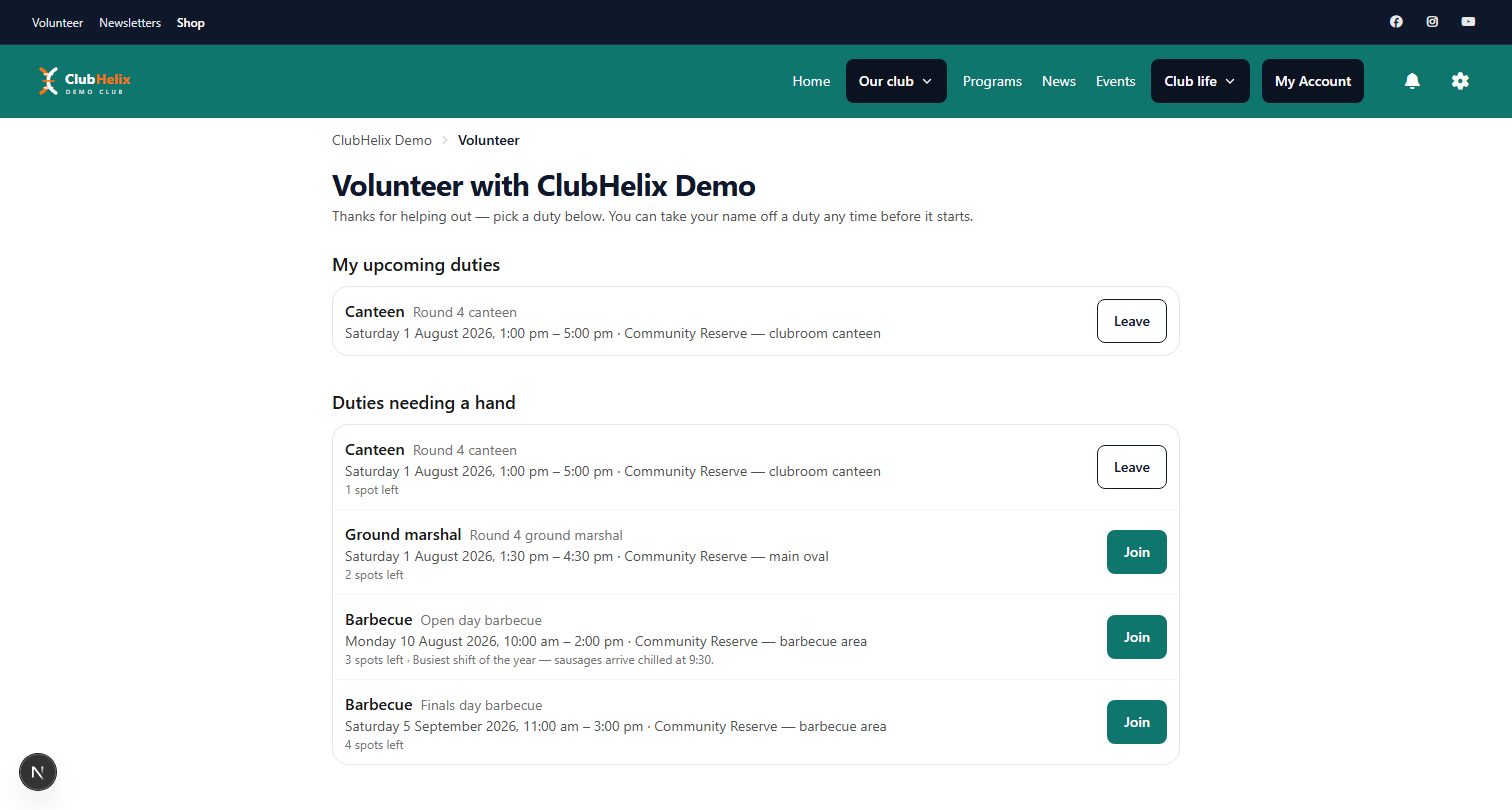
Pair rosters with RSVPs and attendance tracking for events and you can see headcounts and helper numbers in the same place — no more catering for 200 when 80 RSVP'd, or discovering at 8am that the sausage order assumed a crew of eight and two came.

Frequently asked questions
How long should a canteen shift be?
Ninety minutes to two hours. It's long enough to be worth the walk over and short enough that a parent can serve either side of watching their own child play. Four-hour shifts are why canteen rosters don't fill — they demand the whole morning, so only the already-overcommitted say yes. If coverage needs four hours, roster two shifts of two people rather than one heroic pair, and make set-up and pack-down separate jobs so serving crews aren't silently working extra.
How do we stop volunteers not showing up for their shift?
Three fixes, in order of impact: send an automatic reminder the day before (most no-shows are honest forgetting), roster people in pairs (nobody leaves a mate alone in the canteen), and make swaps easy so "can't make it" becomes an open slot others can grab rather than a silent gap. A rostering system does all three without the coordinator lifting a finger — which is precisely the Friday-night chasing it exists to end.
Should volunteer rosters be organised by family or by team?
Both, in layers. Allocate baseline duty rounds to teams ("Round 5 canteen is the U14s"), because team managers are your best micro-recruiters and it caps any family's load automatically. Then let individuals claim specific named slots within those rounds, and keep a per-family tally across the season so the same three households aren't quietly covering their team every time. Team-level fairness plus individual-level choice fills rosters faster than either alone.
What's a fair number of volunteer shifts per family per season?
For most clubs the maths lands around three to five short shifts per family per season — count your total slots (shifts × home fixtures + events) and divide by your families to get your own number, then publish it as the expectation: "every family covers three shifts, choose your dates early". A visible, low, universal number beats an invisible, unlimited one — people resist open-ended obligation but happily meet a clear, fair quota their neighbours are meeting too.
ClubHelix turns these templates into live rosters — self-serve sign-up, reminders and swaps, RSVPs and headcounts beside them, all under your club's roof. Start free, or compare plans on the pricing page.


