
What this guide answers
- What hourly rate should we use for volunteer time?
Whatever the funder specifies. If they do not specify one, use a published rate from a recognised volunteering organisation in your own jurisdiction, and cite the source in the application.
- Do committee hours count?
Usually yes — governance and administration are normally accepted as volunteer contribution.
- How far back can we claim?
Most applications ask for a defined recent period, commonly the last twelve months.
- What if our numbers are estimates?
Say so. Label them as committee-agreed estimates, note the method, and keep the minute that set them.
- Is there a privacy issue in recording who volunteered?
You are recording a role and a shift, which is ordinary club administration — but apply the same care as with any member data: collect what you need, keep it accurate, and limit who can see it.
Ireland edition. This guide is written for volunteer-run clubs in Ireland. Where rules differ — grants, tax, incorporation, safeguarding — follow the Ireland-specific pointers below or check with your national body.
Grant applications have quietly changed. Ten years ago they asked what you would spend the money on. Now they also ask what the community is putting in — and the most common way a volunteer-run club demonstrates that is volunteer hours, valued at a notional hourly rate as in-kind contribution.
That is good news for community clubs, which are almost entirely made of volunteer hours. It is bad news for a committee that has never recorded any and has three weeks until the round closes.
This guide is about capturing hours in a way that survives scrutiny without becoming a second job for the people you are trying not to burn out.
Why funders ask
Three reasons, and understanding them tells you what to record.
Co-contribution. Many programs require the applicant to match a proportion of the grant. Cash-poor clubs can often meet part of that with in-kind contribution, of which volunteer labour is usually the largest component. This is the reason with money attached.
Capability. A club that can mobilise 2,000 volunteer hours a season is demonstrably able to deliver a project. Hours are evidence of capacity in a way that a bank balance is not.
Community benefit. Volunteering is itself an outcome many programs fund. Your hours are not just an input to the project — sometimes they are the project, sitting alongside the participation figures in your member census.
Which means the useful record is not one big number. It is hours by activity, so you can show the hours relevant to whichever of those three the funder cares about.
What actually counts
Be broad but honest. Most funders accept unpaid time contributed to the organisation's activities, including:
- Coaching, managing, assistant coaching and team management
- Match-day duties — canteen, gate, bar, scoring, timekeeping, ground setup and pack-down
- Officiating, umpiring and refereeing where unpaid
- Committee and administration — meetings, and the work between them
- Working bees, ground and facility maintenance
- Event delivery — fundraisers, presentation nights, carnivals
- Governance — the president's phone calls, the treasurer's reconciliations, the secretary's correspondence
What generally does not count: time by paid staff or contractors, hours already claimed against another funded project, and spectating. If someone is reimbursed for expenses that is usually fine; if they are paid for their time, the hours are not in-kind.
Where a funder publishes its own definition, use theirs and say so.
The capture problem
Every club that has tried this has learned the same lesson: if capturing hours costs the volunteer anything, it will not happen.
Timesheets fail. Sign-in books at the canteen door fail by week three. An honour-system spreadsheet gets filled in by the four people who least need recognition and ignored by everyone else. And the person who chases it becomes unpopular quickly.
Three approaches work, roughly in order of reliability.
1. Derive hours from things you already record
The best data is the data nobody had to enter twice. If your club rosters duties — canteen shifts, gate, ground setup — the roster already knows who was assigned to what and for how long. A four-hour canteen shift filled by two people is eight volunteer hours, and nobody filled in a form.
The same is true of committee meetings (attendance in the minutes, times in the minutes), coaching sessions (session records), and events (the roster for the day).
This will not capture everything. It routinely captures 60 to 80 per cent of a club's hours, which is a far better base than the zero most clubs have.
2. Add a per-role annual estimate, agreed by the committee
For the roles where hours are real but unrostered — the treasurer's reconciliations, the coach's planning time, the secretary's inbox — agree a per-role annual estimate once, at the committee table, and minute it.
"The committee estimates the treasurer role at 6 hours per month across the season" is a defensible line in an application because it was set deliberately by the people who know, and it is documented. What is not defensible is a number invented the night before the deadline.
Review the estimates annually. Note them as estimates in any application.
3. A one-question prompt after the event
For working bees and one-off events, ask the coordinator a single question afterwards: how many people, for how long. One message, one answer, recorded against the event. That is a sustainable habit; a per-person timesheet is not.

What to record against each entry
Keep it minimal or it will not be maintained:
| Field | Why |
|---|---|
| Date | Funders want hours within a specific period |
| Activity type | Coaching, match day, committee, maintenance, event |
| Number of people | The multiplier |
| Hours each | The other multiplier |
| Source | Roster, minutes, coordinator report, committee estimate |
That last field is the one clubs skip and assessors value. Being able to say "1,240 of these hours come from duty rosters and 380 are committee-agreed estimates" is far stronger than a single unsourced total.
Presenting the number
Three principles for the application itself.
Show the working. Not the raw log — a summary table by activity type with the method noted. Assessors are not auditing you; they are checking that you know where the number came from.
Use the funder's rate. Most programs specify an hourly value for volunteer time. Use theirs. If none is specified, use the published rate from a recognised volunteering body in your jurisdiction and cite it. Never invent a rate, and never use a professional hourly rate for general volunteering.
Be conservative. An implausible figure damages the whole application. A club of 200 members claiming 20,000 volunteer hours will be questioned; the same club claiming 4,500 with a clear method will not. Under-claiming slightly costs you little; over-claiming costs you credibility on every other number in the form.
What ClubHelix does and does not do here
Worth being direct, because this is an area where software is often oversold.
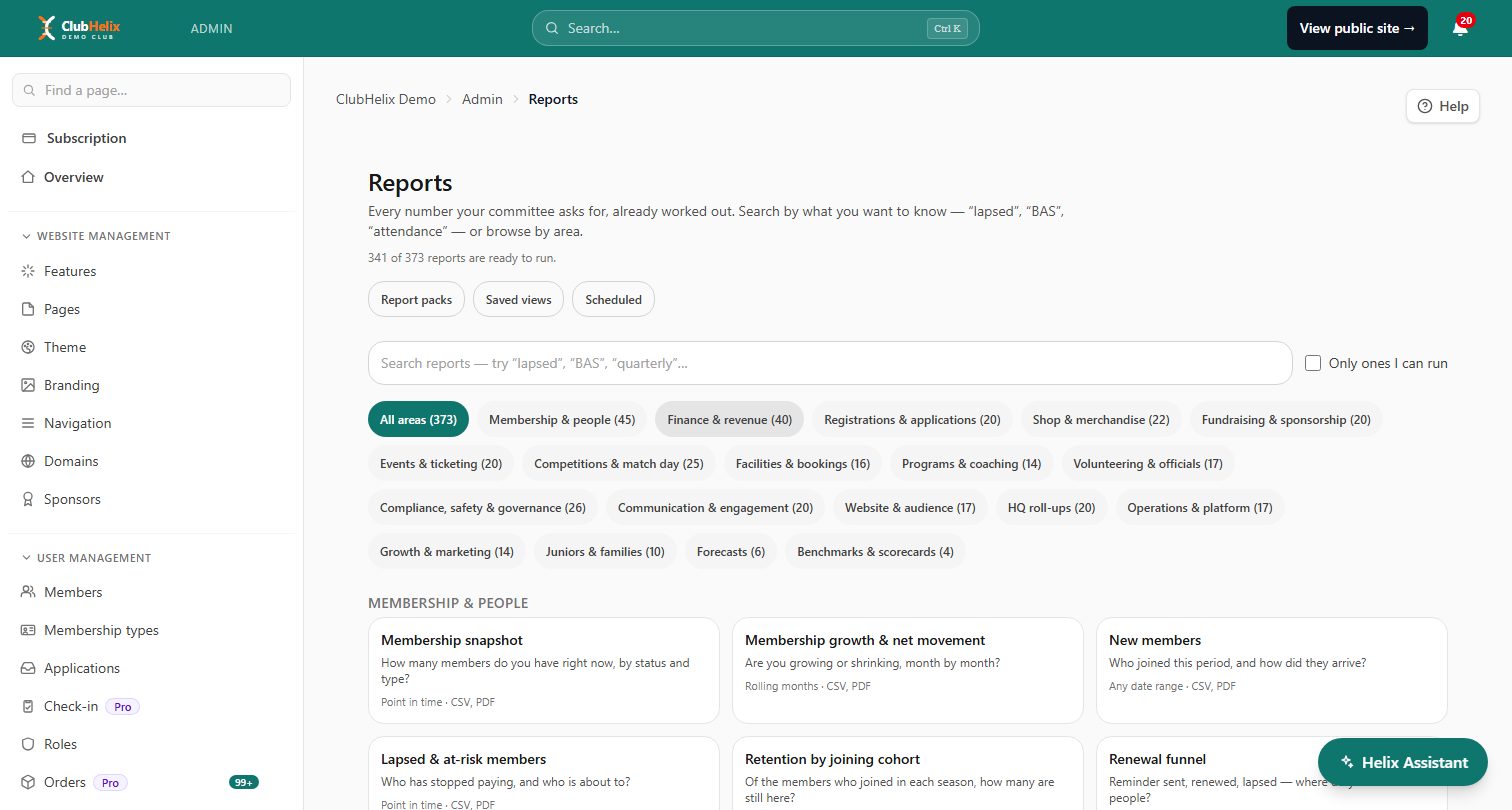
ClubHelix rosters duties and records who filled them, tracks event and session attendance, and reports on roster and volunteer coverage — which gives you the people-and-occasions half of the calculation, automatically, as a by-product of running the club.
What it does not currently do is store an hours value against each volunteer contribution and total it for you. That means the hours arithmetic — shift length × people, plus your committee-agreed estimates — is still a spreadsheet step at the end. We would rather say that plainly than imply a total appears by itself.
What the platform genuinely removes is the hardest part: knowing who did what, when, a year after the fact. Deriving hours from a complete roster history is an afternoon. Reconstructing it from memory is impossible.
A twelve-month plan
If you have nothing today:
- This month — agree what counts, in writing, and set the per-role estimates at a committee meeting. Minute both.
- From the start of next season — roster duties in one place, even the informal ones. This is the single highest-value change.
- Each month — record working bees and one-off events with the coordinator's one-line answer.
- Each quarter — total the hours by activity type and put the figure in the committee pack. Quarterly totalling means the annual number is never a scramble.
- Each year — publish the total in the annual report. It is one of the few numbers that reliably makes volunteers feel seen, and it is sitting right there.
By the time the next funding round opens you will have twelve months of sourced hours and a method you can describe in two sentences.
Frequently asked questions
What hourly rate should we use for volunteer time?
Whatever the funder specifies. If they do not specify one, use a published rate from a recognised volunteering organisation in your own jurisdiction, and cite the source in the application. Do not use professional rates for general volunteering.
Do committee hours count?
Usually yes — governance and administration are normally accepted as volunteer contribution. Check the specific program's definition, because a minority of programs exclude administration and fund only direct delivery.
How far back can we claim?
Most applications ask for a defined recent period, commonly the last twelve months. Reconstructing hours from years ago is neither practical nor credible. Start recording now; the next round will be much easier than this one.
What if our numbers are estimates?
Say so. Label them as committee-agreed estimates, note the method, and keep the minute that set them. Assessors treat a documented estimate very differently from an undocumented figure.
Is there a privacy issue in recording who volunteered?
You are recording a role and a shift, which is ordinary club administration — but apply the same care as with any member data: collect what you need, keep it accurate, and limit who can see it. Report hours in aggregate in applications; there is rarely any reason to name individuals.


