
What this guide answers
- How many weeks should a term of classes be?
Eight to ten teaching weeks suits most providers, aligned to the local school calendar with public holidays excluded and one catch-up week at the end.
- How do you price a term for a family who joins late?
Divide the term price by the number of sessions to get a per-session rate, then charge for the sessions remaining: a ten-session term at 18 a session is 180, and a family joining before week four pays 7 × 18 = 126.
- What is the difference between a class ratio and a class capacity?
The ratio is how many participants one qualified instructor can safely teach, taken as the lowest of what your governing body, your insurer and your venue allow.
- Should we keep a waitlist for a full class?
Yes, and run it properly: ordered by when the request arrived, recording which times that family could genuinely do, with offers that expire in about 48 hours.
- What should we re-ask every term rather than keep on file?
Medical conditions, medication and allergies, all consents including photography, and agreement to your terms and refund policy — each dated against the named term.
Canada edition. This guide is written for volunteer-run clubs in Canada. Where rules differ — grants, tax, incorporation, safeguarding — follow the Canada-specific pointers below or check with your national body.
A term of classes is a different business from a season of sport. A football club signs a member once before the season and sees them every week until finals. A swim school, a dance studio, a gymnastics centre or a tennis coach sells eight to ten weeks at a time, four or five times a year, to families who decide again every single term. That re-decision is the whole job, and everything below exists to make it easy for a family to say yes again and cheap for you to ask.
Most providers run this on a spreadsheet plus a messaging app, and it holds together for about thirty children. Past that the failure modes are always the same three: a class with eleven children in it and room for eight; a family who paid last term, never got asked about this one, and quietly went elsewhere; and an instructor standing in the rain with a phone, trying to work out who is actually meant to be at the 4:15. None of those is a discipline problem. They are record-keeping problems, and record-keeping problems are fixable.
Start with the term calendar
Every other number depends on the calendar, so publish it first — before pricing, before the enrolment window, before you tell a single family anything.
| Decision | Common answer | Why it matters |
|---|---|---|
| Teaching weeks per term | 8–10 | Sets the price, the pro-rata rate and the venue booking |
| Terms per year | 4, aligned to the school calendar | Four re-enrolments a year is four chances to lose a family |
| Public holidays | Excluded and named on the enrolment page | The single biggest source of "but I paid for that week" emails |
| Catch-up week | One spare week at the end | Absorbs a cancelled session without a refund conversation |
| Break between terms | 1–3 weeks | Long enough to reset, short enough that habits survive |
| Holiday programs | Priced and sold separately | Holiday clinic booking is casual demand, not part of a term |
| Venue booking | Confirmed before enrolment opens | Selling a term you have not booked the hall for is a real mistake |
The rule that saves the most arguments: sell a named list of dates, not a count of weeks. "Term 3, ten Tuesdays: 14, 21 and 28 July; 4, 11, 18 and 25 August; 1, 8 and 15 September" is impossible to misread. "Ten weeks from mid-July" invites a family to count differently from you and be entirely reasonable about it.
Holiday programs deserve their own calendar and their own price. They recruit people who would never commit to a term — a child tries four mornings in the break, likes it, and enrols in the next term. Treat them as the top of the funnel rather than a lesser version of a class.
Capacity and instructor ratios: the two numbers that cap everything
These are two different numbers and conflating them is how a class ends up oversubscribed.
The ratio is pedagogical and legal: how many participants one qualified instructor can safely teach. Your governing body, your insurer and your venue each publish a maximum, and they rarely agree. Take the lowest of the three, write it on the class, and treat it as a hard stop.
The capacity is commercial: the number of places you actually sell, which is the ratio multiplied by the instructors rostered on that session. One instructor at a ratio of six is six places. Two instructors is twelve — but only while both are rostered, which is why capacity has to be tied to the roster and not typed into a spreadsheet once in January.
| Class type | Typical participants per instructor | Notes |
|---|---|---|
| Water familiarisation, parent in | 6–8 pairs | The adult is the second set of hands |
| Learn-to-swim, 4–6 years | 4–6 | Non-swimmers in water: take the lowest number |
| Preschool gymnastics | 6–8 | Circuit format, with a parent helper per group |
| Recreational gymnastics, school | 8–10 | Apparatus rotation needs a spotter per station |
| Junior dance | 12–16 | Floor space, not supervision, is the real limit |
| Junior martial arts | 15–20 | Assumes a senior assistant on the mat |
| Group tennis or ball-sport skills | 6–8 per court | Above eight, half the group is queueing |
Two operational habits go with these numbers. Publish the ratio on the class page, because it is a genuine selling point and the question every careful parent wants to ask and does not. And roster staff against sessions rather than against terms, so a class whose second instructor is away drops to its one-instructor capacity for that week and you find out on the Monday rather than at 4:14.

Pricing a term
Work in whole units of your own currency below — the arithmetic is what travels, not the amounts.
| Model | How it reads to a family | Best for |
|---|---|---|
| One price per term | "Term 3 is 180" | Simple, and the easiest to collect in one movement |
| Per session × weeks | "18 a session, ten sessions" | Makes pro-rata and make-ups obvious |
| Casual per session | "18, book when you can" | Holiday programs, adult classes, drop-in fitness |
| Per term, with a sibling rate | "180, less the sibling rate" | Households with two or three children in the centre |
Quote the total either way. A family budgets in totals, not in rates, so lead with "180 for the term" and show the per-session figure underneath as the reassurance that it is good value. Then derive every other number in your business from that per-session rate, because it is the only one that makes late joiners, make-ups and cancelled weeks calculable instead of negotiable.
The pro-rata rule, worked. A ten-session term at 18 a session is 180. A family enrolling before week four has seven sessions remaining, so 7 × 18 = 126. Round to the nearest whole unit, never round up past the full term price, and publish the rule rather than the outcome — "you pay for the sessions left when you join" ends the conversation before it starts.
Two guardrails worth writing into the policy. Set a floor: below about half a term, do not pro-rata at all, offer a trial class or a casual rate instead, because the administration costs more than the difference. And set a cut-off after which a late joiner waits for next term — by week seven of ten, a beginner joining a class that has moved on is a poor experience for them and a drag on everyone else.
For sibling and household pricing, decide the shape before the mechanism. A flat amount off the second and subsequent child is the easiest to explain and the easiest to audit; a percentage reads as more generous and costs more on your most valuable families. Our guide to family membership pricing works through the trade-off in detail.
The enrolment window and the waitlist
An enrolment window is four dates, and the order matters more than the exact days.
- Re-enrolment opens for current families, about two weeks before anyone else. This is the single highest-return thing on this page: the family already in the 4:15 keeps the 4:15 if you ask them in time.
- Public enrolment opens, roughly a fortnight before the term starts, once you can see which classes have space.
- Enrolment closes for full-price places — usually the end of week one.
- Late joining continues at the pro-rata rate until your cut-off.
Then run a real waitlist, because a full class that turns people away silently is a business decision you did not get to make. A waitlist done properly is ordered by the time the request came in, records the class and the times that family could actually do, and makes an offer that expires — 48 hours is fair and keeps the queue moving. Above all it is the best market research you will ever get for free: three names waiting for Tuesday 4:15 and nobody waiting for Thursday 10:00 tells you exactly which class to add and which one to retire.
What to collect at enrolment, and what to collect once
Ask for everything you need and nothing you do not, because every extra field costs you completed sign-ups. The practical split is between facts that change and facts that do not.
| Collect | Every term | Why |
|---|---|---|
| Participant name, date of birth, current level | Confirm | Level decides the class; age decides the ratio |
| Parent or guardian name, phone, email | Confirm | One contactable adult per enrolment, minimum |
| Second emergency contact | Confirm | The one you actually ring when the first does not |
| Medical conditions, medication, allergies, asthma | Re-ask | This one genuinely changes, and stale is dangerous |
| Consent: participation, first aid, photography | Re-ask | Consent is per term, and photo consent is separate |
| Terms, refund policy and code of conduct agreement | Re-ask | Dated agreement against a named term, not "on file" |
| Accessibility or support needs | Re-ask | Lets the instructor plan instead of improvise |
Two rules. Medical information and consent are re-asked every term — a two-year-old asthma note is worse than none, because it tells your instructor the question has been answered. And keep only what you need for as long as you need it: privacy law where you are will have something to say about how long a former participant's medical notes sit in your files, and the honest answer is almost always "less time than they currently do". Our guides to online club forms and starting a junior program cover the form design and the child-safety side respectively.
The register on the day
The register is where a term either holds together or unravels, and the test is brutally simple: can the person on the floor mark the roll in under thirty seconds, on a phone, with wet hands or chalk on them? If not, it will not get marked, and by week four nobody knows who attended anything.
What a good register does: shows the enrolled list for that session and no other; takes a present, absent or late mark with one tap each; carries the medical flag beside the name rather than in an attachment; shows the emergency contact without leaving the screen; and works when the venue's connection does not. What it also does, quietly, is produce the attendance record that answers the three questions you will actually be asked — which children are drifting before they leave, whether the 10:00 class is viable, and who was in the building on the day something happened. Our guide to club attendance tracking goes through the reporting side.
Rolling one term into the next
Re-enrolment is not a marketing campaign, it is a maintenance task with a deadline. The pattern that works:
- Build the list from confirmed enrolments, not from everyone who ever enquired. One invitation per participant, with anyone who cancelled or was refunded left out — a cancelled family being invited back by name is the worst message you can send.
- Offer the same day and time first. Habit is the product. Changing a child's class time is a bigger ask than changing the price.
- Send in batches, not all at once, so you can answer the replies from the first batch before the second lands.
- Give the window a visible end date, and say what happens after it: the place goes to the waitlist.
- Follow up once, to the families who opened nothing, three or four days before the window closes.
- Reconcile before the term starts. Every class gets a headcount, every instructor gets a roster, every unfilled place goes to the waitlist in order.
When a family asks to pay in instalments
Most providers get this request two or three times a term, and it is almost always from a family you want to keep. Decide the policy once so the answer is not a function of who was asked.
The workable shape is a written schedule against the term: an amount at enrolment that secures the place, and the balance across two or three dated payments that all land before the last session. Two conditions make it safe — the place is confirmed only once the first payment clears, and the schedule finishes inside the term, so a family never carries a balance into a term they may not enrol in. Write down what happens on a missed payment (a reminder, then a conversation, then the place goes to the waitlist) and apply it the same way to everyone.
Keep it dignified and keep it quiet. A family asking to spread the cost of a term is not a credit risk, and handling it discreetly is the cheapest loyalty you will ever buy. If your organisation runs a hardship or participation-support fund, this is the conversation to mention it in.
Doing it on ClubHelix: the worked example
Everything above is an operating decision you would make whatever coaching class management or class management software you used. Here is how the decisions land in ClubHelix programs and enrolment — a worked example, in the order you would set it up.
- Publish the term as a program with its session dates, a capacity cap and session attendance, so the calendar you decided above is the thing families enrol into. Full classes queue demand on a waitlist instead of losing it.
- Book your staff against the sessions. Enrolment is refused when a class would break the ratio you set, so the commercial capacity can never quietly drift above the safe one.
- Write out your own ladder of levels and the skills under each, then mark them off against each child. A level belongs to the enrolment, so the same child can be at different levels in two programs, and families see the level on the program page.
- Turn on make-up credits and trial classes. A family reports a missed class from your website and earns a credit they book into another class time. Offer a free or paid trial class to people who have not enrolled, one per child — no account needed, which is exactly what a first-time enquiry needs.
- Mark the register on the phone through attendance, and read the term back through reports when you are deciding which classes to run again.
- Build next term's invitation list from this term's confirmed enrolments — one per child, with anyone who cancelled or was refunded left out — and send it in batches.
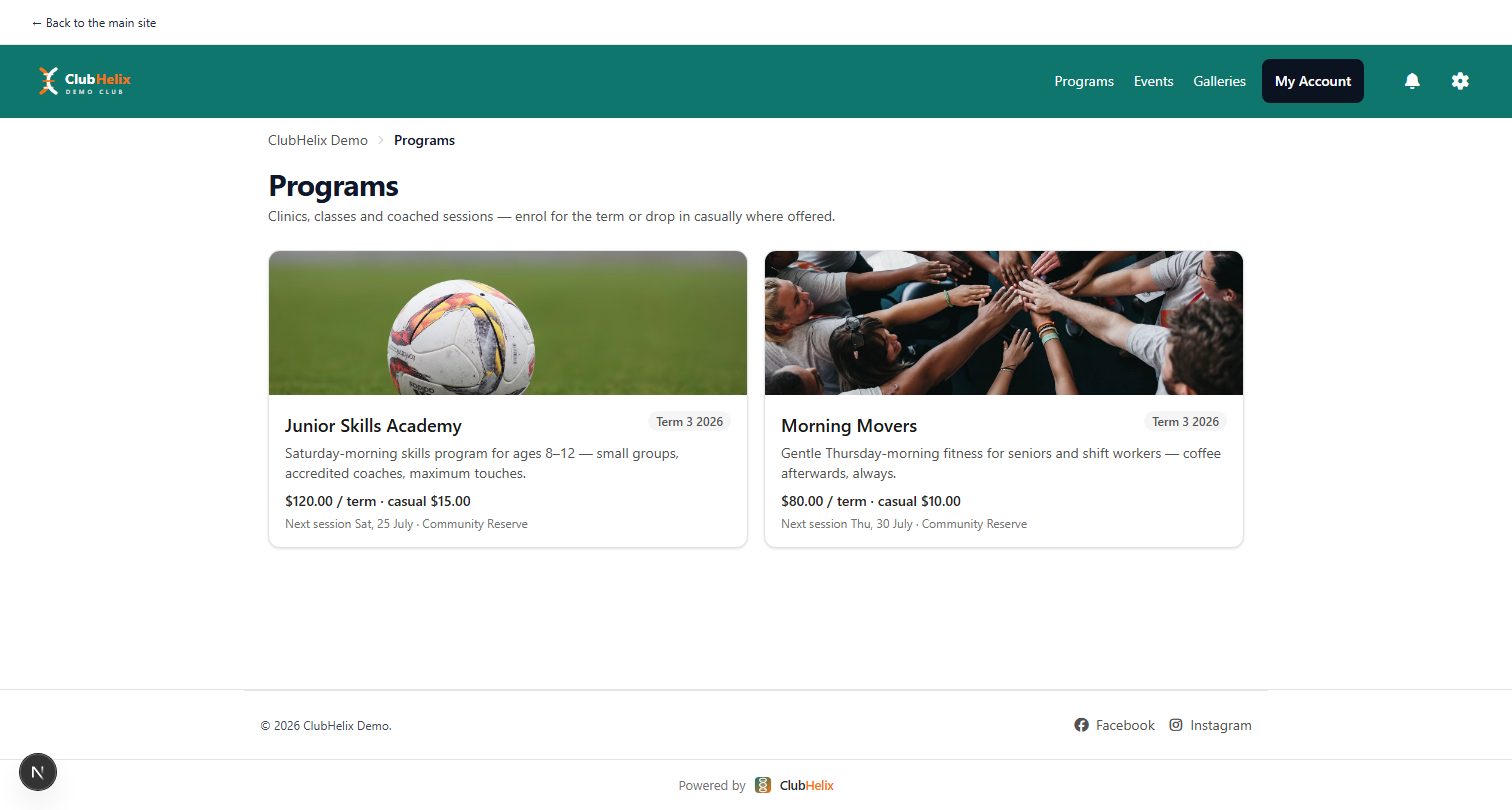
New families reach the roster through self-registration rather than a form you retype, which is what turns junior program sign up from an administrative event into a link you put in a newsletter. Plans are on the pricing page, and you can start on the free tier.
The first-term checklist
- Publish the calendar — named dates, public holidays excluded, catch-up week included.
- Set the ratio per class from the lowest of your governing body, insurer and venue maximums.
- Roster the instructors, so capacity is a consequence of the roster rather than a guess.
- Price the term as a total, with the per-session rate shown underneath and the pro-rata rule published.
- Open re-enrolment two weeks early to current families only.
- Open public enrolment once you know where the space is, and turn the waitlist on everywhere.
- Re-ask medical details and consent against this term, not last term.
- Test the register on a phone — your own, in the venue, before week one.
- Review in week three: which classes are under half full, which times have a queue, who has missed two in a row.
Frequently asked questions
How many weeks should a term of classes be?
Eight to ten teaching weeks suits most providers, aligned to the local school calendar with public holidays excluded and one catch-up week at the end. Publish the actual dates rather than a count of weeks — a named list of sessions is impossible to misread, and it removes the most common billing argument before it happens.
How do you price a term for a family who joins late?
Divide the term price by the number of sessions to get a per-session rate, then charge for the sessions remaining: a ten-session term at 18 a session is 180, and a family joining before week four pays 7 × 18 = 126. Publish the rule instead of the outcome, set a floor of about half a term below which you offer a trial or casual rate instead, and set a cut-off after which a late joiner waits for the next term.
What is the difference between a class ratio and a class capacity?
The ratio is how many participants one qualified instructor can safely teach, taken as the lowest of what your governing body, your insurer and your venue allow. The capacity is the number of places you actually sell, which is that ratio multiplied by the instructors rostered on the session — so capacity must follow the roster, or a class with one instructor away is suddenly oversubscribed.
Should we keep a waitlist for a full class?
Yes, and run it properly: ordered by when the request arrived, recording which times that family could genuinely do, with offers that expire in about 48 hours. Beyond filling cancellations, a waitlist is the best free market research you will get — three people waiting for Tuesday afternoon and nobody waiting for Thursday morning tells you precisely which class to add.
What should we re-ask every term rather than keep on file?
Medical conditions, medication and allergies, all consents including photography, and agreement to your terms and refund policy — each dated against the named term. A two-year-old asthma note is worse than no note at all, because it tells your instructor a question has been answered when it has not.

