
What this guide answers
- What is the main difference between TeamUnify and TeamSnap?
Scope. TeamUnify is built for swim clubs specifically — registration, billing, meet entries with Hy-Tek integration and hosted team websites — so the swimming workflow is native to it.
- How much do TeamUnify and TeamSnap cost?
As at July 2026, TeamUnify does not publish pricing — expect a quote, and treat any specific figure you find in a third-party round-up with caution.
- Is swim-specific software worth it for a small club?
It depends on whether meets are your bottleneck. If your swimmers compete regularly and entries, qualifying times and results files consume a volunteer every month, specialist software earns its keep.
- Can we use one system for swimming and our other sections?
Yes, but only if the system models a club rather than a team.
- What should we test during a software trial?
Test the awkward cases, not the demo. Move a swimmer between squads mid-term and see what happens to their invoice.
A swimming club's admin year has a shape almost nothing else in community sport shares. Training runs in squads, most of them before breakfast, in blocks that follow school terms rather than a single season with a start and a grand final. Fees are charged per term or per month, not once a year at sign-on, and a swimmer who moves up a squad in week three changes what they owe. On top of all that sits a completely separate machine — meet entries, qualifying times, entry deadlines and results files — with its own software, its own file formats and usually one volunteer who is the only person who understands it.
So when a swim committee goes shopping for software, it is really asking two questions at once: what runs the club, and what runs the meets. TeamUnify and TeamSnap sit on opposite sides of that split. One was built for swimming and nothing else. The other was built for every team sport and treats swimming as one of many. This guide compares them on the arguments a swim committee actually has — squads and sessions, term billing, and meets — and then takes on the question that neither vendor's marketing page will answer: what happens when your club is not only a swim club.
We should declare our position before refereeing. We are ClubHelix, an all-in-one club platform, so we compete in the neighbourhood of one of these products and not at all in the other. We will say plainly where each one beats us. Everything below is public information current as at July 2026; both companies change things, so verify anything decision-critical against their own sites, and tell us if we have something wrong.
What each product actually is
TeamUnify is the swim-club vertical standard, built and sold in the United States. Its scope is the swim-club job end to end: registration, billing, meet entries with Hy-Tek integration, and hosted team websites. That last clause is the important one — meet entry and the file interchange around it are first-class parts of the product rather than an add-on, which is exactly what you would expect from software that only has one sport to satisfy. The company states it serves more than 4,000 swim teams. We could not find published pricing at our July 2026 check, so budget on the basis that you will need to request a quote rather than on any figure you find in a round-up article.
TeamSnap, from Boulder, Colorado, is the team-management app that largely defined the category in its home market: scheduling, communication, payments and registration, wrapped in native mobile apps with a very large consumer brand behind them. Its pricing page (checked October 2026) shows no dollar figures: single teams are "$0 to start", and clubs and leagues are served by TeamSnap ONE on customised pricing. What web presence each plan includes varies, so ask. Around it is an ecosystem shaped by its home market: background-check integration for coaches and volunteers, and a sponsorship advertising network.
Put the two next to each other and the difference is not really features, it is the question each product was designed to answer. TeamUnify asks "how does a swim team operate?" TeamSnap asks "how does a team coordinate?" Those produce different software.
Squads, sessions and meets — the part that actually decides it
This is the section your head coach cares about and your treasurer does not read. It matters because squad structure is not a cosmetic label in a swim club: it drives which sessions a swimmer may attend, what they pay, when they move up, and which meets they are eligible for. Software that treats a squad as a chat group will fight you every term.
Three distinct jobs hide under the word "training" in a swim club:
- Squad membership. Who is in Development, who is in Junior Performance, who moved up in week three and whose fees change as a result. This is a roll that changes mid-term, not a fixed team list.
- Session attendance. Twelve to twenty pool sessions a week, each with a lane allocation, a coach and a cap. Squads overlap sessions; a swimmer might be entitled to four of the six their squad runs.
- Meets. Entry windows, event selection, qualifying times, relay declarations, and a results file that comes back in a format your club software either speaks or does not.
| Job | TeamUnify | TeamSnap |
|---|---|---|
| Built for | Swim clubs specifically | Team sport generally |
| Squad and group structure | Native to the product — squads drive billing and eligibility | General team and group structure |
| Session scheduling | Swim-shaped session and attendance handling | Scheduling and availability across the whole club |
| Meet entries | Yes, including Hy-Tek integration | Not part of its published scope — it is not a swimming-specific product |
| Registration and payments | Yes | Yes |
| Websites | Hosted team websites | Varies by plan; ask TeamSnap |
| Mobile apps | Not covered by our research — ask them directly | A major strength — the apps are the product for most users |
| Published pricing | Not published at our July 2026 check — quote-based | Single teams "$0 to start"; TeamSnap ONE custom-quoted; no figures (Oct 2026) |
The honest summary: if meet entries and the timing-file round trip are the thing that consumes your volunteers, a general team-management product will not solve them, no matter how good its calendar is. That is a decisive difference and no amount of "but the app is nicer" makes it go away.

Paying for training that arrives in blocks
Here is where a swim club diverges hardest from the football club down the road, and where a lot of software chosen on the strength of its app turns out to be the wrong shape.
A football club charges one registration fee, collects it in February, and the money question is essentially settled until next year. A swim club charges for a block of training, four or five times a year, at a rate that differs by squad, with movement between squads mid-block, plus meet entry fees, plus a club membership component, plus casual fees for the swimmer who does two sessions a week and no competition at all.
Four billing shapes cover most swim clubs. Work out which one you are before you compare products, because it changes the answer.
| Billing shape | How it works | What it needs from software | Where it bites |
|---|---|---|---|
| Annual membership | One fee covering the year | Straightforward registration and renewal | Cash arrives once — awkward for a coach on a wage |
| Per-term block | A fee per squad per term, invoiced before it starts | Term or program enrolment with per-squad pricing and a roll | Mid-term squad moves and pro-rata credits |
| Monthly recurring | A subscription per swimmer, paused over the break | Stored payment methods and reliable retries on failure | Pausing and restarting cleanly at the right dates |
| Pay per session | Casual swimmers pay for what they attend | Attendance that is trusted enough to bill from | It only works if the roll is marked honestly |
A worked example, using illustrative numbers so the mechanics are visible rather than the prices. Say a club runs four ten-week terms. Development squad is charged at $190 per term, Junior Performance at $265, Performance at $340. There are 180 swimmers, roughly split 90 / 60 / 30. That is $43,200 per term of training income, arriving in four lumps, plus meet entry fees collected on top with a small levy for the club's timekeeping costs.
Now the part that decides your software. In a single term, perhaps twelve swimmers move up a squad, four drop back, six take an injury pause and two families ask for a payment plan across the term. That is twenty-four individual money decisions per term — around a hundred a year — and if your system cannot express "half a term at the old rate, half at the new one" the club registrar is doing them by hand in a spreadsheet and emailing revised invoices. Any product you shortlist should be tested against that exact scenario in a trial, not against how nice the fixtures screen looks.
TeamUnify's billing depth is a direct consequence of its vertical focus — it exists because swim clubs bill this way. TeamSnap covers payments and registration as part of a broader product; whether the shape of your term billing fits is precisely the thing to test before you commit, and it is a fair question to put to their sales team in writing.
Where each one is strong, fairly stated
TeamUnify's real advantages are the ones that come from serving one sport for a long time: meet entry and the Hy-Tek interchange, billing that was designed around the way swim clubs charge, and the plain fact that a swim-specific product does not need to be bent into shape before your head coach can use it. Its hosted team websites also mean a club with nothing at all gets a public presence in the deal.
TeamSnap's real advantages are breadth and adoption. The native apps are well regarded and, in its home market, a large share of families already have one installed from another sport, which removes the single hardest step in any club software rollout. Its communication and availability tooling is mature. And the free tier for single teams means a squad's coach can start using it this week without a committee decision, which is how it wins most of its ground.
Where each is weaker. TeamUnify is a vertical product, which is a strength until your organisation stops being purely a swim club — more on that next. TeamSnap does not solve meets, and what web presence each plan includes isn't spelled out on its pricing page, so a club expecting a proper public site should confirm exactly what that includes and what it costs before assuming.
What a multi-sport club should do instead
This is the case the vendor comparison pages ignore, and in community sport it is common. A great many clubs that swim also do something else: a surf club with a pool squad, a school-linked club with swimming and water polo, an aquatic centre club running learn-to-swim, squads and a masters group, or a multi-sport community club where swimming is one of six sections sharing a committee, a bank account and an insurance policy.
Vertical software is a poor fit for that organisation, for a structural reason rather than a quality one. A swim-specific product models a swim team. It does not model a club with sections, a shared member roll, one committee, one set of accounts and one public website. Adopt it for the swimming section and you have solved swimming while committing the other five sections to their own tools, which means five member lists, five payment arrangements and no single answer to "how many members do we have?"
The pattern that works is to split the two jobs deliberately:
- Keep the specialist rails for the specialist job. If meet entries and timing files are core to your competitive squads, keep whatever handles them. Nobody wins by re-keying meet data to prove a point.
- Run the club itself on one system that covers every section. One member record per person, one place fees are collected, one website, one committee view. Swimming becomes a program within the club rather than a separate organisation with its own software.
- Decide where the member record lives and make everything else defer to it. The most expensive failure in club software is not choosing the wrong product; it is running two systems that both think they are the source of truth. Our guide to running a swimming club works through the operational side of this.
- Test the awkward case in the trial. Mid-term squad moves, a family with three swimmers at different levels, and a swimmer who is also in the water polo section. If a product handles those three, it will handle your year.
For a single-sport club with strong competitive squads, that argument does not apply and vertical depth wins outright. Be honest about which one you are.
Running the club around the pool
The gap both products leave for a broader club is the club itself: the public website that sponsors and new families judge you on, the events and presentation night, the volunteer roster for timekeepers, the shop selling club caps, and the member record that every section shares. ClubHelix covers that layer — programs and term enrolment for squad blocks with per-squad pricing, self-registration with payments so families enrol and pay in one flow, attendance and RSVPs for sessions, and team management for the groups around them, all on one member roll and one branded site. We should be equally clear about our limits: we do not do meet entries, qualifying times or timing-file integration, we ship an installable web app rather than native app-store apps, and we have no background-check integration for the United States market. If meet management is your bottleneck, a specialist tool remains the right answer for that specific job.
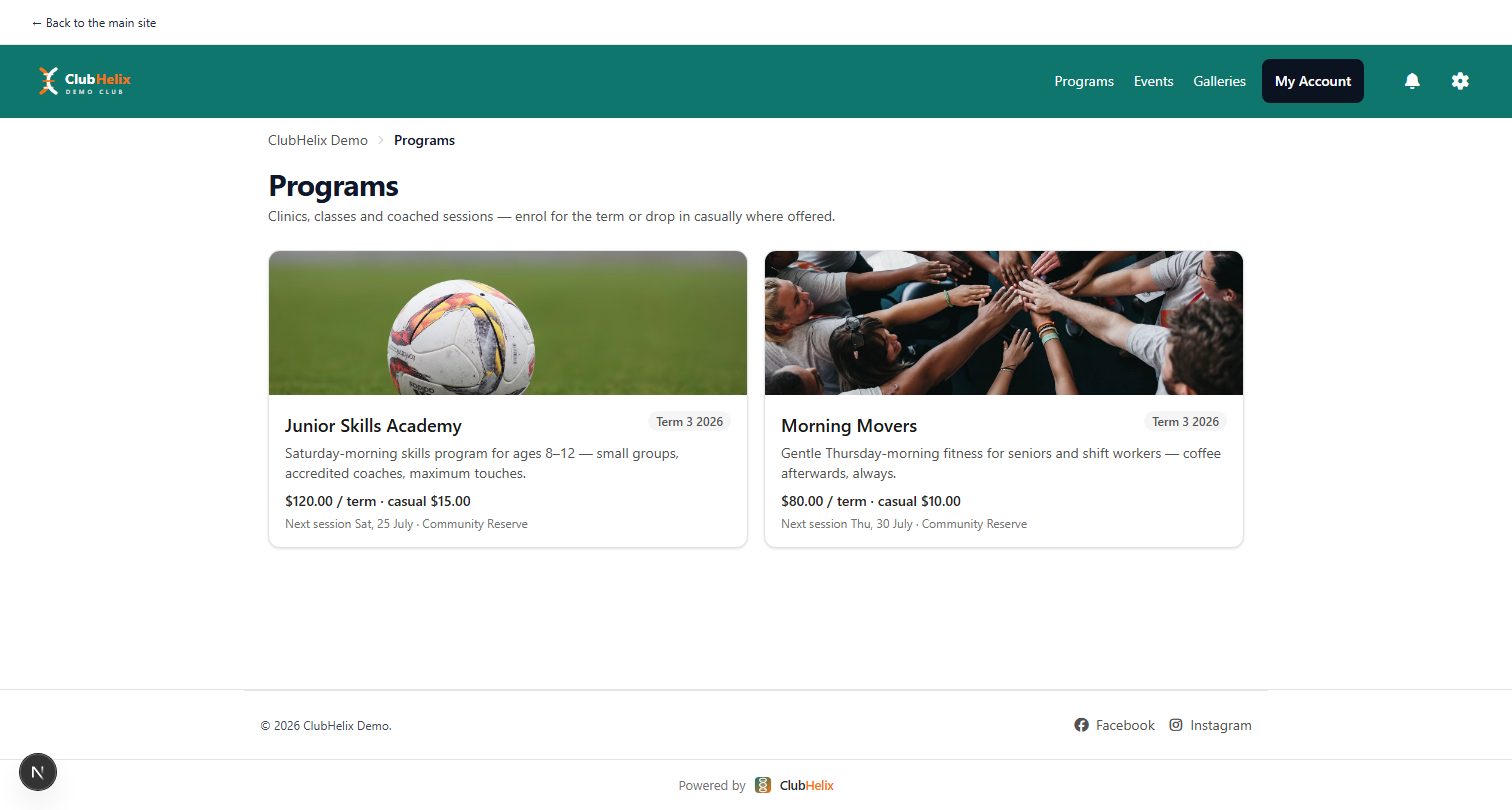
If your committee's real problem is that swimming, the club and the money live in three different places, that is the problem we built for. There is a free tier to start on, pricing published openly rather than quoted on request, and the platform is Australian-built and Australian-hosted rather than adapted from another market. You can create your club site and have squads, term fees and a public home page working in an afternoon — and if you would rather not do the setup yourself, done-for-you exists for that. Our longer write-up of the generalist comparison lives at /compare/teamsnap-alternative.
Frequently asked questions
What is the main difference between TeamUnify and TeamSnap?
Scope. TeamUnify is built for swim clubs specifically — registration, billing, meet entries with Hy-Tek integration and hosted team websites — so the swimming workflow is native to it. TeamSnap is a general team-management product covering scheduling, communication, payments and registration across many sports, with native apps and a large consumer brand, and a club and league product, TeamSnap ONE, on customised pricing. If meets are the job you need solved, that difference is decisive.
How much do TeamUnify and TeamSnap cost?
As at July 2026, TeamUnify does not publish pricing — expect a quote, and treat any specific figure you find in a third-party round-up with caution. TeamSnap's pricing page (October 2026) shows no dollar figures: single teams are "$0 to start", and club and league pricing under TeamSnap ONE is a custom quote. Because both quote at club scale, get the number in writing with the member count and features you actually need before comparing.
Is swim-specific software worth it for a small club?
It depends on whether meets are your bottleneck. If your swimmers compete regularly and entries, qualifying times and results files consume a volunteer every month, specialist software earns its keep. If you mostly run learn-to-swim and squads with occasional competition, you are paying for depth you will not use, and general club software with good term enrolment will fit your money and your roll better.
Can we use one system for swimming and our other sections?
Yes, but only if the system models a club rather than a team. Look for one member record shared across sections, per-section fees and rolls, and a single committee-level view of money and membership. The failure mode to avoid is adopting a sport-specific product per section, which leaves you with several member lists that never agree and no reliable answer to how many members the club actually has.
What should we test during a software trial?
Test the awkward cases, not the demo. Move a swimmer between squads mid-term and see what happens to their invoice. Enrol a family with three children at different levels. Pause a member for injury and restart them. Pull a list of who has paid this term. If a product survives those four with no spreadsheet involved, it will survive your season; if it does not, no feature list will save you later.
Related reading for a swim committee — how to run a swimming club covers the operational year, and best apps for sports clubs maps the wider landscape.


