
What this guide answers
- Who should write the team selection policy?
A small working group — typically the coaching coordinator, one committee member and one experienced coach — drafts it; the committee consults coaches and adopts it by resolution before the season.
- Should junior sport guarantee equal game time?
Up to early-teen age groups, a stated minimum (commonly half a game, averaged across the season) is the widely accepted fair-play baseline: kids develop by playing, and families pay the same fees.
- How do we handle parents who dispute a selection?
Route everything through the grievance path, every time: a calm conversation with the coach first (never on match day), then a written referral to the club's nominated officer, then a committee decision that's final.
- How often should the policy be reviewed?
Re-adopt it every pre-season, even unchanged — that keeps it owned by the current committee rather than inherited folklore.
Ireland edition. This guide is written for volunteer-run clubs in Ireland. Where rules differ — grants, tax, incorporation, safeguarding — follow the Ireland-specific pointers below or check with your national body.
No decision a club makes generates more heat per week than team selection. Who made the top side, who got dropped, why one under-12 plays a half and another plays the whole game — these are the conversations happening in the car park after training, and when a club has no written selection policy, every one of them becomes a referendum on a coach's fairness.
A selection policy doesn't stop hard decisions. It stops hard decisions being personal ones. When the policy says how teams are picked, who picks them, how selections are communicated and what a parent can do if they disagree, the coach is applying club policy rather than defending private judgement — and the committee has something to point to that was agreed calmly in the off-season rather than argued in week seven.
This guide covers the principles a good policy rests on, the junior fair-play questions that need explicit answers, and then gives you the full template to adapt.
Why a written policy matters
Three practical reasons, beyond general good governance:
- It protects coaches. Volunteer coaches quit over selection conflict more than over losing. A policy the committee adopted — and will back publicly — moves the pressure off individuals.
- It converts complaints into process. "That's not fair" becomes "here's the policy, and here's the grievance step if you believe it wasn't followed". Most complaints end at the first sentence.
- It forces the club to decide what it actually values. Is the under-14 second side about development or about winning the B-grade flag? Clubs that never write it down discover mid-season that the coach and the parents assumed different answers.
Adopt the policy at a committee meeting before the season starts — write it into your pre-season checklist at the same time you appoint coaches. Publish it on your website, link it in the season info pack, and make every coach and team manager read it as a condition of appointment.
The principles that make a policy defensible
Whatever your sport, strong selection policies share the same bones:
- Stated purpose per competition level. Senior first grade may select purely on performance; junior teams up to a stated age select for participation and development. Say which applies where — this single sentence prevents most junior disputes.
- Named selectors and a defined process. Who selects each team (coach alone? coach plus a selection panel for senior grades?), when selections happen, and what inputs count: training attendance, form, fitness, availability, team balance, discipline.
- Objective anchors where possible. You can't fully objectify selection, but you can anchor it: registered and paid, attends training (with a stated attendance expectation and stated exceptions for work/school/family), meets any eligibility rules (age, association player-points, finals qualification games — the same eligibility discipline that a clean fixture and finals setup needs).
- A communication standard. How and when players learn the team — and crucially, that non-selection at a higher grade comes with a reason and a "what to work on", delivered privately, before the team is public.
- A grievance path that skips no steps. Player (or parent) → coach conversation → written referral to the club's nominated officer → committee decision, final. Time-boxed at each step. No selection is ever reversed by car-park pressure — only by process.
- An annual review. The policy is re-adopted (and amended) each pre-season, so it stays owned by the current committee, and gets a line in the end-of-season report each year.

Junior fair play: the questions to answer explicitly
Junior selection is where vague policies burn clubs, because "we pick on merit" and "everyone gets a fair go" are both popular and mutually contradictory. Answer these in writing.
Check your national governing body's juvenile regulations first — several mandate minimum playing time or rotation up to a stated age, and age-grade rules on playing up are usually mandatory rather than advisory, with a formal dispensation process the only legitimate route around them.
- Minimum game time. The gold standard for juniors: every fit, selected player receives a stated minimum share of game time — half a game is common up to a stated age — averaged across the season where formats make single-game guarantees impractical. Name the age or grade where this stops applying.
- Equal opportunity vs equal outcome. Up to what age do you rotate positions and share "glamour" roles (captaincy, set-piece takers, goalkeeper)? Development-focused clubs rotate meaningfully until at least early teens.
- Playing up an age group. Who can approve it (coach + age coordinator + parent consent is the safe triad), what criteria (physical readiness and social readiness, not just skill), and the default answer for finals ("playing up never displaces a regular player from finals" is a policy many clubs adopt after learning the hard way).
- When teams are graded within an age group. If you field under-13 Division 1 and Division 2, say how kids are allocated (trials? coach assessment? friendship requests honoured up to what point?), and whether mid-season movement happens.
- Finals selection for juniors. The single most explosive junior issue. State it plainly: does the minimum-game-time rule hold in finals, or does the club permit performance-based selection in junior finals? There is no universally right answer — there is only the club that decided in March versus the club deciding in September.
Run selection like a process, not a group chat
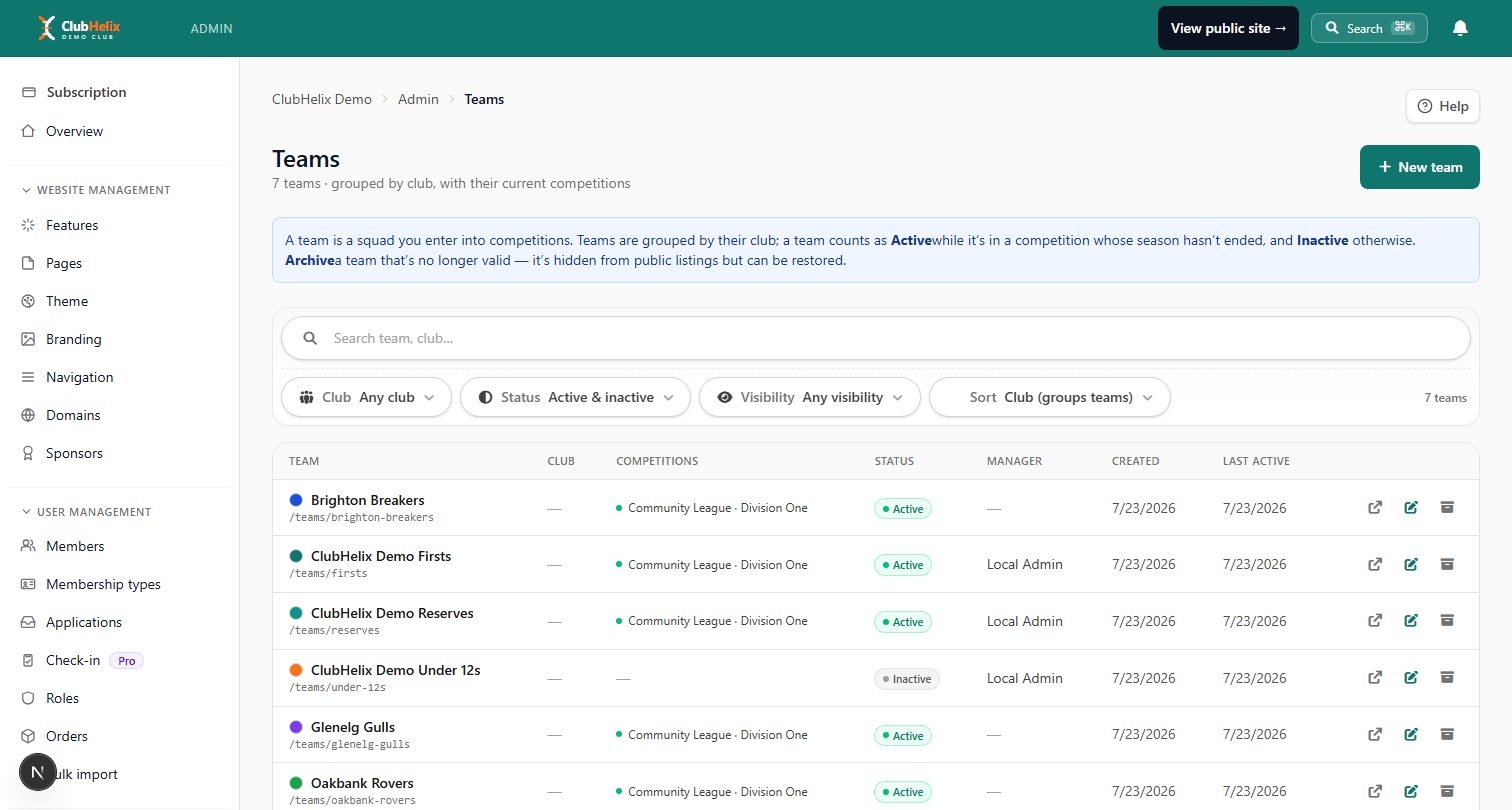
However good the policy, selection collapses if the mechanics are chaotic — availability collected in three different chats, teams announced in one of them, a late change nobody saw. Give selection the same operational discipline as fixtures: availability collected the same way every week, selections published in the same place every week, and changes pushed to the people affected. A team management system that tracks squads, availability and selections — with role-based access so coaches manage their own team and only their own team — takes the administrative friction (and the "I never saw the team" grievance) off the table entirely.
The template
Adapt the bracketed items, delete what doesn't apply to your sport, and adopt it by committee resolution. It's deliberately written in plain language — a selection policy nobody reads protects nobody.
[Club Name] Team Selection Policy
Adopted: [date] · Review: annually before season start · Owner: [Committee / Football Operations Sub-committee]
1. Purpose This policy explains how [Club Name] selects teams, so that selection is consistent, transparent and accountable. It applies to all teams entered by the club in any competition.
2. Selection philosophy 2.1 Senior teams from [grade] upward are selected on performance, form, fitness, training commitment and team balance. 2.2 Junior teams up to and including [age group] are selected to maximise participation and development. Winning is an outcome, not a selection criterion, at these ages. 2.3 Between these levels, [describe the transition — e.g. "under-15 to under-17 teams balance development with performance at the coach's judgement, within the fair-play rules below"].
3. Who selects 3.1 Each team is selected by its appointed coach. 3.2 For [senior grades / representative teams], selection is by a panel of [coach, plus captain or a committee-appointed selector], decided by majority. 3.3 The [Coaching Coordinator] resolves disagreements between coaches sharing a playing pool.
4. Eligibility A player may be selected only if they are (a) registered with the club and the association, (b) financial or on an approved payment plan, (c) eligible under association rules including age and finals-qualification requirements, and (d) not under suspension.
5. Selection criteria Selectors will consider: skill and form; training attendance and effort (expected attendance: [X sessions/week], with allowances for work, school and family commitments notified in advance); availability; fitness and injury status; team balance and positional needs; and conduct consistent with the club's code of behaviour.
6. Junior fair play 6.1 Every fit, selected junior player up to [age group] receives at least [half] of available game time, averaged across the season. 6.2 Positions and roles are rotated meaningfully up to [age group]. 6.3 Playing up an age group requires the agreement of both coaches, the [Age Group Coordinator], and a parent/guardian, and must serve the player's development. Playing up will not displace a regular player from a finals team. 6.4 In junior finals, rule 6.1 [continues to apply / is modified as follows: …].
7. Communication 7.1 Teams are published by [day/time] each week via [the club's team management system / website]. 7.2 A player dropped from a higher grade will be told privately by the coach, with reasons, before teams are published. 7.3 Selection feedback is available to any player (or parent of a junior player) on request within [7] days.
8. Grievances 8.1 Step 1: raise the concern with the coach, at an arranged time — not on match day. 8.2 Step 2: if unresolved, submit the concern in writing to the [Secretary / Member Protection Officer] within [7] days. 8.3 Step 3: the committee (excluding any conflicted member) will decide within [14] days. Its decision is final. 8.4 No selection will be changed other than through this process.
9. Review This policy is reviewed and re-adopted by the committee before each season. Amendments require a committee resolution and are published to members.
Rolling it out without a fight
- Consult coaches on the draft — they'll flag the unworkable bits, and consultation buys adoption.
- Announce it as protection, not restriction: "so every family knows how teams are picked" lands better than "new rules for coaches".
- Put it where people already look — the club website's policies page, linked from every team page, referenced in the welcome email new members get when they register.
- Hold the line in week one. The first grievance handled exactly by the book — no shortcuts, no car-park reversals — is worth more than the document itself.
Frequently asked questions
Who should write the team selection policy?
A small working group — typically the coaching coordinator, one committee member and one experienced coach — drafts it; the committee consults coaches and adopts it by resolution before the season. It should never be written by a single coach (it protects them, so it can't be seen as theirs) and never adopted mid-season in response to a live dispute, because a policy born from one controversy is read as targeting one family.
Should junior sport guarantee equal game time?
Up to early-teen age groups, a stated minimum (commonly half a game, averaged across the season) is the widely accepted fair-play baseline: kids develop by playing, and families pay the same fees. The honest debates are at the margins — finals, and the transition ages — and the answer matters less than deciding it in writing before the season. A club that says "performance-based selection begins at under-16, and here's how we'll communicate it" will have almost no disputes; a club that leaves it unsaid will have one per week.
How do we handle parents who dispute a selection?
Route everything through the grievance path, every time: a calm conversation with the coach first (never on match day), then a written referral to the club's nominated officer, then a committee decision that's final. The discipline that makes this work is refusing to let any selection change happen outside the process — the first time a car-park complaint reverses a team sheet, the policy is dead. Most disputes evaporate at step one when the coach can point to published criteria and a published policy.
How often should the policy be reviewed?
Re-adopt it every pre-season, even unchanged — that keeps it owned by the current committee rather than inherited folklore. Do the substantive review annually using the season's evidence: how many grievances, at what ages, about what clauses. If the same clause generates friction two seasons running, the clause is wrong, not the parents.
ClubHelix keeps selection orderly — team management for squads, availability and published selections, with roles and permissions so each coach controls exactly their own team. Start free and give your coaches the structure this policy deserves.


