
What this guide answers
- Can we just copy another society's constitution?
You can start from one, but never adopt one unchanged. The clauses that need to fit you specifically are quorum, committee size, officer eligibility, the membership year and the objects — and those are exactly the ones…
- How long should a student society constitution be?
Around 1,200 to 1,800 words, or three to four pages. Longer and no future committee reads it, which defeats the purpose; shorter and you have probably dropped discipline, dissolution or the adjournment fallback.
- Do we need to register the society as a legal entity?
For most student societies the answer is no, because recognition by your student association is what unlocks insurance, rooms and funding.
- What quorum should we set for our AGM?
Set it low enough that a normal year clears it and high enough that a handful of friends cannot rewrite the rules — for a society under 60 members, 10 members or 20% of the membership, whichever is lower, works well.
- Who owns the society's money and equipment if we fold?
Whoever your dissolution clause says, which is why clause 15 exists and why associations insist on it.
New Zealand edition. This guide is written for volunteer-run clubs in New Zealand. Where rules differ — grants, tax, incorporation, safeguarding — follow the New Zealand-specific pointers below or check with your national body.
Most student society constitutions start life as somebody else's. A committee of five finds a PDF from a society two faculties over, changes the name in clause 1, misses it further down, and emails it to the affiliation officer on the night of the deadline. It comes back four days later with six comments — no dissolution clause, a quorum you will never reach, an officer eligibility rule that would disqualify your own treasurer — and the launch slips past the club fair.
A society constitution is a short, boring, unusually useful document: about fifteen clauses, and two hours of committee time if you start from a structure rather than a stranger's PDF. Below is the full template with model wording you can paste and adapt, the reason each clause exists, the numbers only your committee can choose, and the clauses that get constitutions sent back. Running a community club rather than a campus one? Our general club constitution guide covers the same ground for that setting.
What a constitution actually has to do
Your constitution has three readers, ever, and writing for them is the whole trick. The affiliation officer at your student association, who has forty of these to assess in a fortnight and is checking for a specific list of clauses. Whoever controls the money — a bank, or your association's finance team — who wants to know who is authorised to spend and how they were appointed. And the committee three years from now, opening this document at 9pm the night before an AGM to find out how much notice they were meant to give.
Everything else is decoration. It does not need a preamble about the value of student life, and it should not try to restate the law. It needs to say who your members are, who runs the society, how those people are chosen and removed, how decisions are made, what happens to the money, and what happens if you fold.
Most societies are unincorporated clubs under the campus students' association, so your constitution plus the association's club regulations are effectively the whole rule book. Once a society holds real money of its own, becoming an incorporated society is the usual next step — and the 2022 Act sets out what a society's constitution must contain, including dispute-resolution provisions, so an older borrowed template will not pass. General information only: check with your students' association.
The seven numbers only your committee can choose
Almost everything else in the template can be pasted as written. These cannot — and they are where borrowed constitutions do their real damage, because a quorum copied from a 400-member society is a quorum your 40-member society will miss every single year.
| Decision | Sensible for a society under 60 members | Why |
|---|---|---|
| Committee size | Minimum 5, maximum 9 | Below 5 you cannot run a quorate committee meeting when two people have a class |
| Notice for a general meeting | 14 days | Long enough to be fair, short enough to fit inside a semester |
| Quorum for a general meeting | 10 members, or 20% of members — whichever is lower | The "whichever is lower" is the clause that saves your AGM in a bad year |
| Quorum for a committee meeting | Half the committee rounded up, including one office bearer | Stops three friends approving spending on their own |
| Members needed to requisition a meeting | 10 members, or 25% of members | Your members' safety valve if a committee goes rogue or goes quiet |
| Majority to change the rules or dissolve | Two-thirds of members present and voting | Constitutional change should be harder than ordinary business |
| Treasurer's spending limit between meetings | $100, receipts to the next meeting | Lets someone buy the pizza without calling a special meeting |
Write them in as numerals, never as a range. "The quorum shall be a reasonable number of members" is not a rule; it is a future argument.
The template, clause by clause
Copy this into a document, replace everything in square brackets, delete what does not apply, and keep the clause numbering — affiliation officers navigate by it. The quoted blocks are model wording; the line underneath is why the clause exists.
1. Name and status
1.1 The name of the society shall be [Society name] ("the Society").
1.2 The Society is affiliated to [name of your student association] ("the Association") and is bound by the Association's regulations for affiliated clubs and societies. Where these rules conflict with those regulations, the regulations prevail.
Clause 1.2 is the most-checked line in the document, and it is genuinely protective: you inherit the association's insurance, room-booking rights and dispute processes instead of inventing your own. See getting and keeping affiliation.
2. Objects
2.1 The objects of the Society are: (a) to [the specific thing your society exists to do]; (b) to organise regular activities, social events and competitions for its members; (c) to represent the interests of its members within the university community.
2.2 The Society shall apply its income and property solely towards its objects. No part of its income or property shall be paid or transferred to members by way of profit.
Grant panels quote your objects back at you when they assess an application, and 2.2 — the non-distribution clause — is what tells a funder the money cannot end up in a committee member's pocket. Write objects specific enough to mean something and broad enough to survive a change of interest.
3. Membership
3.1 Membership is open to all students currently enrolled at [institution], regardless of age, race, ethnicity, nationality, religion, disability, gender, gender identity, sexuality or political belief.
3.2 The Society may admit associate members — staff, alumni, and students of other institutions — who may attend activities but may not vote or hold office. Associate members shall not exceed [25]% of total membership.
3.3 Membership begins when the subscription is paid and the member is recorded in the register of members, and ends on [31 <month>] each year.
3.4 The Secretary shall maintain a register of members recording each member's name, student identifier, contact email and date of joining.
The associate cap exists because most associations require a majority-student society, and because the society that quietly becomes an alumni drinking club loses its funding. Clause 3.3 matters more than it looks: a membership year with a defined end date is what makes renewals possible and stops the register accumulating six years of graduates.
4. Subscriptions
4.1 The annual subscription shall be set by the committee before the start of each academic year and reported to the next general meeting.
4.2 [Life membership, valid while the member remains enrolled, may be purchased for $X.]
4.3 Subscriptions are not refundable, except where the Society cancels an activity that the subscription specifically covered.
Setting fees by committee resolution rather than writing "$10" into the constitution is deliberate — a fee in the rules can only be changed by a two-thirds vote at a general meeting, which is how societies end up charging 2019 prices in 2026. See setting and collecting membership fees.
5. Cessation of membership and discipline
5.1 Membership ends when a member resigns in writing, when their subscription lapses, or when they cease to be eligible under clause 3.1.
5.2 The committee may suspend or expel a member whose conduct breaches the Association's code of conduct or brings the Society into disrepute, provided that: the member is told the substance of the allegation in writing; the member is given a reasonable opportunity to respond; the decision is made by a two-thirds majority of the committee; and the member may appeal to the Association.
Nobody writes clause 5.2 until they need it, and by then they cannot use it. Four lines of process let a committee act on harassment, theft or a member who makes events unsafe without the decision being challenged as arbitrary — and pushing the final say to your association keeps a friendship group from being judge and jury.
6. The committee
6.1 The Society is managed by a committee of not fewer than [5] and not more than [9] members, all of whom must be currently enrolled students and members of the Society.
6.2 The office bearers are the President, Secretary and Treasurer. The committee may also include [Events Officer, Publicity Officer, Welfare Officer, First-Year Representative].
6.3 Committee members hold office from the close of the annual general meeting at which they are elected until the close of the next, and may stand for re-election.
6.4 No person may hold more than one office-bearer position at the same time.
Clause 6.4 exists because of the society where the president was also the treasurer and the only bank signatory. What each committee role actually does sets out the real weekly load of each position — the honest thing to circulate before nominations open.
7. Duties of office bearers
7.1 The President chairs meetings, represents the Society, and is accountable to members for its activities.
7.2 The Secretary convenes meetings and gives notice, keeps the minutes and the register of members, holds the Society's records, and lodges the annual affiliation return.
7.3 The Treasurer keeps the accounts, banks all receipts promptly, reports the balance at every committee meeting, and presents a statement of income and expenditure to the annual general meeting.
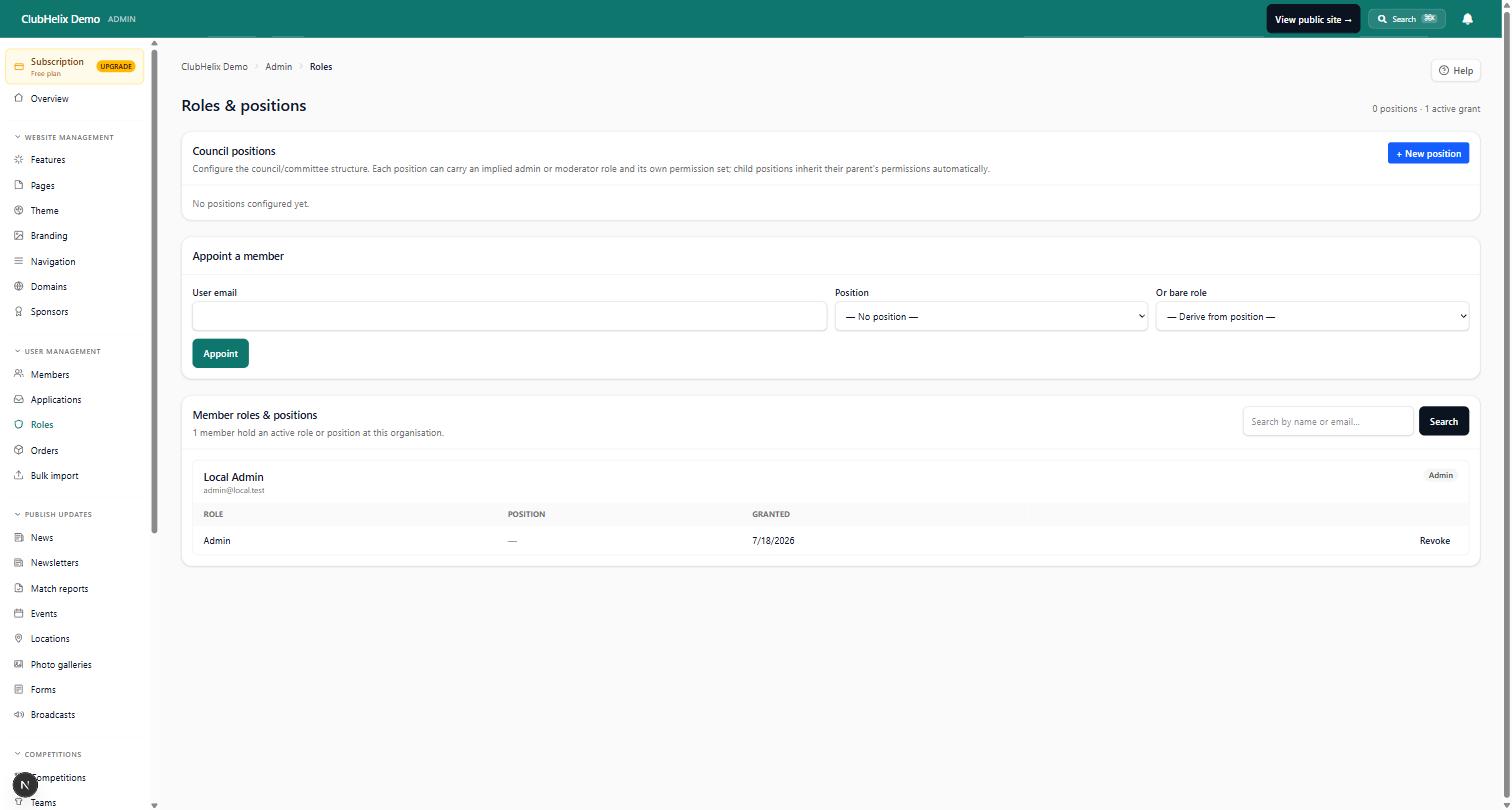
Three sentences beat three pages. What makes these duties real is whether the incoming holder can do them on day one, which is why societies that keep committee access as named roles with permissions hand over in ten minutes instead of a fortnight of chasing a graduate who has stopped replying.
8. Elections and vacancies
8.1 Committee members are elected by secret ballot at the annual general meeting. Nominations may be lodged with the Secretary up to [48] hours before the meeting, or taken from the floor where a position is otherwise unfilled.
8.2 Only members of the Society may nominate, second, stand for election or vote.
8.3 A position that attracts no nomination remains vacant and may be filled by the committee as a casual vacancy, that appointment lasting until the next general meeting.
8.4 A committee member may be removed by a resolution of a general meeting carried by a two-thirds majority, or ceases to hold office on resigning, ceasing to be a member, or being absent from [three] consecutive committee meetings without apology.
The absence rule in 8.4 is the quiet workhorse of student governance. Committee members rarely resign; they go on exchange, take a placement, or simply stop replying, and the seat stays technically filled while quorum quietly fails. A defined lapse rule refills it without a confrontation. Running the AGM and the ballot itself is a separate craft.
9. General meetings
9.1 The annual general meeting shall be held [before the end of the teaching year / by <date>] each year, and shall receive the President's report and the Treasurer's statement, elect the committee, and consider any other business set out in the notice.
9.2 At least [14] days' notice of a general meeting shall be given to all members by email and published on the Society's website.
9.3 The quorum for a general meeting is [10] members or [20]% of members, whichever is the lower. If quorum is not reached within 30 minutes, the meeting stands adjourned to a date not less than [7] days later, at which those present shall constitute a quorum.
9.4 The Secretary shall convene a special general meeting within [21] days of a written request signed by [10] members or by a majority of the committee.
9.5 Each member present has one vote. The chair has a casting vote where votes are equal. Proxy voting [is / is not] permitted.
The adjournment fallback in 9.3 is worth more than any other sentence in the document. Without it, a society that misses quorum in exam week has no lawful way to elect a committee, and the association's only remedy is to declare it dormant.
10. Committee meetings
10.1 The committee shall meet at least [four] times each semester or term.
10.2 The quorum for a committee meeting is half the committee rounded up, and must include at least one office bearer.
10.3 Minutes shall be kept of every committee meeting and made available to any member on request.
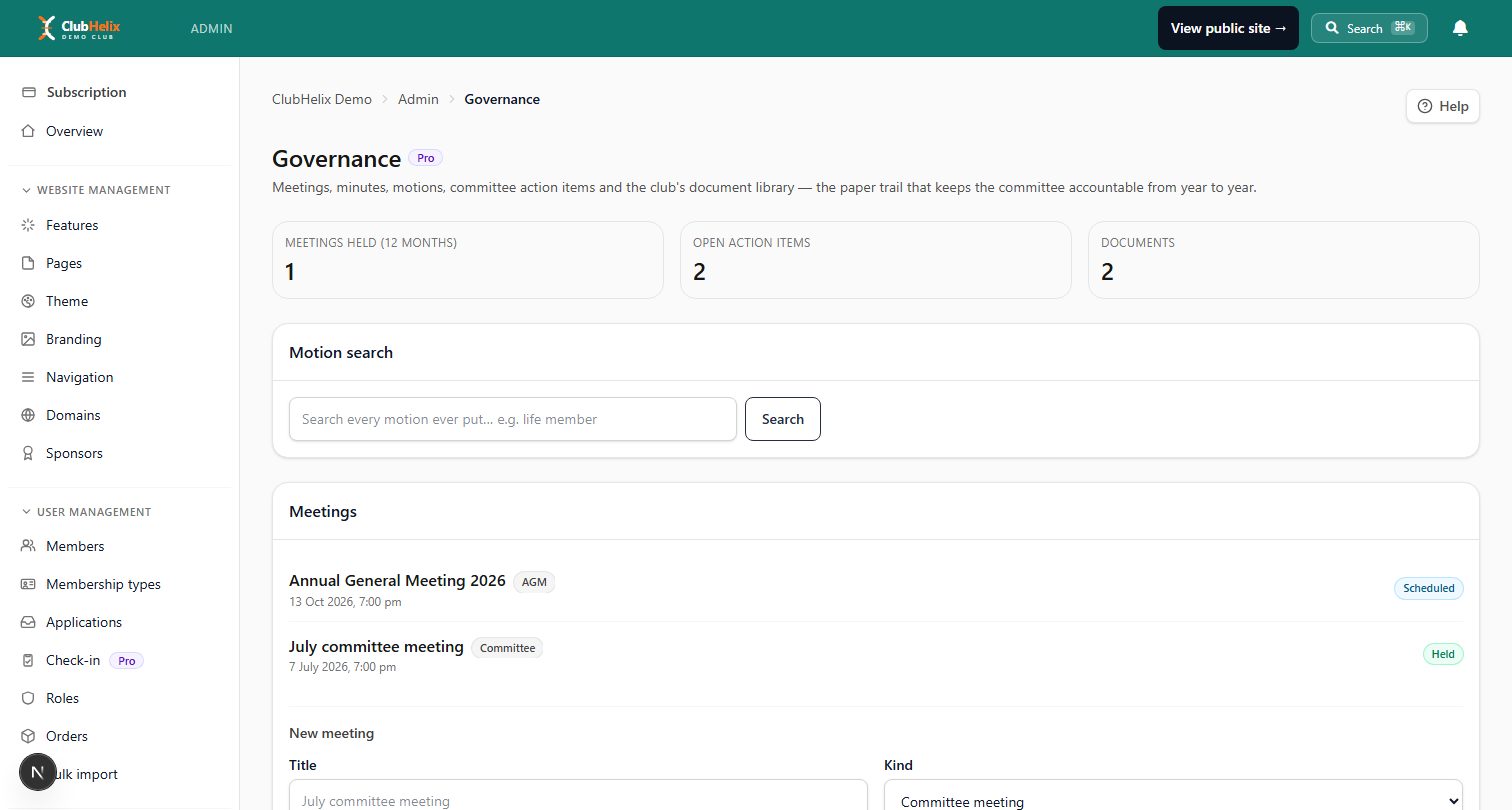
Clause 10.3 is the transparency clause and also how a committee protects itself: a society that records every motion in one place can show exactly when a spend was approved and by whom. Keeping meetings, motions and minutes in the society's own system, with an audit log of who changed what, means the answer survives the people — and our minutes template gives you the format.
11. Finances
11.1 The financial year runs from [1 <month>] to [30 <month>].
11.2 All Society funds shall be held [in an account in the Society's name / by the Association on the Society's behalf] and shall not be held in any personal account.
11.3 Payments require the approval of two of the President, Secretary and Treasurer. The Treasurer may commit up to $[100] between committee meetings, reporting it at the next.
11.4 The Treasurer shall present a statement of income and expenditure to the annual general meeting and to the Association with the affiliation return.
11.5 No member shall receive payment for holding office. Reasonable out-of-pocket expenses may be reimbursed on production of a receipt.
Clause 11.2 is not paranoia. Society money sitting in a member's personal account is the most common cause of a genuinely nasty handover, because the moment that person stops replying the funds are gone in practice even when nobody stole anything. Two-signatory approval protects the treasurer as much as the society.
Association club grants funded from the student services levy normally carry conditions your constitution must be compatible with: funds held in the club's own account, no surplus distributed to members, and receipts acquitted at year end. Some associations hold club money centrally, so the treasurer requests spending rather than holding a card — write clause 11.2 to match whichever applies to you.
12. Records, property and privacy
12.1 The Society's records — including the register of members, minutes, accounts, website, social accounts and email addresses — are the property of the Society and not of the individual who created them, and shall be transferred to the incoming committee within [14] days of the annual general meeting.
12.2 Member information is collected only for the purposes of running the Society, is accessible only to those committee members who need it, is not shared with any third party without consent, and is deleted or archived when no longer required.
Write clause 12.1 now and the awkward message to a graduated president reads "clause 12.1 says the accounts come across by the 14th" rather than "sorry to bother you again". Pair it with a real handover checklist.
Name your privacy obligations rather than reciting them: the Privacy Act 2020 sets the baseline, and your students' association usually has its own data rules for affiliated clubs on top. If any activity involves under-18s — a school outreach day, a junior coaching session — ask the association early which committee members need a children's worker safety check, and who pays for it.
13. Non-discrimination and conduct
13.1 The Society shall not discriminate against any person on the grounds set out in clause 3.1, and shall make reasonable efforts to ensure its activities are accessible to all members.
13.2 Members and committee members are bound by the Association's code of conduct at all Society activities, on and off campus.
The words "and off campus" do a lot of work at 1am on a society trip.
14. Amendments
14.1 These rules may be amended only at a general meeting, by a two-thirds majority of members present and voting, where the proposed wording was set out in full in the notice of that meeting.
14.2 An amendment takes effect when approved by the Association.
"Set out in full in the notice" stops a constitution being rewritten at 9pm by whoever is still in the room. Clause 14.2 means you must send changes in, so diarise it.
15. Dissolution
15.1 The Society may be dissolved by a two-thirds majority at a general meeting called for that purpose, or by the Association where the Society has been inactive for [12] months.
15.2 On dissolution, any remaining funds and property shall pass to the Association, or to a society with similar objects nominated by the Association, and shall not be distributed among members.
Every association checks this clause, and borrowed constitutions most often omit it. It answers the question no founding committee wants to think about — where the $840 and the marquee go — and removes any suggestion that the last three people standing split the balance.
The five things that get constitutions sent back
- A quorum you cannot reach. Copied from a much larger society, usually. Fix it with "whichever is the lower" and an adjournment fallback.
- No dissolution clause. Or one that distributes assets to members, which almost every association forbids.
- Officer eligibility that fails on its own committee. "Officers must have been members for two years" in a society founded last March.
- Contradictions between clauses. The old society's name still buried in a later clause; a 21-day notice period in one place and 14 days in another.
- Missing the association's own mandatory wording. This is the big one, and it is entirely avoidable.
Students' associations commonly mandate a minimum membership, a majority-student committee, a rule that only currently enrolled students may hold office or vote, a non-discrimination clause, and a dissolution clause returning assets to the association. Most publish a model constitution — start from that, keep its clause numbering, and flag any deviation on your affiliation form rather than hoping nobody notices it.
Adopting it: the meeting that makes it real
A draft is not a constitution until members adopt it — at your inaugural general meeting if you are new, or at an AGM or special general meeting if you are not.
- Send the full text with the notice, at least 14 days out. Not a summary: clause 14.1 will one day require exactly that.
- Take it in one motion, not clause by clause, unless a specific clause is genuinely contested. Clause-by-clause adoption turns a 20-minute item into two hours.
- Record the vote precisely in the minutes — mover, seconder, numbers for and against, and that the required majority was met. This is what your affiliation officer looks for. Note the adoption date and a version number on the document itself: "Adopted 14 August 2026, v1.0" saves a future committee comparing three near-identical PDFs.
- Send the adopted text to your association with the minutes, file both somewhere that is not a personal drive, and diarise a fifteen-minute review at the first committee meeting after next year's handover.
That annual review is where constitutions stay alive. You are looking for three things: numbers that no longer match reality, clauses you ignored all year, and anything your association has since made mandatory. Fixing one clause a year at the AGM is painless; finding six problems the week before an affiliation deadline is not.
Frequently asked questions
Can we just copy another society's constitution?
You can start from one, but never adopt one unchanged. The clauses that need to fit you specifically are quorum, committee size, officer eligibility, the membership year and the objects — and those are exactly the ones people forget to change. The safer starting point is your student association's model constitution if it publishes one, because it already contains the mandatory wording your affiliation will be assessed against. Then work through this template and set the numbers for the society you actually have.
How long should a student society constitution be?
Around 1,200 to 1,800 words, or three to four pages. Longer and no future committee reads it, which defeats the purpose; shorter and you have probably dropped discipline, dissolution or the adjournment fallback. If you find yourself writing procedure for how events get planned or who posts to the socials, that belongs in a committee handbook, not the constitution — those rules should be changeable by a committee vote rather than a two-thirds majority of members.
Do we need to register the society as a legal entity?
For most student societies the answer is no, because recognition by your student association is what unlocks insurance, rooms and funding. The question only becomes live when the society holds substantial money in its own name, signs contracts nobody at the institution has approved, employs anyone, or owns property. This is general information rather than legal advice — ask your student association first, and take professional advice if you are genuinely at that threshold.
Most societies stay unincorporated clubs under their students' association. Becoming an incorporated society is the usual next step for a body with its own significant funds, and the 2022 Act prescribes both a minimum membership and specific constitution content.
What quorum should we set for our AGM?
Set it low enough that a normal year clears it and high enough that a handful of friends cannot rewrite the rules — for a society under 60 members, 10 members or 20% of the membership, whichever is lower, works well. The more important half of the clause is what happens when quorum fails: an adjournment provision letting a reconvened meeting proceed with those present is what stops a bad exam timetable leaving you without a committee. If you miss quorum two years running, the problem is usually the timing of the meeting rather than the number.
Who owns the society's money and equipment if we fold?
Whoever your dissolution clause says, which is why clause 15 exists and why associations insist on it. In almost every case the answer is your student association, or a society with similar objects that the association nominates — never the members. Equipment bought with grant money often has to go back to the funder specifically, so check any grant conditions before assuming the general clause covers it. Writing this down at the start also spares the final committee an uncomfortable judgement call while everyone is disappointed.
Where ClubHelix fits
A constitution only works if the things it promises actually happen — the register is kept, the minutes exist, the accounts are visible, and access moves to the new committee within a fortnight of the AGM. ClubHelix gives a society one place for all of it: a member register with the fields your rules require, committee roles and permissions you grant and revoke rather than passwords you pass on, meetings, motions and minutes recorded against the society itself, and an audit log showing who changed what. A student association can sit above its affiliated societies in the same hierarchy, so affiliation returns stop being an email attachment nobody can find.
Setting a society up from scratch? Start with how to start a university club and keeping member records safely. Plans are sized by member count, so check the limits on the pricing page against the size of your register before you plan a year around a tier.


