
What this guide answers
- How big should a student society's reserve be?
Enough to cover next year's float plus one bad event, which for most societies means somewhere between $300 and $600.
- What should a student society budget include?
Income from memberships, event tickets, grants, sponsorship, fundraising and merchandise; expenses for venues and deposits, catering, equipment, printing and promotion, the flagship event, the always-on costs, payment…
- Do we need accounting software, or is a spreadsheet enough?
For most societies a single well-structured sheet is genuinely enough for the budget itself — the seven-row template above works fine as a shared sheet.
- How do we budget when we have no idea how many members we will get?
Build three columns rather than one: a pessimistic case at about 60% of last year's members, a realistic case matching last year, and an optimistic case at 130%.
- We have to pay for things before our grant arrives — what do we do?
This is the most common cash problem in student society finance, and the fix is sequencing rather than money.
USA edition. This guide is written for volunteer-run clubs in the United States. Where rules differ — grants, tax, incorporation, safeguarding — follow the USA-specific pointers below or check with your national body.
You were elected treasurer in week two, probably because you were the only person who did not look away. Nobody handed you a budget. What you inherited was a balance figure someone read out at the AGM, a suspicion that last year's committee never claimed back the money they spent on the fair stall, and a stall booking invoice due in eleven days — before a single member has paid anything.
That is the actual shape of student society finance, and it is why most budget templates fail a society within a fortnight. They are built to answer "did we make a profit this year", which no society genuinely cares about. Your society needs a budget that answers a much sharper question, roughly weekly: can we pay for this thing on the day it falls due, with money we actually have access to?
This guide gives you a template built around that question — a term-by-term cash view, break-even maths for individual events, and the two numbers (the float and the reserve) that decide whether the next committee starts with breathing room or starts in a hole. It assumes you are not an accounting student, you have about twenty minutes a fortnight, and everything you build has to be intelligible to a stranger in eight months' time.
Budget for cash timing, not for profit
A commercial budget is about margin. A society budget is about timing. Your income arrives in violent spikes — a three-week rush of membership payments after the start-of-year club fair, a grant that lands in the sixth week, ticket money that arrives eight days before an event you paid a deposit on two months ago. Your spending, meanwhile, is remorselessly early: deposits, printing, stall fees, the first social.
That mismatch is where societies get hurt. A society can be comfortably "in profit" for the year and still be unable to pay a $400 venue deposit in week one, because the money is either not yet collected, held by somebody else, or sitting in a committee member's personal account waiting to be reimbursed.
Four numbers make the whole thing legible. Write them at the top of your budget and update them every time you touch it.
- The float — the cash you need available before any income arrives. Stall fee, banner reprint, first-social deposit, the tray of biscuits. For a mid-sized society this is usually $200 to $400, and it is due at the worst possible moment in the calendar.
- The reserve — what you deliberately leave the incoming committee so they can pay their float without begging. This is a budget line, not leftovers.
- Committed spend — money you have promised but not yet paid. Deposits agreed, an act booked, an order placed. A balance that ignores commitments is fiction.
- Uncommitted income — money you can genuinely spend, which is not the same as your balance. Grant money earmarked for a specific project is not spending money, even while it sits in the account.
Two of the four sit outside your bank balance entirely, which is exactly why a committee that only ever looks at the balance ends up surprised.
Where your money physically sits changes the whole exercise. Most recognised student organisations spend from a university agency account rather than a bank account of their own: purchases run through a requisition or a purchasing card held by the activities office, and reimbursements need an adviser's signature. Turnaround is commonly two to four weeks and slows dramatically at the end of the fiscal year. Groups with an outside account normally need two signers, and swapping them after officer transition takes the bank a couple of weeks.
Whichever model you are in, budget for the process and not just the price. If reimbursement takes three weeks, the practical question for every purchase is who is fronting the money and whether they can afford to. Committees quietly run on the one member with a credit card, and that member gets resentful somewhere around week nine. Where a vendor will bill the university directly, always take that option, even if it is slightly dearer — it removes the personal exposure entirely. And keep every receipt as a photo the day you get it, in a shared folder rather than a phone camera roll, because a lost receipt is money the organisation simply never sees again. General information only — your activities office sets the actual process.
The template: a term-by-term cash view
Here is the whole template. Seven rows, five columns, and it fits on one screen — which is the point, because a budget nobody opens is worth nothing.
Below is a worked year for a mid-sized society: 280 sign-ups at the club fair, 40% converting to a paid $10 membership, one big end-of-year ball, a modest grant and one sponsor.
| Period | Money in | Money out | Net | Balance |
|---|---|---|---|---|
| Handover balance | — | — | — | $450 |
| Before teaching starts | $0 | $240 — stall fee, banner reprint, flyers | −$240 | $210 |
| Teaching period 1, weeks 1–6 | $1,420 — 112 memberships @ $10, $300 tickets | $760 — welcome social, room deposit, catering | +$660 | $870 |
| Teaching period 1, weeks 7–12 | $800 — association grant | $620 — speaker night, printing, subscriptions | +$180 | $1,050 |
| Between teaching periods | $0 | $90 — domain, storage, admin | −$90 | $960 |
| Teaching period 2, weeks 1–6 | $680 — $180 late joiners, $500 sponsorship | $540 — socials, equipment replacement | +$140 | $1,100 |
| Teaching period 2, weeks 7–12 | $2,400 — 70 ball tickets | $2,900 — venue, act, decorations | −$500 | $600 |
| After the year ends | $0 | $150 — AGM catering, awards | −$150 | $450 |
Total in: $5,300. Total out: $5,300. The society ran a full year of programming, filled a ball, and finished exactly where it started — with $450 for the next committee's float. That is a successful year, and it looks like nothing on a profit-and-loss statement. This is why the template tracks a running balance rather than a bottom line.
Read the rows in order and the pressure points announce themselves. The society dips to $210 before a single member has paid — that is the float working, and a committee that handed over $50 instead of $450 would have been unable to book the stall at all. The ball lost $500, absorbed by a balance that was healthy because everything before it worked. Nothing here is dramatic; it is just visible, in advance, which is the entire benefit.
Two adaptations worth making. If your society runs on a different rhythm — three shorter terms, a mid-year intake, a summer program — change the row labels, not the structure. And if your association holds your money, add a column called "claimed / not yet paid" so you can see the gap between what you have spent and what has actually come back.
Event break-even maths (the number that stops a disaster)
Every event gets one line of arithmetic before it is announced. Not after. The formula is:
Break-even tickets = fixed costs ÷ (ticket price − variable cost per head)
Fixed costs are what you owe whether four people come or four hundred: venue hire, minimum spend, the act, the deposit, printing. Variable cost per head is what each additional attendee costs you: catering, wristbands, a drink token.
Work the ball from the table above, because it contains the trap that catches most committees.
- Venue minimum spend: $2,400 — which covers catering for up to 80 people
- Act: $350. Decorations and printing: $150
- Fixed costs: $2,900. Ticket price: $35. Room capacity: 120
The naive sum is $2,900 ÷ $35 = 83 tickets. That number is wrong, and the reason is the minimum spend. Above 80 heads the venue charges an extra $30 a head, so every ticket after the eightieth contributes only $5, not $35. Walk it out: at 80 tickets you are $100 short; each ticket after that closes $5 of the gap; you need 20 more. Real break-even: 100 tickets — $3,500 in, $2,900 + (20 × $30) = $3,500 out.
One hundred tickets is 83% of the room's capacity. That is not a plan, it is a bet, and this society lost it: 70 tickets sold, $2,400 in, $2,900 out, $500 gone. The maths predicted that outcome months earlier. The committee could have negotiated the minimum spend down, raised the ticket to $45, moved to a cheaper room, or found a $500 sponsor to cover the act — all easy in August, all impossible in the final fortnight.
The rule of thumb worth writing into your budget: if break-even is above 60% of capacity, change something. Between 40% and 60% is a normal, healthy event. Below 40%, you have probably priced too high and will under-fill a room that felt empty.
Two more habits. Sell in waves — an early-bird tier that closes on a real date gives you a genuine read on demand while you can still act on it, rather than a panic discount in the last week that annoys everyone who paid full price. And use a small ticket price on "free" events: free RSVPs convert to attendance at roughly 55–70%, paid tickets above 90%, so a $5 ticket is not a revenue decision, it is how you know whether to cater for 40 or 80. The ball ticketing guide goes through pricing against a venue minimum in detail.
One thing to check before you set a ticket price: sales tax. It varies by state and by whether the university's own exemption extends to a recognised student organisation, and it bites hardest on merchandise — a hoodie run priced without tax in the sum is a real hole. Where you spend through a university agency account, the activities office usually knows the answer immediately, so ask before you price anything you intend to sell in volume. Admission charges are treated differently from goods in many states, which is exactly the kind of detail worth confirming rather than guessing.
The other tax-shaped question is deductibility, which comes up the first time a local business offers you $500 or a parent asks for a receipt. Sponsorship is generally a business expense for the sponsor and ordinary income for you. A tax-deductible donation is a different thing and requires 501(c)(3) status, which your group almost certainly does not have on its own — though gifts routed through the university foundation sometimes qualify. Never imply on a donation page that a gift is deductible unless someone in a finance role has confirmed it in writing. This is general information, not tax advice — your activities office or a professional is the right source.
The six line items societies always forget
Nobody forgets the venue. These are the six that quietly turn a $200 surplus into a $200 loss, in rough order of how often they bite.
1. Payment and ticketing fees. Card processing typically costs a small percentage plus a fixed amount per transaction, and it is the fixed part that hurts a society. On 112 memberships at $10 each, a fee of roughly 50c a transaction is $56 — a full 5% of that income, because the fixed component dominates small payments. Budget fees as a line, and if you are collecting $5 and $10 amounts, consider whether one $12 annual membership beats three small charges.
2. The reimbursement gap. Not a cost, but a cash requirement: the total your committee members are personally out of pocket at any moment. Track it. When it exceeds about $300, you are running the society on someone's overdraft, and that is both unfair and fragile.
3. Deposits, bonds and minimum-spend shortfalls. A refundable bond is still money you cannot spend for six weeks. A minimum spend you do not reach is a real cost with no benefit — if the bar minimum is $800 and your crowd spends $600, the society owes $200 for nothing. Both belong in the budget on the day they are committed, not the day they are paid.
4. Catering against no-shows. Free RSVPs convert at 55–70%. Cater to the RSVP number and you burn a third of the food budget; cater to 60% and have everyone turn up and you have a worse problem. The workable answer is a small ticket price to firm up the number, plus food that scales — trays rather than plated portions.
5. The always-on costs nobody owns. Domain renewal, storage or cupboard hire, printing, replacing the marquee weight that walked off, the AGM catering, the awards at the end. Individually trivial, collectively $200 to $400 a year, and invisible because they belong to no event. Give them their own row.
6. The reserve. Yes, again — because the most common way a society ends the year with nothing is not overspending, it is treating whatever is left as "spare" in week ten and putting it into pizza. Write the reserve in as a line item at the start of the year, alongside the venue costs, and treat it as spent.
Keeping the budget alive for twelve months
A budget is a forecast on the day you write it and worthless by week five unless you update it. Twenty minutes a fortnight is genuinely enough.
- Reconcile fortnightly, not annually. Match what the account says against what your budget says. Two figures, one difference, and you find errors while people still remember the transaction.
- One line before, one line after. Every event gets its break-even sum before it is announced and its actual result written next to it afterwards. After three events you can forecast the fourth accurately, which is a superpower at grant time.
- Report a variance, not a balance. At each committee meeting: here is what we forecast, here is what happened, here is why. Three minutes. Our treasurer report template has a format that works.
- Never let the treasurer be the only person who can see the money. Two people with visibility, always. It protects the treasurer as much as the society.
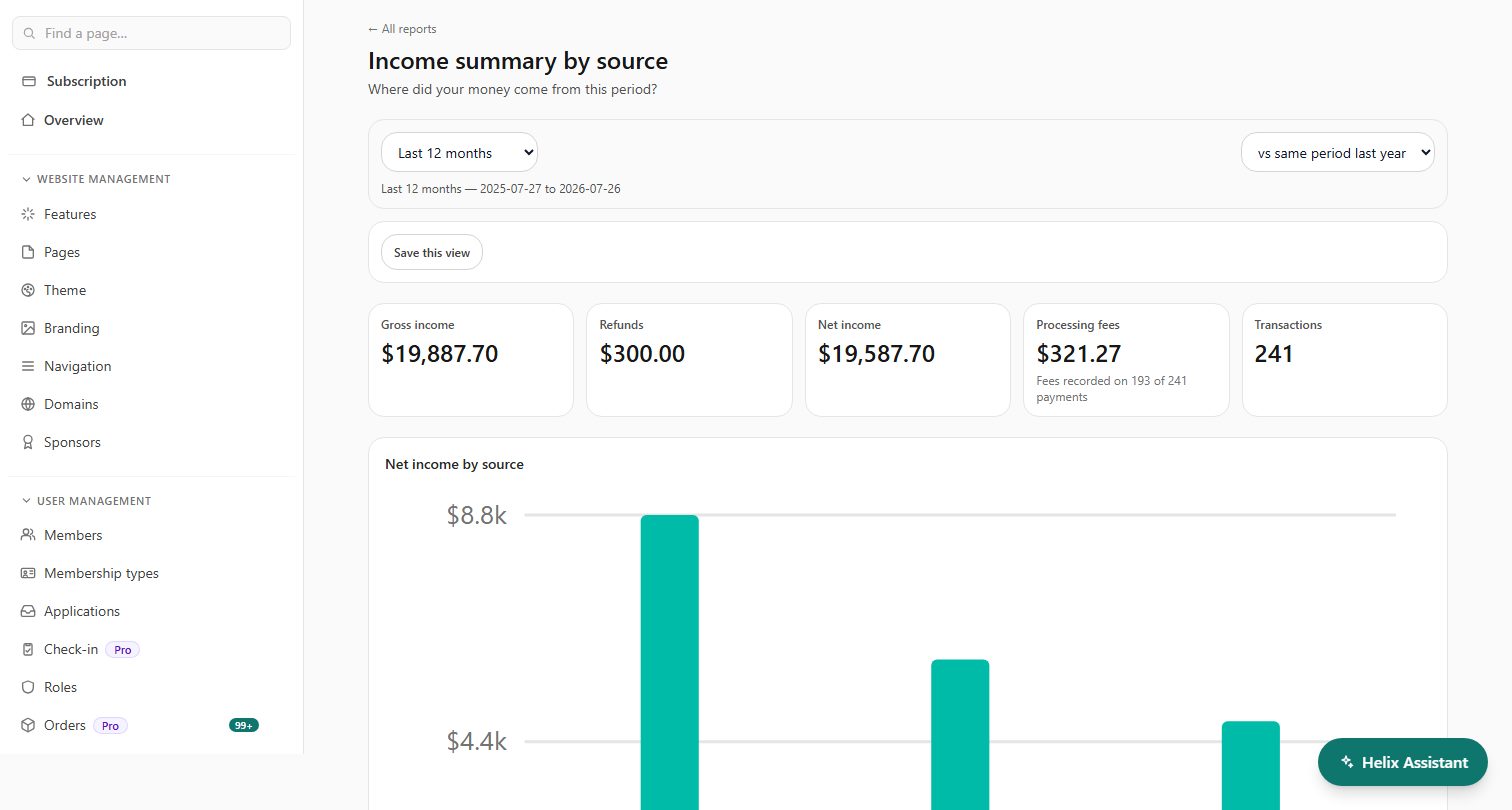
This is the point where a spreadsheet in someone's drive starts costing you. It only shows what somebody typed into it, which means the treasurer spends their fortnight transcribing payments rather than thinking. If members pay through your own site, the income side fills itself in — every membership, ticket and merchandise sale recorded against a real person, with the fees visible. Built-in reports will show you income by source and by month, which is the same view your association's grant panel asks for and the same view your successor needs on day one.
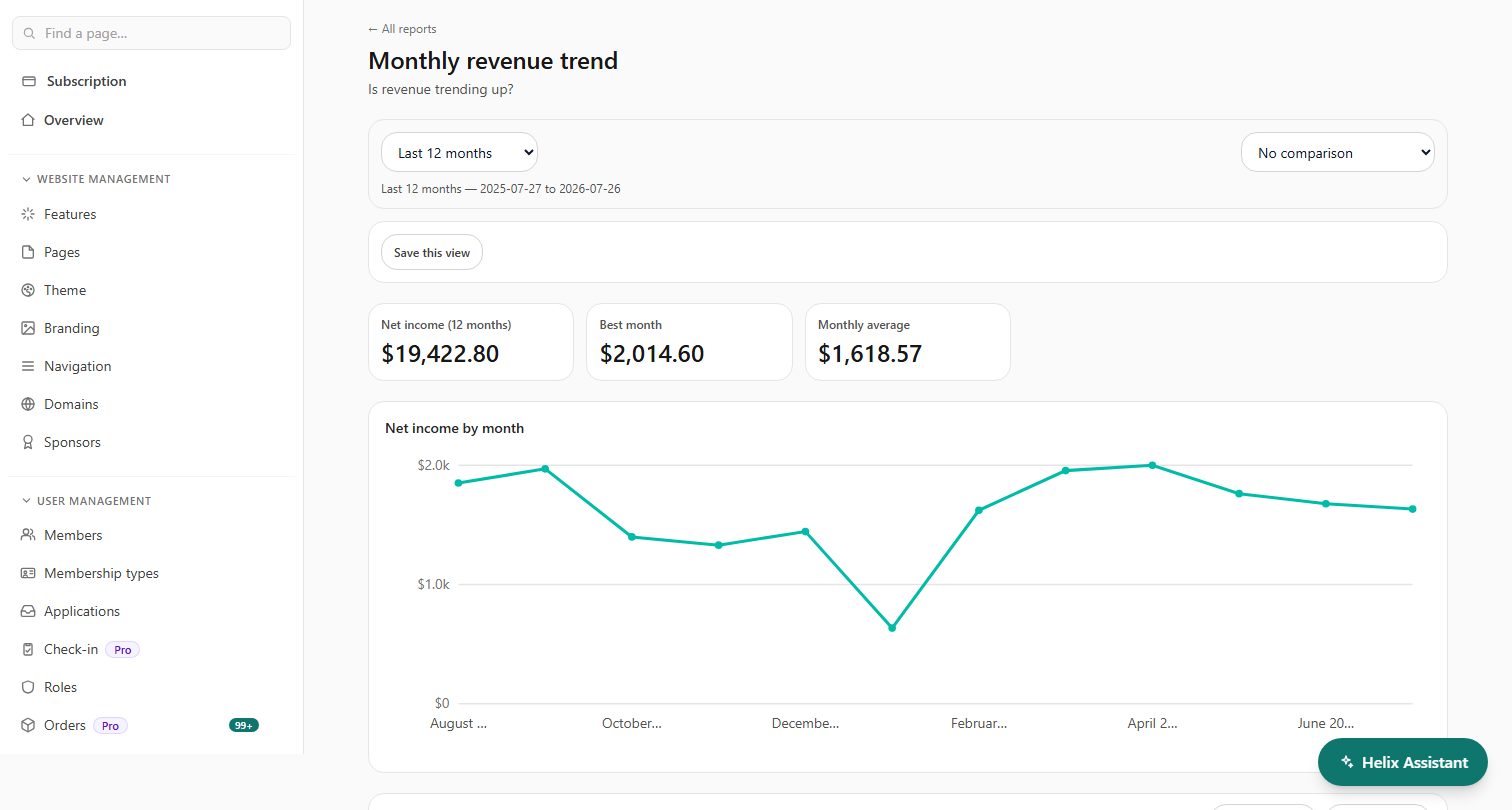
Two other income lines worth wiring in properly rather than handling by hand. Donations — for alumni, departing final-years and the parents who come to a showcase — arrive irregularly and are almost always under-collected because nobody has anywhere to put them. And sponsor records keep what each sponsor agreed, what they paid, and what you still owe them in deliverables, which is what turns a one-year sponsor into a three-year one.
The budget half of the handover
The single most valuable thing you can leave your successor is this year's actual numbers next to this year's forecast. It converts a blank page into an editing job. Hand over:
- The completed budget with actuals filled in — the file above, no reformatting.
- The closing balance and the reserve, stated as two separate figures with a sentence explaining the difference.
- Every commitment that outlives you: deposits paid, invoices unpaid, the act booked for next March.
- Outstanding reimbursements, including the ones owed to committee members who are graduating. These get forgotten and they are somebody's actual money.
- Grant obligations: what was awarded, what was spent, what still has to be acquitted and when.
- Every event's break-even sum and result, so next year's committee can price with evidence.
- Access to the money, not a password — signatories changed at the bank or the association's portal, and per-person logins to whatever system holds the records.
Book that meeting within two weeks of the AGM. The full version, covering everything beyond money, is in the society handover checklist, and the general club budget template is the right starting point if your organisation runs on a calendar year rather than an academic one.
Frequently asked questions
How big should a student society's reserve be?
Enough to cover next year's float plus one bad event, which for most societies means somewhere between $300 and $600. The float is the concrete part: add up the stall fee, printing, the first social's deposit and any early commitments, and that is the minimum your successors need before income arrives. Societies holding a lot more than a year's operating costs sometimes come under pressure from their student association to spend it on members rather than hoard it, which is a fair challenge — the reserve is insurance, not savings.
What should a student society budget include?
Income from memberships, event tickets, grants, sponsorship, fundraising and merchandise; expenses for venues and deposits, catering, equipment, printing and promotion, the flagship event, the always-on costs, payment fees, and the reserve as a deliberate line. The structure matters more than the categories: keep it as a term-by-term running balance so you can see the low points, and separate committed money from available money. A budget that lists twenty categories but never shows a date is much less useful than seven rows in time order.
Do we need accounting software, or is a spreadsheet enough?
For most societies a single well-structured sheet is genuinely enough for the budget itself — the seven-row template above works fine as a shared sheet. The problem is not the maths, it is the data entry and the handover: a sheet only knows what someone typed in, and it leaves with whoever owns the drive folder. The practical middle ground is to take income through a system that records members and payments automatically, and keep the forecast in a sheet the whole committee can see. What you should not do is run the year out of a bank statement and a group chat.
How do we budget when we have no idea how many members we will get?
Build three columns rather than one: a pessimistic case at about 60% of last year's members, a realistic case matching last year, and an optimistic case at 130%. Then check that the pessimistic column still pays for your fixed commitments — the stall, the deposits, the always-on costs. If it does not, you are relying on growth to cover bills, which is how societies end up cancelling events in week nine. Commit spending against the pessimistic number and treat anything above it as funding the extras. Our membership fees guide covers how price affects the conversion rate you plug in.
We have to pay for things before our grant arrives — what do we do?
This is the most common cash problem in student society finance, and the fix is sequencing rather than money. Ask suppliers to invoice your student association or the university directly wherever possible, so no individual fronts anything. Negotiate deadlines: most campus suppliers and many local ones will hold a booking on a small deposit and invoice the balance later, if you ask early and politely. And where you genuinely must pay first, make it a committee decision recorded in the minutes, with a named reimbursement date.
Ask the activities office whether the purchase can go on a departmental card or a purchase order rather than a personal reimbursement — that is usually possible and removes the exposure entirely. Where student government has approved an allocation that has not yet been released, the approval is often enough for a campus vendor to hold a booking. Plan around the fiscal year end, when purchasing slows dramatically.
Where ClubHelix fits
The template above works in any format you like — the hard part was never the arithmetic. What breaks a society's finances is that the money arrives by hand, the record lives in one person's drive, and the whole thing is rebuilt from memory every twelve months. ClubHelix takes membership payments, event tickets, merchandise, donations and sponsor records through the society's own site, so the income half of your budget fills itself in and the reports your grant panel wants already exist.
Because the records belong to the society rather than to whoever set them up, next year's treasurer opens the same reports on their first day instead of asking a graduate for a spreadsheet. If your student association wants oversight of its affiliated societies, it can sit above them in the same structure while each society keeps its own site and its own numbers — that is what the university clubs and societies setup is for. Costs, including the free tier for building the site and trying it out, with taking payments online and being found in search on the paid plans, are on the pricing page, and there are ready-made site templates if you are starting from nothing. For the wider picture, our complete guide to running a student society covers the year around the budget, and the funding and grants guide covers where the external money comes from.
ClubHelix gives your society income reports the next treasurer can actually read, donations that do not need a bucket and sponsor records that survive the handover. Start free before your next budget is due.


