
What this guide answers
- How much notice do we have to give for a society AGM?
Whatever your constitution says, plus whatever your student association's affiliation rules require — take the longer of the two.
- What counts as quorum, and what if we do not reach it?
Quorum is the minimum number of voting members present for the meeting to be valid, and it is defined in your constitution — often a flat number like fifteen, or a percentage of paid members.
- Can we run the election online?
Only if your constitution allows it and you can demonstrate that voters were eligible, voted once each, and voted secretly.
- Do we have to send our AGM minutes to anyone?
Almost certainly, and sooner than you think. Your student association usually wants the minutes and the new committee's details before it renews affiliation or releases funding, and your bank will want them before it…
- Can a member who has not paid vote at the AGM?
That depends on how your constitution defines membership, and it is worth resolving before the meeting rather than at the sign-in desk.
UK edition. This guide is written for volunteer-run clubs in the UK. Where rules differ — grants, tax, incorporation, safeguarding — follow the UK-specific pointers below or check with your national body.
The president graduates in four months. The treasurer is going on exchange next semester. The bank account has two signatories, one of whom finished her degree eighteen months ago and has not answered a message since. Somewhere there is a constitution that nobody on the current committee has read.
The AGM is the meeting that fixes all of that, once a year, in about fifty minutes. Run it properly and the society hands itself cleanly to the next committee with a mandate, a full slate of officers and a paper trail. Run it badly and you get an inquorate meeting, a disputed election, a treasurer who never actually agreed to be treasurer, and a bank that will not change the signatories because your minutes do not say what the bank needs them to say.
Societies have one problem that community clubs do not: the entire electorate turns over every three or four years. Nobody in the room remembers how last year's AGM was run, so the rules have to be visible rather than remembered. That is the whole job — make the rules visible, follow them in public, and write down what happened.
Start with the rule book, not the room booking
Before you pick a date, find your constitution and look up four numbers. If you cannot find it, that is task one: your student association almost certainly holds the copy you lodged when you affiliated, and a society constitution template will tell you what should be in it.
| Look up | Typical for a society | What goes wrong without it |
|---|---|---|
| Notice period — days between sending the notice and the meeting | 10–21 days | A member who missed the meeting challenges the result, and they are right |
| Quorum — voting members needed for the meeting to be valid | A flat 10–20 members, or 10–25% of paid members | You elect a committee that is legally not a committee |
| Nomination deadline — written nominations before, or from the floor | 3–7 days before, or from the floor | Someone is nominated on the night for a role your rules say needed a form |
| Who may vote — paid members only? currently enrolled only? | Paid members who are current students | The "is Sam a member?" argument happens mid-ballot instead of at the sign-in desk |
Write those four answers at the top of your planning document and put them in the notice. Almost every disputed student society election traces back to one of them being assumed rather than checked.
Two more things worth checking while the document is open. First, whether proxy voting is allowed — most society constitutions are silent, and silence usually means no. Second, whether a specific person must chair, which is normally the outgoing president; if that person is standing for re-election, hand the chair to someone else for that item.
Your constitution is not the only rule book. The students' union societies handbook or bye-laws sit on top of it, and they are usually more prescriptive than the constitution — a set notice period, a requirement that the AGM falls inside a stated window, sometimes a requirement that elections run through the union's own voting system with a union staff member as returning officer. Most societies are unincorporated members' clubs governed almost entirely by their own rules; a society large enough to have become a CIO also has Charity Commission obligations that the AGM is the natural place to approve. General information only — check your union's current handbook.
The six-week countdown
Semester calendars are unforgiving, so work backwards from a date that actually exists. The sweet spot is roughly weeks 9 to 11 of the second teaching period: late enough that the year's story is complete, early enough that people are still on campus and not yet in exam panic. Avoid the week your student association runs its own elections, avoid the fortnight before exams, and never schedule the AGM in the final week — half your members have already gone home.
Six weeks out. Fix the date, the room and the start time. Book the room the moment the date is set, because on most campuses the good rooms are gone six weeks ahead. Confirm the treasurer can have a full year of figures reconciled by then.
Five weeks out. The treasurer reconciles. Every account, every outstanding reimbursement, every unpaid invoice, and a plain one-page summary of income, expenditure and closing balance. If the numbers are not ready five weeks out, they will not be ready on the night.
Four weeks out. Personal asks. This is the single highest-value hour of the whole process. Every retiring officer should personally approach two people about their own role and tell them honestly what it costs in hours. AGMs do not fill committees; the coffees beforehand do. Send everyone the committee role descriptions so nobody is signing up for a mystery.
Three weeks out. Send the formal notice to every member, with the agenda, the nomination form and the deadline. Use a channel your rules recognise, and keep proof. An email broadcast to the member list gives you a timestamped send log — exactly what you want if anyone later claims they were not notified.
Two weeks out. Nominations open. Post them publicly as they arrive; visible nominations trigger more nominations, because people who were undecided see a real contest rather than an empty page.
One week out. Nominations close (if your rules require it), and the meeting pack goes out: agenda, last year's minutes, the financial summary, and the confirmed nominations.
The day before. Print the attendance sheet — it is your quorum evidence — plus ballot slips, spare packs and one printed copy of the constitution for the chair. Somebody brings snacks. Attendance at a student AGM correlates with pizza more strongly than with any agenda item.
Nominations decide the meeting before it starts
By the time you open the floor, the outcome is usually already set. A society that reaches the AGM with five nominations for six positions has a governance problem no amount of good chairing can fix on the night.
Ask for four things on a nomination form: the candidate's name and contact, the position, a nominator and seconder who are both members, and 100 words on why. The word limit is not decoration — it filters people who have not thought about it, and it gives the meeting something to read when three people stand for president.
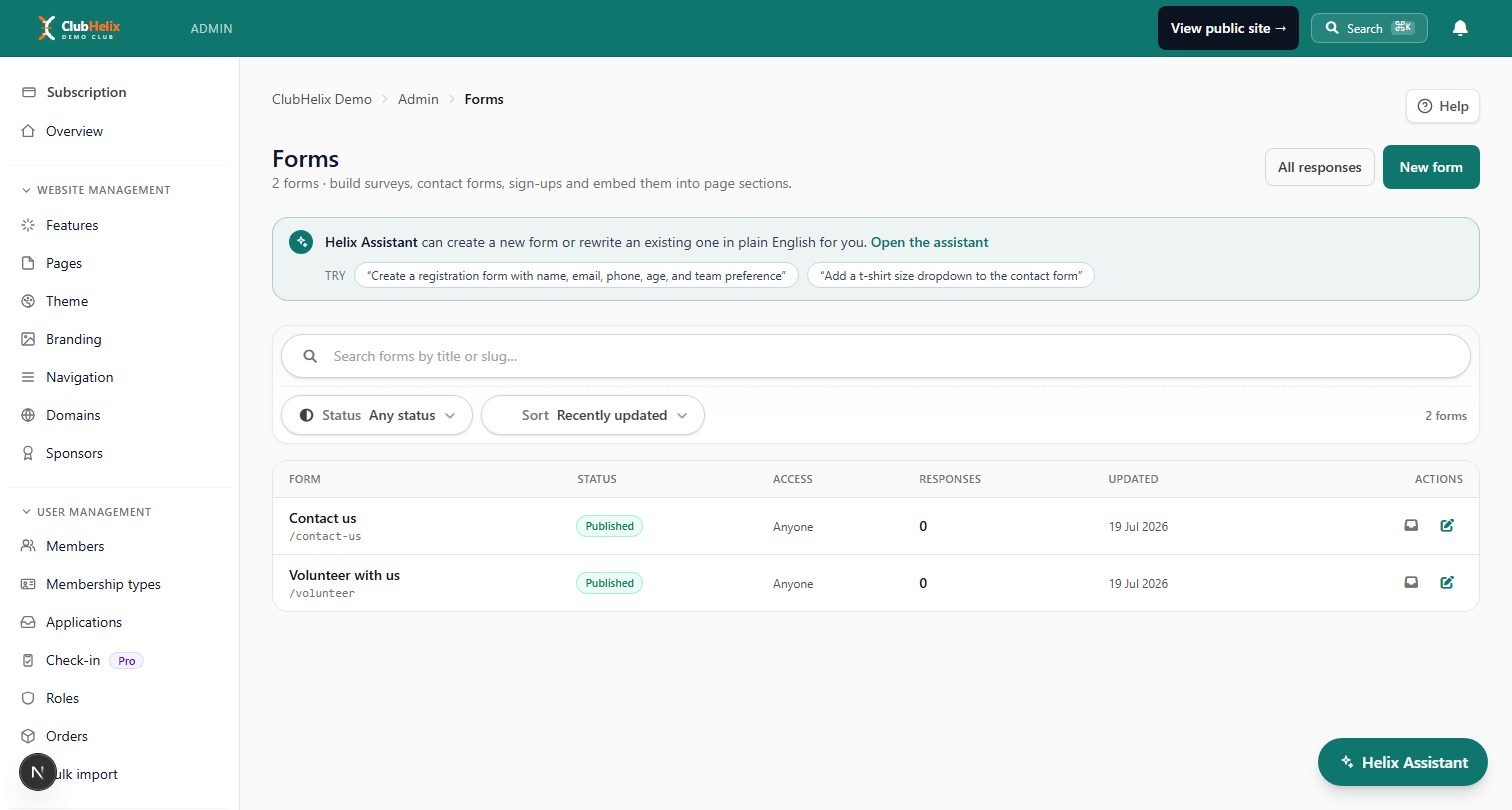
Collect nominations through a form on your own site rather than a shared document. A form gives you one clean list and timestamps every entry, so a nomination either arrived before your deadline or it did not — and each submission is a fixed record rather than a live document a candidate can quietly rewrite after reading a rival's. If you restrict the form to signed-in members, you also stop the nomination that arrives from someone who has never been a member. And the list belongs to the society rather than to the graduating secretary who happened to create the document.
Three nomination rules worth writing down now, before they are contentious:
- Can someone stand for two positions? Usually yes, with the higher office decided first, and they withdraw from the second if elected. Say so in the notice.
- Can a nomination come from the floor? Only if your constitution allows it. If it does, allow it — a rule that blocks a willing volunteer on a technicality is a rule that costs you a treasurer.
- Can someone stand in absentia? Yes, if they have confirmed in writing that they accept the nomination. Never elect an absent person who has not confirmed; it is the single most common way societies end up with a phantom officer.
Running a ballot people accept afterwards
Appoint a returning officer — sometimes called an election officer or scrutineer — who is a member, is not standing, and is not the flatmate of anyone who is. A retiring president who is definitely leaving is ideal. They declare each position vacant in turn, read the nominations, run the vote and announce the result.
Run contested positions by secret ballot on paper slips, counted by the returning officer plus one non-aligned witness. A show of hands is quicker and quietly brutal: in a society of forty people who all know each other, nobody wants to be seen voting against a friend. Friendships survive secret ballots far better.
Decide and announce the counting method in the notice, not after the votes are in. Two work well: simple first-past-the-post for a single position, or a preferential count where voters rank candidates and the lowest is eliminated until someone has a majority. Include a "re-open nominations" option on any single-candidate ballot — it gives members a legitimate way to say "not this person" without personal confrontation, and if it wins you run that position again rather than starting the year with a mandate nobody believes in.
Online voting is fine if your rules permit it and you can prove three things: only eligible members voted, each voted once, and the ballot was secret. That is harder than it sounds with a generic free form tool, which will happily accept ten submissions from one enthusiastic member. If you cannot prove all three, run the ballot on paper in the room and let remote members join for everything else.
Ties happen more often than statistics suggest, because members vote in friendship groups. Your constitution may give the chair a casting vote; if it is silent, agree the tiebreak before the count — a second ballot between the tied candidates is fairest, and drawing lots is a legitimate last resort as long as everyone agreed to it in advance.
Check first whether your students' union requires society elections to run through its own voting platform with a union staff member as returning officer. Where it does, that system replaces your paper ballot entirely and has its own nomination deadlines, which are often earlier than yours.
The notice and agenda templates
Notice of AGM
NOTICE OF ANNUAL GENERAL MEETING — [Society name]
Notice is hereby given that the Annual General Meeting of [Society name] will be held:
Date: [day, date] · Time: [time] · Where: [room, building, plus online link if offered]
Business:
- Welcome, apologies and confirmation of quorum
- Confirmation of the minutes of the previous Annual General Meeting
- President's report
- Treasurer's report and financial statements — motion to accept
- Setting of membership fees for [year]
- All committee positions declared vacant; election of the incoming committee
- Special business as set out below, in full: [text of any constitutional amendment]
- General business
Nominations for [list positions] must reach the Secretary at [address] by [time, date] using the form at [link], or may be made from the floor. Nominees must be members and must confirm they accept nomination.
Voting is open to members whose [year] membership is paid. Contested positions will be decided by secret ballot using [first-past-the-post / a preferential count]. A "re-open nominations" option appears on every ballot.
[Name], Secretary — [date]
Any constitutional amendment must appear in the notice in full. You cannot spring a rule change on the night, and an amendment passed without proper notice is the kind of thing that unravels a year later when someone reads it properly.
Agenda with times
A student society AGM should take 50 minutes. Give the chair a copy with the timings on it.
| # | Item | Who | Time |
|---|---|---|---|
| 1 | Welcome, apologies, confirm quorum against the attendance sheet | Chair | 5 min |
| 2 | Minutes of the previous AGM — motion to confirm | Secretary | 3 min |
| 3 | President's report — the year in review, taken as read | President | 6 min |
| 4 | Treasurer's report and financials — motion to accept | Treasurer | 8 min |
| 5 | Membership fee for the coming year — motion | Treasurer | 4 min |
| 6 | Special business as per notice (constitutional amendments) | Chair | as needed |
| 7 | Positions declared vacant; elections, position by position | Returning officer | 15 min |
| 8 | General business, time-boxed | Incoming chair | 6 min |
| 9 | Thanks to the outgoing committee, photo, close | Chair | 3 min |
Take written reports as read. A report read aloud from a document everyone is holding is how a 50-minute meeting becomes 90 minutes and loses quorum halfway through.
The minutes, and who will ask for them
The outgoing secretary minutes the meeting, and the minutes need six things: who attended and who sent apologies, a note that quorum was confirmed, every motion with its mover, seconder and result, the election result for each position with vote counts, the incoming committee's names and contact details, and the time of close. A meeting minutes template covers the format.
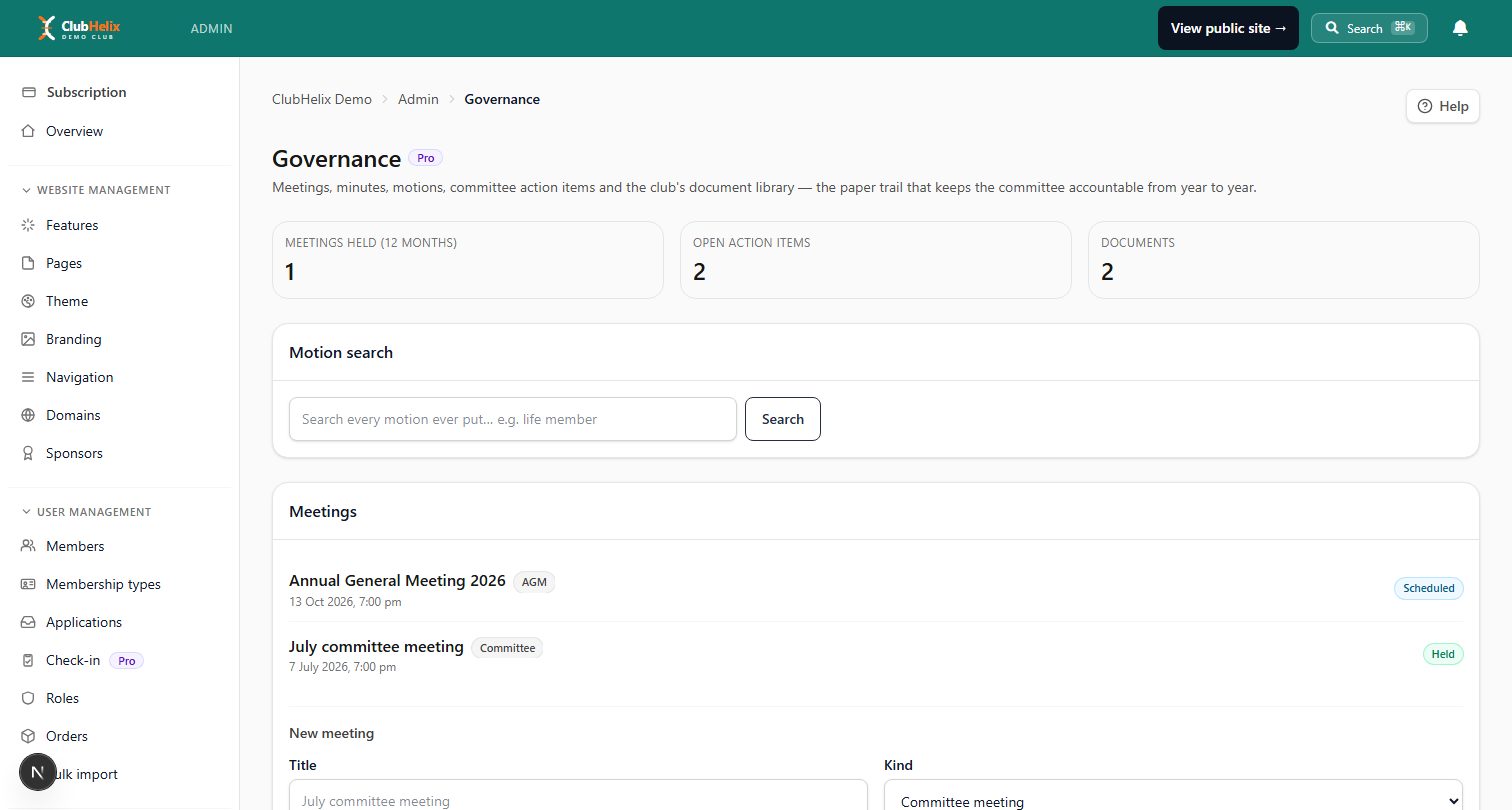
Those minutes are not ceremonial. Three different parties will ask for them within a month: your student association, before it releases funding or renews your affiliation; the bank, before it changes signatories; and next year's committee, when they need to know what was actually decided. A society that keeps its meetings, motions and resolutions in the society's own system instead of a departing secretary's laptop can produce all three on request, years later.
Submit the new committee to your students' union promptly — funding bids, room bookings and society bank access are usually tied to a current committee record, and unions commonly require the incoming treasurer to complete finance training before the account is released.
When nobody nominates for treasurer
Every society hits this eventually. Here is what actually works for the four common failures.
No nominations for a position. Do not leave it to the night. If a position has no nominee a week out, the outgoing holder rings five people and asks each one directly, with an honest hours figure and an offer to help for the first month. On the night, if it is still empty, elect everything else and leave the position vacant — most constitutions allow the new committee to fill a casual vacancy later. What you must not do is talk a reluctant person into it in front of a room; that treasurer resigns in week four and takes the account access with them.
Quorum not met. Follow the constitution, which usually means adjourning to a stated date. Do not proceed quietly — every decision from an inquorate meeting is void, and you will discover this at the bank. If quorum fails two years running, the number is wrong for your society's size and fixing it is itself a job for a valid meeting.
A contested presidency that splits the society. Contest is healthy; a campaign is not. Give each candidate the same two minutes, take questions from the floor for the same length of time, ban campaigning inside the meeting room, and have the winner thank the loser publicly. Then give the losing candidate a real job that night — events, sponsorship, welfare — before they drift away.
The outgoing committee that will not hand over. Sometimes it is obstruction; usually it is a graduating student who has stopped checking email. Prevent it by making handover a scheduled meeting, not a favour: book it before the AGM, with a written handover checklist covering accounts, logins, supplier contacts, the member list and any debts. If access is genuinely stuck, your student association can usually help you re-establish control of the society's records.
The seven days after
The AGM's real output is a mandate and a to-do list. Inside a week:
- Publish the results to all members — who was elected, thanks to the outgoing committee, and the two or three priorities for the year.
- Lodge the new committee with your student association, and check what else is due at the same time.
- Change the bank signatories. Book the appointment the day after the AGM; it always takes longer than anyone expects, and it stalls completely once a signatory has left town.
- Move the accounts, not the passwords. Give each new officer their own login with the permissions their role needs, and remove the leavers. Shared logins are how societies lose their site, their member list and their email in the same week.
- Diarise the first committee meeting within a fortnight, using the general business items from the AGM as its opening agenda.
- Update the member list so the next year's paid members and the incoming committee's access reflect reality from day one.
Frequently asked questions
How much notice do we have to give for a society AGM?
Whatever your constitution says, plus whatever your student association's affiliation rules require — take the longer of the two. Ten to twenty-one days is typical, and longer where you are proposing a constitutional amendment. Count carefully if your rules say "clear days", which excludes both the day you send and the day of the meeting, and send it by a channel your rules recognise. Keep the send log; it is the only evidence you will have if the result is challenged.
What counts as quorum, and what if we do not reach it?
Quorum is the minimum number of voting members present for the meeting to be valid, and it is defined in your constitution — often a flat number like fifteen, or a percentage of paid members. If you do not reach it, follow the adjournment procedure in your rules rather than carrying on; elections and motions passed without quorum are void, and the bank or your association will eventually notice. Take attendance on a signed sheet so quorum is provable afterwards, not just asserted.
Can we run the election online?
Only if your constitution allows it and you can demonstrate that voters were eligible, voted once each, and voted secretly. Plenty of societies run a hybrid meeting where remote members watch and speak, but the ballot is on paper in the room — that is a perfectly respectable compromise and much easier to defend. If your rules are silent on electronic voting, amend them at an in-person meeting first rather than assuming permission.
Do we have to send our AGM minutes to anyone?
Almost certainly, and sooner than you think. Your student association usually wants the minutes and the new committee's details before it renews affiliation or releases funding, and your bank will want them before it changes signatories. Beyond that, the minutes are the only record next year's committee will have of what was decided, so keep them somewhere permanent rather than in a graduating secretary's downloads folder.
Can a member who has not paid vote at the AGM?
That depends on how your constitution defines membership, and it is worth resolving before the meeting rather than at the sign-in desk. Most societies restrict voting to members whose fee for the current year is paid, which means the treasurer needs an accurate paid-member list on the night. If someone pays at the door, decide in advance whether that makes them eligible immediately — write the answer into the notice so nobody has to improvise.
Our student association wants a copy of our member list — do we have to hand it over?
Usually you do have to confirm your member numbers, and often the names of members, because affiliation and funding are calculated from them. That is not the same as handing over everything you hold: send the fields they actually need, not your whole roster with phone numbers, dietary notes and payment history attached. Tell members at sign-up who their details may be shared with, and keep the request and your reply on file so the next committee knows what was sent. General information — check with your student association or a professional.
Your society is handling personal data under UK GDPR and the Data Protection Act 2018, and your students' union is often a separate controller of the same data rather than a parent of your records. That means you need a lawful basis, a privacy notice members actually saw at sign-up, and data minimisation when you respond to a request — the union rarely needs anything beyond names, student numbers and membership status. Many unions publish a template privacy notice for societies; use it rather than writing your own.
Where ClubHelix fits
An AGM is really a records problem wearing a meeting's clothes: who is a member, who was notified, who was nominated, what was decided. ClubHelix keeps all four in the society's own account rather than across four people's personal drives — a member list that shows who has paid, broadcasts with a send log that proves notice went out, forms for nominations with real timestamps, and meeting and motion records that outlive the committee that wrote them. Roles and permissions change hands in a couple of minutes at handover, so the incoming secretary gets access on the night and the graduating one does not keep it. Pricing is worked out per society rather than per committee member, which matters when six people need admin access and none of them is paying for it personally. If it is the secretary's workload rather than the AGM that is drowning you, our club secretary page covers the rest of the year.


