
What this guide answers
- What should a standard registration form for clubs actually contain?
Only the questions your own office will act on — identity and eligibility, safeguarding and consent, a closed medical flag, and the participation data your funder asks for.
- Can a governing body see a club's registration answers?
It should not, and a well-designed arrangement makes that structural rather than a promise.
- How do we handle a club that already collects the same information?
Declare your question the one that counts for the return, tolerate the duplicate for a season, and be clear that nothing is imported — a standard question collects answers from the first registration after it is…
- When should a governing body change a mandatory question?
At the season boundary, and almost never otherwise, because a question reworded mid-season splits the season into two populations that cannot be added together.
- How do we stop the standard form growing every year?
Fix the number of mandatory questions and make every new one displace an existing one.
Somewhere on your website there is a PDF called "Standard Registration Form". A committee thought hard about it. It says at the top that all affiliated clubs are required to use it. It has been downloaded four hundred times, and it has been used exactly as printed by nobody at all.
Here is what a club actually does with it. The registrar opens it, recognises about two thirds of the questions, decides three of them do not apply to a club her size, adds the four she needs that are not on it — uniform size, which training night, whether the family can help in the canteen — and types the result into whatever her club already uses to sign people up. She is not being difficult. The form she sends members is the form that takes the money and puts people into teams, and yours does neither.
Then the return falls due, and you are holding ninety spreadsheets in ninety shapes. One club counted juniors as under 18, another as under 16. Four clubs recorded a date of birth; the rest recorded an age, once, at some point in the season. Two have no gender field at all because a well-meaning volunteer deleted it. You add it up, caveat it heavily, and send a number you know is roughly right and not defensible.
The fix is not a better PDF. It is working out which questions are genuinely yours, wording them so they survive ninety different registrars, publishing them as a form clubs adopt instead of retyping — and then leaving the rest of the form alone.
Why a downloadable standard form never becomes the standard
A standard registration form for clubs standardises nothing unless the club never has to retype it. The moment your questions have to be copied into the club's own sign-up, they stop being your questions, and they fail in three predictable ways.
Transcription. The closed list of five options becomes a free-text box, because typing a box is faster than typing five options. Now "under 12s", "U12", "u12s" and "Under-12 (mixed)" are four different answers to the same question, and your return has to guess.
Amendment. Nothing stops a club editing a document it downloaded. The question that was blocking submissions at nine o'clock on a Sunday night becomes optional, or disappears, and you find out in September.
Drift. Last year's copy is still on the club's own website, still being emailed to new families, two wordings behind. A PDF has no way of telling anybody it has been superseded.
None of that is a discipline problem to be solved with a firmer email. It is the predictable result of asking a volunteer to maintain your data standard by hand, once a year, for free.
The four kinds of question you legitimately own
A governing body registration form should be short, and the test for every question is uncomfortable but simple: will somebody at your office do something different because of this answer? If the answer only ever gets acted on at the ground, it is the club's question, no matter how sensible it is.
| Question | Owner | The test it passes or fails |
|---|---|---|
| Date of birth | Governing body | Age-group eligibility and every age band in the return |
| Gender | Governing body | Reported to your funder; cannot be reconstructed afterwards |
| Safeguarding clearance for adult roles | Governing body | You carry the obligation, so you word the question |
| New or returning participant | Governing body | The growth figure every funder asks for first |
| Code of conduct acceptance | Governing body sets it, club holds it | You will be asked to produce it if something goes wrong |
| Emergency contact | Club | The person who rings that number is standing on the sideline |
| Medical detail | Club | Nobody in your office will ever treat anybody |
| Uniform size | Club | No head office has ever acted on a size |
| Preferred training night | Club | A conversation between a parent and a coach |
| Canteen and roster availability | Club | Yours to encourage, never yours to collect |
Inside the first column, four kinds of question do all the work.
1. Identity and eligibility. Full name as it appears on identification, date of birth, the club they are registering with, and the grade or division they are eligible for. This is the set that lets you say a person is registered once, in one place, at one age — and it is the only defence you have on the morning two clubs both believe they have the same junior.
2. Safeguarding and consent. Whether an adult taking a role with young people holds the clearance your jurisdiction requires, its reference and its expiry date, plus the consents you carry the risk for: a code of conduct, and permission to use photographs. The wording is yours because you are the organisation that will have to produce it.
Safeguarding is where wording matters most, because the check itself is not national: each state and territory in Australia runs its own working-with-children scheme, with its own card, its own reference format and its own renewal period. If your affiliates sit in more than one, ask for the issuing jurisdiction as a closed list first, then the reference, then the expiry date — one question per thing, so a registrar in one state is never typing a reference into a field labelled for another. Where the scheme lets you verify a reference directly, put the instruction for doing so next to the question rather than in a circular nobody kept.
3. Safety and medical — as a count, not a case file. You need to know how many registered participants have a condition a club must plan for. You do not need to know what it is. Your mandatory question is therefore closed — "is there a medical condition or allergy the club needs to know about?", yes or no — and the detail is the club's own follow-up question, sitting with the people who will act on it. Our guide to emergency contact and medical forms covers the club's half properly.
4. Participation data for the return. Whether this is somebody's first season, the fee band they paid, and the locality they live in if your funder reports by area. These are the questions that are impossible to add after the fact, because the season is over and the family has moved on.
A worked core question set
What you are publishing is not really a form. It is a member registration data standard, and a form is just the most useful way to hand it over. Eleven questions is a realistic size — enough to answer a funder, short enough that no registrar feels colonised.
| Question | Answer type | Why it is mandatory for every club |
|---|---|---|
| Full name as it appears on identification | Short text | The only reliable way to spot the same person registered twice |
| Date of birth | Date | Every age band in the return; an age recorded once cannot be re-banded later |
| Gender | Closed list, including prefer-not-to-say | Reported to your funder, and a blank must read as blank rather than zero |
| Club registering with | Pre-filled by the club, not typed | Ties one record to one affiliate, with no spelling variants |
| Grade or division | Closed list from your own competition structure | Eligibility disputes are settled by the form, not by memory |
| First season, returning, or returning after a break | Closed list | The new-participant figure, which no funder ever fails to ask for |
| Is there a medical condition or allergy the club needs to know about? | Yes or no | A number you can report; the detail stays with the club |
| Role taken with young people | Closed list of roles, including "none" | Decides who needs a clearance, so nobody is chased unnecessarily |
| Clearance reference and expiry | Short text and a date, shown only when a role is chosen | Proves the obligation is met, with a date you can chase before it lapses |
| Code of conduct | Required tick against a dated wording | The record you will be asked for is "which version, and when" |
| Photograph and media permission | Closed list: yes, team photographs only, no | A list you can filter before anything is published |
| Fee band paid | Closed list matching your own fee schedule | The fee column in the return, without a chase for dollar figures in October |
Two rows are worth dwelling on. Date of birth, not age, is the single highest-value line in the table: an age collected once decays immediately and can never be re-banded when your funder changes its brackets, while a date of birth answers every bracket anybody invents for the next decade. And "prefer not to say" as a real option matters because a question people cannot honestly answer is a question people abandon — and a declined answer you can count is worth far more than a guess you cannot.
Writing a mandatory question so it survives ninety clubs
Your questions will be read by ninety registrars you will never meet, most of them at night, most of them in a hurry. Five rules cover nearly everything that goes wrong.
- One thing per question. "Clearance reference and expiry date" is two questions wearing one label, and you will get half an answer in one box.
- A closed list wherever a number will be counted. If you will ever total it, it cannot be free text. Free text is for the things you will read one at a time, and nothing else.
- No jargon, and no internal shorthand. A question that makes sense in your office and nowhere else gets answered wrong, confidently, by everybody. Test each one on somebody who has never sat in your building.
- The same wording every year. Comparability is the whole point of a standard. A question reworded for elegance has quietly ended one data series and started another.
- Make a non-answer visible. "Not recorded" is a legitimate result and should be reportable as itself. A missing answer that arrives as a nought is the one failure that makes a whole return untrustworthy.
And then there is versioning, which has no clever solution. Change a mandatory question partway through registration and your season contains two populations: the clubs that registered before the change, and the clubs that registered after. Add them together and the number means nothing, because two different questions were asked.
The discipline is boring and it works. Wording changes at the season boundary only. If you are genuinely forced to change mid-season — a regulator changes what you must ask — do not edit the question. Retire it, publish the new one under a distinct label, and report the two populations separately for that season, saying so on the face of the return. No system does this thinking for you: it is a decision you minute, and it is the reason a change of wording should feel like a governance item rather than a tidy-up.
Put your questions first, theirs after
Order is not cosmetic. People abandon a form at the first question they cannot answer from memory, and the questions that need a conversation are almost always the club's: which training night suits, what uniform size the child will be by July, whether anyone in the household can do a canteen shift.
Your questions are the answerable ones — a name, a date of birth, a yes or no, a tick. Putting them first means that when somebody does stall, they stall after the core record exists. Put the club's questions first and the pattern reverses: you inherit a season of half-finished registrations with nothing in them you can report on.
There is a structural benefit too. A form that runs "governing body block, then club block" reads as one form with a beginning and a middle, rather than two forms bolted together. Clubs can add and remove their own questions freely, all season, without disturbing a single one of yours — which is exactly the boundary that makes affiliated club forms sustainable rather than a standing argument. The general craft of this, branching and all, is in our guide to setting up online club forms, and what a membership form should collect goes field by field on the club's side.
Who sees which answers

Standardising the questions is the easy half. The half that decides whether clubs trust the arrangement is what happens to the answers, and the rule is short enough to minute: a governing body sees the answers to the governing body's questions. Not the club's. Not "while we're in there".
| Answer to | The right level of detail for a governing body | Why not more |
|---|---|---|
| Date of birth | Age bands, club by club | You report bands; you do not need a list of birthdays |
| Medical flag | A count of yes answers per club | The detail belongs where treatment happens |
| Clearance reference | The individual record, with its expiry | The one place you genuinely need a person's own row |
| Photograph permission | A count, and the individual answer when you publish | Filtering before publication is the only real use |
| Fee band | Totals per band, per club | A band answers the funder; individual amounts are the club's ledger |
| First season or returning | Counts per club | Growth is a number, not a list of names |
| The club's own questions | Nothing at all | Uniform sizes are not a governing body's business, ever |
Data minimisation sounds like a compliance word until you notice what it buys you: a club that knows you cannot read its members' medical notes stops treating your form as an intrusion and starts treating it as the part of registration it no longer has to design. Every question you decline to receive is goodwill you can spend on the ones you insist on.
The club that already collects this in its own system
Some of your affiliates will already ask half of your core set, in their own words, in a system they like. That is a good sign, not a problem, and it needs three decisions rather than an argument.
Your question becomes the one that counts for the return. Not because it is better, but because it is the only one asked identically across ninety clubs. Say that plainly.
Let the duplicate live for a season. A club that asks for a date of birth twice on one form is mildly annoying; a club told to rip its own question out in week one is a club that stops cooperating. Most registrars delete their version themselves at renewal once they see yours arriving pre-filled.
Nothing migrates. Be honest about this in the memo, because it is the assumption that causes the most disappointment: a standard question starts collecting answers from the first registration after it is published. Last season's answers, held in the club's own system in the club's own wording, stay exactly where they are. The first year under a standard is a year of collecting fresh, and that is worth saying out loud rather than discovering in March.
If a club's version of a question turns out to be clearly better than yours — clearer, or with an option you had not thought of — adopt theirs at the next review and tell everyone where it came from. It is the cheapest credibility available to a head office.
The annual review, and the rule that stops the form growing

Review the question set once a year, after the return has gone in rather than before, while you can still remember which fields let you down. Four questions are enough.
- Which mandatory question produced the most "not recorded"? Either the wording is wrong or the question is unanswerable. Both are your problem, not the clubs'.
- Which answer did nobody act on? A question whose answers were never opened is a question that cost ninety clubs a season of typing for nothing.
- Which question generated the most emails from registrars? Confusion at scale is a wording defect with a very precise location.
- What did your funder ask for that you could not answer? The only legitimate source of a new mandatory question.
Then apply the rule that keeps a standard usable for more than three years: a new mandatory question has to displace an existing one. Every year somebody will have an excellent reason for one more question, and every one of those reasons will be genuine. A form with no fixed budget grows from eleven questions to nineteen to twenty-six, each addition sensible on its own, and the whole becoming the thing clubs work around rather than fill in. A fixed count forces the comparison a growing form never makes: is this new question worth more than the weakest one already there? If it is, swap them. If it is not, it was never mandatory — and it can go to the clubs as a suggestion, where it belongs. Our guide on reporting to your governing body looks at the same relationship from the club's end, and club-run versus governing-body registration covers where the line falls when both sides want to own the sign-up.
How this works in ClubHelix
Everything above is doable with a well-written circular and a lot of goodwill. What sports governing body software should add is the mechanism, so the standard holds without anyone policing it.
ClubHelix models your group as a multi-level hierarchy — federation, regions, sub-regions and clubs, each with its own site and admin — on every plan, including the free tier. Clubs apply to join your network through affiliation applications, and approvals, leaves and removals keep a history, so "who was affiliated in which season" is a record rather than a recollection.
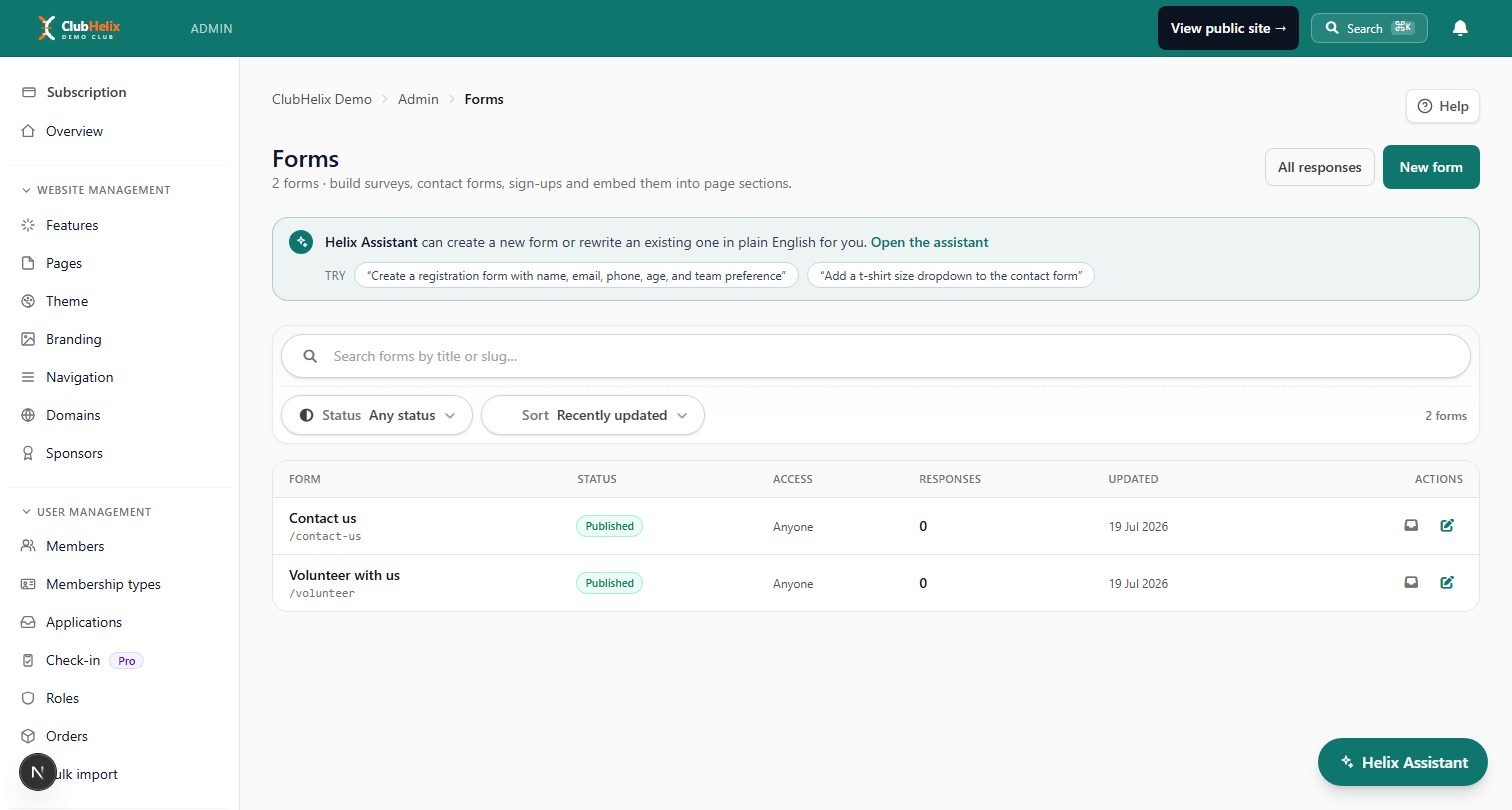
On the Enterprise plan, which carries the HQ tools, you can publish standard forms across your group: the questions every affiliated organisation has to ask. Clubs adopt the form, add their own questions after yours, and cannot edit or remove one of yours — while you see the answers to your questions added up across the group, and never theirs. That last clause is the data-minimisation rule from earlier, enforced by the software rather than promised in a policy.
Two more pieces matter for the return. Member records carry an optional date of birth and gender, used for age-group eligibility and funding returns, so the two hardest-to-backfill fields sit on the record rather than in a one-off answer. And the funding body return — also Enterprise — assembles participants, new participants, age bands, gender split and fees, club by club, with an honest "not recorded" column instead of a nought, which is the difference between a number you can defend and a number you can only submit. Clubs still run their own registration and their own self-registration alongside all of this, and the group's reports section is where a head office goes to read what came back.
One honest caveat, and it is the one clubs will ask about first: being the parent organisation in the hierarchy does not hand you operational control of an affiliated club's data. Cross-organisation access needs a role that somebody at that club grants. Clubs keep their own house — you get the answers to your questions, and that is the whole arrangement. Plans and what sits on each are on the pricing page, and a governing body can set up its hierarchy and start on the free tier before committing to anything.
Frequently asked questions
What should a standard registration form for clubs actually contain?
Only the questions your own office will act on — identity and eligibility, safeguarding and consent, a closed medical flag, and the participation data your funder asks for. Around eleven questions is a realistic size, with everything else left to the club, and the honest test for each one is whether a named person at head office will do something different because of the answer.
Can a governing body see a club's registration answers?
It should not, and a well-designed arrangement makes that structural rather than a promise. The body sees the answers to the body's own questions, added up across the group; the club's own questions — uniform sizes, training nights, medical detail — stay with the club, which is both the legal instinct and the thing that keeps clubs cooperating.
How do we handle a club that already collects the same information?
Declare your question the one that counts for the return, tolerate the duplicate for a season, and be clear that nothing is imported — a standard question collects answers from the first registration after it is published, not retrospectively. Most registrars quietly drop their own version at renewal once they see yours already sitting on the form.
When should a governing body change a mandatory question?
At the season boundary, and almost never otherwise, because a question reworded mid-season splits the season into two populations that cannot be added together. If a regulator forces a change, retire the old question rather than editing it, publish the new one under a distinct label, and report the two populations separately for that year.
How do we stop the standard form growing every year?
Fix the number of mandatory questions and make every new one displace an existing one. That single rule forces the comparison a growing form never makes — is this question worth more than the weakest one already there? — and anything that fails it goes to clubs as a suggestion rather than an obligation.
Keep reading — setting up online club forms covers the craft of the form itself, and paper forms vs online registration costs a sign-on day both ways.


