
What this guide answers
- Should a club use SMS or email for updates?
Both, for different jobs. Email carries anything long, considered or worth keeping — newsletters, renewal notices, fixtures, policies.
- Is texting club members too expensive for a small club?
Untargeted texting is expensive; targeted texting is not. Sending one message to your whole database every week costs many times more than sending only to the affected team when something changes.
- What is the best way to contact club members quickly?
A push notification to members who have installed your club site, immediately followed by a text to the same group for everyone who has not.
- Do we need permission to text club members?
Yes, and you should record it. Collect consent at registration with separate options for urgent alerts, club news and sponsor offers, keep the date and the wording, honour opt-outs immediately, and identify the club in…
- How do we know if members are actually reading our messages?
Not from open rates, which are distorted by mail services loading tracking images automatically.
Ireland edition. This guide is written for volunteer-run clubs in Ireland. Where rules differ — grants, tax, incorporation, safeguarding — follow the Ireland-specific pointers below or check with your national body.
Two hours before the first junior game, the ground is closed. The person holding the phone has about eleven minutes of useful time before families start putting kids in cars, and in that window they have to decide: email everyone, text everyone, post it and hope, or ring the four team managers and let it spread.
Watch what happens next in most clubs. Someone says "texts cost money", the committee does a rough sum in their head, and the notice goes out by email — where it lands beside a supermarket receipt and an appointment reminder, at an hour when nobody is reading email. Forty families drive to a closed ground. The club has saved a small amount of money and spent a large amount of goodwill, and next season those forty families are a little slower to renew.
That is the real trade. This guide is for the person who ends up sending club messages — a secretary, a registrar, a team manager — and it argues that cost per message is close to irrelevant compared with the cost of a message being missed. It covers a triage table you can pin above the desk, what each channel is genuinely good at, why you should stop chasing open rates and what to measure instead, the consent rules that differ between text and email, and why push notifications solve the urgent middle without adding a cent to your per-message bill.
The metric that actually matters
Every committee that debates this starts with the unit price and stops there. Try scoring the message instead. For anything you are about to send, answer three questions:
| Question | Score 1 | Score 2 | Score 3 |
|---|---|---|---|
| How soon must they know | This week | Today | Within the hour |
| What happens if they miss it | Mild inconvenience | Wasted trip or missed deadline | Safety, money or a forfeited game |
| Can they act on it later | Yes, any time | Only before a cutoff | No, the moment passes |
Add the three numbers. A score of 3 to 4 is a newsletter item. A score of 5 to 6 is a targeted email or a push notification. A score of 7 or higher earns a text message, and the cost of sending it is not the question — the cost of forty wasted trips is.
Run last season's messages through that scoring for ten minutes and two things usually fall out. First, the club has been texting things that scored 4, which is how members learn to ignore the texts. Second, the genuinely urgent messages went by the slowest channel available, because that was the free one. Fixing both costs nothing.
Triage — urgent, timely, archival
Sort every message the club sends into three buckets and the channel choice becomes automatic. Print this and stick it where the messages get written.
| Bucket | Definition | Channel | Examples |
|---|---|---|---|
| Urgent | Acting on it in the next few hours changes the outcome | Push first, text as backup for the same list | Ground closed, venue changed, game time moved, session cancelled, lost child found, evacuation |
| Timely | Matters this week and has a deadline | Targeted email, push for the same group | Team selection posted, availability needed by Thursday, subs due Friday, roster gaps, ticket cutoff |
| Archival | Reference material people return to | Website page, plus a newsletter pointer | Fixture list, fees table, committee contacts, codes of conduct, policies, season calendar |
Two rules make the table work. Never send an archival message by text — it trains people to skim past the urgent ones. And never send an urgent message only by email, because email is a medium people check on their own schedule, which is precisely what an urgent message cannot wait for.
The third rule is quieter but matters more: an urgent message should exist in two places. The text or push tells them something changed; the website page holds the detail, and can be updated as the situation develops without sending a second and third message. Our club communication plan sets out the whole rhythm across a season.

What each channel is genuinely good at
Text messages
The one channel that arrives with a sound on a phone that has no apps installed, no data connection worth speaking of, and an inbox full of unread email. It reaches grandparents, it reaches the parent whose phone is four years old, and it reaches people standing in a car park with one bar of signal. It is also intrusive by design, has almost no room for nuance, and costs per recipient — which is the discipline that keeps it valuable. Use it for the messages you would be prepared to phone about.
Still the backbone of club communication because it is the only channel that handles length, attachments, images, links and a permanent record. It is where the newsletter lives, where the renewal reminder with a payment link belongs, and where anything a member may want to find again in March should go. Its weakness is timing: you cannot control when it is read, and a proportion of it will not be seen at all because of filtering. If your club emails are landing in spam folders, fix that before you conclude email does not work — why club emails go to spam covers the causes, most of which are configuration rather than content.
Push notifications
The underused one. If a member has added your club site to their home screen, the club can send a notification straight to the lock screen with no per-message cost. It arrives like a text, looks like an app notification, and is free to send to a hundred people or a thousand. The catch is that it only reaches members who installed the site and allowed notifications, which will never be everyone.
Group chat
Excellent for the back-and-forth inside a team — who is bringing oranges, who can fill in — and terrible as a broadcast channel, because important messages scroll away and nobody can tell what was actually announced. Keep chat for conversation and keep announcements somewhere they persist.
The website
Not a push channel at all, and that is the point. It is the destination every other channel links to, the version of the truth a visiting team or a new family can find without being on any list, and the only one that works for people you have no contact details for.
One more factor decides the mix, and it is local rather than technical — where your members are when the message arrives, and what their phone can do there.
Coverage varies enough across rural parts of Ireland that a club with members travelling to away fixtures cannot assume a data connection at the moment it matters. There is also a generational split in many clubs, where older members and long-serving volunteers rely on text and a phone call rather than any app. Keep both channels alive rather than migrating everyone to one.
Stop chasing open rates
Committees love an open rate because it feels like proof. It is a much weaker signal than it looks, and it is worth understanding why before you make decisions with it.
An email "open" is recorded when a tiny invisible image loads. Several major mail services now fetch those images automatically, on their own servers, before the recipient has done anything — which registers an open for a message nobody read. Privacy features on phones do something similar. The number is not fake, but it is not a count of humans reading either, and it drifts differently across mail providers, so comparing your club's figure to a published benchmark tells you almost nothing.
Text messages have the opposite problem. There is no read receipt at all — carriers can confirm delivery to a handset, not that a human looked at it. Push notifications sit between the two: you know it was delivered to a device, not that it was seen.
So measure the thing you actually wanted, not the proxy:
- Did the action happen. Availability responses received by Thursday. Renewals paid within a week of the reminder. Tickets sold in the 48 hours after the announcement.
- Did the wrong thing stop happening. How many families turned up to a cancelled session this season versus last.
- Link clicks, not opens. A click is a person choosing to do something. Track that per send.
- Unsubscribes and complaints. A rising unsubscribe rate is your members telling you the frequency or the relevance is wrong.
- Bounce and undeliverable counts. These are the honest data-quality metric, and they tell you when your member list needs a clean-up.
Set a baseline this season, and compare your club against itself. That is the only comparison that means anything.
Consent, and why it differs by channel
The general principles are consistent almost everywhere. You need permission to send marketing-style messages, that permission should be specific and recorded, every commercial message needs a working way to opt out and an identification of who sent it, and operational messages that a member needs in order to participate — your team is playing at a different ground — sit in a different category from promotion. Capture consent at registration with separate tick boxes for club news, sponsor offers and urgent alerts, record the date and wording, and honour an opt-out immediately and permanently.
Two practical habits matter more than the fine print. Keep your urgent alert list separate from your marketing list, so a member who opts out of the newsletter still gets told the ground is closed. And never buy, borrow or scrape a list — a school parent directory is not a mailing list, and using one is the fastest way to lose the trust you spent years building.
In Ireland, the ePrivacy Regulations sit alongside GDPR and cover electronic marketing by email and text, with limited exceptions for existing customers. Consent should be specific, recorded and easy to withdraw, and every message needs an identifiable sender. The data protection authority publishes guidance for small organisations on direct marketing. Treat this as general information and confirm your position with an adviser.
Modelling what texting actually costs
Here is the arithmetic committees skip. The figures are illustrative and in your own currency — put your provider's real rate in and rerun it.
Assume a club with 240 contacts, a 20-week season, and a rate of 0.05 per message segment. A message up to about 160 characters is one segment; go longer and each message costs twice as much, which is why a text should never carry a paragraph.
| Sending pattern | Recipients | Sends per season | Segments each | Messages | Illustrative cost |
|---|---|---|---|---|---|
| Weekly all-club text | 240 | 20 | 1 | 4,800 | 240.00 |
| Weekly all-club, but written long | 240 | 20 | 2 | 9,600 | 480.00 |
| Urgent only, whole club | 240 | 4 | 1 | 960 | 48.00 |
| Urgent only, affected teams | 36 | 8 | 1 | 288 | 14.40 |
| Urgent, teams plus 2 whole-club alerts | 36 and 240 | 8 and 2 | 1 | 768 | 38.40 |
The lesson is not "texting is expensive". It is that untargeted texting is expensive and targeted texting is trivial. A club that texts only the affected team, only when it matters, spends less over a season than a single set of match balls — and every one of those messages gets read, because members learn that a text from the club always means something.
Two habits keep the bill where it belongs: send to a group rather than the whole database, and keep the message under one segment by putting the detail on a web page and texting the link.
Rates in Ireland vary by provider and drop with volume. Alphanumeric sender IDs showing the club name are standard, though registration requirements have been tightening across the industry, so confirm what your provider needs before the season rather than on the day. Check whether the quoted rate is per message or per segment, since long messages bill as two.
Push notifications — the middle ground nobody switches on
Push sits exactly where most club messages actually live: more urgent than a newsletter, not worth a text to 240 people.
What it gives you is a notification on the lock screen, in the club's name, at no cost per recipient — so the message you would never send because it is "not worth texting about" finally has a home. Selection posted. Bus leaving in an hour. Two spots left in tomorrow's session. Canteen closed tonight.
What it does not give you is universal reach. A member has to add your club site to their home screen and allow notifications, and some phone platforms require that install step before notifications are permitted at all. There is no way to make everyone do that. Which is why push does not replace text — it absorbs the middle tier, so your texts can stay rare and therefore loud.
The practical way to get installs is to stop asking by email and do it in person. Thirty seconds at registration night, with a volunteer holding a phone and showing the step, converts more people than a year of reminders. Our installable club app does exactly this, and SMS messaging sits beside it for the messages that must reach the people who never installed anything.
| Text message | Push notification | ||
|---|---|---|---|
| Reaches everyone with a phone number | Yes | No | No |
| Cost per recipient | Per message | Effectively none | None |
| Arrives on the lock screen | Yes | Rarely | Yes |
| Room for detail | About 160 characters | Unlimited | A headline and a line |
| Can carry a link | Yes | Yes | Yes |
| Findable again later | Poorly | Yes | No |
| Needs setup by the member | No | No | Install and allow |
| Right for | The genuinely urgent | The considered and the archival | The timely middle |
The run sheet — a cancellation, minute by minute
Have this written down before you need it, and give it to whoever holds the decision.
- Decision made (0 min). One named person decides and says it out loud in the committee chat so nobody else sends a competing message.
- Website first (2 min). Update the fixture or event page with the new status and one line of detail. Everything else will link here.
- Push, then text, the affected group (4 to 6 min). Same words both times, under 160 characters, with the link. "Under-12s v Riverside is off — details on the club site." The text is what catches everyone who never installed anything.
- Tell the other side and the officials (8 min). A separate, direct message — they are not on your member list.
- Email the club-wide summary (later that morning). Once the situation is settled, not while it is moving. This is the record.
- Log what you sent. One line in a shared document: time, channel, audience, wording. It takes ten seconds and it is what makes next season's decision faster.
For the fuller version of this, including who has the authority to call it off, see the wet weather communication plan.
Message volume is not spread evenly across a year, which matters when you are budgeting for a channel that charges per send. Work out when your spikes land and hold a reserve for them.
In Ireland the spikes are registration and then the wet stretch of the season, when pitch inspections and named storms concentrate cancellations into a handful of weekends. A club with several juvenile teams can send more messages in one bad weekend than in the previous two months. Budget for those specific weekends rather than assuming an even monthly spend across the year.
Writing for each channel
Same news, three shapes. Copy these and change the nouns.
Text (one segment, link carries the detail).
Riverside FC — U12 training tonight is cancelled. Next session Thursday 5pm as normal. Details riversidefc.example/news
Push (a headline and one line).
Title — U12 training cancelled tonight Body — Ground closed. Back Thursday 5pm. Tap for details.
Email (subject does the work, first line repeats it).
Subject — U12 training cancelled tonight, back Thursday First line — Tonight's under-12 session is cancelled because the ground is closed. Training resumes Thursday at 5pm.
Three rules across all of them. Put the decision in the first six words, never the background. Say what happens next, not only what is not happening. And sign it as the club, not as a personal name, so nobody has to work out who "Dave" is. There are more starting points in our club email templates.
Sending all three from one member list
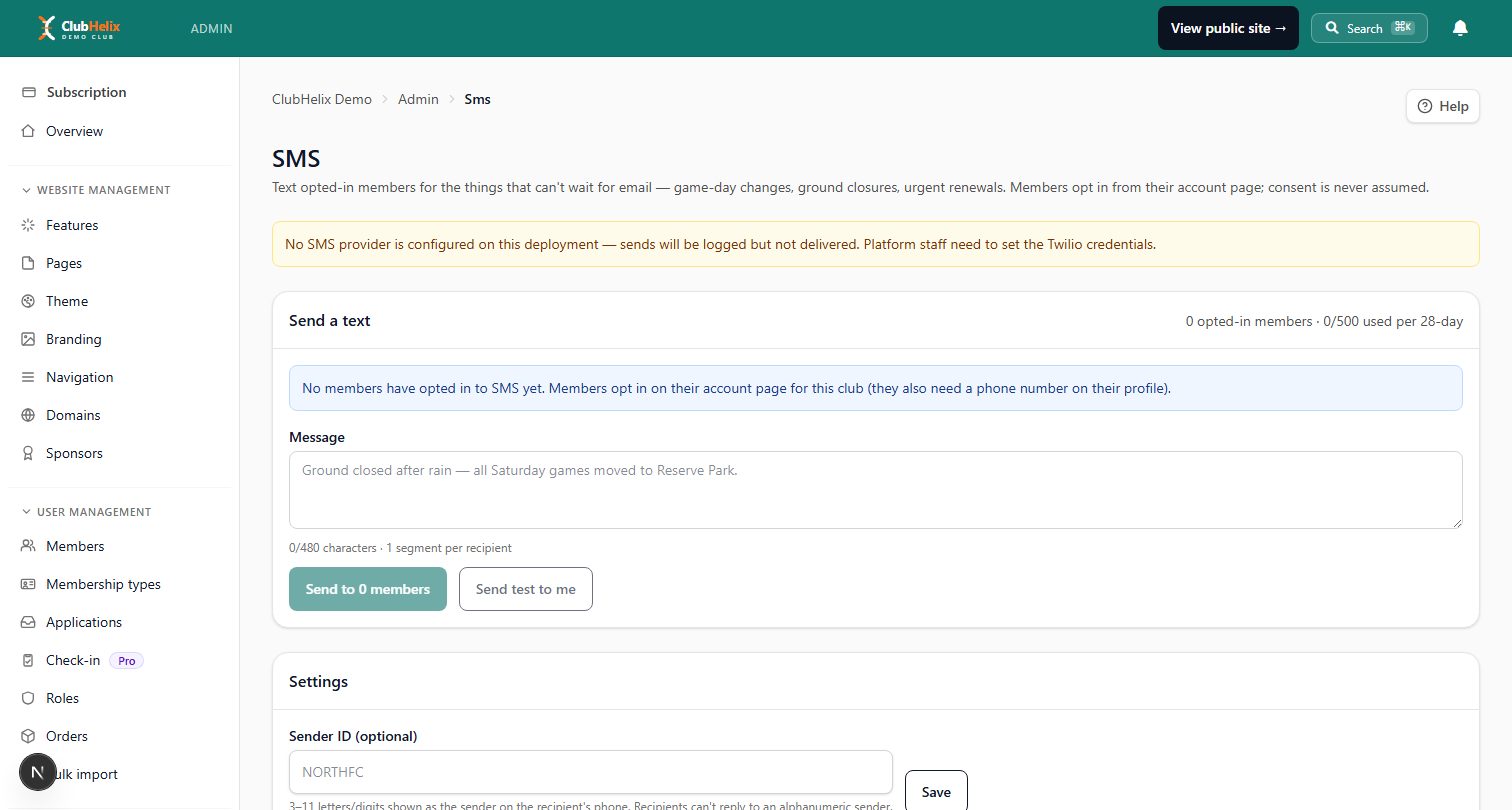
The reason channel choice becomes a fight is usually that the three channels live in three places — a mailing tool with last season's list, a phone with a group thread, and a website only one person can edit. Put them on one member list and the argument disappears, because sending to "under-12 parents" by text, email or push becomes the same three clicks. ClubHelix does that with email broadcasts from your own domain, SMS to any group, and push through the installable app — all addressed to the same live membership data, so nobody is exporting a spreadsheet at 7am.
If you would rather test that than take our word for it, the free tier is enough to import a team, send yourself all three, and see how each one lands. The pricing is published, and you can set your club up in an evening.
Frequently asked questions
Should a club use SMS or email for updates?
Both, for different jobs. Email carries anything long, considered or worth keeping — newsletters, renewal notices, fixtures, policies. Text carries the short, urgent messages where a member missing it costs them a wasted trip or the club a forfeited game. The mistake is using one channel for everything, which either buries the urgent messages or trains members to ignore the texts.
Is texting club members too expensive for a small club?
Untargeted texting is expensive; targeted texting is not. Sending one message to your whole database every week costs many times more than sending only to the affected team when something changes. Keep messages under one segment, send to groups rather than everyone, and the annual cost lands well below what most clubs assume.
What is the best way to contact club members quickly?
A push notification to members who have installed your club site, immediately followed by a text to the same group for everyone who has not. Put the detail on a web page and link to it from both, so you can update the situation without sending a second and third message.
Do we need permission to text club members?
Yes, and you should record it. Collect consent at registration with separate options for urgent alerts, club news and sponsor offers, keep the date and the wording, honour opt-outs immediately, and identify the club in every message. The rules differ by country and channel, so treat this as general information and check the requirements that apply to your club.
How do we know if members are actually reading our messages?
Not from open rates, which are distorted by mail services loading tracking images automatically. Measure the action instead — availability replies received, renewals paid after a reminder, tickets sold in the day after an announcement — and compare your club against its own previous season rather than against a published benchmark.
Keep reading — club communication plan maps the whole season's messaging, and membership renewal reminder templates covers the one sequence that pays for itself.


