
What this guide answers
- Is a digital waiver legally valid?
Electronic signatures are widely recognised, but that is a separate question from whether the waiver's terms are enforceable, which depends on the jurisdiction, the activity, the wording and who signed.
- How much does Smartwaiver cost?
As at July 2026 its published pricing runs from US$19 to US$199 per month, banded by how many waivers are signed each month, with all features available on every tier and an Enterprise arrangement above 2,500 waivers a…
- Do we still need a waiver if members already accept terms when they register?
Sometimes yes, sometimes no. Many clubs fold an acknowledgement into registration for ordinary participation, then use a separate signed document for higher-risk activities, trips or non-member participants.
- Can a teenager sign their own waiver?
Generally a person under the age of majority cannot bind themselves, so a parent or guardian signs on their behalf and your record should capture who that adult was.
- What happens when we change our terms mid-season?
You need version control and a re-collection plan. Store the exact text each person agreed to rather than a link to a page you later edit, keep the date and the version identifier, and be able to list who is still on…
It is 6.28pm and the 6.30 class is about to start. Someone new is standing at the desk in borrowed shorts, keen and slightly nervous, and the only question that matters in the next ninety seconds is whether they are allowed on the mat. Have they signed? Is the signature current, or is it from the trial they did two winters ago under a different surname? The fourteen-year-old warming up in the corner — did a parent actually sign, or did the kid tick the box themselves on the way in?
That is the real waiver problem in a club. It is almost never "do we have waivers". It is "can the person at the desk find the right waiver, for the right person, at the right moment, without opening a laptop". When clubs go looking for a fix, the first product most of them meet is Smartwaiver, and for good reason — it invented the category and it is genuinely good at it. The alternative is less obvious: waivers built into the platform that already holds your members, your classes and your bookings, so the signature is an attribute of a person rather than a document in a separate archive.
This guide compares the two shapes honestly. Our interest should be declared straight away — we are ClubHelix, and we ship waivers as part of an all-in-one club platform, so we are one of the options being compared. Everything stated about Smartwaiver comes from public information current as at July 2026; verify anything decision-critical on their own site. And one non-negotiable framing: waivers are legal documents, and nothing here is legal advice. What a waiver can and cannot do varies enormously by jurisdiction, by activity and by who is signing — talk to your insurer, your governing body and a lawyer who knows your sport before you rely on any of it.
What Smartwaiver actually is
Smartwaiver is a dedicated digital waiver product, based in Bend, Oregon, and it owns the category the way a first mover usually does — if you search "digital waiver", you meet it. Its entire job is turning a paper release into a signed, stored, searchable electronic document, and it does not pretend to be anything else.
Two things about its commercial shape are worth knowing before you compare anything. First, pricing is metered by volume of signed waivers per month, running from US$19 to US$199 a month across the published bands, with an Enterprise arrangement above 2,500 waivers a month (public pricing, checked July 2026). Second, and this is unusually fair, all features are available on all tiers — a small club is not fenced out of the good bits because it signs fewer documents. Plenty of club software could learn from that.
A pricing meter tells you who a product is designed around, and a monthly-volume meter points squarely at operations where the signers are mostly strangers and the flow never stops — high volume, high churn, very little ongoing relationship with the person signing. That is a perfectly good shape to be built for. The question for a committee is simply whether your club looks like it.
What "built into your club platform" means
The other shape is not a waiver product at all. It is a waiver field on a person you already have a record for. The member registers, or renews, or books into a program, and the waiver is a step in that flow rather than a separate errand. What gets stored is not only the signed document but the fact that this specific membership, this specific season, is covered.
The difference sounds administrative. It is not. It changes which questions you can answer in one click, which is the whole game once you are past having a waiver at all.
Side by side
| What the club needs | Dedicated waiver product | Waivers inside a club platform |
|---|---|---|
| Core purpose | Capture and store signed releases — its entire job | One compliance artefact among many, attached to a member |
| Pricing meter | Volume of signed waivers per month (published bands US$19–199/mo, Enterprise above 2,500/mo, July 2026) | Included in the platform subscription, which scales with the club |
| Feature gating | All features on all tiers | Varies by platform — check the plan table |
| Where the record lives | In the waiver system, keyed to whatever the signer typed | On the member record, keyed to the member |
| "Can this person train tonight?" | Search the archive by name | Visible on the roster or the door list |
| "Who is unsigned before Saturday?" | You join two lists yourself | A filter on your member list |
| Renewal chasing | Out of scope for a waiver-only tool | Same reminder machinery as fees and accreditations |
| What else you still need | Membership, payments, bookings, comms | Nothing extra for the waiver job itself |
| Best fit | Venues turning over strangers continuously | Clubs whose signers are mostly members |
One honesty note on that table. Where we have written "out of scope", we mean it sits outside what a dedicated waiver product sets out to do — not that it is impossible via export, integration or a bit of spreadsheet work. If a specific join matters to you, ask the vendor directly rather than taking a competitor's word for it, ours included.
Per-waiver pricing versus waivers you have already paid for
The two products meter completely different things, and that is where the money surprise lives.
A volume-metered waiver product charges by how many documents get signed in a month. A club platform charges for the club — members, plan, features — and the waivers ride along. Neither is inherently cheaper. What decides it is the shape of your year, and club years are famously lumpy.
Here is an illustrative worked example, using round numbers rather than any real club. A martial arts club with 220 members re-signs everyone in January when memberships roll over, and takes casual drop-ins the rest of the year.
| Month | Waivers signed | Why |
|---|---|---|
| January | 220 | Annual re-sign plus new-year intake |
| February | 34 | Late renewals and beginners course |
| March–November | 12–25 each | Drop-ins, trials, one grading weekend |
| December | 6 | Everyone is at the beach |
Total for the year is somewhere near 450 signatures. The average month is under 40. But volume-metered pricing does not care about your average — it cares about January. Your band is set by the peak, and the interesting question becomes whether you can move down a band for the eleven quiet months or whether you are paying peak rates all year. That is a fair question to put to any vendor in a demo, and the answer belongs in your budget spreadsheet before you sign.
Run the example the other way and the standalone product wins comfortably. A climbing wall signing 600 strangers a month, none of whom will ever be members, needs nothing from a membership system, and metered pricing with all features on every tier is excellent value. Volume is not the enemy — lumpy volume attached to a membership year is.

There is a second cost that never appears on either price page, and it is usually the bigger one: reconciliation. Somebody has to sit down with the waiver list and the member list and work out who is missing. Twenty minutes a week is roughly seventeen hours a year of unpaid, error-prone work — and the errors are the kind you discover on the day something goes wrong. Price the admin, not just the subscription.
The join that actually matters — waiver, member, session
Ask what a club really does with waivers and you get four questions, not one.
- Can this person take part tonight? Asked at the door, under time pressure, by whoever is on duty.
- Who in the building right now is unsigned or expired? Asked when an insurer, an auditor or a nervous committee member wants a straight answer.
- When someone was injured on 14 May, which version had they agreed to? Asked months later, usually by somebody serious.
- Who are the twenty-three people we still need to chase before the weekend? Asked every single week of the season.
A dedicated waiver product answers question three beautifully. It is a document archive with search, and that is exactly what a claim needs. Questions one, two and four all require a join to something the waiver system does not hold — your member list, your class roster, tonight's session.
In practice that join is harder than it looks:
- Name drift. Bec on the waiver, Rebecca on the membership form, R. on the roster.
- Shared email addresses. One family inbox covering four juniors, so email is not a key.
- No common identifier. Nothing in the waiver record matches the member number, because the signer never knew it.
- Duplicate signatures. The same person signs three times across two years and you have to decide which one counts.
- Different signing adults. A junior signed by one parent in March and the other in September.
None of that is Smartwaiver's fault. It is what happens whenever a person exists in two systems that were never introduced. Built-in waivers dodge the problem by never creating the second record: the member signs while logged in, and the status attaches to them.
If you are demoing anything — including us — test these five joins with your own messy data rather than the vendor's clean sample:
- Waiver to member record, including a renewing member with a changed surname.
- Waiver to a specific session or class, so the door list can flag it.
- Waiver to an event ticket, for a come-and-try day full of non-members.
- Waiver to a team roster, so a coach can see it on a phone at an away game.
- Waiver to an incident record, so the report you file later cites the right document. Our template for that is at incident report form, and the reporting side lives in incident reporting.
Renewals, minors and guardian consent
This is the part clubs get wrong most often, and it is general information only — the rules genuinely differ by jurisdiction, so confirm yours with your governing body and your insurer.
Three renewal models
| Model | How it works | Suits | Watch out for |
|---|---|---|---|
| Sign once | One signature covers the person indefinitely | Low-risk social clubs | Terms change and nobody has agreed to the new ones |
| Annual re-sign | Signature tied to the membership year | Most member clubs | The January pile-up, unless it is folded into renewal |
| Per activity | A signature per event, camp or session type | Trials, carnivals, high-risk activities | Signature fatigue, and members signing on autopilot |
Most clubs land on the middle row, and the trick is to stop treating it as a separate task. If the waiver is a step inside self-registration, the annual re-sign happens as a by-product of renewal and the chase list is whoever has not renewed — a list you were already working.
Versioning is the underrated bit. Store the text the member actually agreed to, not a link to the page that has since been edited. If your committee updates the terms in March, you now have two cohorts, and you need to know which member sits in which. Any system worth using — standalone or built-in — should be able to tell you that without a search-and-hope.
Minors and guardian consent deserve their own care. Broadly, a child cannot bind themselves, so an adult with parental responsibility signs on their behalf, and your record needs to capture who that adult was and what relationship they claimed. Then handle the awkward realities: separated parents with different views, a grandparent doing the school run, a junior who turns eighteen mid-season and now needs to sign for themselves, a school holiday camp where a temporary carer drops off. Decide your rule in advance, write it into your policy, and check it against your governing body's requirements — several sports mandate specific wording that overrides whatever a software vendor supplies.
Finally, do not let the waiver become a dumping ground. It is not a code of conduct, a photo permission, a medical form or a background-screening check — those are separate documents with different purposes, consent bases and retention rules. Coaching credentials and screening checks belong in accreditations, and the wider picture is in sports club risk management. Signed waivers are personal information, so decide who can read them and how long you keep them.
Who should pick which
Pick the dedicated waiver product if most signers are strangers rather than members, your volume is high and steady rather than seasonal, you already have a membership system you are happy with, and the depth of the waiver tooling itself is the thing you are buying. All features on every tier makes it an easy recommendation at the small end of that use case.
Pick built-in waivers if your signers are mostly your own members, the waiver is one of several compliance artefacts you track, the genuine pain is reconciliation rather than capture, and you would rather your committee learned one system than four. The test is simple — if your last three waiver problems were "we could not tell who had signed", built-in wins. If they were "we needed better capture at a busy front desk", it does not.
Run both, deliberately, if you operate a public venue and a member club out of the same building. That is a legitimate answer. Just own the join on purpose, with a named person and a weekly routine, instead of discovering at claim time that nobody did.
Bringing the paperwork back to the people it belongs to
If your waiver headache is really a "which of these 220 people is covered tonight" headache, the fix is not a better archive — it is putting the signature on the member. In ClubHelix, digital waivers attach to the member record and can be required as part of self-registration or a program intake, so the renewal chase is the same list you already run. Coaching tickets and screening expiries sit alongside in accreditations, and if something does go wrong, incident reporting links the report to the person, the session and the document version they agreed to.
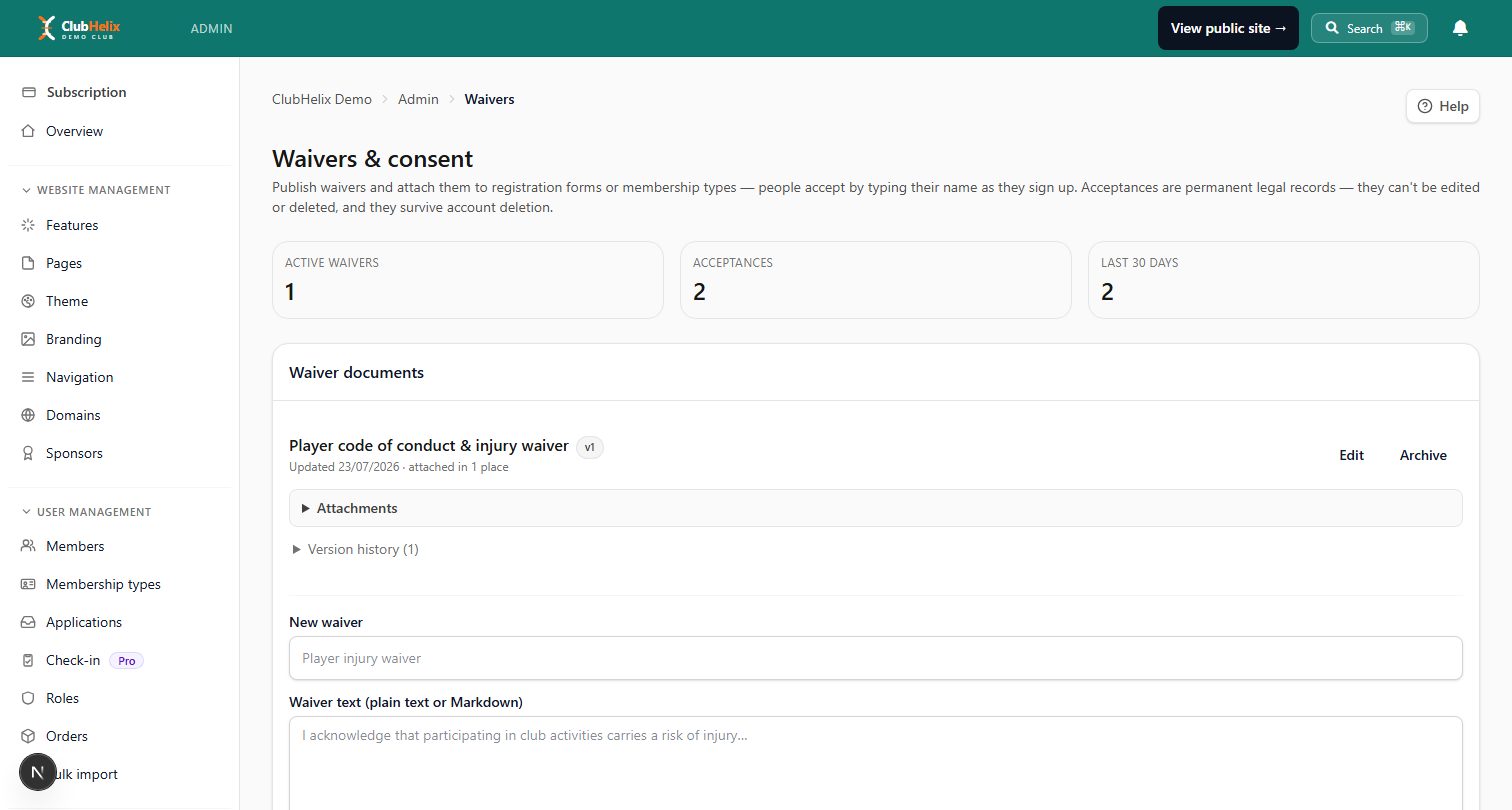
The free tier exists precisely so you can paste your real waiver in and see whether the joins hold up before any money changes hands. Every plan and limit is laid out on the pricing page, the platform is Australian-built and Australian-hosted, and you can create your club site and have a waiver flow taking signatures the same afternoon. If you coach a striking or grappling club, the martial arts rundown covers how this sits alongside gradings and casual classes, and how to run a martial arts club covers the rest of the operation.
The honest limits: we are not a waiver specialist and we do not try to out-feature one. We have no access-control hardware, no native app-store apps, and if your day involves a tablet on a counter capturing hundreds of unrelated strangers, a dedicated product is the better tool and we will happily say so.
Frequently asked questions
Is a digital waiver legally valid?
Electronic signatures are widely recognised, but that is a separate question from whether the waiver's terms are enforceable, which depends on the jurisdiction, the activity, the wording and who signed. Treat the software as the easy part. Confirm the wording with your insurer, your governing body and a lawyer familiar with your sport, and re-check it whenever your activities change.
How much does Smartwaiver cost?
As at July 2026 its published pricing runs from US$19 to US$199 per month, banded by how many waivers are signed each month, with all features available on every tier and an Enterprise arrangement above 2,500 waivers a month. Because the meter is monthly volume, a club with one enormous intake month should ask specifically how band changes work. Prices move, so check their site before budgeting.
Do we still need a waiver if members already accept terms when they register?
Sometimes yes, sometimes no. Many clubs fold an acknowledgement into registration for ordinary participation, then use a separate signed document for higher-risk activities, trips or non-member participants. Your insurer and governing body will usually tell you which activities need a distinct signed release.
Can a teenager sign their own waiver?
Generally a person under the age of majority cannot bind themselves, so a parent or guardian signs on their behalf and your record should capture who that adult was. The practical edge cases matter more than the principle — separated parents, a carer at a holiday camp, a junior who turns eighteen mid-season. Set a written rule, and check it against the requirements your governing body imposes.
What happens when we change our terms mid-season?
You need version control and a re-collection plan. Store the exact text each person agreed to rather than a link to a page you later edit, keep the date and the version identifier, and be able to list who is still on the old version. Then decide, with advice, whether the change is significant enough to require everyone to re-sign or whether it applies from the next renewal.
Keep reading — sports club risk management puts waivers in the context of the rest of your obligations, and how to run a club registration day covers getting the signatures collected without a queue out the door.


