
What this guide answers
- How many levels should a progression scheme have?
Size the levels first and let the count follow: a level should take one to two terms of weekly sessions for a typical child, which puts a whole junior pathway at roughly 8 to 12 levels.
- How do I write a skill so every coach marks it the same way?
Make it observable, a single action, and pass-or-not-yet, then put a number in it: "swims 15 m freestyle with face in the water and no stop" rather than "shows good technique".
- What do I say to a parent who thinks their child should have moved up?
Report against the written level rather than judging the child: name the exit skill, say what the child did last week, give the family one thing to work on, and tell them when it will be checked again.
- Can a child move up with one skill still outstanding?
Yes, and you should allow it rather than hold a child for a whole extra term over one skill.
- Should we use our governing body's badge scheme or our own levels?
Align with theirs where you can, because the awards travel with the family and the wording is already tested, but map it rather than copying it wholesale — their scheme may hold dozens of awards that were never meant…
South Africa edition. This guide is written for volunteer-run clubs in South Africa. Where rules differ — grants, tax, incorporation, safeguarding — follow the South Africa-specific pointers below or check with your national body.
Ask a swim school owner, a gymnastics head coach or a dance studio principal why families come back next term and almost nobody says "the timetable". They say a version of the same sentence: she's nearly through Level 4. That sentence is the product. It is also the part most providers leave to chance — inheriting a badge scheme from a governing body nobody on the pool deck has read properly, or inventing a ladder of twenty-two levels one wet Sunday and then spending three years defending it to parents.
Whatever you call it — a skill progression scheme, a coaching progression framework, a levels chart on the wall — it is the spine of any term-based program. Get it right and re-enrolment largely looks after itself, coaches speak the same language, and holding a child back becomes a conversation about evidence instead of opinion. Get it wrong and you have a laminated sheet on a clipboard, three coaches marking the same child three different ways, and a parent at the desk asking why the girl next door moved up.
This guide is the design work: what a scheme is for, how many levels to run, how to word a skill so it cannot be argued with, who marks and when, and how to handle the awkward cases every head coach eventually meets. ClubHelix is the worked example in the final third, for where a ladder like this lives once it is written.
What a progression scheme is for
Write the four jobs down before you draw a single level, because every decision later is a trade-off between them.
Retention. A term program with no visible progression is a series of unrelated purchases, each one re-decided from scratch. A ladder turns it into a journey with an obvious next step, and the next step is the reason to enrol again. It is the highest-leverage thing in a junior program — more than a discount, more than a better timetable.
A visible reason to re-enrol. Visible is the operative word. A scheme the family cannot see does none of the retention work. If a parent can only find out their child's level by catching a coach at the gate, you have a private staff record, not a progression scheme.
A fair basis for moving a child up. Classes are regrouped every term, and every regrouping produces a handful of families who disagree. A written ladder with written skills moves that conversation from "we don't think she's ready" to "she has three of the four exit skills, and this is the one to work on".
A shared language between coaches. When a relief coach takes Level 3 for a fortnight, the scheme is the handover. Combined with a standard session structure — see our training session plan template — it means a substitute delivers the class the regular coach would have.
How many levels is right
Here is the rule that settles most arguments: a level should take one to two terms of weekly sessions for a typical child. A ten-week term at one session a week is around thirty to forty hours of contact time a year. Work the arithmetic through and 8 to 12 levels covers an entire junior pathway, from first lesson to squad or senior class — four to six years of enrolments, which is further ahead than any family plans.
That rule is doing two things at once. Levels short enough to finish inside a couple of terms keep the reward visible. Levels long enough to actually take a term stop the ladder becoming a conveyor belt where advancement is automatic and therefore means nothing.
| Ladder length | What it feels like to a family | What it does to you |
|---|---|---|
| Too many (20+) | Constant movement, no achievement — each badge is a shrug | Classes fragment: five children at Level 11, three at Level 12, no viable class for either |
| About right (8–12) | A level takes a term or two, so there is always a near goal and a far one | Each level fills a class of its own; regrouping is arithmetic rather than a puzzle |
| Too few (3–5) | A whole year in "Intermediate" with nothing to show for it | Parents ask what has changed since March and you have no answer on paper |
The too-few failure is more common than it looks, because it arrives disguised as Beginner / Intermediate / Advanced. Three levels across six years means a child spends two years in the same named class and the family has nothing to point at. The too-many failure usually comes from copying a governing body's full badge scheme — which may carry dozens of awards designed to be collected across several years and several disciplines at once — and treating every one of them as a class group.
A useful test: count the children you have at each proposed level. If a level cannot hold a class of its own on a normal week, it is a skill, not a level.
Writing the skills so two coaches mark the same child the same way
This is where most schemes fall over. Inside each level sit the skills a child must show to complete it, and those have to be written so two different coaches, on two different days, reach the same verdict.
Three tests for every line you write:
- Observable. It describes something you could film. If the evidence lives in the coach's head, it cannot be checked and it cannot be defended.
- Single action. One skill, one thing. A line with an "and" in it is two skills wearing one coat, and a child will sit half-done between them forever.
- Pass or not-yet. Two states only. The moment you add a middle grade, coaches use it for every child they are unsure about, and the whole ladder turns to mush.
| Written like this | Better |
|---|---|
| Shows good technique in freestyle | Swims 15 m freestyle with face in the water and no stop |
| Confident in deep water | Enters deep water unassisted and returns to the wall |
| Good body shape | Holds a tucked shape for three seconds with no hands on the floor |
| Improving cartwheel | Performs a cartwheel landing on one foot and then the other |
| Knows the routine | Dances the full 32-count phrase unprompted, on the music |
| Good listener | Follows a three-part instruction without it being repeated |
| Sound backhand and footwork | Returns five of ten backhand feeds over the net |
Two things to notice. The better column is longer — precision costs words, and that is fine. And nearly every better line carries a number: a distance, a count, a time, a shape held for seconds. Numbers are what remove the argument. "Five of ten" is deliberate too, because a skill is a repeatable ability rather than one lucky attempt, so say how many times out of how many.
Keep the count per level honest as well. Six to ten skills is plenty. A level with twenty-five ticks under it is a level nobody finishes and no coach maintains.
A worked example: ten swim levels
| Level | Focus | Typical time | Exit skill |
|---|---|---|---|
| 1 | Water confidence | 1–2 terms | Submerges the face and blows bubbles for five seconds |
| 2 | Floating and gliding | 1–2 terms | Glides 3 m from the wall on the front, unassisted |
| 3 | First propulsion | 2 terms | Swims 5 m on the front and 5 m on the back kicking |
| 4 | Freestyle and backstroke | 2 terms | Swims 15 m freestyle with face in and no stop |
| 5 | Breathing to the side | 2 terms | Swims 25 m freestyle breathing every three strokes |
| 6 | Breaststroke introduced | 2 terms | Swims 15 m breaststroke with a legal kick |
| 7 | Three strokes held together | 2 terms | Swims 25 m of each of three strokes without stopping |
| 8 | Distance and turns | 2 terms | Swims 100 m continuously, turning at each wall |
| 9 | Butterfly and starts | 2 terms | Swims 25 m butterfly and dives from the blocks |
| 10 | Squad readiness | 1–2 terms | Completes a 200 m set inside a written time |
Ten levels, about eighteen terms, one exit skill each that a parent can read and a coach can film. The same arithmetic produces a similar ladder of gymnastics levels (shapes, then rolls, then the cartwheel, then bridge and handstand, then a level per apparatus), a graded year-by-year syllabus in a dance school, and in a martial arts club a ladder you already have — the belt colours are the levels, and the design work is writing the observable skills underneath each one.
Who marks, and when
Marking happens in the water, on the mat or on the court, during the session — never from memory on Sunday night. Sunday-night marking is where a scheme quietly dies: the coach remembers the loud children, marks generously to avoid difficult conversations, and by week six the records describe nobody in particular.
- The coach who ran the session marks it, at the end of that session, while the class is still drying off or rolling up mats.
- Mark only what you set up. A session plan targeting two skills produces marks against two skills. Nobody assesses ten skills in a 45-minute class.
- Re-check, don't re-test. A child who showed a skill in week 3 keeps it. Formal re-testing belongs to the level exit, not to every skill.
- Run one moderation session a term. The head coach watches two classes and marks alongside the coach, then the two of them compare. Nothing calibrates a team faster, and it catches the coach who is a full level tougher than everyone else.
- Attendance and marking are the same moment. If the coach has the register open, the skills belong on the same screen. That is the difference between a scheme that stays current and a clipboard last updated in April — our guide to club attendance tracking covers the register side.
The awkward middle, and the mid-term move
Two cases worth deciding as policy before they arrive.
The child with one skill left. She has nine of ten and the tenth is the one she is frightened of. Do not hold her in the level for another full term. Move her up with the outstanding skill carried forward and named: the new coach knows to work on it, the family knows it is being worked on, and the child is not repeating ten weeks she finished in August. A scheme that cannot carry an exception is a scheme coaches will quietly start ignoring.
Moving a child up mid-term. Allow it, but only into a class that has a place, and only after both coaches have spoken. Make the rule that the move happens at a session boundary and that the family is told before the child is. What you must never do is move a child quietly and let the parent find out from the other parents.
What to tell the parent who thinks their child should have moved
This conversation is the reason the scheme is written down at all. It runs in four steps.
- Name the evidence, not the child. "Level 4 needs 15 metres unassisted. Last week she swam 10." The ladder does the disagreeing, not you.
- Give them the one thing to work on. Families accept a hold far more readily when they leave with a task. One skill, phrased exactly the way the level phrases it.
- Say when it will be looked at again. "Her coach checks it every second week and we will call you when she has it." An open-ended hold feels like a verdict.
- Never compare children. Not even to reassure. "Mia is in Level 5 because she has all five exit skills" invites the parent to audit Mia.
If the scheme has been designed properly you will notice that you never defend the scheme in this conversation — you only report against it.
Awards, certificates and the moment they happen

A level completed with no moment attached is a row in a database. The moment is the part the child remembers and the part the parent photographs, and it costs almost nothing.
- Award at the end of the session, in front of the class. Thirty seconds: the coach says what the child did, and the certificate is handed over while she is still wet. Do not post it out later.
- Make the certificate name the skill, not just the level. "Swam 15 metres unassisted" reads as an achievement; "Level 4" reads as administration.
- Badges, wristbands and belt colours all work for the same reason — the child wears the evidence to school. Pick one physical token and keep it consistent for years, so that an older sibling's badge still means something.
- Put a short end-of-term presentation on the timetable for every level finished that term. It is also the moment families are most willing to enrol for the next one.
- Never award attendance dressed up as achievement. Children can tell, and it devalues the badge that was earned.
Staying aligned with a governing body's badge scheme
Most sports have a national or state badge scheme, and it is usually worth aligning with rather than replacing: the awards travel with the family, the wording has been tested on thousands of children, and a family moving town recognises them.
The discipline is mapping, not re-typing.
- Map your levels one-to-one onto theirs wherever the shape allows, and give your level the same number they use. Two numbering systems inside one program is a permanent source of confusion at the front desk.
- Lift their skill wording verbatim where it is already observable. Somebody has done the hard editing — do not paraphrase it back into vagueness.
- Write down every place you deviate, and why. If your Level 6 adds a skill because your pool is shallow at one end, that sentence belongs in the coaches' handbook.
- Re-check once a year at a fixed time against their published scheme. Schemes get revised, and a scheme you last checked three years ago is a scheme you invented.
- Keep the mapping in one dated document, not in the head of the coach who has been there longest.
Where the ladder lives
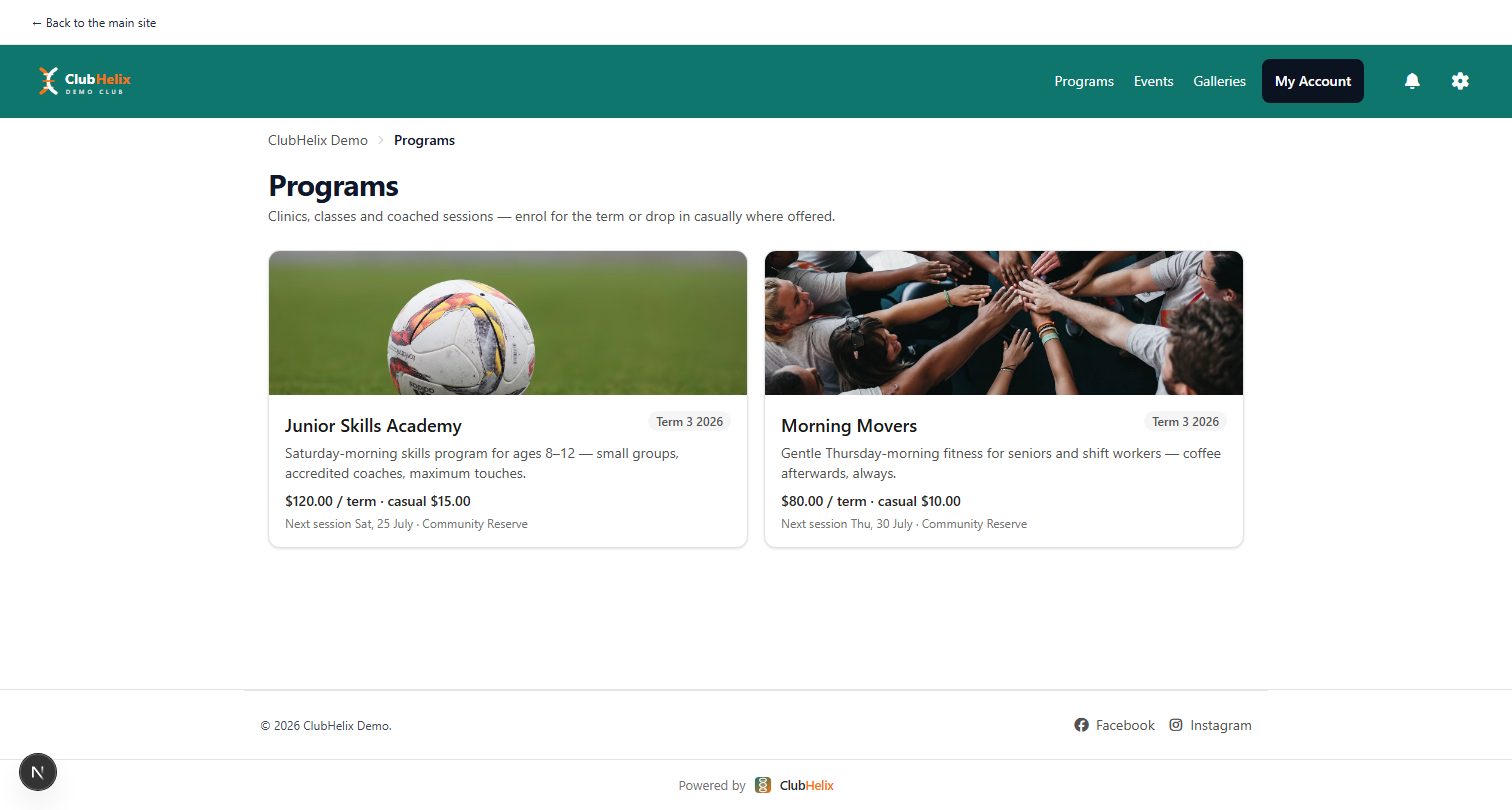
A designed scheme still needs somewhere to live, and a clipboard is not it. Levels and badges for clubs are the part of any class management software that families actually notice, and the part most likely to be missing.
In ClubHelix, programs and term enrolment covers clinics and term programs with capacity, waitlists and session attendance, and each program carries levels and progression of its own: you write out your own ladder of levels and the skills under each, then mark them off against each child.
Two details matter for the design work above. A level belongs to the enrolment, so the same child can be at different levels in two programs — Level 6 in the term swim program, Level 2 in the holiday diving clinic — and families see the level on the program page, which is what makes a scheme visible instead of internal. And skills are marked off from the session attendance register, which puts the "mark it on the mat" rule on the same screen the coach already has open rather than leaving it to nagging.
At the end of term, re-enrolment invitations build next term's invitation list from last term's confirmed enrolments — one per child, with anyone who cancelled or was refunded left out — and send it in batches. Plans are on the pricing page. If you are designing a junior pathway from scratch, start with how to start a junior program, then how to increase junior participation.
Frequently asked questions
How many levels should a progression scheme have?
Size the levels first and let the count follow: a level should take one to two terms of weekly sessions for a typical child, which puts a whole junior pathway at roughly 8 to 12 levels. If a proposed level cannot hold a class of its own on a normal week, it is a skill rather than a level.
How do I write a skill so every coach marks it the same way?
Make it observable, a single action, and pass-or-not-yet, then put a number in it: "swims 15 m freestyle with face in the water and no stop" rather than "shows good technique". Anything with an "and" in it is two skills, and any middle grade between pass and not-yet will be used for every child a coach is unsure about.
What do I say to a parent who thinks their child should have moved up?
Report against the written level rather than judging the child: name the exit skill, say what the child did last week, give the family one thing to work on, and tell them when it will be checked again. Never compare their child to another child, even to reassure them.
Can a child move up with one skill still outstanding?
Yes, and you should allow it rather than hold a child for a whole extra term over one skill. Carry the outstanding skill forward by name so the receiving coach works on it and the family knows it is being tracked — a scheme with no room for an exception is one coaches will stop using.
Should we use our governing body's badge scheme or our own levels?
Align with theirs where you can, because the awards travel with the family and the wording is already tested, but map it rather than copying it wholesale — their scheme may hold dozens of awards that were never meant to be class groups. Use their numbering, lift the observable wording, record every deliberate deviation, and re-check the mapping once a year.


