
What this guide answers
- Is Skedda good for a sports club?
Yes, as booking software. It is a mature, well-designed product for scheduling spaces, with deeper rule and permission handling than most club platforms offer and integrations aimed at organisations running single…
- What is a good alternative to standalone court booking software?
The main alternative is booking built into the platform that already holds your members, fees and website, so members log in once and rates follow their membership.
- How much should a club pay for court booking software?
Compare the shape of the price, not just the headline. Standalone products commonly charge a monthly subscription that grows with the number of bookable spaces, while bundled booking comes with the club plan regardless…
- Can members book courts without creating an account?
You can allow it, but think carefully first. Anonymous booking invites no-shows and makes it impossible to apply member rates, enforce fair-use limits or contact someone when a court closes.
- How do we stop no-shows on booked courts?
Three things do most of the work. Take payment or a card at the time of booking for anything chargeable, set a clear cancellation window and enforce it, and send an automatic reminder the day before with a one-tap…
It is 6:15 on a Tuesday and two members are standing on court four having the same conversation the club has been having for eleven years. One of them wrote their name on the whiteboard in the clubhouse on Sunday. The other booked through the Facebook group because that is what the last committee told everyone to do. Neither is wrong, and one of them is going home.
Every club with courts, greens, rinks, halls, nets or meeting rooms eventually reaches the point where the whiteboard has to go. The question that follows is narrower than it first appears: do you buy a product whose entire job is booking spaces, or do you use the booking that comes inside the platform already holding your members, fees and website? This guide takes the best-known name in the first category — Skedda — and compares it honestly with the second approach, on the three things that decide it in practice: how the pricing is shaped, how member rates and casual hire behave, and what happens when members are asked to keep a second login.
Our bias, declared up front so you can weigh everything after it: we are ClubHelix, and booking is one feature inside our platform, which puts us squarely in the second camp. We will still say plainly where a dedicated booking product is the better buy, because for some clubs it clearly is. Facts below are public information current as at July 2026, and pricing pages move constantly, so verify anything decision-critical at the source and tell us if something here has gone stale.
What each option actually is
Skedda is venue and space scheduling software, sold globally and now headquartered in Boston after being founded in Melbourne. It is the category's SEO owner — search almost any phrase containing "booking system" and it will be near the top — and it earned that with a strong product. In recent years its centre of gravity has moved towards workplace and desk booking, the hybrid-office use case, though it remains the default answer people find for venue hire. What it gives you is booking done seriously: spaces, rules, availability windows, permissions about who may book what and when, and integrations aimed at organisations with an identity system, including single sign-on and Microsoft Teams.
Booking inside a club platform is the other shape: the courts sit in the same system as your member roll, your fees, your website and your communications. There is no separate product to buy or administer. The booking rules are usually less elaborate than a specialist tool's, and in exchange the system already knows that Priya is a full playing member whose fees are paid to October, that Tom's membership lapsed in March, and that the person trying to book the hall on Saturday is not a member at all.
That is the real distinction, and it is not about feature counts. One product knows a great deal about spaces and nothing about people. The other knows about people and does a competent job on spaces.
The two pricing shapes, and why the numbers mislead
Committees compare monthly prices. The more useful comparison is the shape of the price, because the shapes behave differently as your club grows.
A dedicated booking product is typically priced as a subscription tier plus a charge related to how many bookable spaces you have. Third-party review round-ups published during 2026 put Skedda's tiers roughly in the US$99 to US$199 per month range with a small charge for spaces beyond the plan's allowance — we have not been able to confirm those figures against Skedda's own pricing page, so treat them as indicative and check directly before you budget on them. What is more reliably true, and more useful to you, is the shape: you pay a platform fee, and the bill grows as you add spaces.
Bundled booking is priced the opposite way. Booking is not a line item — it comes with the plan you are already paying for to run the club, so a club with three courts and a club with fourteen pay the same for booking.
Count your bookable spaces properly before you compare, because clubs almost always undercount. A tennis club that says "we have eight courts" usually has:
| Space type | Typical count | Often forgotten |
|---|---|---|
| Match courts | 8 | Sometimes split into halves for coaching |
| Hit-up or practice wall | 1 | Booked constantly by juniors |
| Clubhouse or function room | 1 | Hired to outside groups, which is real income |
| Meeting room | 1 | Committee, coaching meetings, community groups |
| Coaching lanes or nets | 2 | Held by the coaching contractor most afternoons |
| Equipment sets | 2 | Ball machine, portable nets — bookable in practice |
That is fifteen bookable things, not eight. Under a per-space model those extra seven either cost money or, more commonly, never get put in the system at all — which is how a club ends up with courts online and the function room still on a paper diary.
The honest counter-argument for the dedicated product: if booking is genuinely your core business — you hire out a multi-purpose venue commercially, with dozens of spaces and complex rules — then paying for a specialist tool is normal, sensible spending, and the club platform's simpler rule engine may not stretch far enough. Do not talk yourself out of the right tool because it has a subscription.

Member rates, casual hire and actually getting paid
Here is where the "knows about spaces versus knows about people" difference stops being philosophical and starts costing you money.
Almost every club charges differently depending on who is booking. A typical structure looks like this — the numbers are illustrative, but the structure is not:
| Who is booking | Court hire, off-peak | Court hire, peak | Function room, half day |
|---|---|---|---|
| Full playing member | Included | Included | $60 |
| Social or off-peak member | Included | $12 per hour | $60 |
| Lapsed member | $18 per hour | $24 per hour | $120 |
| Coach (contracted) | Block-booked | Block-booked | Not applicable |
| Public casual hire | $22 per hour | $30 per hour | $180 plus bond |
Every one of those rows requires the booking system to answer a membership question before it can price a booking: is this person a member, which category, and are their fees current? A dedicated booking product can express user groups and different rates, but it has no independent knowledge of your membership — someone has to keep its user list in step with the club's, and that reconciliation is a permanent, unglamorous job that falls to whoever is least able to refuse it.
When booking lives with the member record, the question answers itself. The rate follows the membership category, a lapsed member sees the casual rate automatically, and the renewal that fixes it is one link away in the same account.
Three practical consequences worth planning for either way:
- Casual hire is real income and needs a card. Public hire without payment at the time of booking becomes a chase, and chasing $22 is not worth a volunteer's evening. Take payment at booking, and set your cancellation window in the same breath.
- Bonds and access are separate problems. A function-room booking usually involves a key, a bond and a condition report. Whatever system you choose, write down who hands over the key, because no booking product does that for you.
- Coaching blocks are not bookings, they are an agreement. Give your coach a standing block, review it each season, and make sure members can see clearly which times are unavailable rather than discovering it at the net. Our guide to hiring out your clubrooms covers the commercial side of this in more detail.
The double-login problem
This is the failure mode that sinks more club booking systems than any pricing decision, and it is almost never discussed in a software comparison.
A club adopts a separate booking product. Members now have two accounts: one for the club — membership, fees, the website, the newsletter — and one for the booking tool. Two passwords, two apps or bookmarks, two profiles containing the same phone number, and two places where a member's details can be right in one and wrong in the other.
What happens next is predictable:
- Adoption stalls at the enthusiasts. The members who play four times a week set it up. The Saturday social crowd does not, and rings the club captain instead.
- Two member lists drift apart. New members join the club but not the booking tool. Departed members keep booking for a season. Nobody quite owns the reconciliation.
- Communication splits. Court closures for resurfacing need to go out through the booking tool. Everything else goes through the club's channels. Half your members hear one and not the other.
- The whiteboard comes back. Not officially, but it comes back.
If you do choose a separate product, you can mitigate this — deliberately, not by hoping:
- Use single sign-on if your platform and the booking tool both support it, so at least the password is shared.
- Nominate one person as the owner of the member-list sync and put it on the committee agenda monthly, so it is a job rather than an assumption.
- Put a prominent, permanently linked booking button on your club website so members never have to remember a separate address. Our guide to running a tennis club treats this as part of the club's front door, and that is exactly the right framing.
- Decide in advance what happens when someone books a court while unfinancial, because it will happen in your first month.
The alternative is not needing the mitigation. When booking is a page inside the club's own site, a member logs in once, and the system already knows who they are.
Side by side
As at July 2026, from public information. Where a figure is not confirmed at the source, we say so rather than presenting it as fact.
| Area | Skedda | Booking inside a club platform |
|---|---|---|
| What it is | Dedicated venue and space scheduling software | One feature within the club's membership and website system |
| Scheduling rule depth | Deeper — its whole reason for existing | Competent for club use; less elaborate |
| Knows your membership status | No — it holds its own user list | Yes — the same member record |
| Pricing shape | Subscription tier plus a charge as spaces grow | Included in the club plan; space count does not change it |
| Pricing figures | Review-sourced figures around US$99–199/mo plus a per-space charge — unconfirmed at source | Published plan pricing, free tier available |
| Enterprise integrations | Single sign-on, Microsoft Teams and similar | Generally not — clubs rarely have an identity system |
| Logins for members | A second account alongside the club's | One |
| Everything else a club needs | Not its job | Membership, fees, website, events, comms in the same place |
Where a dedicated booking product is the better answer
We would rather be useful than one-eyed, so here is the case against us:
- Venue hire is your business, not a sideline. Community centres, multi-purpose halls, indoor centres selling court time commercially all day — booking is the core operation and deserves the specialist tool.
- Your rules are unusual. Complex conditional availability, tiered approval workflows, or booking windows that vary by group and season in ways a simpler engine will not express.
- You need workplace-grade identity. If bookings must run through corporate single sign-on or a chat platform, a specialist product built for that world will do it properly.
- You are not really a membership organisation. If there is no member roll to connect to, the main advantage of bundling disappears, and you should pick on booking quality alone.
Booking that already knows who is booking
For most clubs, the problem was never that booking was hard. It was that booking, membership and money lived in three places and nobody had time to keep them agreeing. ClubHelix puts facility and court booking on the same member record as membership and payments, so rates follow membership category, a lapsed member sees the casual rate without anyone intervening, and roles and permissions decide who can book what. It is a page on your own club website rather than a separate address members have to be taught, and it works on a phone as an installable web app with no app store involved.
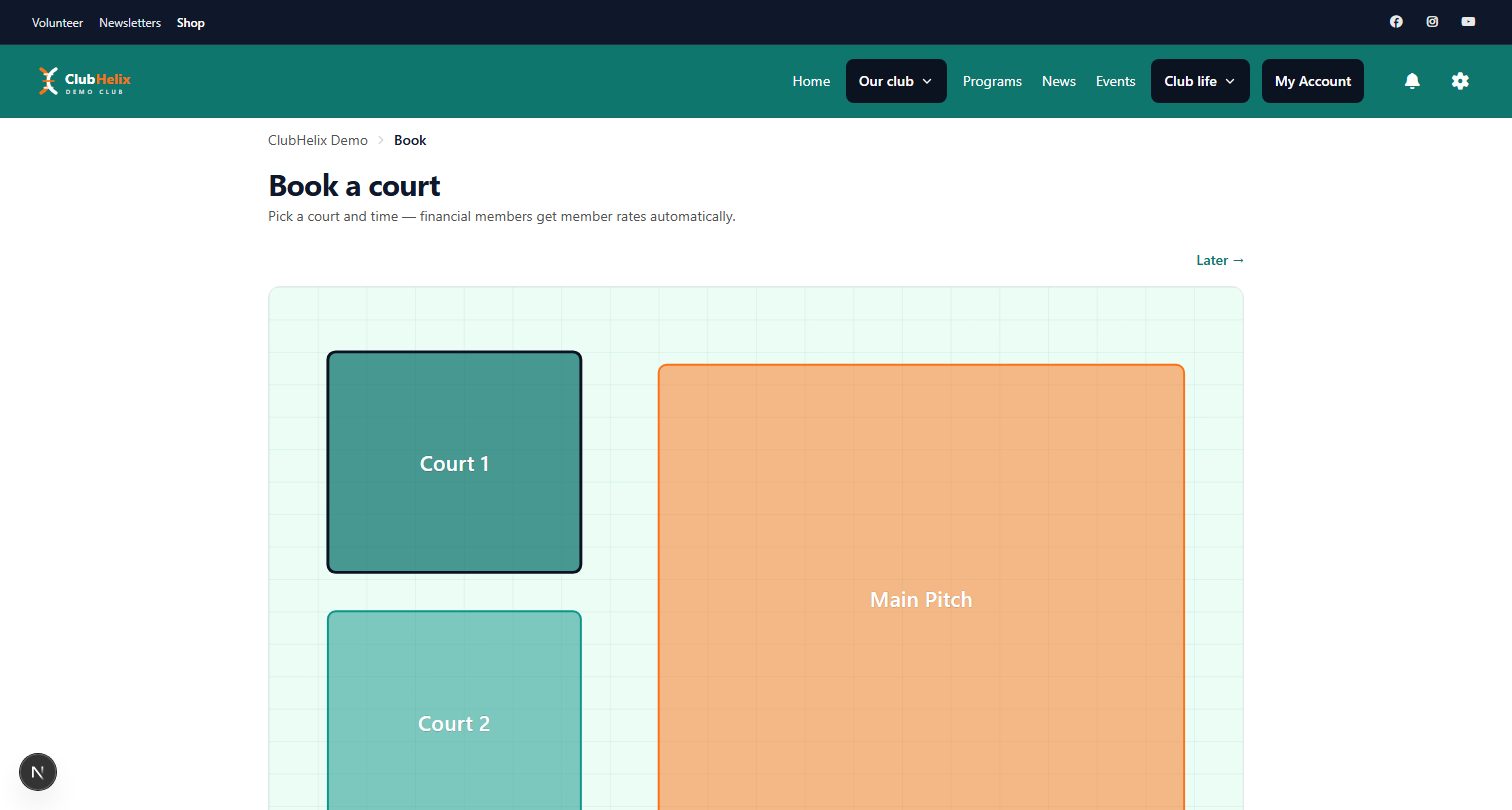
Booking is included in the plan rather than priced per space, which means putting the meeting room, the ball machine and the function room online costs nothing extra and they finally come off the paper diary. There is a free tier to try it on, pricing you can read without a sales call, and the platform is Australian-built and Australian-hosted. Have a look at what it does for a tennis club specifically, or start your club site and put your courts online before the weekend.
Frequently asked questions
Is Skedda good for a sports club?
Yes, as booking software. It is a mature, well-designed product for scheduling spaces, with deeper rule and permission handling than most club platforms offer and integrations aimed at organisations running single sign-on. The trade-off is that it holds its own user list rather than your membership, so it cannot price a booking by membership category without someone keeping two lists in step. Whether that matters depends on how much of your booking is member-rate versus public hire.
What is a good alternative to standalone court booking software?
The main alternative is booking built into the platform that already holds your members, fees and website, so members log in once and rates follow their membership. It usually trades some rule-engine depth for that simplicity. Judge it on your actual booking rules — if they fit on a page, bundled booking is likely to serve you better; if they run to a policy document, a specialist tool may be worth the extra subscription and the extra login.
How much should a club pay for court booking software?
Compare the shape of the price, not just the headline. Standalone products commonly charge a monthly subscription that grows with the number of bookable spaces, while bundled booking comes with the club plan regardless of how many courts you have. Count every bookable thing — courts, halls, meeting rooms, nets, equipment — before you compare, because a per-space model prices the full list, not the courts alone.
Can members book courts without creating an account?
You can allow it, but think carefully first. Anonymous booking invites no-shows and makes it impossible to apply member rates, enforce fair-use limits or contact someone when a court closes. A better middle ground is requiring an account for members while allowing public casual hire to book and pay by card in one step, which gives you a contact and the money without demanding a full sign-up from a visitor.
How do we stop no-shows on booked courts?
Three things do most of the work. Take payment or a card at the time of booking for anything chargeable, set a clear cancellation window and enforce it, and send an automatic reminder the day before with a one-tap cancel link so releasing an unwanted slot is easier than ignoring it. Then publish how many slots were released back — clubs that show the effect get far better behaviour than clubs that scold.
More on the same problem — how to run a tennis club covers court allocation and peak-hour policy, and how to hire out your clubrooms covers turning your spaces into income.


