
What this guide answers
- Is SignUpGenius good for club volunteer rosters?
For one-off events and simple sign-ups it is very good, and the sheet model keeps the ask light, which removes a real barrier to helping.
- What is the best alternative to a sign-up sheet for clubs?
Rostering that is connected to your member record. The test is simple: can the system tell you how many shifts a specific family has done this season, and can it check whether a volunteer holds the accreditation a role…
- How do you handle volunteers who do not turn up?
Record it, calmly and consistently, and separate the causes.
- Can volunteer hours really count towards a grant?
Often, yes, as an in-kind contribution towards matched funding, but it depends entirely on the program.
- How many volunteer hours does a typical club need to record?
There is no meaningful average, and any number quoted at you should be treated with suspicion.
The canteen roster is the most honest document a club produces. Everything else — the strategic plan, the annual report, the sponsorship deck — is written for an audience. The roster is written for Saturday, and it tells you exactly who is actually carrying the club.
Most clubs run that roster on a sign-up sheet, and for good reason: sign-up sheets work. You make a list of slots, you send a link, people claim slots, and the whole thing takes fifteen minutes to set up with no training and no budget approval. SignUpGenius built an enormous business on precisely that, and it is not an accident. But there is a specific point at which a sheet stops being enough, and clubs usually hit it without noticing — they just find themselves doing more and more manual work around a tool that is technically still functioning.
This guide is about that point. It compares a generic sign-up sheet with volunteer rostering that is connected to your member record, on the three things that decide it: what the tool knows about the person claiming a slot, what happens when someone cannot make their shift, and whether you can produce a defensible hours figure when a grant application asks for one. We build one of the options — ClubHelix includes volunteer rostering — so treat our verdict accordingly, and note that we will spend a whole section on when the sheet is still the better call. Everything here reflects public information current as at July 2026; if something has changed, let us know.
What each option actually is
SignUpGenius, based in Charlotte, North Carolina, is a sign-up sheet tool. It does one thing extremely well: turn a list of slots into a page people can claim from. Like any sheet-style tool, what it ends up holding is a name someone typed into a box rather than a person your club already knows — which is the whole subject of this comparison. It has a free tier, and paid plans that directory listings at July 2026 place roughly in the US$12 to US$60 per month range — the figures vary between sources and we have not confirmed them against their own pricing page, so check directly if the number matters to your decision. It is used by clubs for canteen duty, working bees, event help, bringing plates to a function, and roughly a hundred other things.
Volunteer rostering inside a club platform is a different object. Slots and shifts still exist, but they are attached to your member roll, so the system knows who claimed the slot, whether they are a current member, what other roles they hold, whether their accreditation is current, and what they have done across the season. It is not a better sign-up sheet — it is a roster with a memory.
Enterprise volunteer management is the third category, worth naming so you can rule it out. Products such as Rosterfy serve major events, councils and large sporting organisations managing volunteer workforces at scale. They are excellent at that job and priced for organisations with a paid volunteer manager. A community club is not the customer.
Most clubs sit in the middle, which is precisely the gap this comparison is about.
What a sign-up sheet is brilliant at
Let us be fair before we are critical, because the sheet's virtues are real and clubs discard them too casually.
- Low friction for the volunteer. A link arrives, they tap a slot, they are done. Every barrier you add costs you volunteers, so how much sign-up a tool demands before someone can claim a shift is the first thing to check in any trial.
- Low friction for the organiser. Anyone can set one up in a few minutes. No admin permissions, no committee approval, no training. The under-13s manager can organise the away-game car pool without asking anyone.
- It works for non-members. Parents who are not members, a neighbouring club helping at your carnival, community volunteers at a fundraiser — none of them need to exist in your club's systems to help.
- It scales down beautifully. For a one-off working bee or a single event, a sheet is not a compromise. It is the correct tool.
If your volunteer coordination amounts to a handful of one-off events a year, stop reading and go use a sheet. The rest of this guide is for clubs where volunteering is continuous.

The blind spot — a sheet does not know who your members are
Here is the structural limitation, and everything else in this article follows from it. A sign-up sheet stores a name someone typed into a box. It has no link to your membership. That single disconnection produces a long list of consequences that clubs experience as vague administrative friction rather than as a software problem:
- You cannot check eligibility. Some roles require a current working with children check, a food-handling induction, an accreditation or simply current membership. The sheet cannot enforce any of it, because it does not know. Someone has to check the list by eye afterwards, and eventually someone forgets.
- Names do not reconcile. "Sam", "Sam T", "Samantha Taylor" and "Sam Taylor (Ellie's mum)" are four rows. Across a season they are dozens of rows, and no total you produce from them can be trusted.
- You cannot see who is carrying the club. The question every committee should ask each season is which families have done six shifts and which have done none. A per-event sheet cannot answer it, because each event forgets the last one.
- You cannot target the ask. Recruiting is far more effective when you can approach the people who have never been asked rather than blasting everyone. Our guide to recruiting club volunteers is built on that principle, and it needs history to work.
- The record leaves with the organiser. Sheets are typically created under one person's account. When they step down, the season's history goes with them, along with the login.
A roster tied to the member record turns all of those into non-problems, not by being cleverer, but by knowing who claimed the slot.
Reminders, swaps and the no-show
Filling a roster is the easy half. What separates a system from a sheet is what happens in the seventy-two hours before the shift.
Reminders. A slot claimed in February for a shift in June needs a reminder, and email alone is not enough for a Saturday morning. The reliable pattern is a reminder a week out, a second the evening before, and a text message for anything before 9am. Text matters here because it is the only channel people read from bed.
Swaps. This is the real workload. Somebody cannot make Saturday. In a sheet-based club, they text the canteen coordinator, who then texts four people individually, and finds a replacement roughly eighty per cent of the time. That coordinator is doing a job the software should do. What good rostering does is let the volunteer release the shift themselves, which then offers it — automatically — to the people who fit it, with the coordinator merely notified.
No-shows. Clubs handle these badly, usually by pretending they did not happen and then quietly resenting people. The only fair approach is to record them, because a record distinguishes the person whose car would not start from the person who has missed four in a row. A sheet cannot support that distinction. A roster with history can.
Here is a run sheet worth stealing for a season-long canteen roster, whichever tool you use:
| When | Action | Channel |
|---|---|---|
| Pre-season | Publish the whole season's slots at once | Website and newsletter |
| Pre-season plus 2 weeks | Chase families with no shift claimed, by name | Direct message |
| 7 days before | Reminder with time, location and what to bring | |
| Evening before | Short confirmation with a one-tap release link | Text message |
| 2 hours before | Coordinator sees who has confirmed | Roster view |
| After the shift | Mark attended, released or no-show | Roster view |
| End of season | Publish hours by person, thank people by name | Newsletter and website |
The last row does more for next season's recruitment than any appeal ever will, and it is only possible if the middle rows were recorded against real people. Our volunteer roster template covers the slot structure if you are starting from a blank page.
Counting hours you can put in a grant application
This is the argument that usually settles it, because it turns roster admin into money.
Many grant programs allow volunteer time to be counted as an in-kind contribution towards a project's co-funding requirement. That can be the difference between an application that meets a matched-funding condition and one that does not. The rate that may be applied — and whether it may be applied at all — is set by the funding program, so read the guidelines for the specific grant and ask the funding body if the wording is unclear. Never assume a rate from another program, and never assume last round's guidelines still apply.
What every program has in common is that the figure has to be defensible. An assessor asking "how do you know it was 1,840 hours?" needs an answer better than an estimate at the kitchen table.
A worked example, with an illustrative rate rather than a real one, to show the mechanics:
| Activity | Shifts | People per shift | Hours per shift | Total hours |
|---|---|---|---|---|
| Saturday canteen | 20 | 3 | 5 | 300 |
| Ground and line marking | 20 | 2 | 2 | 80 |
| Team managers | 12 teams | 1 | 40 per season | 480 |
| Coaching (unpaid) | 12 teams | 2 | 60 per season | 1,440 |
| Working bees | 3 | 18 | 4 | 216 |
| Committee meetings | 11 | 9 | 2.5 | 247 |
| Events and fundraising | 4 | 12 | 6 | 288 |
| Total | 3,051 |
At an illustrative in-kind rate of $45 per hour, that is roughly $137,000 of contributed labour in one season. Written into an application with a system-generated report behind it, that is a serious number. Estimated on the back of an envelope, it is a number an assessor will discount.
The difference between those two outcomes is entirely whether your roster recorded real people against real shifts and marked them off afterwards. A sign-up sheet gives you claimed slots under typed names, with no attendance confirmation and no way to deduplicate across the season. That is why this section belongs in a software comparison rather than in a grants article — though tracking volunteer hours for grants goes considerably deeper on the reporting itself.
Side by side
As at July 2026, from public information.
| Area | SignUpGenius | Rostering inside a club platform |
|---|---|---|
| What it is | A sign-up sheet tool | A roster attached to the member record |
| Set-up effort | Minutes, by anyone | Set up once by an administrator, reused all season |
| Friction to claim a shift | Low — the sheet model is built for quick claims | Usually requires a member account |
| Knows who the volunteer is | No — it stores a typed name | Yes — the same person record as membership |
| Eligibility and accreditation checks | Not possible | Can be checked against the member record |
| Season-long history | Per sheet, not per person | Per person, across the season |
| Swaps and releases | Manual, usually via the coordinator | Volunteer releases, system offers it onward |
| Reminders | Available | Available, including text for early shifts |
| Hours reporting for grants | Not designed for it | A report you can attach to an application |
| Pricing | Free tier plus paid plans; directory-listed figures around US$12–60/mo are unconfirmed at source | Included in the club plan |
When a sign-up sheet is still the right call
We would rather you used the right tool than ours, so here are the cases where a sheet wins outright:
- One-off events with outside helpers. A community fun run where half the volunteers have no connection to the club. Requiring accounts would cost you people.
- A single team's logistics. Car pooling, bringing oranges, a barbecue after the last game. This is a team manager's job and should never require a committee-level tool.
- You have no member system at all. If your membership currently lives in a spreadsheet, connecting a roster to it is not possible, and a sheet is the honest interim answer.
- The organiser is not on the committee. Sheets are democratic — anyone can run one. That is a real cultural advantage in clubs where the committee is already stretched.
The pattern many clubs land on is both: a sheet for one-off community events with outside helpers, and a connected roster for the recurring, member-facing commitments where history matters. That is a reasonable answer, provided you are deliberate about which is which.
Turning the roster into something the club can use
If your canteen coordinator is the club's single point of failure, the fix is not a better sheet — it is a roster that knows who your members are. ClubHelix's volunteer rostering sits on the same member record as membership and registrations, so shifts are claimed by real people, eligibility can be checked, and the season's history accumulates against each family instead of evaporating with each event. Text messaging handles the evening-before reminder that email cannot, attendance records who actually turned up, and reports give you the hours figure your next grant application needs, per person and per activity.
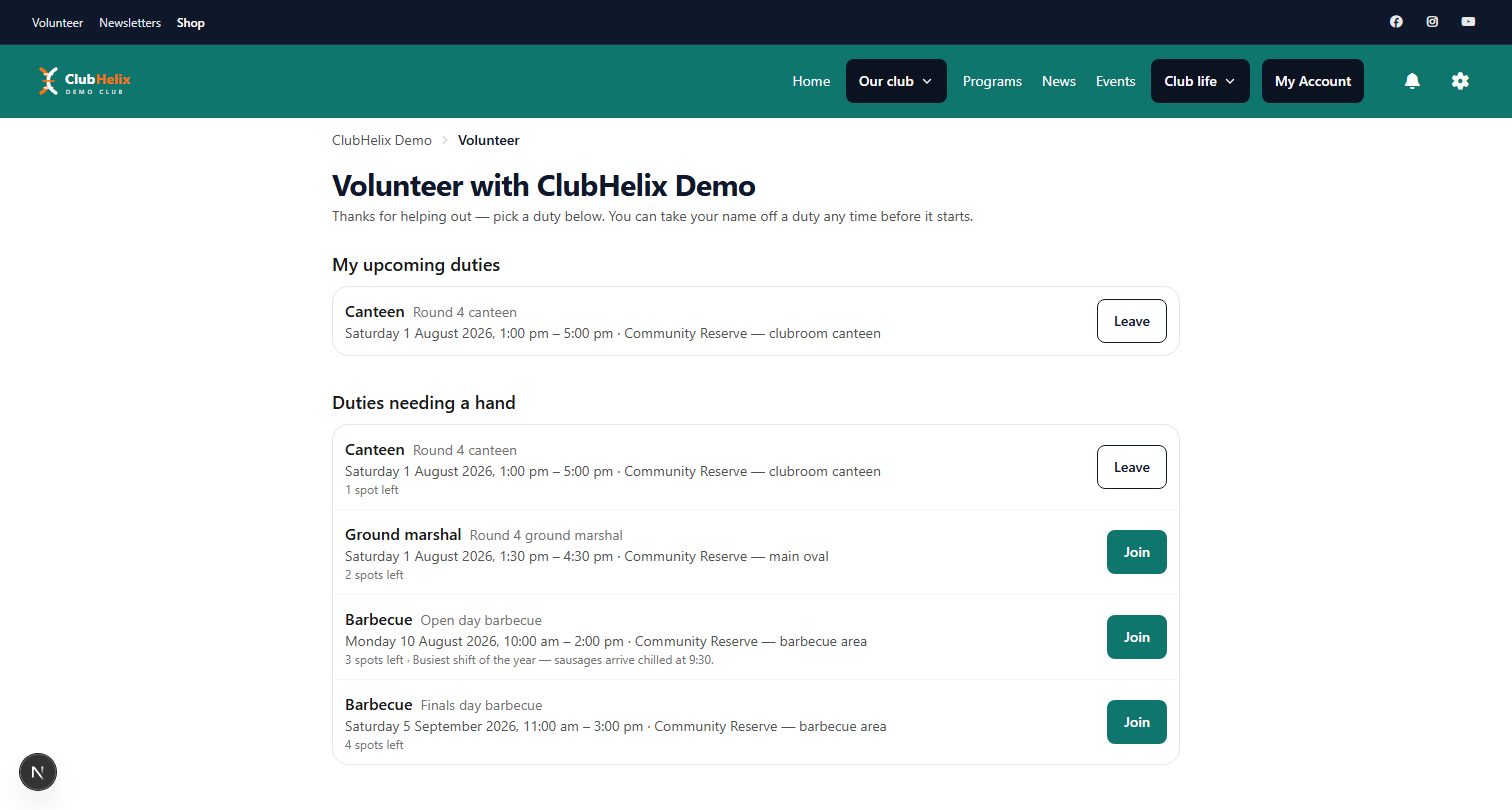
There is no separate subscription for it — rostering comes with the platform, alongside the member roll, the website and everything else the committee runs. Start on the free tier, read the pricing without booking a call, and note that it is Australian-built and Australian-hosted, which matters when the roster holds your members' contact details. See how it fits a community organisation. You can set your club up and have the season's canteen roster published before the next committee meeting, or hand the whole setup to us through done-for-you if the committee's time is the scarce thing.
Frequently asked questions
Is SignUpGenius good for club volunteer rosters?
For one-off events and simple sign-ups it is very good, and the sheet model keeps the ask light, which removes a real barrier to helping. Its limitation for clubs is structural rather than a quality issue — it stores typed names, not members, so it cannot check eligibility, cannot accumulate a season of history per family, and cannot produce a defensible hours total. Clubs with continuous, member-facing rosters usually outgrow it without noticing.
What is the best alternative to a sign-up sheet for clubs?
Rostering that is connected to your member record. The test is simple: can the system tell you how many shifts a specific family has done this season, and can it check whether a volunteer holds the accreditation a role requires. If the answer to both is yes, you have a roster; if not, you have a sheet with extra steps. Keep a sheet for events involving outside helpers.
How do you handle volunteers who do not turn up?
Record it, calmly and consistently, and separate the causes. A no-show recorded against a person distinguishes a one-off from a pattern, which is the only fair basis for a conversation. Make releasing a shift genuinely easy — a one-tap link in the reminder the evening before — because most no-shows are people who knew days earlier and had no low-friction way to say so.
Can volunteer hours really count towards a grant?
Often, yes, as an in-kind contribution towards matched funding, but it depends entirely on the program. The guidelines for each grant set out whether volunteer time is eligible, what rate may be applied and what evidence is required, so read them and ask the funding body if anything is unclear. This is general information rather than advice — what matters at your end is keeping records good enough to substantiate the figure.
How many volunteer hours does a typical club need to record?
There is no meaningful average, and any number quoted at you should be treated with suspicion. What matters is completeness at your own club — count coaching, team management, committee time, canteen, grounds, events and fundraising, because clubs routinely undercount by leaving out committee and coaching hours, which are usually the two largest categories. Build the list of activities first, then count.
Next steps for a volunteer coordinator — how to recruit club volunteers covers making the ask, and tracking volunteer hours for grants covers the reporting end.


