
What this guide answers
- What if our numbers do not match the association's portal?
Investigate before submitting. The usual causes are a different date, a different definition of "registered", or members who registered directly with the body rather than through the club.
- Do we have to give them member contact details?
That depends on your affiliation agreement and on the privacy law where you operate.
- Who at the club should own these returns?
Usually the secretary or the registrar, with a nominated backup.
- What happens if we miss a deadline?
Usually a reminder and occasionally a late fee. The bigger risk is that a missed compliance declaration affects insurance or eligibility, which is why compliance deadlines deserve a different level of attention from…
- Can we automate any of this?
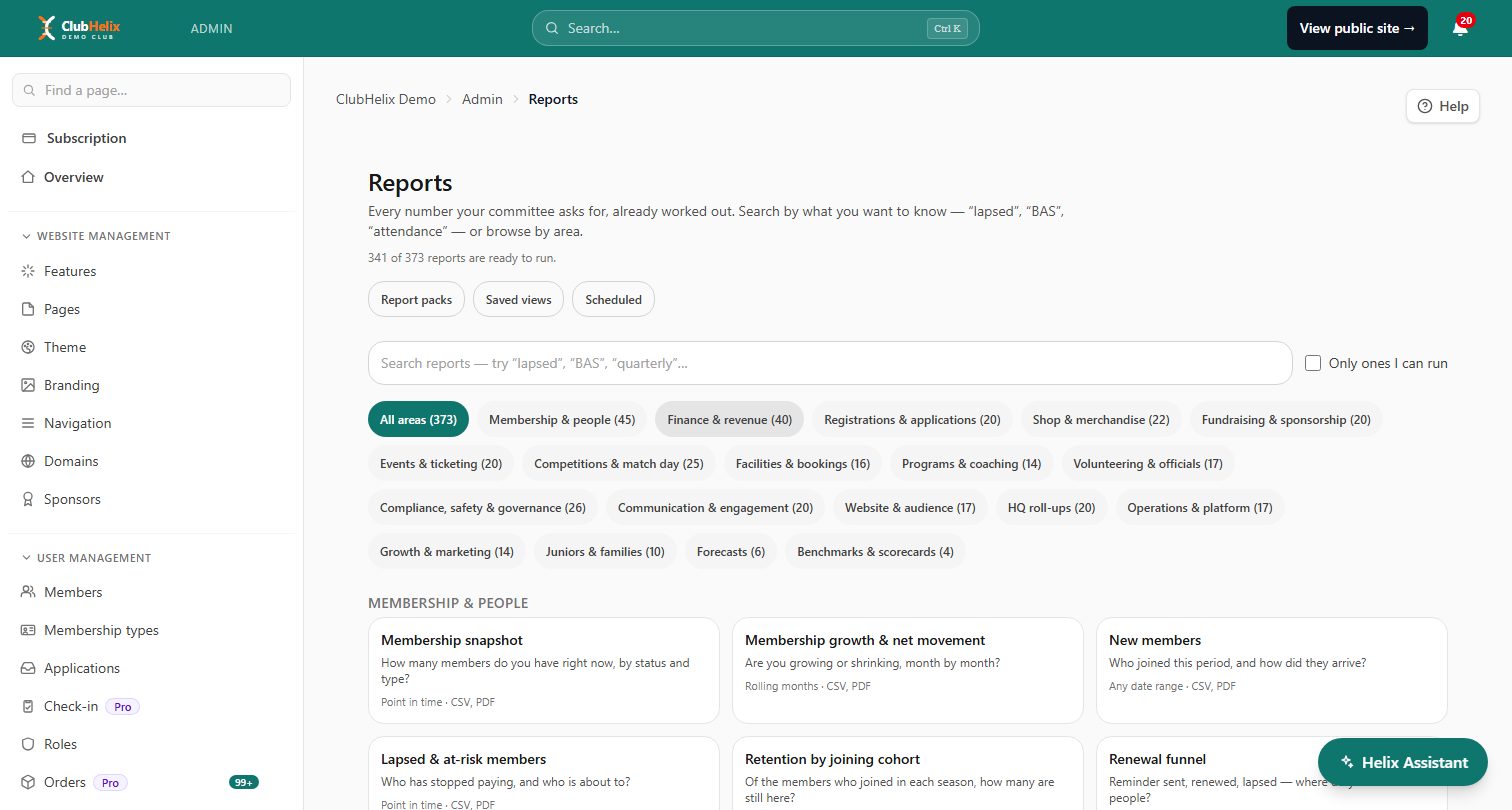
The data preparation, largely yes — counts, splits and compliance coverage can all be reports rather than research.
USA edition. This guide is written for volunteer-run clubs in the United States. Where rules differ — grants, tax, incorporation, safeguarding — follow the USA-specific pointers below or check with your national body.
Somewhere between the end of sign-on and the first round, an email arrives from the association. It needs registered numbers by grade, it needs them by Friday, and the portal it wants them entered into does not accept the format your club exports.
Then a month later the regional body wants participation figures on a different date, and the national body wants a safeguarding compliance declaration, and the council wants a usage report for the lease.
None of these requests are unreasonable individually. Collectively they consume an extraordinary amount of volunteer time, and almost all of that time is spent producing the same underlying facts in four different shapes.
What governing bodies actually ask for
Across sports and levels, the requests reduce to six things.
1. Registered numbers. Members with a current registration, usually on a specified date, split by grade, division or age band. This is the one that drives affiliation fees, so it gets checked.
2. Participation. People who actually took part. Increasingly requested separately from registrations, because funders ask governing bodies for participation and governing bodies pass the question down.
3. Teams and entries. Squads nominated into competitions, with grade and age group.
4. Compliance declarations. Confirmation that coaches, officials and volunteers hold current checks and accreditations — sometimes as a declaration, increasingly as a count or a list.
5. Officials and volunteers. Umpires, referees, coaches, and often the club's capacity to supply them.
6. Governance basics. Office holders, insurance, incorporation status, constitution version.
Notice that four of the six are counts of things you already know. The work is not in knowing them; it is in producing them on demand, on the requested date, in the requested cut.
Prepare once, answer many times
The clubs that find this easy have done one thing: they treat the underlying facts as a standing dataset rather than a set of one-off answers.
Keep a single roster with dates. Joining date, paid-until date, membership type, team, and date of birth if your sport's age grades require it. Everything in category 1 and most of category 2 comes out of that one table.
Record attendance somewhere. Participation cannot be reconstructed after the fact. If nothing records who turned up, a participation request can only be answered with a registration figure and a caveat.
Hold accreditations against people, with expiry dates. Category 4 becomes a report rather than a round of emails to coaches.
Write your definitions down. "Registered", "participant", "active volunteer" — agree them once, in a document, and reuse them. When two bodies define the same word differently, you can then map deliberately instead of guessing.
With that in place, a return is a filter and an export. Without it, every return is a small research project.
Handling the date problem
The single most common friction is that each body asks for a different date, and clubs answer with today's figure because that is what the roster shows.
Two habits fix it:
- Use reporting that can take a snapshot at a past date. A membership report that can produce the roster as it stood on 30 April, run in July, is worth more than any export button. Reconstructing a past roster from a live list is close to impossible once renewals have moved.
- Keep every submitted return. File the export alongside the return. When the body queries the number eighteen months later — and they do — you have the exact population you counted rather than an argument.
What to push back on
Clubs are often more compliant than they need to be, particularly with member data.
Full member exports. If a governing body asks for your complete member list including contact details, it is entirely reasonable to ask what each field is used for and under what basis. Often the honest answer is that they need counts, and the export is simply how it has always been done. Aggregate figures satisfy most requests.
Duplicate collection. If a body already holds the data through a registration portal your club uses, asking the club to re-key it is a process problem worth naming politely.
Unreasonable deadlines. A Friday deadline emailed on Wednesday is worth a reply asking for a week. Bodies generally set deadlines earlier than they need them, and clubs generally do not ask.
Definitions that shift. If the participation definition changed this season, ask for it in writing, and note it against your own historical figures so your trend stays honest.
None of that is adversarial. A governing body dealing with volunteer-run clubs benefits from clubs that ask clear questions.

If you are the governing body
The same problem, viewed from above, has a much better solution than chasing forty clubs by email.
Where clubs run on a shared platform, participation, compliance coverage and affiliation status can roll up as aggregates computed centrally — every club counted on the same definition, on the same date, without member records leaving the club that holds them. That last point is what makes it acceptable to clubs: affiliation is not surveillance, and clubs are rightly protective of their members' data.
Three principles for a body designing its reporting:
- Publish the definitions, and change them rarely. Every definition change silently invalidates every club's historical comparison.
- Ask for the minimum that answers your question. If you need counts, ask for counts.
- Give something back. A club that receives a benchmark — how its retention compares with the region — will complete the return enthusiastically. A club that only ever sends data upward will do it late.
An annual calendar
Rather than reacting, put the known requests in the club calendar with a two-week lead:
- Pre-season — team nominations, affiliation intent, insurance confirmation
- Four weeks after sign-on — registered numbers, the affiliation count
- Mid-season — participation and compliance declarations
- End of season — final participation, officials, and the club's own annual reporting
- Post-AGM — office-holder updates to the association and to any regulator your structure requires
The requests will still arrive at short notice. The difference is that the answer already exists when they do.
Frequently asked questions
What if our numbers do not match the association's portal?
Investigate before submitting. The usual causes are a different date, a different definition of "registered", or members who registered directly with the body rather than through the club. Whichever it is, document it in your submission — a discrepancy explained is fine; a discrepancy discovered later is not.
Do we have to give them member contact details?
That depends on your affiliation agreement and on the privacy law where you operate. It is always reasonable to ask what the data is used for. Many requests that arrive as "send us your member list" are satisfied by counts.
Who at the club should own these returns?
Usually the secretary or the registrar, with a nominated backup. The important part is that it is a named role, not "whoever is free" — returns missed during a handover are one of the more common ways a club falls out of good standing.
What happens if we miss a deadline?
Usually a reminder and occasionally a late fee. The bigger risk is that a missed compliance declaration affects insurance or eligibility, which is why compliance deadlines deserve a different level of attention from participation ones.
Can we automate any of this?
The data preparation, largely yes — counts, splits and compliance coverage can all be reports rather than research. The submission usually still has to be keyed into whatever portal the body runs, unless your sport has a direct integration. Preparing in minutes and keying in ten is a very different weekend from preparing in a fortnight.


