
What this guide answers
- What is peak and off-peak court pricing?
It is charging a different hourly rate for the hours people actually want than for the hours that sit empty — typically a higher rate for weekday evenings and Saturday mornings, and a lower one for weekday mornings and…
- How much more should a peak court hour cost?
Somewhere between a third and a half more than the off-peak rate is where most clubs settle: on a $20 off-peak hour, a peak rate of $27 to $30.
- How do you price a booking that starts off-peak and finishes in peak?
Price it slot by slot, charging each hour at the rate for the band that hour starts in.
- Should members pay a peak rate at all?
Usually yes, at a smaller gap than casual hire pays, because the point of the peak rate is partly to shift flexible players into empty hours and a member paying nothing extra has no reason to move.
- How do we stop the same few members taking every peak slot?
A price rations by willingness to pay, and your keenest members are willing, so use a fair-use cap instead — a limit on how many bookings one member holds per week, counted across the whole venue rather than per court.
USA edition. This guide is written for volunteer-run clubs in the United States. Where rules differ — grants, tax, incorporation, safeguarding — follow the USA-specific pointers below or check with your national body.
Somewhere in your booking grid there are two courts that may as well be different businesses. Court 2 at seven on a Tuesday evening has a queue — three members refreshing the page the minute the week opens, two of them missing out, one of them telling you about it at the bar on Saturday. Court 2 at ten the following morning has nobody on it, has had nobody on it for six weeks, and will have nobody on it next week either.
Same surface, same net, same club, same hourly cost. Completely different product. Peak and off-peak court pricing is how a club charges for that difference, and done carefully it does three useful things at once: it fills some of the empty hours, it pays for the lights over the full ones, and it gets more members onto prime time rather than fewer.
This guide assumes you already have a grid to read. If bookings still live in the diary behind the bar, start with how to set up online court booking — slot length, caps, who may book, opening hours — and read how to price facility hire for the hourly cost floor every rate has to clear. What follows is the layer that sits on top of both.
Name your own peak honestly
Every committee already knows when its peak is, and a good third of them are wrong. Instinct says "evenings and weekends". The grid usually says something narrower and more interesting: two or three weekday hours that are effectively sold out, a Saturday morning that is close behind, and a late evening hour with the lights blazing over nobody.
So do it with last season's data. Export the bookings, group them by hour band and weekday, and work out utilisation as court-hours booked ÷ court-hours available. For a four-court club, a band that runs three hours across five weekdays offers 4 × 3 × 5 = 60 court-hours a week. Here is what a real grid tends to look like.
| Weekday band | Court-hours available | Court-hours booked | Utilisation | What it tells you |
|---|---|---|---|---|
| 7am–9am (early) | 40 | 9 | 23% | A small, loyal, fixed group — not peak |
| 9am–12pm | 60 | 14 | 23% | The hours worth discounting |
| 12pm–4pm | 80 | 18 | 23% | The hours worth discounting |
| 4pm–6pm (after school) | 40 | 26 | 65% | Shoulder — busy, not full |
| 6pm–9pm | 60 | 57 | 95% | This is your peak. Members miss out |
| 9pm–10pm (lights on) | 20 | 7 | 35% | Costs the most to run, earns the least |
| All weekday hours | 300 | 131 | 44% | Average utilisation hides everything above |
Three things fall out of that table every time. The peak is narrower than instinct — three hours, not "evenings". The shoulder at 4pm–6pm is busy but not full, so it is a candidate for the off-peak rate rather than the peak one. And the 9pm–10pm hour is the club's worst trade: full floodlights, one court in use. A club that prices "evenings" as one block charges its best hour and its worst hour the same money.
Run the same grid for weekends separately. Saturday morning is often a second peak, and Sunday afternoon is often the emptiest block in the week.

What peak pricing is actually for
Be clear with yourself, and later with the members, about which of these you are doing. They pull in different directions.
Recovering the cost of the lights and the heating. An unlit afternoon court costs the club surface wear and a share of the fixed costs. The same court at eight in the evening adds floodlights, and an indoor centre adds heating on top. Charging the same for both means the cheap hours subsidise the expensive ones, which is a choice — just not usually a deliberate one.
Shifting the flexible players into the empty hours. Some members genuinely cannot play before six: work, school, the commute. Others can, and simply default to the evening because it is what everybody does. A visible price difference is what gives the retired pair, the shift worker and the parent with a free Tuesday a reason to move — and every one who moves frees a peak slot for somebody who could not.
Protecting member access at prime time. If casual hire sits at the same price all day, a stranger with a phone and a free evening competes on equal terms with a member who has paid a subscription. A wider casual gap at peak, plus members-only eligibility on the courts that fill (decision five in the court booking setup guide), keeps prime time for the people funding the club.
How big should the gap be?
This is the whole argument, and it is answerable with arithmetic. Take the two bands that matter — the 6pm–9pm peak and the flat 9am–4pm midday stretch — and model a flat rate against a split one. The peak is already at 95%, so raising it loses a booking or two; the off-peak is at 23%, so cutting it wins several.
| Band | Court-hours available | Flat $25 — booked | Flat $25 — revenue | Split $30 / $20 — booked | Split — revenue |
|---|---|---|---|---|---|
| Weekday peak, 6pm–9pm | 60 | 57 | $1,425 | 54 | $1,620 |
| Weekday off-peak, 9am–4pm | 140 | 32 | $800 | 44 | $880 |
| Total | 200 | 89 (45%) | $2,225 | 98 (49%) | $2,500 |
Revenue per available court-hour goes from $11.13 to $12.50 — about 12% more from the same courts — utilisation rises four points, and three peak slots come free for members who previously could not get on. Those are illustrative figures and your own elasticity will differ; the shape is what generalises. Raising a price in a band that is 95% full is nearly free, and cutting one in a band that is 23% full is nearly free too, because the empty hour earns nothing either way.
On the size of the gap, two thresholds are worth knowing:
- Under about 20%, nothing happens. A $22 off-peak against a $25 peak does not move a single booking. It only adds a line to the price list and a question at the desk.
- Over about 50%, the gap stops reading as pricing and starts reading as a penalty. With a $20 off-peak, a $30 peak is defensible in a sentence — "the evening rate carries the lights". A $45 peak is not, and the conversation you get is not about pricing.
Somewhere between a third and a half of the off-peak rate is where most clubs land. Round both numbers to something payable: $20 and $30, not $19.50 and $28.75.
Pricing the boundary, slot by slot
Here is the detail that decides whether members think the whole scheme is fair: what happens to a booking that straddles the change.
There are three possible answers. Charge the rate the booking started at, and every regular learns to book from 5:30pm to catch three peak hours at the off-peak rate. Charge the rate it finished at, and a member who plays 4pm to 6pm pays peak for two off-peak hours and is rightly annoyed. Or price it slot by slot, so each hour is charged at the rate that applies to that hour. Only the third survives contact with members, and it is the only one you can explain at an annual meeting without a whiteboard.
Work it against the slot's own start time. With a peak window running from 6pm to 9pm, a member booking Court 2 from five until seven pays:
| Slot | Slot starts | Rate that applies | Member price |
|---|---|---|---|
| 5pm–6pm | 5:00pm | Off-peak — starts before 6pm | $12 |
| 6pm–7pm | 6:00pm | Peak — starts inside the window | $18 |
| Total | $30 |
The same test settles the other end cleanly: an 8pm–9pm slot starts inside the window and is peak; a 9pm–10pm slot starts at nine, outside it, and is off-peak. Publish that one sentence — "each hour is priced at the rate for that hour, and an hour belongs to the band it starts in" — on the booking page itself, and the boundary stops being a topic.
Member and casual rates, layered on top
Peak pricing does not replace the member and casual rates; it multiplies them. You end up with a small grid, which is fine as long as every cell was decided on purpose.
| Rate | Off-peak | Peak | Why |
|---|---|---|---|
| Member | $12 | $18 | The subscription already paid for part of the hour |
| Casual (non-member) | $20 | $30 | Covers the cost floor comfortably at both ends |
Two rules keep this from turning into a spreadsheet. First, move both rates when you define a peak band — a peak that raises only the casual rate is a message to members that they are not the ones being managed, and a peak that raises only the member rate is worse. Second, keep the member-to-casual gap wide at peak, because that gap is what sells memberships: a casual who plays every Wednesday evening at $30 works out fairly quickly that a subscription plus $18 is the better deal, and that arithmetic is the most effective recruiting you will do all season.

The seasonal overlay
A peak band is defined by a day of the week and a window of the clock, which means it does not know what month it is. That is a feature as long as you remember to revisit it twice a year.
In winter, everything after five is floodlit, so the peak window widens at the front and the case for a higher evening rate is at its strongest. In summer it is light until eight, the courts are playable without lights, and the genuine peak often shifts later and shortens. School holidays invert the whole grid for a fortnight: weekday mornings that run at 23% in term time can run at 60%, so either suspend the off-peak discount for those two weeks or leave it alone and bank the utilisation — both are reasonable, and deciding in advance beats arguing in week one.
Put the review in the calendar at the season boundary, change the windows once, and tell members a fortnight before it happens. Bookings already taken keep the price they were taken at.
Fair-use caps, notice and no-shows
Peak pricing alone does not stop one group taking every prime slot; a price only rations by willingness to pay, and the keenest four members are perfectly willing. Three rules do the rest of the work, and they matter more at peak than anywhere else.
A fair-use cap limits how many bookings one member may hold in a period — three a week is the most common answer at a court club. Decide whether the cap counts one court or the whole venue: a six-court club almost always means "three court bookings a week, whichever court", not three on each.
A cancellation notice window is what turns a released peak slot back into a playable one. Free cancellation right up to the start time means a 7pm court can be handed back at 6:58pm, when nobody is looking for a court any more. Twelve or twenty-four hours' notice gives the slot a chance to be re-booked, and the number has to be published beside the cancel button rather than discovered at the moment somebody is refused.
A no-show mark closes the loop. A member who books peak and does not turn up has cost the club the hour and cost another member the chance to play, and if the booking simply sits there as a completed booking, nothing records it. Marking it as a no-show should keep that slot counted against the member's allowance for the period — the fairness point of a cap collapses if the easiest way around it is to book and not arrive. Our guide to no-shows and late cancellations goes through the policy wording in detail.
Announcing it without losing the room
Price rises are a communication job. The ones that go badly are the ones announced as a price rise.
Lead with the grid, not the rate. "Our 6pm–9pm courts ran at 95% last season and we turned members away most weeks; 10am–4pm ran at 23%" is a problem everybody recognises, and the pricing is then the answer to it rather than the news. Name the off-peak rate first, because for most clubs it is a cut: the majority of members will pay less for at least some of their play. Give a start date at least a month out, publish it in the newsletter and on a sign by the courts, and say plainly what is not changing. Let standing bookings — the coach's Tuesday hour, the pennant slot — run to the end of the season at their current rate, and handle them as admin blocks rather than repricing forty individual bookings. Finally, announce the review: "we will publish utilisation and revenue per court-hour at the end of the season and change this if it has not worked" converts a decision into an experiment, and almost nobody argues with an experiment.
Setting it up on ClubHelix
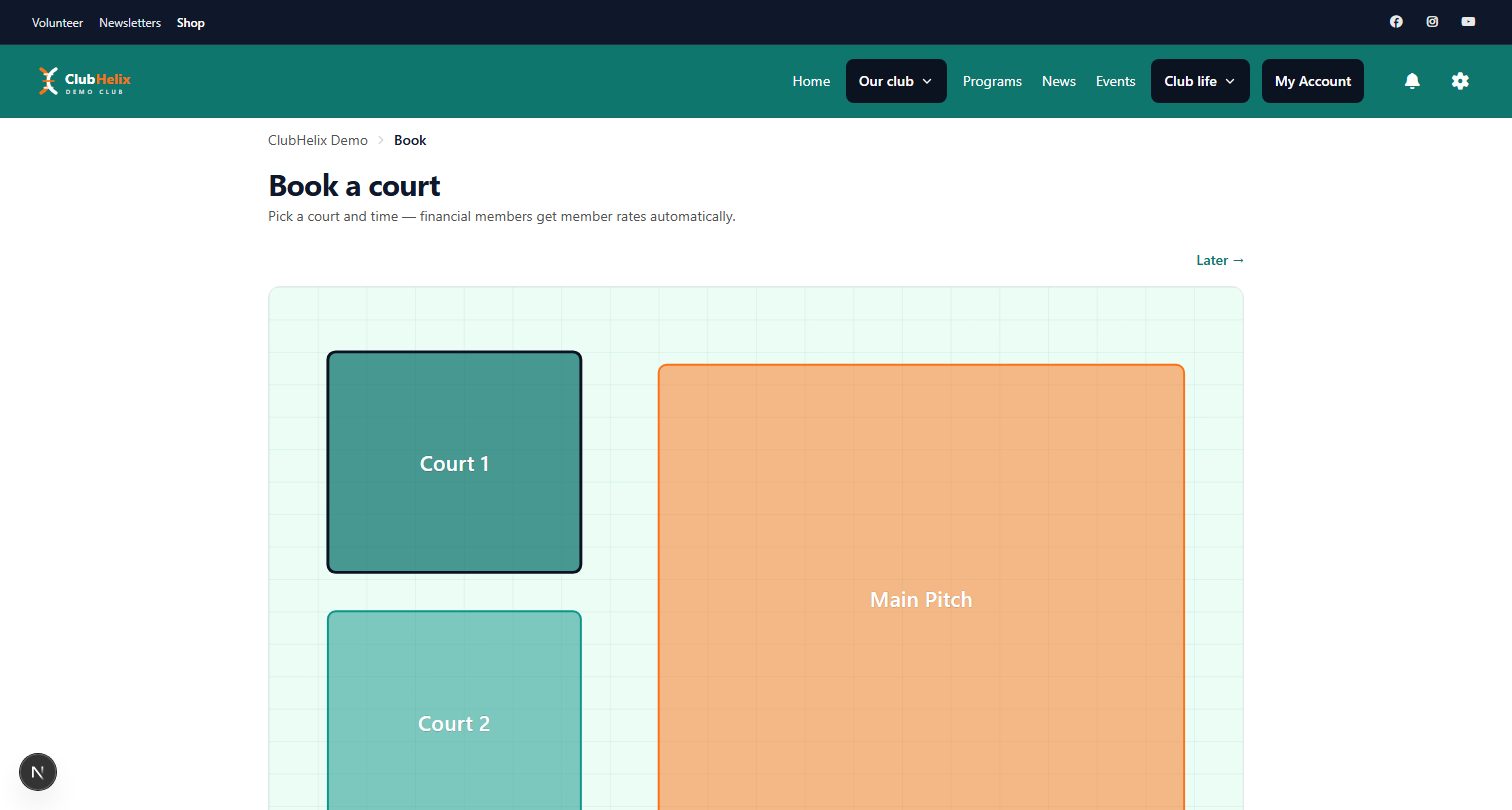
Everything above is configuration in ClubHelix facility booking. Courts, pitches, arenas and rooms are bookable on a drawable venue map — clash-proof, priced per slot or per head, and paid online or at the venue — and each court is drawn onto its own plan on the locations page.
Peak and off-peak rates are their own layer on top of a court's base prices: charge more at the hours people want, and a booking is priced slot by slot, so one that straddles the change pays both rates rather than whichever end it started at. That is the fair answer from the boundary table above, applied by the database rather than by whoever is on the desk. Each rule names both a member price and a casual price, so the grid in this guide sets up as written.
Fair-use caps and cancellation notice cover the rationing side. Cap how often one member books — per day, week or month, on one court or across the venue — and require notice before a free cancellation, both enforced in the database rather than just displayed. You can mark a no-show, which keeps the slot counted against the allowance. Note the honest limit: a cap needs to know who is booking, so a court that accepts anonymous casual bookings cannot cap them — set that court to financial members only if the rule has to bite.
Bookable coaches and equipment extend the same machinery to the things that fill a peak evening alongside the courts. A coach with their own diary, or a ball machine, books exactly like a court — same clash guard, same booking flow, so nobody is booked into two places at once.
One detail worth knowing before you change a rate: the price is snapshotted onto the booking, so a later rate change never rewrites history. Double the peak rate in March and February's bookings still show what February's members actually paid, which is what the treasurer needs at audit and what you need when somebody queries a receipt.
Two things to keep in mind about what this is not. There is no automatic demand-based pricing — you name the windows and the rates, and they hold until you change them, which is what you want on a surface members are supposed to understand. And a no-show is a mark an administrator makes, not a fee that collects itself. If you also share a court between simultaneous bookings, sharing a facility between bookings covers how utilisation is counted there, because a court that is "booked" every peak hour with one player on it is not full. Plans are on the pricing page, and you can start a club and set a first court up in an evening.
Did it work? The three numbers to read six months later
Give it a full season, then read the same grid you started from. Keeping the member roster current through self-registration matters here, because the member rate follows financial status, and the reports page carries booked value against collected so you can see what was charged and what arrived.
| What to read | Before | After a season | How to interpret it |
|---|---|---|---|
| Peak utilisation, weekday 6pm–9pm | 95% | 90% | Still effectively full — the gap did not empty the peak |
| Off-peak utilisation, weekday 9am–4pm | 23% | 31% | A real shift, and a modest one: expect points, not a transformation |
| Revenue per available court-hour | $11.13 | $12.50 | The single number to take to the committee |
| Distinct members with a peak booking | 38 | 51 | Prime time reaching more people, not the same eight more often |
| Complaints about not getting a peak court | 14 | 5 | The reason you did this, and the one members will remember |
Read them together, because each one alone lies. Revenue up with peak utilisation collapsing to 60% means the gap is too wide and you have priced members off their own courts — narrow it. Off-peak utilisation flat at 23% means the discount is not the barrier: the empty hours are empty because people are at work, and no price fixes that, so put the rate back up and stop giving away hours that would have sold anyway. And peak utilisation holding at 95% with the same faces booking it means the pricing worked but the fair-use cap is missing — that is a cap problem, not a rate problem, and lowering the peak rate would make it worse.
Frequently asked questions
What is peak and off-peak court pricing?
It is charging a different hourly rate for the hours people actually want than for the hours that sit empty — typically a higher rate for weekday evenings and Saturday mornings, and a lower one for weekday mornings and afternoons. The aim is to recover the cost of the lights over the busy hours, move the members who can play at any time into the quiet ones, and keep prime time available to the people paying subscriptions.
How much more should a peak court hour cost?
Somewhere between a third and a half more than the off-peak rate is where most clubs settle: on a $20 off-peak hour, a peak rate of $27 to $30. Under about 20% the gap changes nobody's behaviour and only adds a line to the price list, and much beyond 50% it reads as a penalty rather than as pricing.
How do you price a booking that starts off-peak and finishes in peak?
Price it slot by slot, charging each hour at the rate for the band that hour starts in. With a peak window from 6pm, a five-until-seven booking is one off-peak hour and one peak hour, which is both what a club means and the only version members accept as fair — charging the whole booking at the rate it started at simply teaches everybody to book from 5:30pm.
Should members pay a peak rate at all?
Usually yes, at a smaller gap than casual hire pays, because the point of the peak rate is partly to shift flexible players into empty hours and a member paying nothing extra has no reason to move. Keep the member-to-casual gap widest at peak, since that is the comparison that sells memberships.
How do we stop the same few members taking every peak slot?
A price rations by willingness to pay, and your keenest members are willing, so use a fair-use cap instead — a limit on how many bookings one member holds per week, counted across the whole venue rather than per court. Pair it with a cancellation notice window so a released peak slot has time to be re-booked, and mark no-shows so a booking nobody turned up for still counts against the allowance.
How do we know whether peak pricing worked?
Read utilisation by hour band, revenue per available court-hour, and the number of distinct members who got a peak booking — all three, because each is misleading alone. Rising revenue with peak utilisation falling away means the gap is too wide; flat off-peak utilisation means the discount was never the barrier and the rate can go back up.


