
What this guide answers
- How many years should life membership criteria require?
Ten to fifteen years of membership is the common range, always paired with a requirement for exceptional contribution across that time — years alone should earn a service milestone award, not life membership.
- Who decides whether someone becomes a life member?
Best practice is nomination by two members in writing, eligibility screening by the committee, and a final decision by the membership at an AGM or general meeting — usually requiring a two-thirds or three-quarters…
- Do life members pay fees or keep voting rights?
Almost universally, life members receive free club membership for life and retain full voting rights; playing or activity fees usually remain payable.
- Can life membership be revoked?
It should be possible, and it should be hard. Most clubs mirror the award process: revocation only for serious misconduct, by resolution of the members with the same supermajority that granted it, after the person has…
New Zealand edition. This guide is written for volunteer-run clubs in New Zealand. Where rules differ — grants, tax, incorporation, safeguarding — follow the New Zealand-specific pointers below or check with your national body.
Life membership is the highest honour most community clubs can bestow — and the easiest one to devalue. Award it too freely and it becomes a long-service certificate; award it too rarely (or too politically) and the club's most deserving people watch lesser contributions get honoured elsewhere. Either failure is usually caused by the same thing: the club never wrote down what life membership actually requires.
This guide covers the three criteria frameworks clubs use, how to run a nomination and voting process that survives scrutiny, what life members actually receive, and a nomination form template you can copy today.
What life membership should mean
Strip away the ceremony and life membership is a club making a permanent public statement: this person's contribution is part of who we are. Permanent is the key word. Committees change, eras end, but a life member's name stays on the honour board for as long as the club exists. That permanence is exactly why the bar must be high and the process must be fair — every weak or political award devalues every strong one, retrospectively and forever.
A useful gut-check when defining your criteria: life membership should recognise contribution that shaped the club, not merely attended it. Years of service matter, but years alone are a long-service award. The question a nomination must answer is: would this club be meaningfully different, or worse off, without this person's contribution?
Three criteria frameworks (and which to choose)
Most clubs land on one of three models. All three work; the failure mode is having none.
Framework 1 — Years plus contribution (the classic)
The most common model: a minimum period of membership and demonstrated exceptional service across that period.
- Minimum 10–15 years of continuous (or near-continuous) membership, and
- Sustained, exceptional voluntary contribution beyond playing — committee roles, coaching, team management, grounds, canteen, fundraising, or a combination
The years threshold filters out recency bias; the contribution requirement stops it becoming automatic. If you pick this model, resist the temptation to award on years alone "because they've been around forever" — that's what service milestone awards are for (see our volunteer appreciation guide for a full recognition ladder that gives you somewhere to honour long service without reaching for life membership).
Framework 2 — The points system
Some clubs formalise contribution into points: so many per year on committee, per season coached, per major event convened, with life membership eligibility at a published threshold (say, 100 points), subject to a final vote.
- Strengths: transparent, arguable-about in advance rather than after, and it surfaces quiet contributors whose service was spread across many small roles.
- Weaknesses: administration (someone must keep the ledger), and points can't measure quality — ten mediocre committee years can outscore five transformative ones.
Points systems suit larger clubs with high volunteer turnover, where no single person can hold the club's full memory. If you adopt one, keep the final award subject to a vote — points create eligibility, never entitlement.
Framework 3 — Exceptional impact (no minimum years)
A small number of clubs deliberately keep criteria qualitative: life membership recognises contribution of exceptional and lasting impact, period. This allows honouring, say, the founder who built the club in six extraordinary years and then moved interstate.
The risk is obvious — without objective anchors, awards drift toward whoever the current committee likes. If you choose this model, compensate with process: written nominations against published guidance, a supermajority vote, and a cap on awards per year.
Our recommendation for most clubs: Framework 1, with a documented discretion clause allowing the committee to bring an exceptional-impact nomination to the members despite the years threshold. You get a clear default and an escape hatch for the rare genuine exception.
The process: nomination to presentation
However you define the criteria, the process determines whether awards are respected. The elements that matter:
- Written nominations only. A nomination form (template below) completed by a proposer and seconder, both current members. Writing it down forces the case to be made on contribution, not popularity.
- Committee screening against the criteria. The committee's job at this stage is only to check eligibility and completeness — not to pre-judge the honour. Declined nominations should get written reasons referencing the criteria.
- Confidential handling. The nominee shouldn't know until the award is certain (or at least until the vote). A leaked failed nomination is painful for everyone.
- Decision by the members, not the committee. Best practice — and a requirement in many club constitutions — is a vote at the AGM or a general meeting, typically requiring a two-thirds or three-quarters majority. Check your constitution: if it specifies a process, that process is mandatory.
- A cap. Many clubs limit life membership awards to one or two per year, or hold a soft norm that most years have none. Scarcity is the point.
- Proper records. Record the nomination, the vote and the citation in the minutes, add the name to the honour board and website, and keep the nomination document — it's the club's history, written at the moment it mattered.
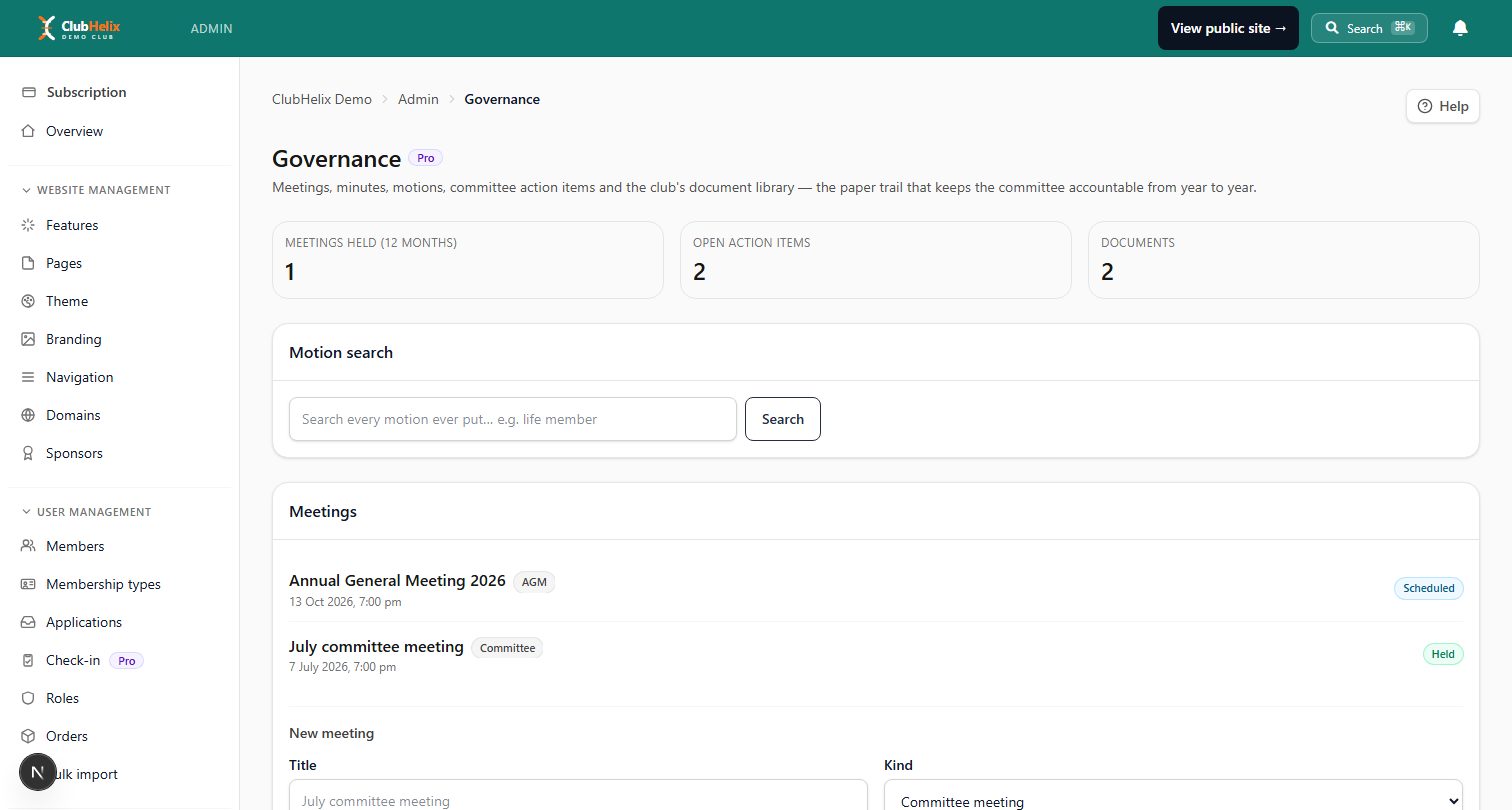
If your governance records live in a proper system, this is straightforward: agendas, nomination papers, minutes and resolutions all attached to the meeting where the decision happened. A meetings and governance tool keeps that trail intact across decades of committee changeovers — which is exactly the timescale life membership operates on.
What do life members actually receive?
Standard practice, mix and match to your club:
-
Free membership for life — the near-universal core benefit (playing fees are usually still payable; be explicit either way)
-
A badge, medallion or framed certificate presented at the AGM or presentation night
-
Name on the honour board and the club website, with the citation
-
Voting rights for life — check what your constitution says; in many clubs life members retain full member voting rights regardless of whether they still pay a subscription
-
Standing invitations to club functions, season launches and milestone events
One thing life membership should not be: a governance role. Life members hold an honour, not a permanent seat at the committee table (unless separately elected like anyone else). Writing this down in advance avoids awkwardness later.
Life member nomination template
Copy, adapt, and attach to your club's criteria document. It works as a printed form or as an online form on your club website.
[CLUB NAME] — Nomination for Life Membership
Nominations are confidential. Please do not inform the nominee.
Nominee: ______________________ Years of membership: ______ (list any breaks)
Proposer: ______________________ (name, signature, membership status) Seconder: ______________________ (name, signature, membership status)
1. Roles and service. List the nominee's roles and contributions, with approximate years (committee positions, coaching, team management, canteen, grounds, fundraising, other).
2. Statement of exceptional contribution. In 200–500 words, describe why this contribution is exceptional and lasting. Address the key question: how would the club be different without this person? Specific examples carry more weight than general praise.
3. Supporting evidence (optional): honours already received, letters of support, records of events or projects delivered.
Proposed citation (one to two sentences, as it would appear on the honour board):
_Office use: Received ____ / Criteria check ____ / Committee resolution ____ / Presented to members on ____ / Vote result ____ / Presented at _____
The proposed citation field is a quiet masterstroke worth keeping: it forces the proposer to distil the case to two sentences, and it gives the club ready-made honour-board and website copy the day the vote passes.

Common pitfalls
- The sympathy award. Someone retires, falls ill, or passes away, and life membership becomes a gesture of affection rather than a judgement of contribution. Create a separate honour (a named trophy, a moment of recognition) for these situations so life membership keeps its meaning.
- The committee club. If every life member is a past president, your criteria are silently excluding the canteen, grounds and junior-program volunteers who kept the club alive. Audit your honour board; the gaps tell you who your process overlooks.
- No published criteria. If members can't read the criteria on the club website, every award looks like favouritism to someone. Publish the criteria, the process, and the current honour roll together — it's also one of the pages that makes a club look genuinely established to newcomers reading your welcome pack.
- Criteria in one retiring secretary's head. Like everything in club governance, the rules and records must live in club systems, not personal files. When the constitution, criteria document and past nomination records are all findable, the honour survives every handover.
Frequently asked questions
How many years should life membership criteria require?
Ten to fifteen years of membership is the common range, always paired with a requirement for exceptional contribution across that time — years alone should earn a service milestone award, not life membership. Whatever number you choose, add a discretion clause letting a truly exceptional shorter contribution go to a member vote, so the rule serves the honour rather than blocking it.
Who decides whether someone becomes a life member?
Best practice is nomination by two members in writing, eligibility screening by the committee, and a final decision by the membership at an AGM or general meeting — usually requiring a two-thirds or three-quarters majority. If your club's constitution prescribes a process, that process is binding; check it before your first nomination, not during it.
Do life members pay fees or keep voting rights?
Almost universally, life members receive free club membership for life and retain full voting rights; playing or activity fees usually remain payable. The details belong in your constitution or a published life membership policy — ambiguity here creates exactly the awkward conversations the honour is meant to prevent.
Can life membership be revoked?
It should be possible, and it should be hard. Most clubs mirror the award process: revocation only for serious misconduct, by resolution of the members with the same supermajority that granted it, after the person has had a chance to respond. Hopefully the clause is never used — but writing it down while nobody needs it is far easier than improvising when someone does.
Keep the whole trail — criteria, nominations, votes and citations — in one place with ClubHelix governance and meetings, and pair the honour with a year-round volunteer recognition program. Building the club's public presence too? Start with how to build a club website.


