
What this guide answers
- How long should a match report be?
For a club website, 250–450 words is the sweet spot — long enough to tell the story, short enough that people finish it.
- What should a match report include?
The score, opponent and competition (early), the game's turning points in order, recognition of standout efforts, and what's next for the team.
- Who should write our club's match reports?
Assign one named person per team for the whole season — commonly the team manager or a keen parent — rather than hoping someone volunteers each week.
- How do you write a match report for junior sport?
Follow your club's consent and naming policy, spread mentions across the whole team over the season, praise effort and moments rather than judging children, and never single out a young player — yours or the…
Most club match reports are written for the filing cabinet, not the reader. "The seniors travelled to Riverside on Saturday for round 7. Conditions were good. We started slowly but improved after the break…" — by the second sentence, everyone except the author's mum has stopped reading. Which is a shame, because a good match report is one of the highest-value pieces of content a club produces: players love seeing their name in it, parents share it, sponsors see their logo next to it, and prospective members read it to work out what kind of club you are.
The difference between a report people read and one they scroll past isn't writing talent — it's structure, a decent opening, and getting it published while the game still matters. This guide gives you all three, plus the extra care junior sport deserves.
What a match report is actually for
Write for three audiences at once: people who were there (they want the story confirmed and their efforts recognised), people who weren't (they want to know what happened and how it felt), and people who don't know your club yet (every report is quietly recruiting). That third group is why reports belong on your club website, not buried in a social feed — a season of reports is a living archive that shows your club is active, organised and enjoyable, and it's exactly the kind of fresh, local content search engines reward. Our guide to club website content ideas covers where reports fit in the bigger picture.
A match report template that works
You don't need to be a journalist; you need a repeatable shape. Aim for 250–450 words in this order:
| Section | Length | What goes in it |
|---|---|---|
| The hook | 1–2 sentences | The single most interesting thing about the game |
| The essentials | 1 sentence | Score, opponent, competition, venue — early, never buried |
| How it unfolded | 2–3 paragraphs | The turning points in order, not every passage of play |
| The people | 1 paragraph | Standout efforts — spread across the team over a season |
| What's next | 1–2 sentences | Next fixture, the table picture, a note of thanks |
Three habits that lift any report written to this shape:
- Pick one storyline. Every game has one: the comeback, the debutant, the wind, the goalkeeper who kept you in it. Build the report around that, and let minor details go.
- Details beat adjectives. "A brilliant performance" tells the reader nothing. "Three saves in the last ten minutes, including a one-on-one in injury time" tells them everything.
- Write the scoreline early and once. Readers hunting for the result shouldn't have to dig; readers who know it don't need it repeated every paragraph.
Openings: the 15 seconds that decide everything
The first two sentences determine whether anyone reads the third. Compare these club match report examples — same fictional game, two openings:
Dull: "The under 16s played Lakeside at home on Saturday in round 9 of the winter competition. The weather was fine and both teams were at full strength."
Better: "Two goals down with twenty minutes left, the under 16s produced their best football of the season to steal a 3–2 win over ladder leaders Lakeside — sealed by a penalty in the final minute."
The first opening is a diary entry; the second is a story. Some reliable ways in:
- The turning point: "One substitution changed everything on Saturday."
- The stakes: "Win, and finals were secure. Lose, and the season came down to the last round."
- The person: "Playing her 100th game, the captain chose a good day for her best."
- The streak: "Seven years since the club last won at Eastfield. Make it none."
And be honest when you lose — a well-told 5–1 defeat ("outclassed by a slicker side, but the effort never dropped") earns far more respect than a report that reads like nothing happened.
Junior sport: extra care required
Junior reports are the most read content most clubs publish, and the easiest to get wrong. The golden rules:
- Follow your club's photo and naming policy. Many clubs use first names only for juniors, and only for families who've consented — check before you publish, not after. Your registration forms should capture this consent up front.
- Name generously or carefully — never habitually. If you name goal scorers, watch that the same three kids aren't the only names all season. Rotate the spotlight: the kid who chased everything, the debutant, the one who played out of position without complaint.
- Praise effort and moments, not verdicts on children. "Defended superbly all day" is great; ranking kids or dwelling on a young player's mistake is not. The winger who missed the last-minute sitter does not need to read about it.
- Keep opposition juniors out of the firing line. Never single out an opposition child negatively, and keep any commentary on young referees kind — they're learning too.
- Scores are optional context, not the point. In the youngest age groups, many associations de-emphasise results entirely; let the report be about the fun and the progress.
A junior report that gets this right gets shared by every family in the team — it's the best retention tool a club has.

A publishing workflow that survives the season
The best match report in the world is worthless on Wednesday. Aim to publish within 24 hours of the final whistle, and design a workflow a volunteer can sustain for twenty rounds:
- Assign the job before the season, not each week. One report writer per team — a team manager, an injured player, a keen parent. Rotating "whoever feels like it" produces silence by round 5.
- Capture notes at the ground. Scorers, key moments and one quote-worthy detail, typed into a phone during the game. If you run a live match centre for score updates, the timeline you build during the game becomes your skeleton — half the report writes itself.
- Draft in the template. With the shape above, 30 minutes is plenty.
- One photo minimum. A report with an image gets dramatically more engagement — see how to take good club photos for getting usable shots on a phone.
- Publish once, share everywhere. Post the report to your club website's news section first, then link it from your social channels and round it up in the club newsletter. The website version is the permanent, searchable home; social posts vanish in a day.
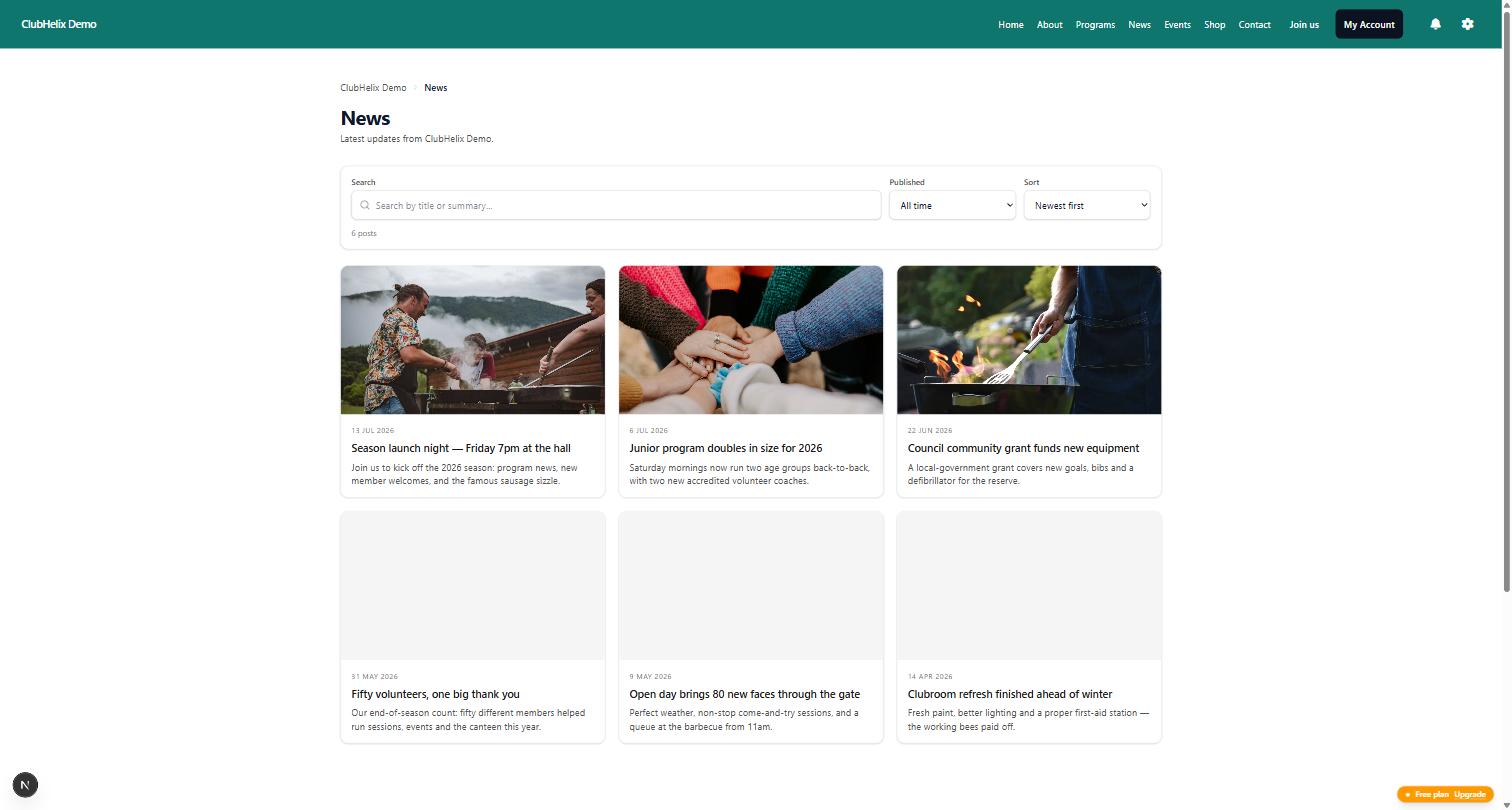
A club news system that lets the team manager draft on their phone from the ground, drop in a photo and hit publish is the difference between a club that reports every round and one that gives up by mid-season.
If your club's match reports currently live and die in a group chat, ClubHelix gives every team a proper home for them — a club website with a built-in news section, a live match centre for game-day scores, and email broadcasts to put every report in front of every member. There's a free tier to start on — see how it works or create your club.
Frequently asked questions
How long should a match report be?
For a club website, 250–450 words is the sweet spot — long enough to tell the story, short enough that people finish it. Finals or milestone games can run longer; a short report published on Sunday always beats a long one published Thursday.
What should a match report include?
The score, opponent and competition (early), the game's turning points in order, recognition of standout efforts, and what's next for the team. Build it around one storyline and support it with one or two photos.
Who should write our club's match reports?
Assign one named person per team for the whole season — commonly the team manager or a keen parent — rather than hoping someone volunteers each week. Give them a template and a 24-hour deadline, and rotate the role each season to avoid burnout.
How do you write a match report for junior sport?
Follow your club's consent and naming policy, spread mentions across the whole team over the season, praise effort and moments rather than judging children, and never single out a young player — yours or the opposition's — for a mistake.


