
What this guide answers
- What makes a grant application successful?
A specific, well-evidenced project that matches the program's purpose, answered against the criteria in their order, with a credible budget backed by quotes and a visible club co-contribution.
- How much detail should the budget include?
Every line should trace to a written quote or a published price, split across who pays what (grant, club, others), with GST treatment stated and a modest contingency included.
- What is a grant acquittal report?
It's the formal report you submit after delivering the project: actual spend against the approved budget with receipts, outcomes achieved against what you promised, photos and other proof of delivery, and evidence you…
- Can volunteer time count as our club contribution?
In many programs, yes — volunteer labour and in-kind donations can be valued (the guidelines usually specify an accepted hourly rate) and shown in the budget as club contribution.
Ireland edition. This guide is written for volunteer-run clubs in Ireland. Where rules differ — grants, tax, incorporation, safeguarding — follow the Ireland-specific pointers below or check with your national body.
Grants are the closest thing community sport has to free money — governments and foundations hand out hundreds of millions of dollars a year specifically to clubs like yours — and yet most clubs either never apply, or apply badly and conclude "grants aren't for us." Neither is necessary. Grant writing is not a dark art; it's a form-filling discipline with a handful of learnable rules, and a club that learns them once can win funding season after season.
This guide covers where grants come from, how assessors actually read applications, the structure and evidence that score points, a model budget table, and the part clubs forget until it bites them: the acquittal report.
Where club grants come from
Clubs generally have four main sources of grant funding, each with its own rhythm:
Here that means the Sports Capital and Equipment Programme (the big one for facilities and equipment, run in periodic rounds), your Local Sports Partnership, local authority community grants, and LEADER rural development funding where you qualify. Register for the capital programme well before a round opens — clubs miss out on registration timing far more often than on the merits of the project.
- Local council. Usually the smallest amounts but the easiest wins — community grants, minor facility improvements, event support. Councils genuinely want local clubs to apply; many run information sessions each round. Start here.
- State government. Sport and recreation departments in every state run recurring programs — infrastructure, equipment, participation, female-friendly facilities, inclusion. Grants are bigger and more competitive, with formal criteria and scoring.
- Federal government. Fewer, larger, more sporadic programs, plus community grants through other portfolios. The federal government lists open opportunities centrally at GrantConnect (grants.gov.au), and business.gov.au has a searchable finder that includes community programs.
- Foundations, trusts and corporates. Community foundations, gaming/club community benefit schemes, banks and supermarkets. Smaller, relationship-driven, and often less oversubscribed than government rounds.
Your national and state sporting bodies typically maintain grant lists for your sport, and most councils publish a grants calendar. Assign one person to check these quarterly — most missed grants are missed because nobody was looking.
Before you write: the eligibility gate
Every grant round rejects a chunk of applications without reading past page one, for mechanical reasons. Check before investing a single evening:
- Incorporation and insurance. Most programs require the club to be an incorporated association (or auspiced by one) with current public liability insurance.
- Governance basics in order. An ABN, an active committee, up-to-date financial statements, and — increasingly — child-safety compliance where relevant.
- Land owner consent. Facility grants almost always require written consent from whoever owns the ground (usually council). This takes weeks; get it first.
- The project fits the program. Read the guidelines twice. If the program funds "increasing participation" and you ask for mower repairs, no prose will save you.
- You can deliver in the timeframe. Grants have delivery windows. If the project needs council approvals you haven't started, be honest about the timeline.
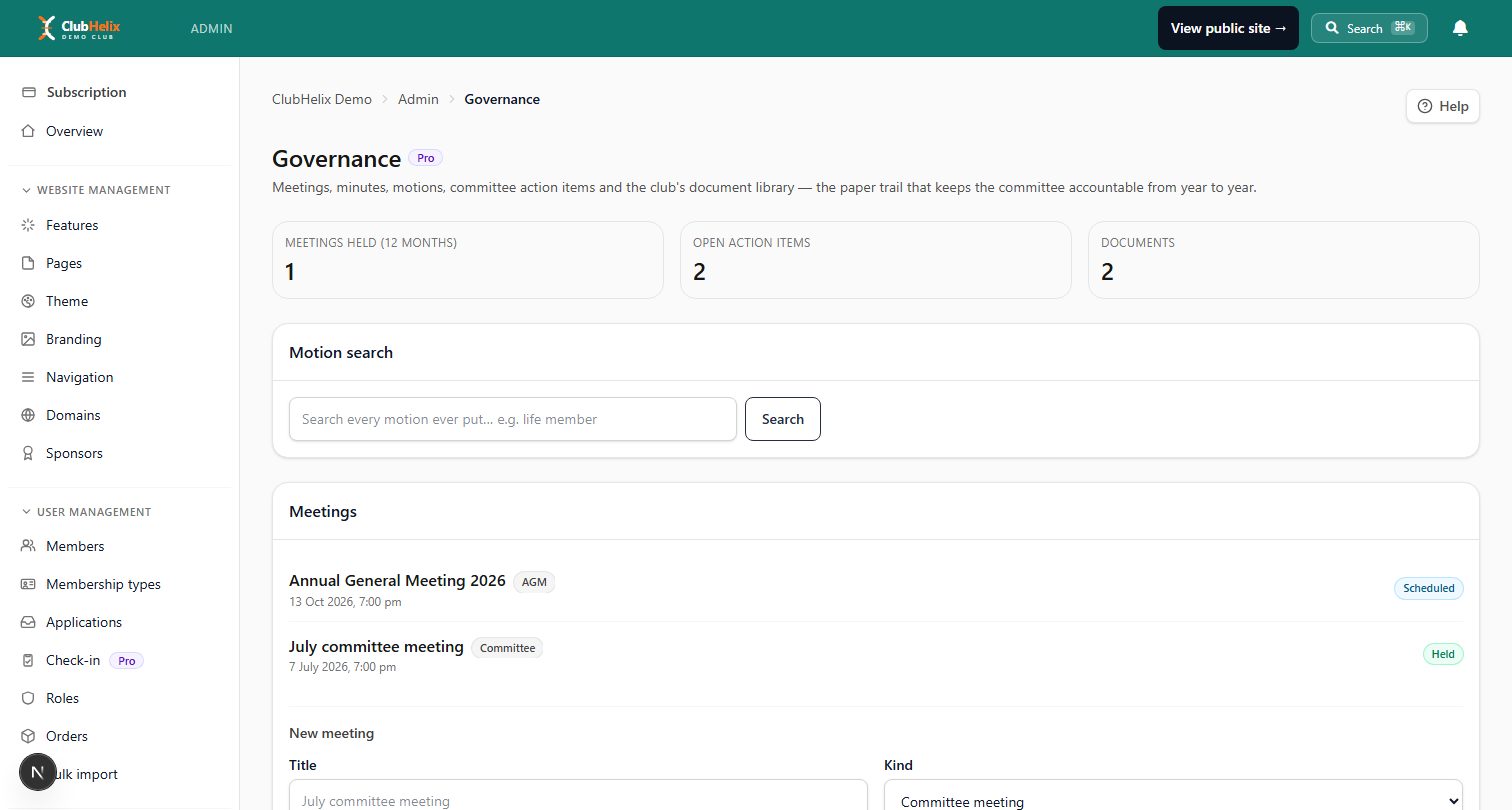
One quiet advantage worth building before you ever apply: tidy club records. Assessors and acquittals both reward clubs that can produce member numbers, participation trends, meeting minutes and financials on demand. If your committee decisions and documents live in a proper governance and meetings system, pulling "evidence of community support" is a ten-minute job instead of an archaeology dig.
How assessors read your application
Understand the reader and half the battle is won. A grant assessor is scoring dozens of applications against a published rubric, quickly. This has three implications:
- Answer the question asked, in the order asked. Assessors score criterion by criterion. If the criterion is "demonstrated community need", your answer should demonstrate community need in its first sentence, not paragraph four.
- Claims without evidence score as hopes. "Our club is growing rapidly" scores nothing. "Junior registrations grew from 84 to 141 over the past three seasons" scores. Numbers, waiting lists, letters of support, photos of the cracked courts — evidence is the application.
- Specific projects beat vague aspirations. "Upgrade our facilities" loses to "install four LED light towers on Oval 2, enabling two additional weeknight training slots for our 220 junior members."
The structure that wins
Whatever the form's headings, strong applications carry the same skeleton. Use it to draft, then paste into the form's boxes.
1. The one-sentence project. [Club] will [specific thing] so that [specific people] can [specific benefit]. If you can't write this sentence, the project isn't defined yet.
2. The need. What's the problem, who does it affect, and what's the evidence? Membership numbers and trends, waiting lists, facility condition reports, demographic data about your area (council profiles are a goldmine), and incidents or near-misses if safety-related.
3. The solution. Exactly what will be delivered, by whom, by when. Include quotes for anything you'll buy — most programs require two or three written quotes for significant items, and applications with quotes read as ready-to-deliver.
4. The beneficiaries and the numbers. Who benefits and how many — current members, projected new members, other community users of the facility. Show your working; assessors distrust round numbers that appear from nowhere.
5. Community support. Letters from your association or league, local schools, neighbouring clubs, and users of the facility. Three specific letters beat ten identical templates.
6. Capacity to deliver. Who on the committee will manage the project, their relevant experience, and your track record of delivering past projects or acquitting past grants on time.
7. The budget. See below — it's scored, not skimmed.

The budget table
A grant budget answers three questions at a glance: what does everything cost, who's paying for which part, and does it all add up. A model layout:
| Item | Detail | Total cost | Grant funds | Club contribution | Other funding |
|---|---|---|---|---|---|
| LED light towers ×4 | Quote A (attached) | $48,000 | $36,000 | $8,000 | $4,000 (association) |
| Electrical connection | Quote B (attached) | $6,500 | $4,000 | $2,500 | — |
| Switchboard upgrade | Quote B (attached) | $3,200 | — | $3,200 | — |
| Project contingency (5%) | $2,885 | — | $2,885 | — | |
| Totals | $60,585 | $40,000 | $16,585 | $4,000 |
Rules that keep a budget credible:
- Every figure traces to a quote or a published price. Attach the quotes.
- Show a club contribution. Cash is strongest, but volunteer labour (valued at a standard hourly rate — check the program guidelines for the accepted figure) and in-kind donations count in most programs. Co-contribution signals commitment and often scores directly. This is where your fundraising engine matters — a season of sausage sizzles and a good trivia night is exactly the co-contribution story assessors like.
- Include contingency and GST treatment. State whether figures are GST-inclusive or exclusive, per the guidelines.
- The grant request must match the program's cap. Asking for more than the maximum is an eligibility fail, not a negotiating position.
The acquittal report: win the next grant now
Winning the grant is the midpoint, not the end. Nearly every grant requires an acquittal report — your formal account, after delivery, of what was spent and what was achieved. Funders share lists; a late or sloppy acquittal quietly poisons your club's chances in future rounds, sometimes across programs.
A standard acquittal asks for:
- Financial statement — actual spend against the approved budget, line by line, with receipts and invoices attached, and any variance explained. Unspent funds usually must be returned or have re-approval sought before being redirected.
- Outcomes against your promises — you said the lights would enable two extra training nights and 60 new junior places; report what actually happened, with numbers.
- Evidence of delivery — photos, invoices, opening-event coverage, and evidence of funding acknowledgement (the funder's logo on your website and signage, the minister at the ribbon-cutting).
Make acquittal painless by starting on day one: create a dedicated folder (and, ideally, a dedicated ledger tag) for the project, file every receipt as it happens, take before-and-during-and-after photos, and record baseline numbers before the project so outcomes are provable. In ClubHelix, giving your treasurer and grants coordinator the right roles and permissions means both can see the records all year without anyone forwarding spreadsheets — and this year's acquittal becomes next year's "capacity to deliver" paragraph.
Grant writing tips: the quick list
- Start a club evidence file today: membership numbers by season, participation stats, photos, letters, past project outcomes. Every application draws from it.
- Write to the criteria, in their order, using their words. If the program says "inclusive participation", say "inclusive participation".
- Get the guidelines' checklist done early — consent letters and quotes take weeks; prose takes evenings.
- Have a non-club member read the draft. If your neighbour can't tell what you're asking for and why, the assessor can't either.
- Apply for the small local grants first. A $2,000 council win builds the track record (and confidence) for the $40,000 state application.
- Debrief every unsuccessful application. Most government programs offer feedback on request. Ask, note, improve, reapply — persistence is the single most reliable grant strategy there is.
Frequently asked questions
What makes a grant application successful?
A specific, well-evidenced project that matches the program's purpose, answered against the criteria in their order, with a credible budget backed by quotes and a visible club co-contribution. Assessors score rubrics quickly — applications that put the evidence in the first sentence of each answer beat better projects described vaguely.
How much detail should the budget include?
Every line should trace to a written quote or a published price, split across who pays what (grant, club, others), with GST treatment stated and a modest contingency included. Attach the quotes. A budget an assessor can verify in two minutes signals a club that will deliver and acquit cleanly — which is a scored consideration in most programs.
What is a grant acquittal report?
It's the formal report you submit after delivering the project: actual spend against the approved budget with receipts, outcomes achieved against what you promised, photos and other proof of delivery, and evidence you acknowledged the funder. File receipts and record baseline numbers from day one and it's an evening's work; leave it to memory and it's a nightmare — and late acquittals damage your club's standing in future rounds.
Can volunteer time count as our club contribution?
In many programs, yes — volunteer labour and in-kind donations can be valued (the guidelines usually specify an accepted hourly rate) and shown in the budget as club contribution. Cash still reads strongest, which is why a steady fundraising calendar matters: it funds the co-contribution that unlocks grants several times its size.
Good grant applications are built on good records. ClubHelix keeps your member numbers, committee minutes and documents, and finances organised year-round — with roles and permissions so your treasurer and grants coordinator both see what they need. Fund the co-contribution with our guides to sausage sizzle fundraising and trivia nights.

