
What this guide answers
- Can we just use a club constitution template from the internet?
Use your state regulator's model rules — they're exactly that: a free, current, legally compliant template for your jurisdiction.
- How long should a club constitution be?
Model rules typically run twenty to forty pages, and that's fine — most of it is meeting and election machinery you'll rarely read but will rely on when it matters.
- What's the difference between a constitution and by-laws?
The constitution is the hard-to-change legal rulebook (amended by special resolution and lodged with the regulator).
- Who should keep the constitution and where?
The secretary is formally responsible, but the practical answer is: everywhere it's needed.
Ireland edition. This guide is written for volunteer-run clubs in Ireland. Where rules differ — grants, tax, incorporation, safeguarding — follow the Ireland-specific pointers below or check with your national body.
A club constitution sounds grander than it is. It's simply the rulebook your club agrees to run by: who can join, who decides things, how meetings work, what happens to the money, and how disputes get resolved before they wreck friendships. If your club is incorporating as an association — and most clubs handling real money should, see how to incorporate a club — a written constitution isn't optional; it's a legal requirement.
The good news: you almost never write one from a blank page. This guide explains where to start, what every section does, the club-specific decisions worth making deliberately, and a full template outline you can walk through with your committee in a single evening.
General information only, not legal advice. What a club's rules must contain depends on the legal form it takes and the jurisdiction it takes it in, and requirements differ and change. Check your own regulator's current guidance, and get professional advice for anything unusual — especially around liquor licensing, property, or significant funds.
Start from your state's model rules, not from scratch
For a typical sports or social club, the right move is nearly always to start from an official or governing-body template rather than a blank page:
There is no single official model, because there is no single legal form. Your national governing body almost certainly publishes a model constitution for affiliated clubs, and if you want sports-body tax exemption the wording has to satisfy Revenue — which publishes the clauses it expects to see, particularly around applying income solely to the club's objects and what happens to assets on winding up. Start from those rather than from a blank page.
- Download the current model rules from the body that registers associations where your club is, or use your governing body's template where there is no official model.
- Adopt them mostly unchanged. They already handle the machinery — notice periods, quorums, voting mechanics, winding up — correctly for your jurisdiction.
- Customise only the club-specific decisions (covered in the next section), and record your choices in the schedule or by amending specific clauses.
Resist the urge to copy a random constitution found online or inherited from a club in another state. Rules that don't meet your own state's requirements can hold up your incorporation application, and clauses imported from other jurisdictions can be quietly invalid. The model rules are free, current and purpose-built — use them as your base.
The decisions worth making deliberately
Model rules leave a handful of blanks that shape how your club actually feels to run. Talk these through as a committee before the formation meeting:
- Purposes. One paragraph, broad enough to grow into ("to promote and administer basketball in the Northside district and foster community participation in sport"), not so broad it's meaningless. Grants and tax questions both look at this clause.
- Membership classes. Playing, social, junior, life members — and crucially, which classes vote. Juniors typically don't; whether social members do is a genuine choice with long-term consequences for who controls the club.
- Committee size and terms. Smaller committees (5–7) move faster; staggered two-year terms stop the whole committee walking out at one AGM. Decide whether to cap consecutive terms for office bearers.
- Financial controls. Two signatories on payments, a spending limit above which committee approval is required, and who may enter contracts. Boring clauses that prevent the worst disputes a club can have.
- Quorums. Set them realistically for your actual membership. A quorum your club can never assemble means you technically can't make valid decisions — a surprisingly common trap.
- Disputes and misconduct. Keep the model rules' procedure. The one time you need it, you'll be very glad the process was written down by someone calm, years earlier.

Club constitution template outline
Here is the standard skeleton of a club constitution. Whichever official or governing-body template you start from will cover all of this — use the outline to understand what each part does and to check nothing club-specific has been missed.
1. Name and definitions
The club's official name (ending "Incorporated"/"Inc." once registered) and definitions of terms used through the document.
2. Purposes / objects
What the club exists to do. Everything else in the constitution — and every use of club funds — must serve these purposes.
3. Powers
What the club may do in pursuit of its purposes: hold property, open accounts, employ people, affiliate with governing bodies, raise funds.
4. Not-for-profit clause
Income and assets are applied solely to the purposes; no distribution of profits to members. Essential for incorporation, grants and tax treatment.
5. Membership
Classes of membership and their rights; how people apply and are admitted; the register of members; fees and when they fall due; how membership ends (resignation, non-payment, expulsion).
6. Discipline and grievances
The procedure for complaints and misconduct: notice, a fair hearing, the right of appeal. Follow the model rules closely here.
7. The committee
Composition (president, vice-president, secretary, treasurer, ordinary members); powers and duties; election process and terms; casual vacancies; removal; conflicts of interest.
8. General meetings
The AGM (timing and required business — reports, financials, elections) and special general meetings; notice periods; quorums; voting rules and whether proxies are allowed; the chair's role.
9. Finances
Financial year; control of funds; signatories; record-keeping and reporting; auditing or review requirements where applicable.
10. Records and common seal
Custody of minutes, registers and documents; member access to records; use of the common seal if the club keeps one.
11. Amendment of the rules
How the constitution changes: normally a special resolution (commonly a 75% vote) at a general meeting, lodged with the regulator to take effect.
12. Winding up
What happens if the club ends — remaining assets go to another not-for-profit with similar purposes, never to members.
Adopting it: from draft to binding rules
A constitution takes effect when your members formally adopt it — at the formation meeting for a new club, or by special resolution for an existing one — and, for incorporated associations, when it's lodged with your state regulator as part of incorporation or as an amendment. Practical tips for that meeting:
- Circulate the draft beforehand with a one-page summary of the deliberate choices you made and why. Nobody should be speed-reading quorum clauses in the room.
- Take motions clause-group by clause-group if there's likely debate, rather than one all-or-nothing vote.
- Minute it properly — the adoption resolution, the vote, and the elected committee. These minutes are foundation documents your club will refer back to for decades.
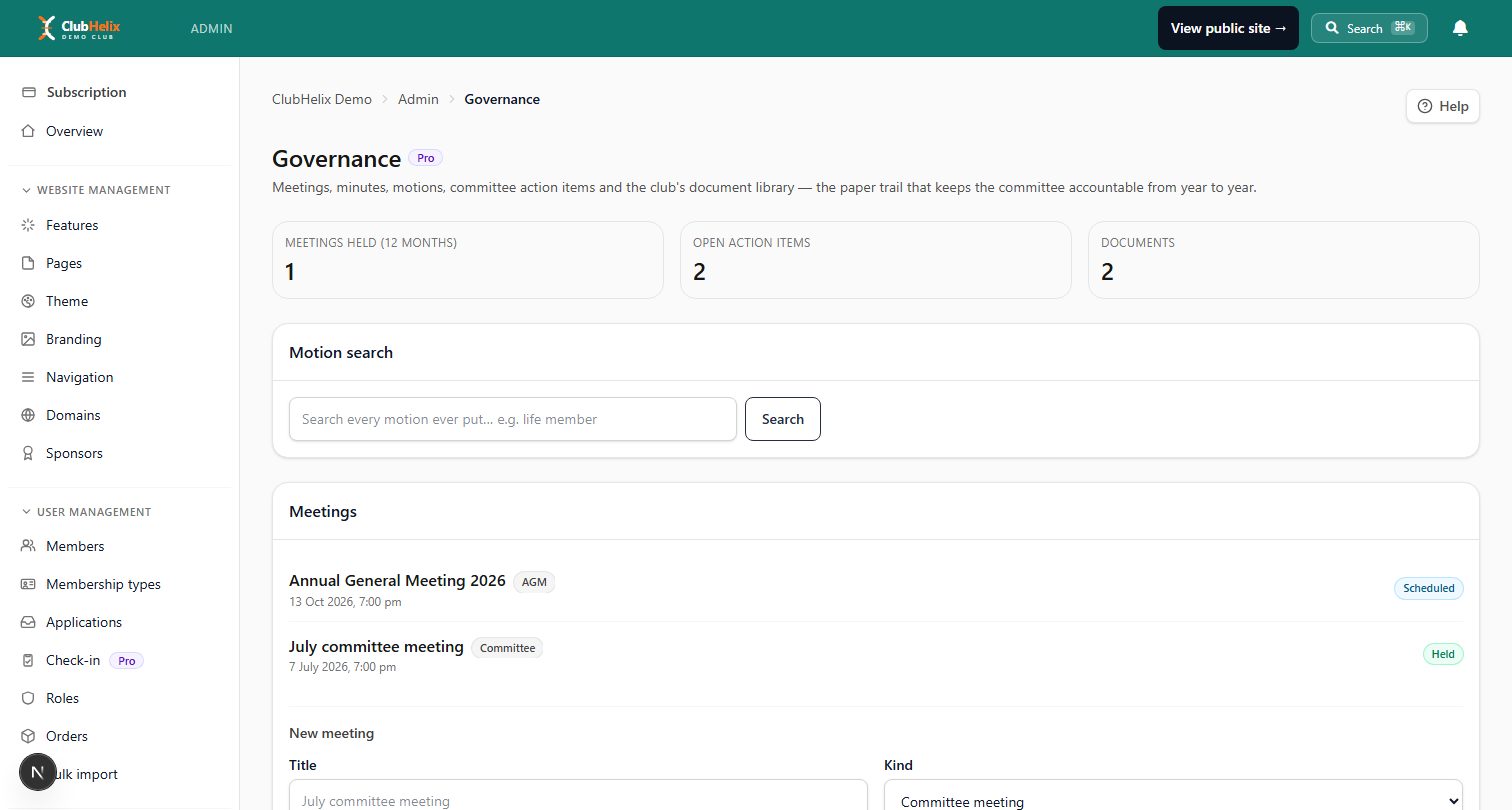
From then on, the constitution is only as good as your adherence to it. Elections on time, notice periods respected, spending within delegations — this is exactly the routine a governance and meetings system turns into muscle memory, with agendas, motions and minutes recorded against each meeting instead of scattered through inboxes.
Keep it alive: reviewing and amending
Constitutions age. Clubs add junior sections, take on liquor licences, merge, outgrow their quorums. Build a light review habit:
- Skim it annually before the AGM — five minutes checking that practice still matches the rules.
- Amend deliberately, not reactively. Gather changes and put them through as one considered special resolution rather than lurching after each incident.
- Lodge amendments with the regulator — unlodged amendments generally have no legal effect, another surprisingly common trap.
- Keep the current version findable. On your club website's about or governance page is ideal; members are entitled to know the rules they're governed by, and grant assessors like seeing it published.
Frequently asked questions
Can we just use a club constitution template from the internet?
Use your state regulator's model rules — they're exactly that: a free, current, legally compliant template for your jurisdiction. Generic internet templates and constitutions borrowed from clubs in other states are the risky version: they may not satisfy your state's requirements and can hold up incorporation. Start from the model rules, customise the club-specific decisions, done.
How long should a club constitution be?
Model rules typically run twenty to forty pages, and that's fine — most of it is meeting and election machinery you'll rarely read but will rely on when it matters. What should stay short is the part you wrote: purposes in a paragraph, membership classes in a table, your handful of deliberate customisations documented in the minutes.
What's the difference between a constitution and by-laws?
The constitution is the hard-to-change legal rulebook (amended by special resolution and lodged with the regulator). By-laws or policies sit underneath it — training rules, selection policy, code of conduct, uniform rules — and can usually be made and changed by the committee alone. Keep operational detail in by-laws so you're not running a special resolution to change the canteen roster.
Who should keep the constitution and where?
The secretary is formally responsible, but the practical answer is: everywhere it's needed. Lodge the current version with the regulator, keep a signed copy with the club records, and publish it on the club website so members, new committee members and grant assessors can always find it without asking.
Rules written — now run the club by them. ClubHelix's governance tools handle agendas, motions and minutes, with your member register and club website in the same login. Start free.
