
What this guide answers
- Can we offer both a full pitch and half-pitches for hire?
Yes, but never in the same hours. A booking system stops two bookings holding the same resource, and it can't know that the full pitch contains the northern half — so offer halves on some days and the full ground on…
- How do we stop ground hire clashing with training and match days?
Load the club's own season first as admin blocks — training nights, home fixtures, the groundskeeper's morning — before the booking page goes live.
- Should we charge per hour, per team or per player?
Per hour for schools, coaches and other clubs; per team when you want to know how many sides are coming but charge for the ground regardless; per player for casual pay-and-play games where each person chips in.
- Can a club take ground bookings without a card payment processor?
Yes. Set the ground to be paid at the venue: the booking is confirmed straight away, the hirer is told what to pay and how — a QR code on the canteen wall, a card reader at the bar, cash — and the admin lists what is…
- What should our ground hire rules cover?
No vehicles on the surface, no pegging or marking without asking, no play when the ground is closed, rubbish taken away, goals and equipment returned, and a bond for anything with marquees, vehicles or large crowds.
Canada edition. This guide is written for volunteer-run clubs in Canada. Where rules differ — grants, tax, incorporation, safeguarding — follow the Canada-specific pointers below or check with your national body.
Every club with a ground has the same diary. It lives in the canteen, or in the groundskeeper's car, and it holds the answer to "is the top oval free on Thursday?" — an answer only one person can give, usually after they get home. Meanwhile a school sports coordinator has rung twice, a social team has given up and booked the council park, and someone has marked cricket creases on a pitch that had a rugby session booked for the same afternoon.
A ground is the most valuable asset most clubs own or lease, and it sits empty for most of the working week. Hiring it out is real money and real goodwill, but only if bookings can't collide with the club's own training and match days, and only if the volunteer stops being the diary. This guide covers who hires grounds, how to fit hire around the club, and what to charge — with ClubHelix as the worked example in the final third.
Who actually hires a sports ground

Ground hire is a bigger market than most committees realise, and almost none of it comes from strangers:
- Schools — sports afternoons, athletics carnivals, and the term-long "we have no oval" arrangement that is the best regular hire a club can land.
- Casual social teams — the Thursday-night kick-around, the touch competition that outgrew the park, parents who want the lights on for an hour.
- Other clubs — the neighbour whose ground is being resurfaced, the summer sport that uses your winter ground, a representative squad needing a neutral venue.
- Coaches and academies — private coaching businesses that need a marked, mown pitch on weekday afternoons and will pay for the reliability.
- Corporate and community days — a company's family day, a charity match, a festival that needs an open, flat, fenced space.
Each books differently — schools want the same slot every week and an invoice, social teams book days ahead and pay on the night — and your setup has to serve all of them without a volunteer translating.
Check the lease before you advertise
Most club grounds are held under a lease or licence from a landowner — usually the local council, sometimes a school or a trust — and many of those agreements say something about third-party hire, commercial use, or who may be on the ground and when. Read yours before you publish a price, and if hire isn't clearly permitted, ask: landowners are often glad to see a community ground used, sometimes with conditions such as capped hours, hirers holding their own insurance, or a share of the income. Tell your insurer, and minute a committee decision. Our clubrooms hire guide covers the hire-agreement checklist — bonds, insurance evidence, alcohol, cancellation terms — and every point in it applies to a ground. This is general information, not legal advice — check your lease and your insurer's conditions.
Fit hire around the club, not the club around hire
The first rule of ground hire is that the club's own use is loaded first, and public bookings can never land on top of it. That takes two tools:
- Admin blocks for everything the club has committed to — training nights, home fixtures, junior clinics, the groundskeeper's mowing morning. A block holds the ground for that time and the public grid simply doesn't offer it. Load the whole season before the booking page goes live, not after the first collision.
- Closures with a visible reason for what the season does to a ground. When the pitch is waterlogged, "Top oval closed — wet weather" on the grid is worth twenty text messages, and it lets a hirer replan without ringing anyone.
The second rule is recovery: a ground hired every free hour wears out, so decide how many hire hours a week the surface can take, block the rest, and treat the block as sacred.
Half-pitch, full-pitch and the thing booking systems can't know
The natural answer to small-group hire is to offer a full pitch and two halves, and it is the most common ground-booking mistake.
A booking system enforces one rule perfectly: two bookings can't hold the same resource at the same time. What it can't know is that "the full pitch" physically contains "the northern half". Offer all three as separate bookable things in the same hours and someone will book the full ground for a carnival while a school has the northern half — each booking valid on its own, the two impossible together. The fix is never to offer overlapping resources in overlapping hours:
| Shape | How it works | Suits |
|---|---|---|
| Halves only | Two resources, "North half" and "South half"; a full-ground hirer books both | Grounds where most hire is training-sized |
| Full ground only | One resource; small groups pay the full rate or share it among themselves | Grounds mostly hired for matches and carnivals |
| Halves by day, full ground by hours | Halves bookable weekday afternoons, the full ground on weekends only — hours that never overlap | Grounds with a mixed week |
Whichever you choose, draw it on the venue map so a hirer turns up at the right end.
Lights
Lights are a cost and a selling point. Set opening hours so the grid ends when the lights go off — the neighbours will thank you — and if you charge more for lit hours, use the same trick as the halves: a "Main pitch" resource until dusk at the day rate and a "Main pitch (lights)" resource from dusk at the lit rate, with hours that never touch. Two resources whose hours don't overlap can't double-book each other.
Pricing: per hour, per team or per player
Grounds get priced three ways, and the right one depends on who is booking:
| Price shape | How it works | Typical hirer |
|---|---|---|
| Per hour | One ground rate per slot, whoever turns up | Schools, coaches, other clubs |
| Per team | You ask how many teams are coming and charge the ground rate regardless | Social competitions, inter-school days |
| Per player | You ask how many players and multiply the price | Casual kick-arounds, pay-and-play |
Per hour is the default: a school pays the ground rate whether forty children or a hundred turn up. Per team is per hour with a headcount attached — you want to know a social competition is bringing four sides, because that decides how you mark the ground, but you charge for the ground, not the sides. Per player is for pay-and-play: the booker enters the number of players and the total works itself out, so nobody is chasing a coin from the one who left early. Use it on the resource that serves casual groups, not the one schools book.
Ring two comparable public grounds and one neighbouring club before you settle on numbers, and price the lit hours and the full ground above the halves — the shape matters more than the figure, which varies enormously between towns.
Member and casual rates apply here as they do to courts: the club's own social teams usually pay less than the public, and either price can be zero. See how to set up online court booking for the member-versus-casual logic in full.
Ground-care rules and the "tell us what you're using it for" box
What damages a ground isn't the hire — it's the hire nobody understood. A cricket group marking creases on a football pitch, a bootcamp dragging tyres across the centre square, a corporate day with a marquee pegged into the irrigation. Two habits prevent most of it:
- Publish the ground rules on the booking page — no vehicles on the surface, no pegging without asking, no play when closed, rubbish taken with you, goals returned to the fence. Short, specific, and next to the price so nobody can say they didn't see it.
- Ask what the hire is for, every time. A comments box on the booking form — "Tell us what you're using the ground for" — and make it required. Most answers are "under-10s training", and the one that says "a colour run with powder cannons" is the one you needed to know about before Saturday. The answer is private to the club: it appears beside the booking in the admin and in the export, never on the public grid.
Take a bond on anything with vehicles, marquees or more than a hundred people.
Getting paid: at the venue for one-off hirers, by card for the rest
How a ground is paid should follow who books it — decide it per ground, not per argument.
Pay at the venue suits the one-off, on-the-night hirer. The social team books on Tuesday, the booking is confirmed straight away, and the confirmation tells them what to pay and how — scan the QR code on the canteen wall, tap the card reader at the bar, or drop cash in the tin. Nothing is taken online, so a rained-off game needs no online refund. The cost is that a human reconciles: the admin shows what is owed, and someone marks it paid when the money turns up. A club with no card processor set up can take bookings from day one this way.
Card at the time of booking suits regulars and anyone booking weeks ahead. The money is taken before the slot is confirmed, so the club is never chasing a coach for a ground already used, and cancellations are mechanical — refund the card, release the slot.
A standing weekly hire — the school that has the oval every Wednesday all term — is a commitment the club makes outside the public grid. Hold it with an admin block and invoice it the way you'd invoice a sponsor; the grid is for the bookings that vary.
Setting it up on ClubHelix: the worked example
All of the above maps onto ClubHelix facility booking, and a club can have a ground live in an evening:
- Draw the ground. On the locations page, draw each pitch, oval and half onto an aerial photo of the venue, each with its own colour.
- Set the rules per ground. A slot length (60 minutes is usual, from a range of 15 to 120), a cap on slots per booking, an advance-booking window, and opening hours per weekday with split sessions — halves on weekday afternoons, the full ground on weekends, lit hours as their own resource.
- Load the club's season first. Training nights, home fixtures and the groundskeeper's morning go in as admin blocks; wet-weather days are closures with a reason visitors can read, for one ground or the whole venue.
- Price it. A member price and a casual price per slot. On the pay-and-play resource, turn on a count of "players" with a maximum per booking and tick "Charge per player" so the slot price multiplies; on the ground schools book, count "teams" with the charge-per-team box left off, so you learn how many sides are coming but charge the ground rate.
- Ask what it's for. Turn on the comments box, label it "Tell us what you're using the ground for", and make it required. The answer sits under the booker's email on the Bookings admin and in the CSV.
- Choose how each ground is paid. "Card at the time of booking" runs through hosted checkout; "At the venue" confirms immediately and shows "Pay [amount] at the venue" with your own instructions — "scan the QR code on the canteen wall" — on the booking screen and in the confirmation email. Venue-settled bookings need no payment processor, and money the club records itself carries no platform commission.
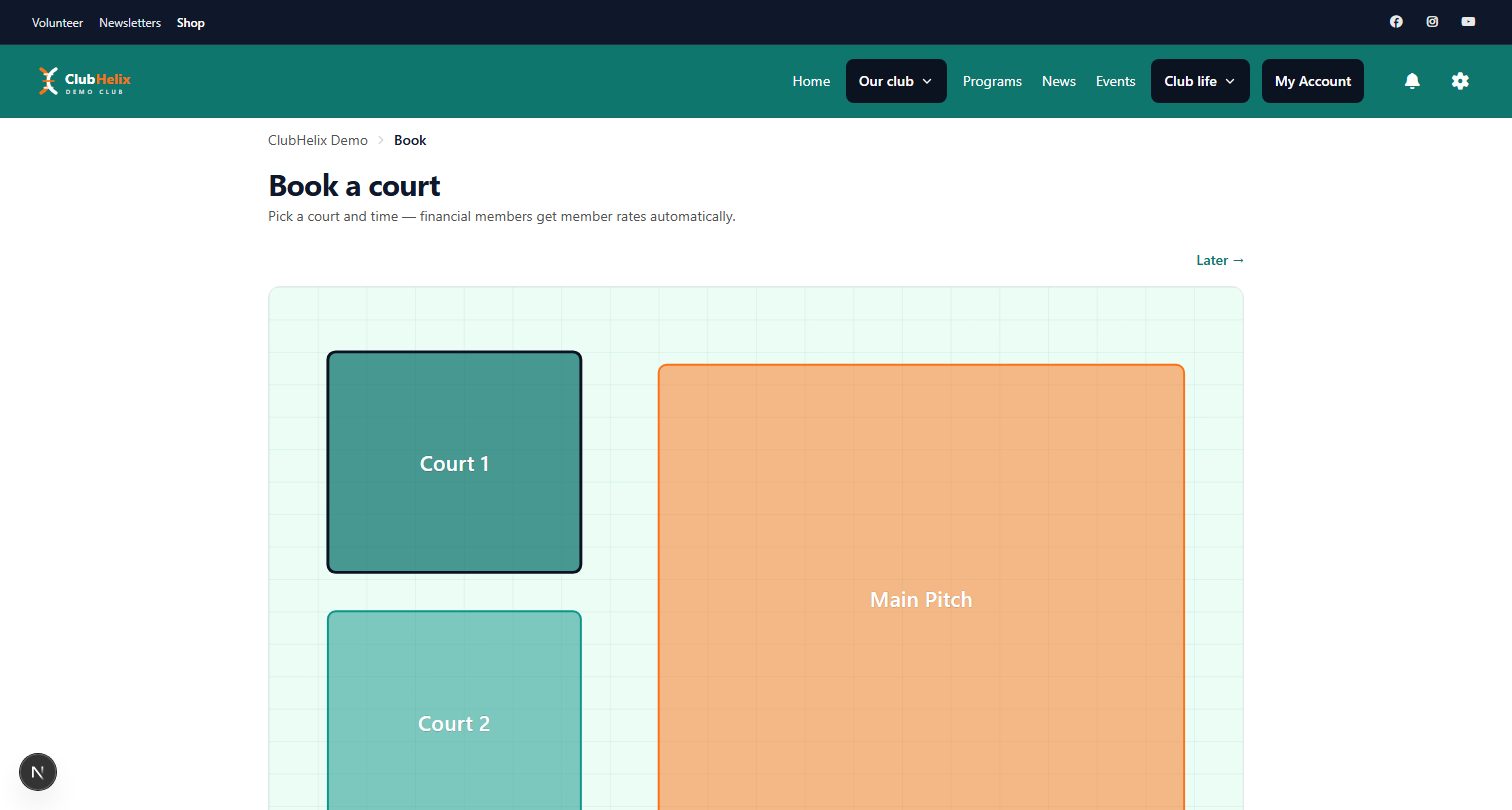
Once it's live, two hirers can never hold the same ground at once — exclusivity is enforced at the database, not in the web page. Guests book with a name and an email; members book from their account and cancel their own bookings, which returns the slot to the grid. The Bookings admin shows an Owed at the venue tile and filter, the comment under each booker's email, a column for teams or players, and a one-click Mark paid that records cash, card at the venue or bank transfer with an optional reference. Download CSV exports the filtered rows for the treasurer, and reports show booked value against what was collected. Publish the club's own fixtures as events so hirers can see the season around their slot.
The soccer and rugby union solutions pages show how it fits a winter-sport club; plans are on the pricing page, and you can start on the free tier.
Frequently asked questions
Can we offer both a full pitch and half-pitches for hire?
Yes, but never in the same hours. A booking system stops two bookings holding the same resource, and it can't know that the full pitch contains the northern half — so offer halves on some days and the full ground on others, or offer halves only and have a full-ground hirer book both.
How do we stop ground hire clashing with training and match days?
Load the club's own season first as admin blocks — training nights, home fixtures, the groundskeeper's morning — before the booking page goes live. A block holds the ground and the public grid simply doesn't offer that time. Wet-weather days go in as closures with a visible reason so hirers can replan without ringing anyone.
Should we charge per hour, per team or per player?
Per hour for schools, coaches and other clubs; per team when you want to know how many sides are coming but charge for the ground regardless; per player for casual pay-and-play games where each person chips in. Use per-player pricing only on the resource that serves casual groups, and keep an hourly rate on the one schools book.
Can a club take ground bookings without a card payment processor?
Yes. Set the ground to be paid at the venue: the booking is confirmed straight away, the hirer is told what to pay and how — a QR code on the canteen wall, a card reader at the bar, cash — and the admin lists what is owed until it is marked paid. Regulars and anyone booking weeks ahead are better served by card at the time of booking.
What should our ground hire rules cover?
No vehicles on the surface, no pegging or marking without asking, no play when the ground is closed, rubbish taken away, goals and equipment returned, and a bond for anything with marquees, vehicles or large crowds. Ask every hirer what the ground is for at booking, and publish the rules next to the price.


