
What this guide answers
- What is the difference between an exclusive and a shared facility booking?
An exclusive facility takes one booking at a time — a court, a room, a boat — and refuses a second booking for the same time.
- How many places should we give a shared facility?
The number of bookings that can genuinely run at once without the session degrading — lanes minus any kept for the squad, the horses the coaches say fit, the supervised firing points rather than the ones built.
- Should we charge per lane or per horse, or a flat rate?
Charge per place when the cost to the club or the value to the booker scales with the number — more horses, more climbers, more supervision.
- How does a booking system decide whether a shared booking fits?
Per slot, not per window: for each hour in the booking, the places already taken plus the places requested must not exceed the capacity, so a longer booking is limited by the hour with the fewest places left.
- Can we name individual lanes or stalls in a shared facility?
Not within one shared resource — it counts places, it doesn't name them.
New Zealand edition. This guide is written for volunteer-run clubs in New Zealand. Where rules differ — grants, tax, incorporation, safeguarding — follow the New Zealand-specific pointers below or check with your national body.
Most booking systems were built for a tennis court: one booking takes it, and the next person waits. That model is wrong for half the facilities clubs actually run. A pool has six lanes and a lap swimmer needs one of them. A riding arena comfortably holds four horses. A range has eight bays, a climbing wall a dozen ropes. Put any of those behind a "one booking at a time" form and you either hire the whole pool to one person or give up and go back to the phone.
Sharing a facility between bookings is a different model with its own decisions: how many fit, what a "place" is, whether you charge per place, and what the booking grid should tell the next person. This guide works through them, then shows how they land in a real system, with ClubHelix as the worked example in the final third.
Two ways a facility can be booked
Every bookable thing at a club is one of two kinds, and getting this choice right per facility is the whole job:
| Model | The rule | Examples |
|---|---|---|
| One booking takes it | Exclusive — a second booking at the same time is refused | A tennis court, a squash court, a function room, a boat |
| Several bookings share it | Shared — bookings run side by side until the places are gone | Pool lanes, a riding arena, range bays, a climbing wall |
The exclusive model is simple and unforgiving: two people can never hold the same court. The shared model swaps that single rule for a number — the capacity — and everything else in this guide follows from choosing the number well.
Choose the capacity
The capacity is the number of bookings that can genuinely run at the same time without the facility degrading. It is the number at which the fifth arrival makes the fourth's session worse, not the number who fit standing up.
| Facility | What a place is | How to choose the number |
|---|---|---|
| Swimming pool | A lane, or a swimmer within lap lanes | Lanes, minus any kept for the squad or public |
| Riding arena | A horse | Ask the coaches — four in a standard arena is common |
| Shooting range | A bay or firing point | The supervised points, not the number built |
| Climbing wall | A rope or a climber | Ropes rigged, or belay pairs the supervisor can watch |
| Rowing shed | A boat | Boats of that class that can safely be on the water together |
| Practice bays | A bay or a mat | Bays, minus any reserved for coaching |
Be conservative the first month. Raising a capacity is painless; lowering one after people have booked into the extra places means cancellations, and a good booking system will refuse to shrink a capacity below the places already taken.
What a place is, and what to call it
A shared facility always counts something. Call it what the people booking call it: "horse" on the arena, "lane" or "swimmer" at the pool, "bay" on the range, "climber" on the wall, "boat" at the shed. The word appears on the booking form, in the confirmation and on the admin's list, so a real word reads as your club and "unit" reads as software. If nothing better fits, "place" is the honest default. Then set the maximum per booking: a rider might bring three horses, a lap swimmer books one lane, and a coach who needs every place is running a block, not a booking.
Per-place pricing versus a flat rate
Once you count something, you can price it. Two shapes:
- Charge per place. The slot price multiplies by the number — three horses for an hour at the per-horse rate, two climbers at the per-climber rate. Right whenever the cost or the value scales with the number: more horses churn more surface, more climbers need more supervision.
- Flat rate, but still count. The booker says how many are coming and pays the slot price regardless. Right when you need the number for safety or planning — how many boats are out, how many shooters the range officer is watching — but the price is for the time, not the head.
The figure varies with the facility and the town; what matters is that the total is worked out on the booking screen — three horses for two hours at the per-horse rate, shown before anyone confirms — not by the treasurer afterwards.
Member and casual rates both apply: a financial member pays the member rate per place automatically, a visiting rider pays the casual rate, and either can be zero.
Why "2 of 4 left" changes how people book

On an exclusive grid a slot is free or taken. On a shared grid it carries a number — "2 of 4 left" — and reads "Full" only when the number hits zero. That small change does three useful things. It sets expectations: a swimmer who books into "2 of 6 left" arrives expecting company, where one who booked a court and found three strangers on it feels cheated. And it makes the refusal fair: when two riders go for the last two places at the same moment and one wants three horses, the system says "there are 2 left now" rather than silently overbooking the arena, and the grid refreshes so they can pick another hour or fewer horses.
Peak occupancy, in plain words
This is the rule that trips up a spreadsheet. Suppose the arena holds four horses. One booking has three horses from 9 to 10; another has two horses from 10 to 11. A rider now asks for one horse from 9 to 11.
Add up everything booked across the window and you get five horses against a capacity of four — refused. But that sum is meaningless: the three horses leave at 10, before the two arrive. From 9 to 10 there are three in, so one place is left; from 10 to 11 there are two in, so two are left. One horse fits in both hours, and the booking should go through.
The rule a good system applies is per slot, not per window: for every hour in the booking, the places already taken plus the places being asked for must not exceed the capacity. What limits a longer booking is the hour with the fewest places left. The same rider asking for three horses from 9 to 11 is refused — not because of the total, but because only one place is free from 9 to 10 — and a helpful grid says so ("only 1 place left across this time") and caps the number they can pick, rather than letting them try and fail.
Blocks that hold every place
A squad session, a coaching clinic, a pool carnival, a range competition: the club needs the whole facility, or most of it, and public bookings must not creep in. That is an admin block. On an exclusive facility a block simply takes the time; on a shared one it holds places — every place unless you say otherwise. Hold all six lanes for the carnival, or three of the four arena places for a clinic and leave one bookable.
Blocks are also how shared hire fits around the club's own program. Squad training takes four lanes at 6am every weekday? Block four places for that hour and lap swimmers can still book the other two. If the club's programs run in the same space, block their places for the term before the public grid goes live.
When several exclusive facilities beat one shared one
A shared facility counts places; it does not name them. The booker gets "one of six lanes", not "lane 3". That is exactly right for lap swimming, a riding arena or a general climbing session, and exactly wrong when the place itself matters: named lanes where lane 1 is slow and lane 6 is fast and swimmers choose on purpose; named stalls where a particular horse always goes in a particular box; the one bay with the bench rest. In those cases set up several exclusive resources — "Lane 1 (slow)", "Lane 2", "Lane 3 (fast)" — each with its own rules and price. Most clubs end up with a mix: the fast lanes named and exclusive, the middle of the pool shared for laps.
Mixing: shared for laps, exclusive for a carnival
The most common real pattern is a facility that is shared most of the time and exclusive occasionally. Keep the pool shared with its six places, and when the carnival comes, place a block that holds every place for the afternoon; when the arena hosts a clinic, block all four horses. The resource goes back to sharing the moment the block ends. Closures cover the other case — the pool drained for maintenance, the arena waterlogged — with a reason the public can read on the grid instead of a text to everyone who had booked.
Rules and etiquette for shared time
Sharing works when everyone knows the rules before they arrive, so publish them on the booking page next to the price:
- What a place gives you — a lane, not the pool; a share of the arena, not the arena.
- Direction and pace — circle swimming clockwise, riders pass left to left, ropes climbed in rotation.
- Who yields — a booking is a place, not priority; the coach on a block has the floor.
- Kit and clean-up — lane ropes back, jumps down, manure picked, mats wiped.
- Supervision — where a supervisor or range officer must be present, say so and stop the grid outside supervised hours.
A comments box on the booking form — "Anything we should know?" — catches the rest: the nervous young horse, the swimmer who needs the ramp, the group that wants to set a course. The answer is private to the club, shown in the admin beside the booking and in the export, never on the public grid.
Setting it up on ClubHelix: the worked example
Everything above is a setting in ClubHelix facility booking, and a shared facility takes about as long to set up as a court:
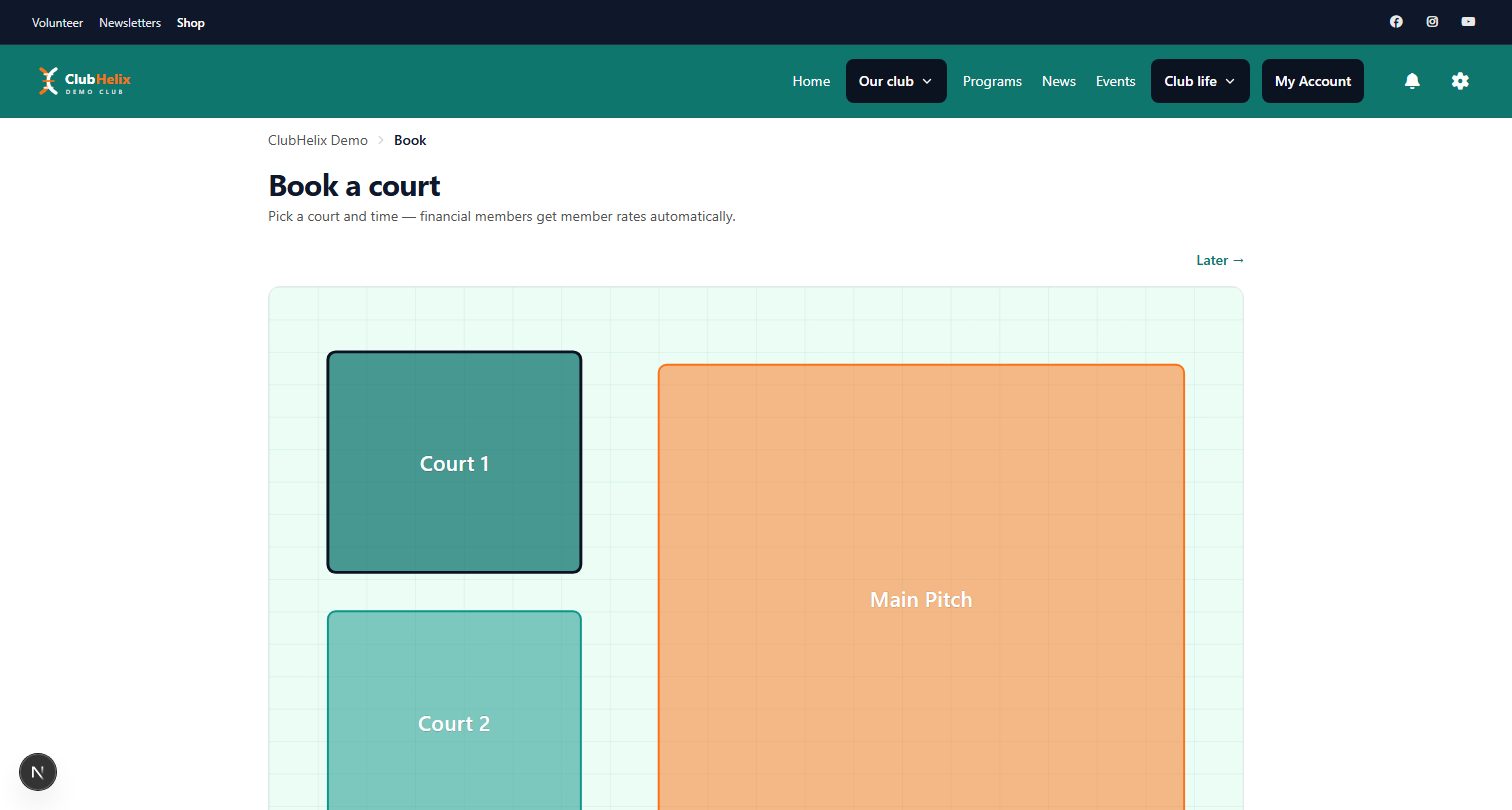
- Draw it on the venue. On the locations page, draw the pool, arena or range onto the venue map with its own colour. Set slot length, opening hours, an advance-booking window and eligibility exactly as you would for a court.
- Choose how it is booked. Pick "Several people can share it" and set the capacity — four for the arena, six for the pool. A court stays on "One booking at a time".
- Name the place and cap it. Give the unit its real name — horse, lane, bay, climber — and a maximum per booking. A shared resource always counts something; leave the name blank and it counts "places".
- Price it. A member price and a casual price per slot, and tick "Charge per horse" (or lane, or bay) to multiply by the number; leave it off to ask the number but charge the slot price.
- Ask what you need to know. Turn on the comments box, label it, and make it required if you need to. It shows in the Bookings admin and the CSV.
- Choose how it is paid. "Card at the time of booking" through hosted checkout, or "At the venue" — the booking is confirmed immediately and the booker sees "Pay [amount] at the venue" with your own instructions (a QR code in the tack room, the desk at the pool) on the booking screen and in the confirmation email. Venue-settled bookings need no payment processor, and money the club records itself carries no platform commission.
Once it's live, the public grid shows "2 of 4 left" per slot and "Full" only at zero, a two-hour booking for three horses needs three places in both hours, and the fifth horse on a four-horse arena is refused at the database with how many are left now. The Bookings admin shows a "3 of 4" badge per booking, how many were brought, what was paid and what is owed at the venue with a one-click Mark paid, and the comment under the booker's email; reports show booked value against what was collected.
For the arena in particular, how to hire out a riding arena walks the equestrian case end to end, and the swimming solutions page covers lanes alongside squads and meets. Plans are on the pricing page; you can start on the free tier.
Frequently asked questions
What is the difference between an exclusive and a shared facility booking?
An exclusive facility takes one booking at a time — a court, a room, a boat — and refuses a second booking for the same time. A shared facility has a capacity, and bookings run side by side until the places are gone: six lanes in a pool, four horses in an arena, eight bays on a range.
How many places should we give a shared facility?
The number of bookings that can genuinely run at once without the session degrading — lanes minus any kept for the squad, the horses the coaches say fit, the supervised firing points rather than the ones built. Start conservative: raising a capacity is painless, but lowering it below places already booked means cancellations.
Should we charge per lane or per horse, or a flat rate?
Charge per place when the cost to the club or the value to the booker scales with the number — more horses, more climbers, more supervision. Use a flat rate that still asks the number when you need it for safety or planning but the price is for the time, not the head.
How does a booking system decide whether a shared booking fits?
Per slot, not per window: for each hour in the booking, the places already taken plus the places requested must not exceed the capacity, so a longer booking is limited by the hour with the fewest places left. Three horses at 9 and two at 10 in a four-horse arena still leave room for one more horse from 9 to 11, even though the two bookings add up to five.
Can we name individual lanes or stalls in a shared facility?
Not within one shared resource — it counts places, it doesn't name them. Where the specific lane, bay or stall matters, set each one up as its own exclusive resource with its own price and rules, and keep the rest of the facility shared. Most pools end up with the fast lanes named and the middle lanes shared for laps.


