
What this guide answers
- When should we open ticket sales?
Four to six weeks out for a major function (presentation night, season launch), two to three for a casual one (quiz night, trivia).
- Should juniors and children need tickets?
Yes — even free ones. A $0 junior ticket costs the buyer nothing but keeps the numbers honest: catering, seating and the door list all need to know a body is coming, and "kids just turn up" is how a 120-seat room meets…
- How do we handle table allocations for a seated function?
Sell the tickets first, allocate tables later — do not turn the purchase flow into a seating negotiation.
- The event made money — where should it show up in the club's books?
As its own line, not blended into general income. Tag or categorise the event's ticket revenue and its costs so the committee sees the night's true net — that number is what decides whether the event runs next year…
New Zealand edition. This guide is written for volunteer-run clubs in New Zealand. Where rules differ — grants, tax, incorporation, safeguarding — follow the New Zealand-specific pointers below or check with your national body.
The event itself is rarely the hard part. Clubs know how to run a presentation night, a quiz night, a season launch — book the room, feed the people, thank the sponsors. What burns the volunteers is everything around the tickets: the cash float that doesn't reconcile, the door list compiled from three message threads at 5pm, the person at the entrance holding a phone displaying "I paid Deb at training", and Deb, who is on holidays.
Ticketing done properly is not more work; it is the removal of work. One selling channel, money that records itself, a door list that builds itself, and a treasurer who can tell the committee what the night made by Sunday lunchtime. This guide covers the whole cycle — pricing, selling, capacity, the door, refunds — for a typical club function. (For the event's promotion, see how to promote a club event; for what makes a presentation night itself work, that has its own guide.)
Price the ticket before you sell the first one
Three numbers decide a ticket price, and committees should write them down in that order:
- True cost per head. Venue, catering, AV, trophies, decorations — divided by realistic attendance, not hopeful attendance. Most clubs under-count here (the "free" clubroom still needs cleaning; the "donated" meat still needs buying next year when the donor moves on).
- Purpose of the night. A fundraiser prices above cost; a thank-you night prices at or below it, with the gap consciously funded by the season's budget or a sponsor. The mistake is not either choice — it is not choosing, and discovering at reconciliation which one you accidentally ran.
- The kitchen-table test. A family of four does the maths before buying. If the family total makes people wince, add a family ticket price rather than lowering the adult price — the same logic as family membership tiers.
Keep the price grid tiny: adult, junior, family covers nearly every club function. Sponsors and life members get comped by name, not by a public "free" option that invites creative self-classification.
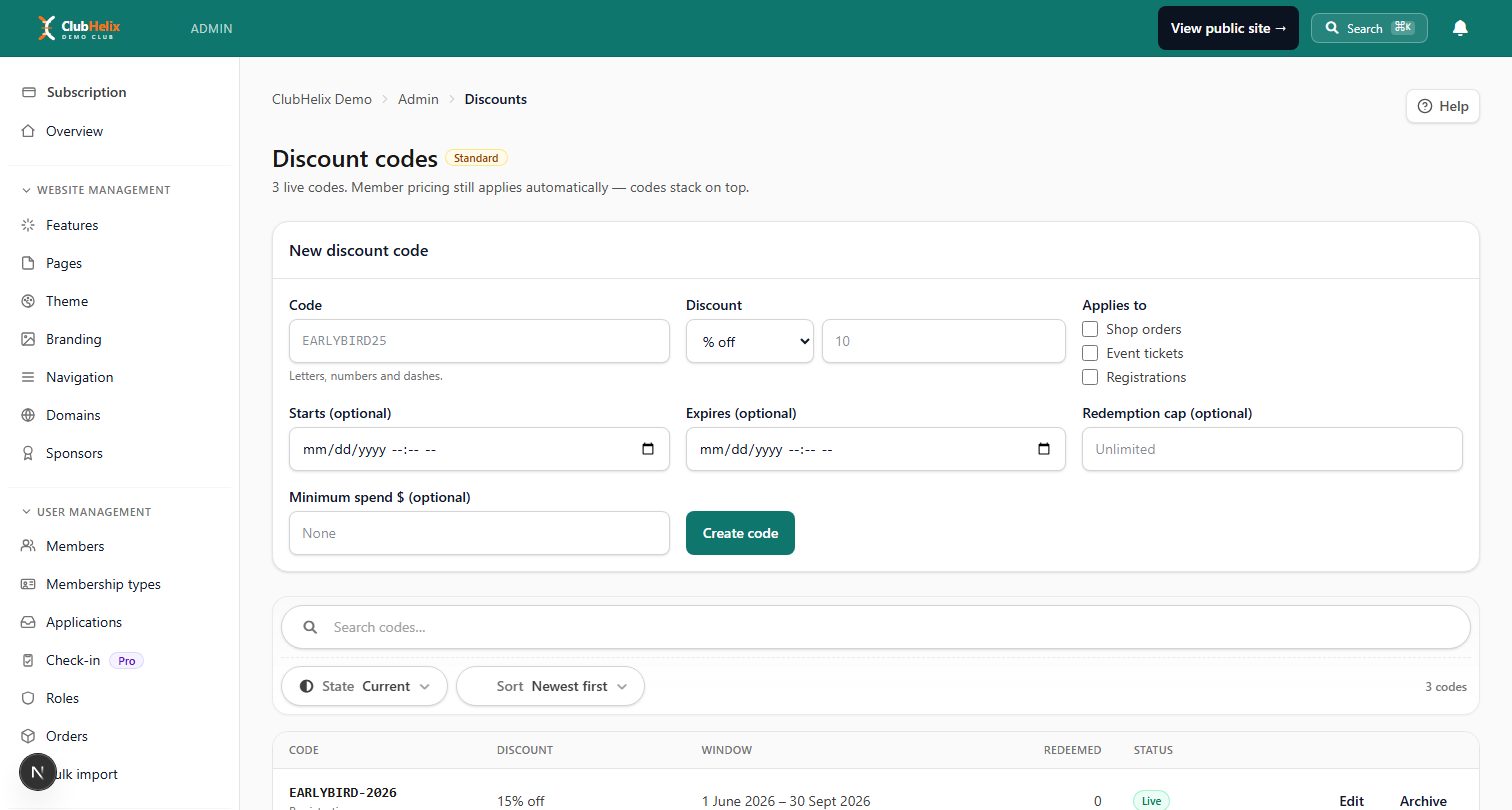
Early-bird pricing is the one tactic that reliably earns its complexity. Clubs sell most of their tickets in the last 72 hours, which makes catering numbers a nightmare — an early-bird price with a real deadline drags purchases forward, which is worth more as information than the discount costs in dollars. Run it as a discount code or a time-boxed price with a hard cut-off, and never quietly extend it: the club that extends the early-bird once has told every member that deadlines are theatre. On ClubHelix this is a discount code with an expiry — thirty seconds to set up.
Sell from the club's own website
Where the tickets are sold shapes the entire night's admin. The options in the wild: cash and bank transfer (the reconciliation horror described above), an external ticketing site, or ticket sales built into the club's own website. We have written a full comparison of external ticketing sites versus built-in ticketing; the short version of why the club's own site wins for club functions:
- The buyer is already your member. Selling through your club's events system means the purchase attaches to the member record — no re-typing names, no guessing which "J. Smith" bought four tickets. An external site's customer list belongs to the external site.
- No per-ticket clip for a middleman's brand. External platforms take a booking fee per ticket — on a $25 club function ticket, a meaningful slice — and put their brand, their upsells and sometimes other events in front of your buyers. Your event page on your own domain sells only your event.
- One less login to lose. The external-site account created by a volunteer in 2022 is a classic single point of failure. Tickets on the club platform live where the club already works, behind the same committee logins, feeding the same income reports the treasurer already reconciles.
Whatever you choose, choose one channel and announce it everywhere the event is promoted. Every side-channel you tolerate ("or pay Deb at training") re-creates the reconciliation problem you were solving.
Set the capacity honestly, and let the system enforce it. The venue holds 120; sell 120, and let the platform show "sold out" rather than a volunteer keeping a mental tally across message threads. If you expect a rush — grand-final lunches, anything with a guest speaker — the sold-out state doubles as marketing for the next event.
The door list runs the night
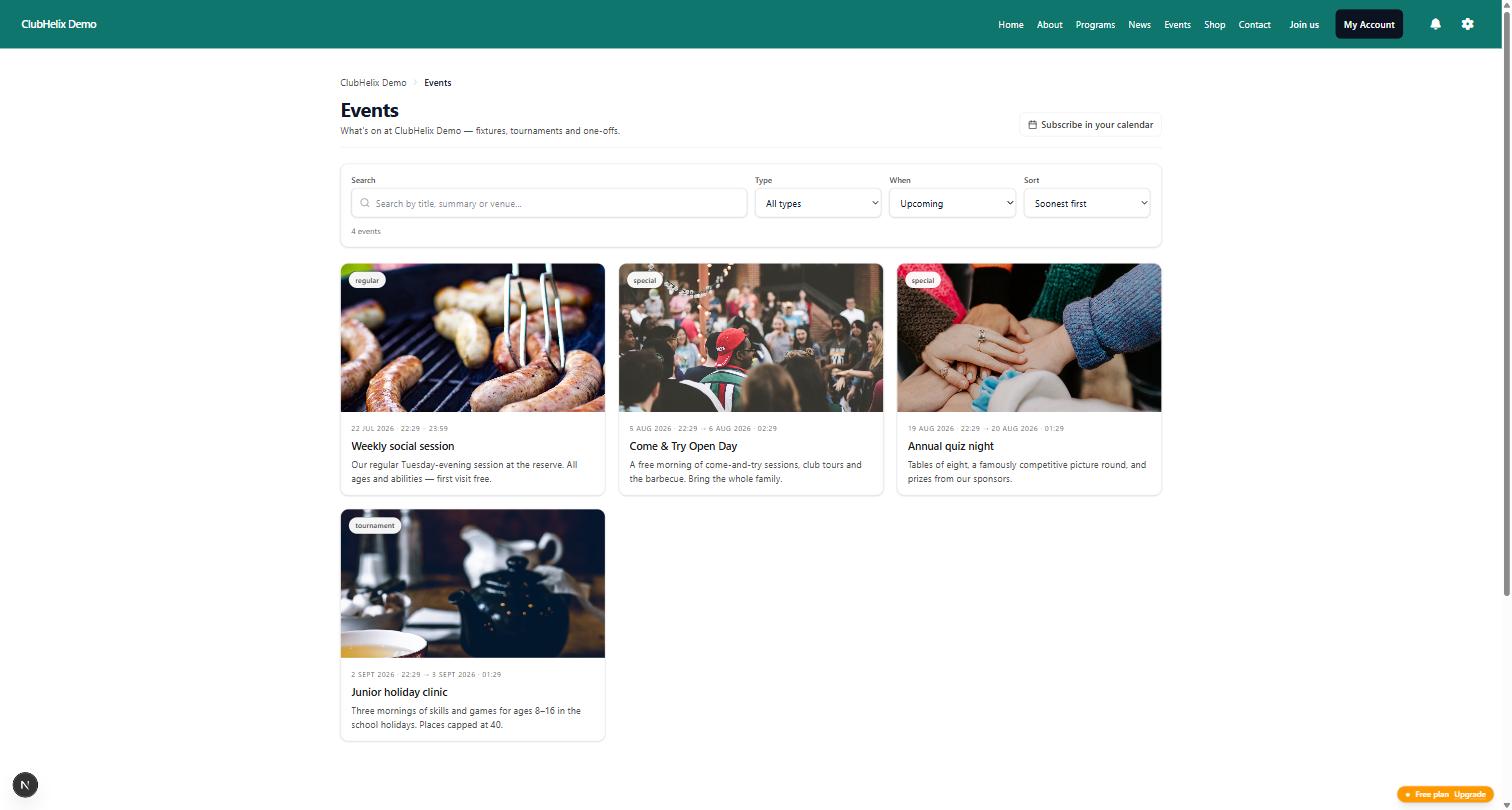
The buyer experience ends at purchase; the club's payoff arrives at the door. Because every ticket was sold through one channel, the door list is not compiled — it already exists: names, ticket types, quantities, paid status. Practical door mechanics:
- Work from a phone or tablet, alphabetically by surname. Ticking off arrivals against the live list beats printed sheets (which are stale by the time they are printed) and beats scanning anything (QR scanning is solving a fraud problem your club function does not have).
- Two people at the door for the first hour, one on the list, one on hellos — the door of a club function is a welcome, not a checkpoint.
- Have a buy-now path at the door. Someone will turn up ticketless with cash and good intentions. The clean answer is the same link everyone else used, on their phone, at the door price — the cash stays in their pocket and the records stay whole.
- Comps are tickets too. Sponsors, life members and the MC go on the list as $0 tickets when invited, not as a separate mental list the door volunteers have to hold.
The same list becomes the attendance record after the night — who actually came — which quietly improves next year's catering numbers and gives the committee a real answer to "do people come to these?" (attendance tracking accumulates the pattern across the season's events).
Refunds and the weather
Decide the refund policy when you create the event, print it on the event page, and make it generous: for a club function, "full refund until 48 hours out, then we've already paid the caterer" is fair, explainable and almost never abused. Consumer law in most places also has views about cancelled events — the safe summary is that if the club cancels, buyers get their money back, full stop. Our refunds guide covers the principles and the graceful handling.
Two club-specific wrinkles worth pre-deciding:
- Postponement. Tickets roll to the new date automatically, with refunds on request for anyone who cannot make it. Announce that rule with the postponement, not in reply to thirty identical questions.
- The sympathetic no-show. Someone's kid got sick on the night and they ask afterwards. The policy can say no; the club can still say yes. A $25 goodwill refund to a volunteer family is the cheapest loyalty you will ever buy — just route it through the platform so the money records stay truthful.
Frequently asked questions
When should we open ticket sales?
Four to six weeks out for a major function (presentation night, season launch), two to three for a casual one (quiz night, trivia). Open earlier and the event feels distant, so nobody buys and the promotion goes stale; later and you compress everything into the panic window. The rhythm that works: open with the early-bird price and the venue booked, push hard at open and at early-bird close, then let the final week's scarcity ("20 tickets left") do the last push. Sales open is also a promotion beat in its own right — coordinate it with the event promotion plan.
Should juniors and children need tickets?
Yes — even free ones. A $0 junior ticket costs the buyer nothing but keeps the numbers honest: catering, seating and the door list all need to know a body is coming, and "kids just turn up" is how a 120-seat room meets 150 people. Free-with-registration is also cleaner at the door than any "under-12s free, just bring them" arrangement, because the family's whole booking sits together on one record.
How do we handle table allocations for a seated function?
Sell the tickets first, allocate tables later — do not turn the purchase flow into a seating negotiation. Collect a "seat us with" free-text field at purchase, close sales a few days out, and have one person draft the seating map from the final list (it is an hour with the attendee export). Publish table assignments at the door, not in advance, which saves the committee a week of relocation requests. For team-based nights, selling whole tables to teams or sponsors at a flat price is simpler again — one buyer, ten seats, one record.
The event made money — where should it show up in the club's books?
As its own line, not blended into general income. Tag or categorise the event's ticket revenue and its costs so the committee sees the night's true net — that number is what decides whether the event runs next year, gets a sponsor, or quietly retires. Platforms where ticket sales land in the same reporting as the rest of the club's income make this a filter rather than a spreadsheet job, and the treasurer's post-event report writes itself by Sunday.


