
What this guide answers
- What club merchandise sells best?
Hoodies are the consistent number one, followed by caps, beanies and drink bottles — simple, wearable items in club colours with few or no sizes.
- Should our club do pre-orders or hold stock?
Start with pre-orders for anything sized — zero stock risk and every unit pre-sold — and hold small standing stock only for one-size evergreen items like caps and bottles.
- How much margin should a club merch store make?
8× your true landed cost (garment, decoration, setup, freight), priced in round numbers.
- Do we need to charge GST on club merchandise?
It depends on whether the club is registered for, or required to register for, the relevant sales tax — and on what you're selling.
South Africa edition. This guide is written for volunteer-run clubs in South Africa. Where rules differ — grants, tax, incorporation, safeguarding — follow the South Africa-specific pointers below or check with your national body.
Club merchandise is the rare fundraiser where nobody feels fundraised at. Members genuinely want the hoodie; parents genuinely need the second pair of club socks; and every cap you sell becomes free advertising at the local shops for the next five years. Done well, a club merch store is steady, repeatable income that doesn't ask a single volunteer to stand behind a trestle table.
Done badly, it's a garage full of size-S polos nobody ordered, a spreadsheet of who's paid, and a volunteer chasing $45 across three seasons of training nights. The difference is almost entirely in the setup — what you sell, how you take orders, and how the money and stock flow. Here's the whole system.
What actually sells (and what doesn't)
Two decades of club merch tables produce a remarkably consistent answer:
| Item | Verdict | Why |
|---|---|---|
| Hoodies | The banker | Everyone wears them, parents buy them for the whole family, worn year-round |
| Caps and beanies | Reliable | Low price, one-size, no size-chart risk |
| Drink bottles | Reliable | Cheap, useful, kids lose them and re-buy |
| Polo shirts | Solid | Supporters and officials wear them off-season |
| Training tees | Solid at junior clubs | Cheap entry point, bought in multiples |
| Scarves | Seasonal winner at winter clubs | Great crowd photos, giftable |
| Tote bags, socks, stubby holders | Nice margins in small runs | Add-on purchases, low risk |
| Full replica playing kit | Careful | Sizing complexity, higher cost, smaller audience |
| Novelty one-offs | Usually a garage filler | Order only against confirmed demand |

The pattern: simple, wearable, few sizes, club colours. Start with a tight range — a hoodie, a cap, a bottle — and expand only when those prove themselves. Ten products with three sales each is a storage problem; three products with fifty sales each is a program. Keep playing uniforms and supporter merch clearly separated in your range and your rules — your club uniform policy governs what's worn on the field; merch is everything else.
Pre-orders vs holding stock
This is the biggest financial decision in club merch, and the honest answer is: start with pre-orders, graduate to hybrid.
Pre-orders (make to order). Open an order window — three or four weeks, twice a year — collect paid orders online, then place one bulk order with your supplier. Zero stock risk, zero cash tied up, every unit pre-sold, and sizing is the buyer's choice rather than your guess. The costs: buyers wait a few weeks, you miss impulse purchases, and someone must run the window to a deadline. This is the right model for anything sized (hoodies, polos) and any new product you haven't proven.
Holding stock. Buy a run up front, sell year-round. You capture the new-family start-of-season walk-up and the "lost his bottle again" repeat sale — but you're gambling club money on a size curve, and the leftover smalls are pure loss. Reserve it for one-size, evergreen items: caps, beanies, bottles, stubby holders.
The hybrid most clubs land on: two pre-order windows a year for sized apparel (season launch and mid-winter), plus a small standing stock of one-size items sold continuously. Pre-order windows also create natural marketing moments — "orders close Friday" is the most effective merch message ever sent.
Pricing and margins: fundraiser, not charity
Price club merch to make money — that's the point. A simple, defensible approach:
- Know your true landed cost per unit: the garment, decoration (embroidery outlasts print on hoodies and caps), any artwork setup fee spread across the run, and freight.
- Apply a real margin. Most clubs price at roughly 1.4–1.8× landed cost — enough to fund the program and absorb the odd replacement, while staying obviously cheaper than retail sportswear.
- Price in round numbers. $55, not $53.70. Nobody comparison-shops a club hoodie against the open market; they compare it against how much they love the club.
- Don't race to the bottom. A $5 margin per hoodie is a lot of volunteer effort for very little club benefit. If the price needed feels high, choose a cheaper garment rather than a thinner margin.
- Mind minimums. Decoration minimums (often 20–25 units) are another argument for pre-order windows — you hit the minimum with sold units, not speculative ones.
A worked sanity check: a hoodie landing at $32 sells at $55 — roughly $23 to the club. Fifty hoodies in a pre-order window is over $1,100 of clean fundraising with no stock risk and no sausage sizzled.
Set up the online store (retire the spreadsheet)
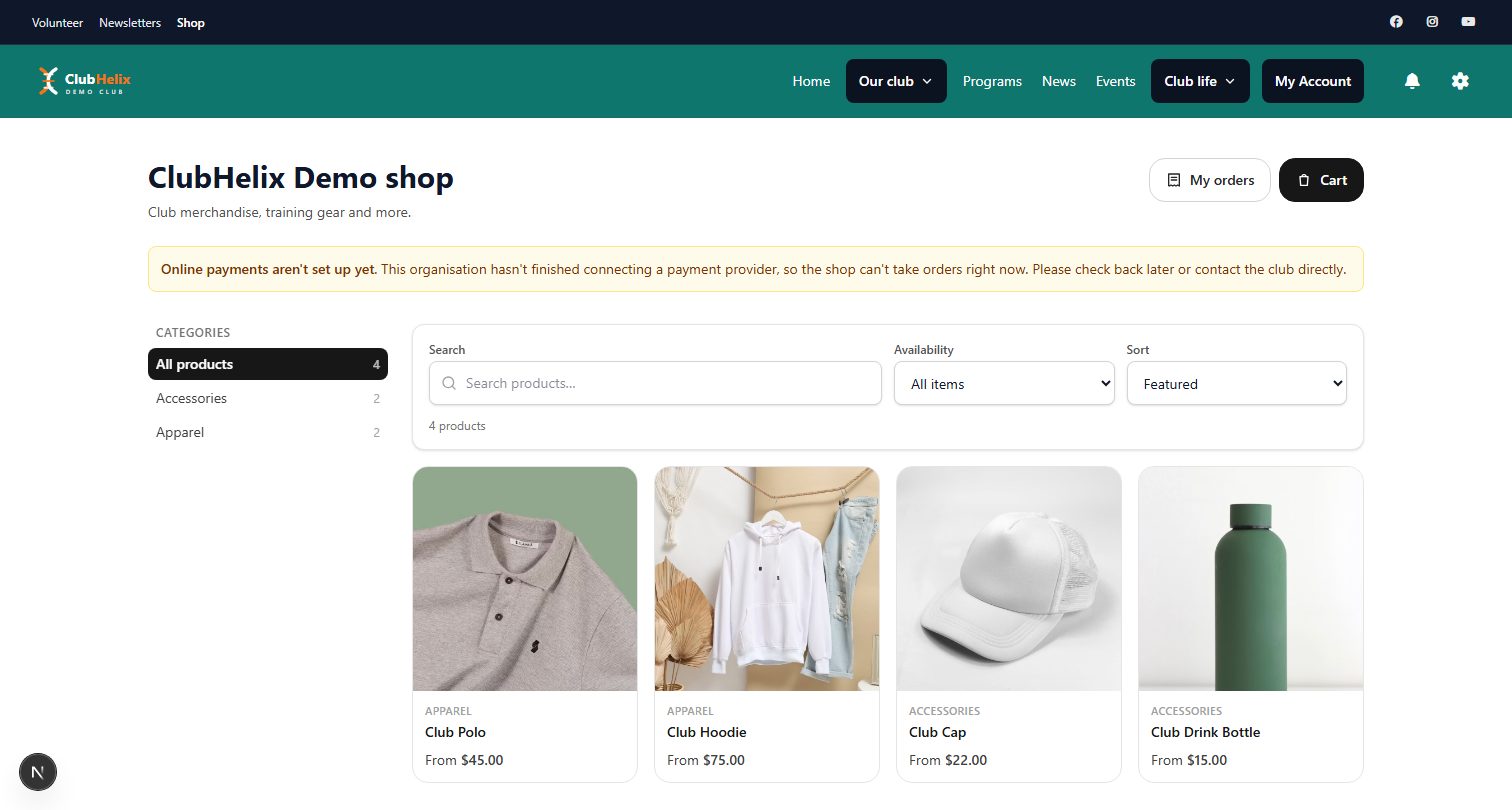
Paper order forms and bank-transfer honesty systems are where merch programs die — unreadable size columns, unpaid pickups, and a treasurer reconciling $55 deposits with no reference. Selling club merchandise online through your own club website fixes all of it at once:
- Products with photos, sizes and live pricing — buyers pick size and quantity themselves, which alone eliminates half the admin errors.
- Card payment at checkout — no cash, no chasing, no "I'll fix you up at training". Money lands in the club account via Stripe or Square.
- Orders tracked automatically — who ordered what, in what size, paid, and whether it's been collected — with order statuses replacing the spreadsheet entirely.
- A pre-order window is just an open/close date — publish the products, promote the deadline, close the window, and export the size breakdown as your supplier order.
With ClubHelix, the club shop is part of your club website — same login members already use for registration, same branding, no separate storefront to bolt on. Launches go further with discount codes: an early-bird price for the first week of the window, a bundle deal for new families, or a volunteer thank-you code that costs the club its margin, not real dollars.
Pickup vs postage
Decide fulfilment before the first order, because it shapes pricing and promises:
- Pickup at training or match day is the default for good reason: free, simple, and a nice touchpoint. Publish set pickup nights ("collection at Thursday training, weeks 1–3 of the season") rather than ad-hoc arrangements, and mark orders collected as they go so the tub in the canteen doesn't become a mystery box.
- Postage suits clubs with far-flung supporters — country leagues, alumni, grandparents. Charge a flat rate that genuinely covers a padded satchel, batch the post-office run to once a week, and update the order when it ships. Don't offer postage on day one unless you know someone will actually do the posting.
- The honest hybrid: pickup free, postage at a flat rate, and let the buyer choose at checkout.
Whatever you choose, put collection details on the shop page and in the order confirmation — "where's my hoodie?" messages are a sign the system, not the buyer, failed.
GST and the money basics
Merch revenue is club revenue, so loop your treasurer in early — and settle the sales-tax question before you set prices, not after, because retrofitting tax into a published price list means either eating the margin or annoying every member who already ordered.
Whether the club needs to register for VAT depends on turnover across all its activities, and merch plus kiosk plus venue hire adds up faster than committees expect. If the club is registered, merchandise sales are generally standard-rated, so decide whether your published prices are VAT-inclusive before you open orders. Check the current threshold with SARS.
Either way, treat merch income like the rest of your money handling — through the club account with proper records, exactly as you would for membership fees collected online.
This is general information, not tax or financial advice — check the current requirements with your national tax authority, or ask your club's accountant.
Launch it properly
Merch sells on momentum, not availability. For each pre-order window: tease it ("new hoodie design drops Monday"), launch with real photos on real members — not supplier catalogue mock-ups — then remind at the midpoint and again 48 hours before close. "Orders close Friday night" does more selling than every other message combined. Photograph pickup night for next season's launch, and note what sold out and which sizes lagged — that data is next window's order sheet.
If your club runs on ClubHelix, the whole pipeline — shop, sizes, card payments, order statuses, pickup tracking and launch-week discount codes — is built into the same site that runs your registrations and events. There's a free tier to start on; see pricing.
Frequently asked questions
What club merchandise sells best?
Hoodies are the consistent number one, followed by caps, beanies and drink bottles — simple, wearable items in club colours with few or no sizes. Start with a tight range of proven items and expand only when they sell.
Should our club do pre-orders or hold stock?
Start with pre-orders for anything sized — zero stock risk and every unit pre-sold — and hold small standing stock only for one-size evergreen items like caps and bottles. Most clubs settle on two pre-order windows a year plus a small year-round range.
How much margin should a club merch store make?
Roughly 1.4–1.8× your true landed cost (garment, decoration, setup, freight), priced in round numbers. If that price feels too high for your members, pick a cheaper garment rather than shrinking the margin — thin-margin merch isn't worth the volunteer effort.
Do we need to charge GST on club merchandise?
It depends on whether the club is registered for, or required to register for, the relevant sales tax — and on what you're selling. Ask your club's accountant; this is general information, not tax advice.
Only if the club is registered (or required to register) for VAT. Check the current threshold with SARS, remembering it applies across all the club's activities combined, not merch alone.


