
What this guide answers
- How do you manage an esports roster across several titles?
Treat each title as its own section with its own captain, and cap how many starting spots one player can hold — two is a sensible ceiling.
- How do you schedule an online season across time zones?
Pick one anchor time zone, publish every fixture in it, and let calendars convert.
- What should an esports forfeit policy cover?
A grace period and the point at which the match is forfeited, the minimum number of players, the consequence of fielding an unregistered player, when a disconnect allows a remake, how account sharing is handled, and…
- How do you handle screen time and welfare in a club setting?
Coach it rather than legislate it — breaks every fifty minutes, a genuine warm-up, hard stop times for junior squads that the coach enforces, and a real off-season with no fixtures.
- How do you decide which games junior squads can play?
Start from the content rating that applies where you are and make it a written committee policy rather than a case-by-case call.
USA edition. This guide is written for volunteer-run clubs in the United States. Where rules differ — grants, tax, incorporation, safeguarding — follow the USA-specific pointers below or check with your national body.
It is 8:47pm. Four of your five starters are in the voice channel, the match lobby opens at nine, and the fifth has not been seen since Thursday. Your designated substitute is at work until ten. The opposition manager has just asked, politely, whether you intend to show up. Somewhere in a chat thread from eleven days ago, somebody said they might be away this weekend.
Every committee member in every sport recognises that evening. What makes esports different is that none of the physical constraints that quietly solve the problem elsewhere apply. Nobody drives to a ground, so nobody is visibly missing until the moment it matters. There is no clubroom where you notice a player has stopped turning up. There is no wet weather to cancel into. And your fixture list can be scheduled across four time zones by an organiser who has never met any of you.
This guide is for the committee of a community esports club — the sort with a few squads, a mix of teenagers and adults, subs measured in the price of a takeaway, and one very tired person who does the scheduling. It covers roster management, tryouts and multi-title squads; running a season online, including ladders, scheduling and forfeits; and player welfare, screen time and age-appropriate titles. If you run a club inside a university, read how to run a university esports club alongside it, because the student-body funding and eligibility layer changes a lot.
Structurally, you are a multi-sport club
The single most useful mental model: each title you compete in is a section, exactly like a club that fields cricket in summer and hockey in winter. Sections have their own squad sizes, their own seasons, their own captains and their own culture, and they compete for the same volunteers and the same money.
| Section type | Squad shape | Season shape | Staff it really needs |
|---|---|---|---|
| Team tactical shooter | 5 starters, 1-2 subs, coach | Weekly ladder, playoffs, off-season | Captain, coach, manager |
| MOBA-style five-a-side | 5 starters, 2 subs, analyst | Split-based, long, heavy scrim load | Captain, coach, analyst |
| Small-team sports title | 3 starters, 1 sub | Fast weekly ladders, frequent cups | Captain who also manages |
| Fighting or racing titles | Individuals, entered as a squad | Monthly brackets, open entry | One coordinator |
| Casual and social ladder | Anyone, mixed ability | Continuous, no stakes | A moderator, not a coach |
Write your sections down and give each one an owner. Clubs that do not do this end up with a committee that talks about whichever title had a crisis this week, and a social membership that quietly withers because all the attention goes to the one competitive squad.
The second structural decision is where the club actually lives. Most esports clubs run on a chat platform, which is excellent for conversation and terrible as a system of record — nobody can tell you who is a paid member, which roster was locked when, or who has a parental consent on file. Keep the chat for talking, but hold the membership list, the team sheets, the fixtures and the results somewhere permanent. Member chat inside your own club site gives you channels that are tied to actual membership records rather than to whoever wandered in through an invite link.
Rosters, tryouts and the multi-title problem
Selection is the hardest social task in an esports club, because everybody can see their own rank and almost everybody believes it undersells them. The fix is process. Publish it, run it the same way every season, and make selection a decision about roles and reliability rather than raw skill.
A tryout process that survives contact with reality
- Open trial night. Anyone in the club can enter. Mixed teams, rotated, two hours, coaches watching rather than playing.
- A role and availability questionnaire. Preferred role, second role, realistic weekly hours, nights they can never make, whether they can commit to a scrim block.
- Two scrim blocks in provisional line-ups. Skill shows up in one night; communication and coachability take two.
- Selection published with a reason. A sentence per player, sent privately. Silence is what turns a non-selection into a departure.
- A four-week review point. Named in advance, so a bench conversation is a scheduled event rather than an ambush.
Roles worth naming on every squad
| Role | Owns |
|---|---|
| Shotcaller | In-game decisions, calls the strategy, runs the review |
| Core players | Their role, their preparation, their availability being accurate |
| Designated substitute | Real practice time and a guaranteed number of starts |
| Coach | Session structure, review, the difficult conversations |
| Team manager | Scheduling, results submission, contact with the opposition |
The designated substitute is the position clubs get wrong. A substitute who never scrims and never starts will not be there in week nine, which is exactly when you need them. Guarantee them scrim time and a minimum number of starts in writing, and your no-show problem largely evaporates.
Then cap the multi-title problem before it caps you: a player may hold a starting spot in no more than two sections. The keen ones will sign up for four, and then one Saturday all four sections have a fixture and your best player has to disappoint three teams. Publish rosters per section on the club site rather than in four separate chat threads, so the overlap is visible when you pick, not when you clash — team management keeps the squad lists, contact details and staff assignments in one place.

Practice that is not just playing more
A scrim block with no structure is matchmaking with extra steps. The clubs that improve run something closer to a training session: fifteen minutes on a specific focus, two or three scrims with that focus called out loud, then a short review of two moments rather than a full replay. Set an individual goal per player per month, write it on the team page, and check it at the review point. Attendance at scrims should be recorded the same way a football club records training — patchy attendance is the leading indicator of a squad about to fall apart, and it only shows up if somebody is marking attendance.
Running a season online
Online seasons fail in three specific places: the schedule, the reschedule, and the no-show. Solve those and an internal ladder is genuinely easier to run than a field sport.
Choose a format that matches your numbers
| Format | Works when | Watch out for |
|---|---|---|
| Round robin | 6-10 squads, a fixed season length | Dead rubbers late in the season |
| Swiss rounds | Large, uneven entry, limited weeks | Needs an admin to pair each round on time |
| Challenge ladder | Continuous, casual, variable availability | Top spots stop accepting challenges |
| Group stage into cup | A one-day or one-weekend event | Tight timing — build in slack between rounds |
For anything with more than six squads, a fixed round-robin draw published before round one beats a ladder you have to referee weekly. How to make a fixture draw covers the mechanics, and spreadsheet fixtures vs competition software is worth reading before you commit another season to a shared spreadsheet.
The anchor-time rule
Never publish a start time without a zone. If your league spans several time zones — and online leagues almost always do — pick one anchor zone, publish every fixture in it, and let each member's calendar do the conversion. Then add three habits: a default weekly slot per section so most weeks need no negotiation at all, a reschedule window that requires the request at least seventy-two hours ahead with both captains agreeing and an admin confirming, and a hard rule that an unconfirmed reschedule means the original slot stands. Fixtures published on the club site with results and a live ladder do this work for you; competitions with fixtures and ladders will keep the table current without anyone maintaining a spreadsheet at midnight.
The forfeit policy, written before you need it
This is the document that decides whether your season keeps its integrity. Write it in the pre-season, publish it, and apply it without negotiation.
| Situation | Default ruling | Evidence |
|---|---|---|
| No-show at start time | 15-minute grace, then first map forfeited; 25 minutes, match | Timestamped lobby screenshot |
| Short of the minimum players | Stand-in from the club's registered pool, or forfeit | Registered roster at lock |
| Unregistered or ineligible player | Result reversed, match awarded to the opponent | Roster snapshot at lock date |
| Disconnect in the opening rounds | Remake if both captains agree, once per match | Both captains confirm |
| Disconnect later in the match | Play on, result stands | — |
| Account sharing or a ringer | Match forfeited, player suspended pending a committee review | Screenshots, opposition report |
| Disputed result | Raised within 24 hours with evidence, ruled within 72 | Clips or screenshots |
Two supporting mechanics make it work. Roster lock — squads are locked at a published date and cannot add players mid-season without approval, which is what makes the ineligibility rule enforceable. And both-captain reporting — each captain submits the result within a fixed window, mismatches go to an admin, and non-reporting has a default consequence. Without those two, a forfeit policy is a wish.
Player welfare, screen time and age-appropriate titles
This is where an esports club earns the right to call itself a club, and it is the part parents judge you on. It also matters more than in most sports, because the training environment is the same room, the same chair and the same screen the member uses for school or work.
Session hygiene, published and coached. A break every fifty minutes, away from the screen and standing up. Water on the desk. A screen at arm's length and roughly eye level. Wrists and shoulders warmed up before a scrim block the same way any other athlete warms up. None of this is exotic, and a coach who models it changes the culture faster than a policy that nobody reads.
Hard stops, especially on school nights. Set an end time for junior squads and enforce it on the coach rather than the player. A scrim block that finishes at 9:30 with a review to 9:45 is a club with a curfew; one that drifts to eleven because a series went long is a club that will lose families.
Titles matched to age. Decide, as a committee, which titles your junior squads compete in, and put the reasoning in writing for parents. Content ratings exist for exactly this decision, and it is far easier to explain a policy in advance than to defend a fixture afterwards.
In the United States, games carry ESRB ratings — E, E10+, T, M and AO — along with interactive elements disclosures covering in-game purchases and user interaction. Use the rating as the baseline for junior sections, pay particular attention to the user-interaction notice, and confirm a title's current rating before entering an under-age squad.
Safeguarding in voice channels. Treat an online team channel exactly as you would a change room. Two adults present in any channel with juniors, no private messages between adult staff and under-eighteens, team channels logged rather than ephemeral, parental consent recorded for voice communication, and a named person to report to. Publish the reporting path where members can find it without asking.
Conduct and toxicity. Your code of conduct needs three things a generic one lacks: it applies in-game as well as in club channels, it applies to spectating and clipping, and it names the consequence ladder — a word from the captain, a written warning, a match suspension, removal. Apply it to your best player the first time, or it means nothing forever after.
Burnout and the bench. Watch for the member who is playing more and enjoying less. Scheduled reviews, honest benching conversations, and an off-season with no fixtures at all are the club-level treatment. An esports club with a genuine off-season keeps people for years.
The committee an esports club actually needs
Five roles do the work. A section captain per title, who owns the squad and the fixtures. A scheduling officer, who owns the calendar across sections and is the person who spots two fixtures on the same night. A welfare and conduct officer, ideally not a coach, who handles reports and holds the safeguarding line. A treasurer, because subs and entry fees are still money. And a content and community lead, who runs the social side, the clips and the recruitment.
Split those five ways and each is an hour a week. Leave them merged into one enthusiastic founder and you have a club with a twelve-month lifespan. How to recruit club volunteers has the playbook for slicing roles small enough that people say yes.
Money, entry fees and prize pools
Esports club finances are unusually clean: subs in, entry fees and equipment out, plus whatever a venue costs when you run something in person.
- Subs. Charge something, even a token amount. A free club has no members, only a chat server population, and the difference shows up the moment you need to know who is actually in.
- Entry fees. Budget per section per season and decide up front whether the club pays or the squad does — inconsistency here causes more resentment than the amounts justify.
- Hardware and peripherals. Avoid buying gaming PCs. Peripherals, a club account for a scrim tool, and streaming gear are affordable; hardware is a money pit that ages badly.
- In-person events. A LAN day or a watch party is where a club becomes a community. Venue hire, power, tables and a projector, sold as tickets.
- Sponsorship. Local businesses will back a well-presented club. Be deliberate about which categories you decline — gambling and wagering sponsorship in a club with junior members is a decision to make consciously, in writing, before someone offers you money.
Prize pools deserve care. Once you combine an entry fee with a cash prize, you may be running a regulated competition rather than a club event, and the rules differ sharply between markets and even between states or provinces.
In the United States, contest and sweepstakes rules are set state by state, and an entry fee combined with a prize can change how an event is classified. Check your state's requirements before advertising a cash prize — this is general information, not legal advice. On subs, community esports clubs here commonly sit somewhere between $25 and $75 a year, with squad entry fees on top.
Latency is rarely the constraint here, which means the format questions are about calendar rather than connection. The one to watch is the summer break, when juniors disappear for weeks and squads lose continuity — plan a short off-season deliberately rather than letting a league die of attrition in July.
Getting the club out of the chat thread
The specific pain in this guide is not the gaming. It is the fixture nobody could find, the roster that lived in a pinned message, the results table someone updated on their phone, and the parent who could not tell you what their kid had agreed to. That is a records problem, and it is exactly what a club platform is for: fixtures, ladders and results that stay current on your own site, squad lists and staff assignments per section, scrim attendance that tells you which team is fading, and club channels tied to real membership rather than an invite link.
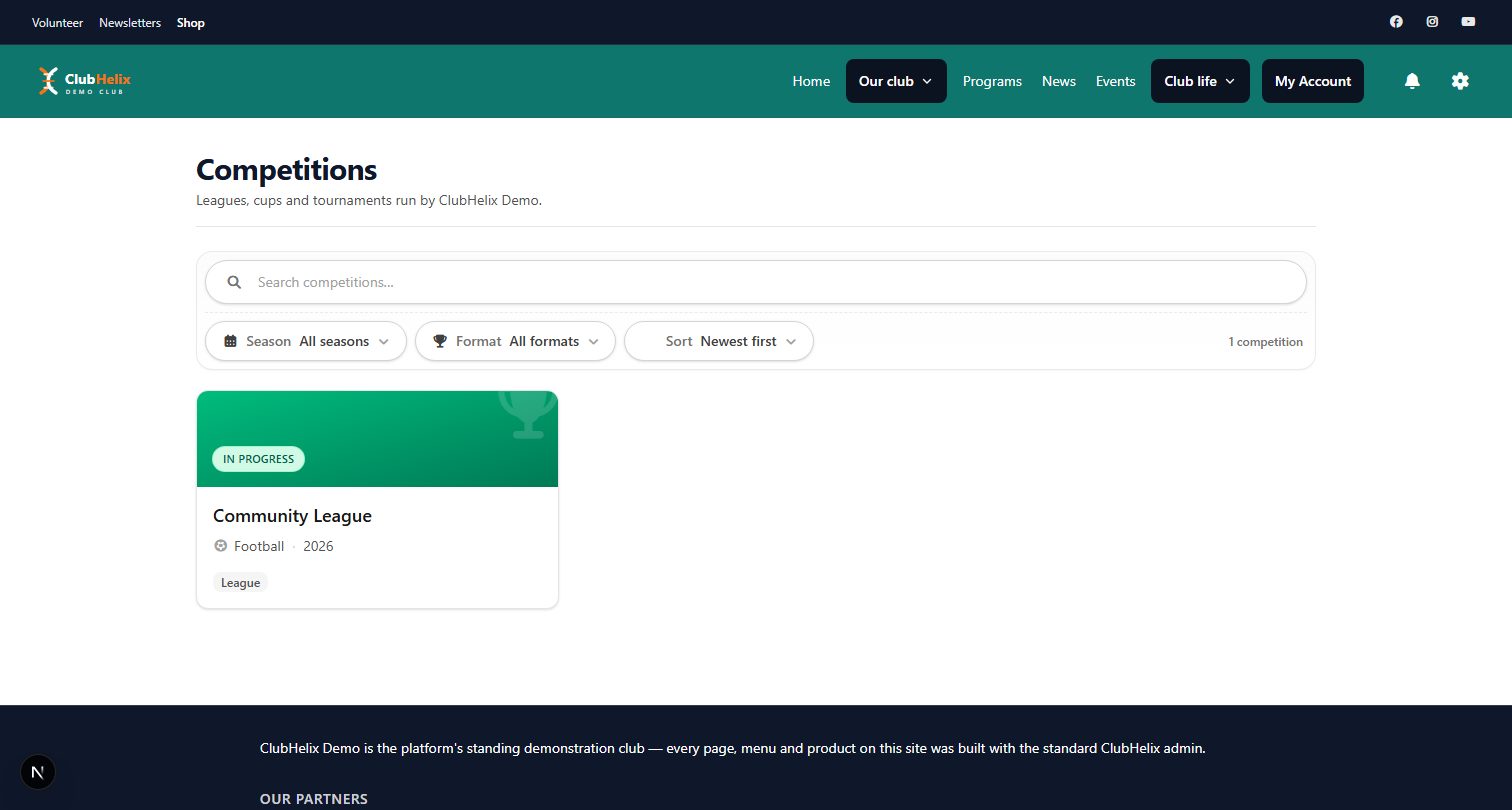
ClubHelix is built for volunteer-run community clubs, not for enterprise leagues — free to start, with clear pricing as your sections grow, and a club website your members can actually point their parents at. If your season currently lives in a spreadsheet and three pinned messages, set up your club online before the next split starts. The esports club management software page shows the setup in more detail.
Frequently asked questions
How do you manage an esports roster across several titles?
Treat each title as its own section with its own captain, and cap how many starting spots one player can hold — two is a sensible ceiling. Lock rosters at a published date, keep squad lists somewhere permanent rather than in chat, and give designated substitutes real scrim time and guaranteed starts so they are still around when you need them.
How do you schedule an online season across time zones?
Pick one anchor time zone, publish every fixture in it, and let calendars convert. Set a default weekly slot per section so most weeks need no negotiation, require reschedule requests at least seventy-two hours ahead with both captains and an admin agreeing, and rule that an unconfirmed reschedule leaves the original slot standing.
What should an esports forfeit policy cover?
A grace period and the point at which the match is forfeited, the minimum number of players, the consequence of fielding an unregistered player, when a disconnect allows a remake, how account sharing is handled, and the window and evidence needed for a dispute. Publish it before round one and apply it identically to every squad, including your best one.
How do you handle screen time and welfare in a club setting?
Coach it rather than legislate it — breaks every fifty minutes, a genuine warm-up, hard stop times for junior squads that the coach enforces, and a real off-season with no fixtures. Watch for members playing more and enjoying less, schedule review conversations in advance, and make benching a planned discussion rather than a surprise.
How do you decide which games junior squads can play?
Start from the content rating that applies where you are and make it a written committee policy rather than a case-by-case call. Be explicit with parents that a content rating covers what is in the game, not who your child is matched against, and pair the policy with voice-channel rules — two adults present, no private messages, and a named person to report to.
Keep reading — how to run a gaming club for the broader social side, and spreadsheet fixtures vs competition software before you plan another season.


