
What this guide answers
- How many training sessions should a triathlon club run?
A small club can start with four or five weekly sessions — two swims, a ride, two runs — and grow toward eight to twelve as membership supports it.
- How do triathlon clubs manage open-water swim safety?
With written protocols: a designated water safety lead who can cancel on conditions, water craft or paddlers on course, bright caps, swimmers counted in and out, buddy pairing, and a supervised first swim for newcomers.
- Do triathlon club members need their own insurance?
Most clubs affiliate with the national or state triathlon body, whose membership generally includes personal accident and liability cover for club training and sanctioned events.
- What should a triathlon club website include?
The weekly multi-discipline timetable with RSVPs, online membership and payment, the season race calendar and club championship point score, beginner program enrolment, safety rules and waivers, and club news.
New Zealand edition. This guide is written for volunteer-run clubs in New Zealand. Where rules differ — grants, tax, incorporation, safeguarding — follow the New Zealand-specific pointers below or check with your national body.
Running a triathlon club means running three sports at once. A soccer club books one ground and trains twice a week; a triathlon club juggles pool lanes, open-water swim spots, bunch rides on open roads and track or trail run sessions — often all in the same week, led by different coaches, at different venues, for members whose abilities in each discipline vary wildly. The same athlete might be your strongest swimmer and your most nervous descender on the bike.
That's what makes triathlon club management its own craft. This guide covers the structures that work: committee and coaching roles, the multi-discipline training calendar, open-water safety, membership and fees, the race calendar and club championship, beginner pathways, and the triathlon club website that stops the whole thing collapsing into group-chat chaos.
What makes a triathlon club different
Three things separate triathlon clubs from single-sport clubs:
- Venue complexity. You're negotiating pool lane hire, finding a safe open-water venue, mapping ride routes and booking run venues — four ongoing facility relationships instead of one.
- Session volume. A modest club can run eight to twelve sessions a week across the disciplines. The timetable is the club; if it's unclear or unreliable, members drift back to training alone.
- The race is elsewhere. Unlike footy or netball, your club rarely stages the competition. Members race at external events, so the club's competitive life needs to be deliberately constructed — a published race calendar, club championship point score and team tents — or it doesn't exist.
Committee and coaching structure
Alongside the standard president, secretary and treasurer (our guide to club committee roles and responsibilities covers those), triathlon clubs benefit from:
| Role | What they own |
|---|---|
| Head coach / coaching coordinator | Session design, coach rostering across disciplines, periodisation toward key races |
| Discipline leads (swim / bike / run) | Venue liaison and session delivery for their discipline |
| Race secretary | The season race calendar, club entries, championship point score |
| Safety officer | Open-water protocols, ride safety briefings, incident follow-up |
| New-member / beginner coordinator | Come-and-try days, beginner programs, buddying newcomers |
Accredited coaches matter more in triathlon than in most community sport, because so much of the value members pay for is coached sessions. Track your coaches' accreditations and first-aid currency somewhere visible to the committee — an accreditation expiry tracker beats finding out at the pool deck that a qualification lapsed.
The multi-discipline training calendar
The weekly timetable is the heart of triathlon club management. A typical shape: two swim squads (early weekday mornings, pool), one open-water swim (Saturday, in season), two bunch rides (graded, weekend mornings), two run sessions (a track or interval session and a longer social run), and perhaps a brick session (bike-then-run) as races approach.
Three rules keep it working:
- Publish it once, authoritatively. Every session on the club calendar with venue, start time, coach and ability guidance. When the pool changes lane allocations or a ride route changes, the calendar is where truth lives.
- Grade honestly. Swim squads by lane pace, rides by bunch speed with a no-drop option, runs by pace groups. Triathletes tolerate being slower than clubmates; they don't tolerate being surprised by it.
- Know your numbers before the session. Lane hire is priced per lane; bunch rides need splitting above a certain size; coaches need to plan sets. RSVPs are not bureaucracy in a triathlon club — they're how you avoid paying for four lanes when twelve swimmers show up, or sixty.
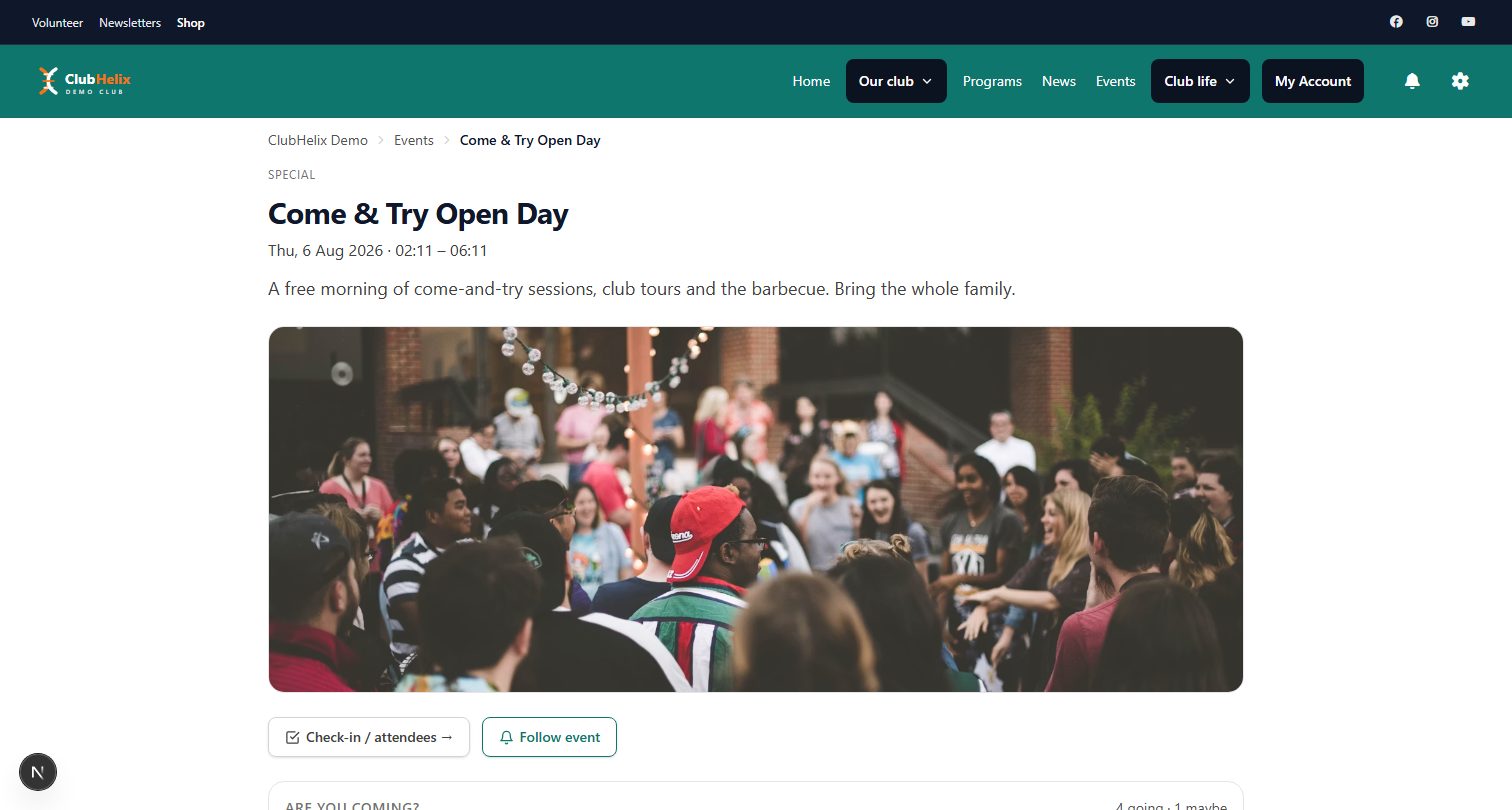
Run the timetable through your club website's events calendar with RSVPs and attendance switched on, and session logistics largely manage themselves: recurring sessions repeat automatically, members RSVP from their phones, coaches see numbers the night before, and attendance history shows you which sessions are earning their venue cost.
Open-water safety
Open-water swimming is the discipline that keeps club presidents awake, and deserves written protocols rather than habit:
- A designated water safety lead for every open-water session, who makes the swim/no-swim call on conditions and has the authority to cancel.
- Water safety craft or paddlers appropriate to the venue and numbers, with swimmers in bright caps, counted into and out of the water — a simple tally at entry and exit is the minimum standard.
- Buddy pairing and course design — swim loops that keep swimmers within reach of safety cover, never a straight line out to sea.
- A newcomer rule — first-timers swim a short, supervised loop before joining the main group.
Have every member accept the club's open-water and ride safety rules through a digital waiver at registration, and log anything that goes wrong — a panic in the water, a bunch crash, a near miss — through simple incident reporting so the committee sees patterns while they're still near misses. Your state triathlon body publishes open-water guidance; align your protocols with it and revisit them each season.
Membership, fees and insurance
Most triathlon clubs affiliate upward to a national body, whose membership typically includes personal accident and liability insurance covering club training — a big deal given open roads and open water. Check exactly what the cover includes before you rely on it, because club training rides and open-water swims are precisely the activities policies most often carve out.
Affiliation runs through your regional structure to the national body, and the membership licence is also what most local races require you to hold or buy on the day.
Club fees then come in layers: annual club membership, plus either session fees or a training subscription that covers coached sessions and lane hire. Keep the structure simple enough to explain in two sentences, publish it on the website, and collect everything online — online registration with payment at sign-up, and automatic renewal reminders so lapsed members are winged back rather than lost. For sizing the fee itself, our guide on how much club membership should cost applies directly.
The race calendar and club championship
Because members race at external events, the club has to create its own shared season. The pattern that works: the race secretary publishes a season race calendar — local sprint series, one or two olympic-distance targets, a destination race — and designates a handful as club championship races with a point score across distances and age groups. Add a club tent, a post-race breakfast and a results round-up on the club news page, and individual racing becomes a team sport. Publish the point score on the website all season; nothing drives race entries like sitting fourth.

Beginners: the pathway that grows the club
Triathlon looks intimidating from the outside — three sports, expensive bikes, jargon. Clubs that grow run a deliberate on-ramp: a come-and-try day each season, followed by a structured beginner program (typically eight to ten weeks, aimed at a first sprint race) with its own coach and its own cohort. Run the program through programs and term enrolment so places, payments and session lists are handled once. Graduates who finish their first race with clubmates cheering become your most loyal members — the retention logic in how to retain club members starts here.
Your triathlon club website
A triathlon club generates more logistics than almost any community sport, and a good triathlon club website is where it all lands: the weekly timetable with RSVPs, online membership and payments, the race calendar and championship point score, beginner program enrolment, waivers, and news. ClubHelix handles the lot — see the triathlon club management software page for the club setup, and pricing for plans (free tier available). If your committee wants it live without a tech volunteer, sign up and start with the calendar this week.
Frequently asked questions
How many training sessions should a triathlon club run?
A small club can start with four or five weekly sessions — two swims, a ride, two runs — and grow toward eight to twelve as membership supports it. Consistency beats volume: a reliable timetable members can plan around matters more than an ambitious one.
How do triathlon clubs manage open-water swim safety?
With written protocols: a designated water safety lead who can cancel on conditions, water craft or paddlers on course, bright caps, swimmers counted in and out, buddy pairing, and a supervised first swim for newcomers. Align your protocols with your state triathlon body's guidance.
Do triathlon club members need their own insurance?
Most clubs affiliate with the national or state triathlon body, whose membership generally includes personal accident and liability cover for club training and sanctioned events. Check the current inclusions with the body directly — cover details change.
What should a triathlon club website include?
The weekly multi-discipline timetable with RSVPs, online membership and payment, the season race calendar and club championship point score, beginner program enrolment, safety rules and waivers, and club news. One link that answers "what's on and where" is the single biggest admin saver.


