
What this guide answers
- How many heats can you run in a club round?
Work it out before you publish a program: total heats multiplied by heat length plus changeover must fit your daylight and tide window.
- How should a small club judge its rounds?
0, a two-wave total per surfer, and a head judge who manages the panel and calls interference rather than scoring.
- Who decides whether a round runs, and when?
One named contest director with a deputy, at a fixed time published before the season, with the message going out at a fixed time shortly afterwards.
- How do season points work in a boardriders club?
A published points table by placing, a drop rule so members can miss a round or two without losing the title race, a minimum number of rounds surfed to be eligible, and a written tie-break.
- What safety cover does a club contest need?
At minimum, dedicated water-safety people whose only job is watching the water — more of them for junior divisions — a stocked first aid kit, a competitor briefing covering hazards, boundaries and signals, and a known…
Ireland edition. This guide is written for volunteer-run clubs in Ireland. Where rules differ — grants, tax, incorporation, safeguarding — follow the Ireland-specific pointers below or check with your national body.
At twelve minutes past five, the contest director is standing at the top of the ramp with a head torch, a phone and a tide chart. There is enough light on the water to see lines coming through, and not enough to know whether they are three foot and workable or two foot and closing out on the bank. Low tide is at 6.40. The forecast said the wind swings onshore by ten. Somewhere across town, a hundred and twenty people have alarms set for 5.30, and about forty of them have already loaded boards into cars because they always do.
The call has to be made in the next fifteen minutes, and it has to reach everyone at once.
That moment is the whole job. A boardriders club has no ground to maintain, no fixture list it can trust and no gate to take money at. Its entire product is eight or ten club rounds a year plus a presentation night, and every one of those rounds hangs on a judgement made in the dark with incomplete information. Which means the clubs that feel well run are not the ones that get the best waves — they are the ones where every member knows, by 5.30, exactly what is happening and where to look. This guide covers running the rounds themselves, making and communicating the call, and the junior, coaching and safety side that decides whether the club still exists in ten years.
What a boardriders club is actually made of
Most clubs are a membership, a set of divisions, a season of rounds and a night in a surf club function room where the trophies get handed out. The divisions are where the design decisions live, because every division you add multiplies the time your round takes.
| Division | Typical entries | Heat length | Notes |
|---|---|---|---|
| Opens | 12-24 | 20 minutes | Your headline division, usually run late in the day when the tide suits |
| Women and girls | 6-16 | 20 minutes | Protect it — combining it into opens is how clubs lose it entirely |
| Under 18 and under 16 | 8-20 | 15-20 minutes | The competitive core of most junior programs |
| Under 14 and under 12 | 8-20 | 12-15 minutes | Shorter heats, more of them, parents on the beach |
| Grommets and micro-groms | 6-16 | 10-12 minutes | Run first, in the best light and the smallest tide, with water safety |
| Over 35, over 45, over 55 | 8-20 | 20 minutes | The volunteer base of the club — keep the divisions alive |
| Longboard | 6-16 | 20-25 minutes | Longer heats because wave count is lower |
| Bodyboard | 6-16 | 20 minutes | Where the bank suits it |
Membership and entry usually work one of two ways: an annual membership plus a small entry fee at each round, or a single all-in season fee with rounds free. The all-in model gets more people in the water on a marginal morning because the money is already spent; the pay-per-round model is friendlier to the member who can only make three rounds a year. Plenty of clubs run both — a season entry at a discount, with a casual round rate for everyone else.
Surf clubs in Ireland affiliate to the national surfing body, which administers insurance, coaching and judging accreditation and runs the national series. Affiliation matters practically because most contest beaches in Ireland sit under a local authority with a water safety plan, and a club that arrives with insurance, a safety plan and an accredited contest director gets a very different reception from one that does not.
Running a club round
The heat maths nobody does until it is too late
Every round is a scheduling problem constrained by daylight and tide, and it is worth doing the arithmetic on paper before you publish a program. The formula is blunt: total heats × (heat length + changeover) must fit inside your usable window.
A typical club window is seven in the morning until three in the afternoon — 480 minutes. At 20-minute heats with a five-minute changeover, that is about nineteen heats in a day. Now count what your divisions actually need.
| Entries in a division | Heat plan | Heats |
|---|---|---|
| 8 | Two heats of four, top two to the final | 3 |
| 12 | Three heats of four, two semis of three, final | 6 |
| 16 | Four heats of four, two semis, final | 7 |
| 24 | Six heats of four, three quarters, two semis, final | 12 |
| 32 | Eight heats of four, four quarters, two semis, final | 15 |
Two divisions of sixteen and one of twenty-four is already nineteen heats — a full day with no contingency for a lost hour when the tide goes wrong. That is why most clubs run three or four divisions per round and rotate which divisions run at which round, or split the field across a Saturday and a Sunday. Decide it in advance and publish it, because the alternative is a director quietly dropping the over-45s final at 3.30pm, which people remember for years.
Four-up heats are the practical default at club level: more people in the water per hour, more entries accommodated, and less dependence on strict priority. Man-on-man is better surfing and roughly doubles your heat count, so most clubs save it for finals day or the club title.
Judging that members will accept
You do not need a certified panel to run a fair club round. You need three judges, a head judge, and rules everyone can see.
- Three judges, seated together but not conferring, scoring each ride 0.1 to 10.0 on a printed or on-screen sheet.
- Two-wave total as the standard club format — each surfer's best two scoring rides added together.
- A head judge who does not score, but manages the panel, calls interference, handles queries and signs the result sheet.
- A conflict rule: nobody judges a heat containing a household member or their own coaching student, and judges for a division come from outside that division wherever numbers allow.
- Published scores. Post the sheet, or the totals at minimum, after each heat. Judging that happens in the open is trusted; judging behind a clipboard is not.
- A rotation and a break. Judges lose accuracy after about two hours. Roster them like any other job.
Priority and interference at club level should be as simple as you can make it and stated at the briefing, not assumed. In four-up heats, the surfer closest to the peak has the right of way; dropping in on a surfer with right of way is an interference; the penalty is losing the second scoring wave. Nominate one person on the beach — the beach marshal — to be the only voice that talks to the water on rule questions, and back their calls publicly even when your own kid is in the heat.
Points, the season title and the drop rule
Season points are what turn eight separate mornings into a competition. Keep the table simple and publish it before round one.
| Placing | Points |
|---|---|
| First | 1000 |
| Second | 800 |
| Third | 650 |
| Fourth | 550 |
| Semi-finalist | 400 |
| Quarter-finalist | 300 |
| Competed | 200 |
Then set three policies. A drop rule — best five of eight rounds counting, so a member who misses a family weekend is still in the title race. A minimum participation rule — you must have surfed at least four rounds to place in the season title, which stops a visitor winning on three cameo results. And a tie-break — most first placings, then most seconds, then the head-to-head at the final round. Write them into the club rules and never adjudicate them on presentation night.
The round-day run sheet
| Time | What happens |
|---|---|
| 5.15am | Contest director inspects, makes the call |
| 5.30am | Status message sent — on, backup beach, or postponed |
| 6.30am | Gear on the beach — tent, flags, hooter, vests, first aid, water safety boards |
| 6.45am | Sign-on desk opens; late entries and swaps handled by one person only |
| 7.00am | Competitor briefing — hazards, boundaries, priority, interference, hooter signals |
| 7.15am | First heat of the youngest division, in the best light and calmest tide |
| Rolling | Heat caller keeps the next two heats on the beach ready; results posted per heat |
| Midday | Break for the barbecue; finals seeded and posted |
| Afternoon | Finals, presentations on the sand, photos |
| Pack-up | Vests counted back, rubbish cleared, beach left better than you found it |
Named roles for the day: contest director, head judge, three judges, beach marshal, heat caller, results and scoreboard, sign-on desk, two water safety, first aid, barbecue, photographer. That is fifteen people, which sounds like a lot until you realise that half of them are parents who are on the beach anyway and would rather have a job than stand around.

The dawn call, and telling everyone at once
The decision itself is easier than clubs make it, provided one person owns it and the inputs are agreed in advance.
| Input | What you are actually asking |
|---|---|
| Swell height and period | Is there enough size, and will it hold through the middle of the day? |
| Swell direction | Does it match the bank you intend to run on? |
| Wind speed and direction | When does the onshore arrive, and does that end the day at eleven? |
| Tide times and range | Does the good part of the tide sit inside your daylight window? |
| Sandbank condition | Is the bank actually holding a rideable shape this month? |
| Warnings and closures | Any hazardous surf warning, beach closure or water quality alert after rain |
| Division suitability | It can be perfect for the opens and unrunnable for the ten-year-olds |
The last line is the one committees forget. A round that works for adults can be genuinely unsafe for micro-groms, and "on for the older divisions, postponed for the juniors" is a legitimate call — provided you can communicate it clearly.
A protocol that removes the argument
- One decision-maker. The contest director, with a named deputy. Not a committee, and not a group chat.
- A fixed decision time and a fixed message time. For example, decision at 5.15, message out by 5.30. Publish both at the start of the season.
- Three states only. ON at the primary beach, ON at the named backup beach, or POSTPONED to a stated reserve date. No maybes, no "we will look again at seven".
- One place of truth. The round status on the club website, updated the moment the decision is made, with the notification pushed out as an alert that points back to it.
- A standing rule. No status message by the published time means check the site before you drive. Members learn it in one season.
Message templates you can copy
ON. Round 4 is ON at the main beach. First heat 7.15, under 12s first. Sign on by 6.45. Onshore expected by 11 so we are running tight — be on the beach for your heat call. Full draw and running order on the club site.
BACKUP. Round 4 has MOVED to the point. Too much west in the wind at the main beach. Same schedule — sign on 6.45, first heat 7.15. Parking is limited so carpool if you can. Draw unchanged, details on the club site.
POSTPONED. Round 4 is POSTPONED. Not enough swell and the forecast worsens through the morning. Reserve date is Sunday 14th, same format and same draw. Entries already paid carry over automatically. We will confirm by Friday night.
Short, decisive, and each one ends by pointing at the same place. Choose channels deliberately: a push notification or SMS is the alert, the website is the record, and the group chat is where people talk about it afterwards. SMS versus email for club updates works through when each is worth using, and the broader version of this system is in the wet weather communication plan.
One more piece of discipline: ban reply-all. A hundred and twenty people receiving forty replies about parking at 5.31am is how a good system gets muted by everyone who matters.
The best swell here arrives with the shortest days and the coldest water, which compresses the usable window on a contest morning to a few hours and makes wetsuit rules a safety matter rather than a comfort one. Set a minimum thickness for junior divisions, cap heat lengths in cold water, and give competitors somewhere warm to change. Many clubs run junior rounds in the milder months and the open title through the autumn and winter swell season.
Juniors, coaching and beach safety
Junior divisions are the club's future and the reason most parents ever join a committee. They also carry the highest duty of care, so treat the safety side as part of the program rather than as paperwork bolted on.
Water safety on contest days. Nominate at least two people whose only job is watching the water for the junior divisions, on rescue boards or skis, in high-visibility rash vests, with a radio or a whistle and an agreed signal. They do not judge, they do not run the barbecue, and they are not the parents of competitors in that heat. Keep a stocked first aid kit at the tent, know exactly where the nearest defibrillator is, and confirm before the round whether the beach is patrolled that day and where.
A briefing that is actually delivered. Every competitor, every round: the boundaries, the hazards on that bank, the rip, the hooter signals, the priority rule, what to do if you lose your board, and who to tell if something goes wrong. Two minutes, out loud, before the first heat.
Coaching. Most clubs partner with an accredited coach rather than employing one. Put the arrangement in writing — which sessions, what they pay or provide, how junior members get a discounted rate, and what the club gets back, which is usually a couple of free come-and-try mornings a year. Insist on current accreditation and screening appropriate to your jurisdiction, and check what your affiliation insurance actually covers for coached sessions.
Child safety and conduct. Run the screening, codes of conduct and supervision policies expected of any community organisation working with children, and check the specific requirements with your governing body or the relevant authority, since they differ by jurisdiction. Get photo and video consent at join time — surf clubs generate an enormous amount of imagery and it is far easier to record consent once than to chase it after a great shot goes up.
Sun, water quality and marine hazards. Shade at the tent, sunscreen at the sign-on desk, water available all day, and a stated policy on running after heavy rain when water quality alerts are current. Brief the local marine hazards plainly and without drama at the start of each season.
If your club shares a beach with a lifesaving organisation, build the relationship deliberately — they have the equipment, the training and the local knowledge, and their calendar collides with yours. How to run a surf life saving club is a useful look at the operation from their side.
Vests, sponsors and the money shape
| Income line | Behaviour |
|---|---|
| Membership | The base. Family rates matter more here than in most sports |
| Round entry fees | Small per head, and they cover the day's running costs rather than fund the club |
| Sponsorship | The largest line for most boardriders clubs — local trades, surf shops, cafes |
| Presentation night | Ticketed, catered, and usually the club's biggest social night of the year |
| Raffles and auctions | A donated board raffled across the season funds a lot of trophies |
| Merchandise | Club tees and hoodies, ordered in runs rather than held as stock |
Competition vests are the one piece of equipment every club needs and every club under-buys. Four sets of four colours, numbered, in two sizes, washed and counted after every round. Losing vests is the most common equipment cost a boardriders club has, so make counting them in and out somebody's actual job.
Sponsorship works differently on a beach than at a ground — there is no fence to hang a sign on and no gate to hand out flyers at. What sponsors get instead is the vests, the tent, the round name, the photos that circulate afterwards and the presentation night. Package it that way, deliver a photo set to every sponsor after each round, and you will renew most of them without a conversation. How to get sponsors for a sports club covers the pitch, and how to run a presentation night covers the night they most want to be at.
Club membership in Ireland commonly runs from €30 to €80 a year with juniors cheaper and a family rate, plus a modest entry fee per round and the national affiliation levy. Local authority community grants and national sports funding rounds support coaching, safety equipment and junior participation, and applications that show a structured junior program with qualified coaches present much better.
Running the season from your phone
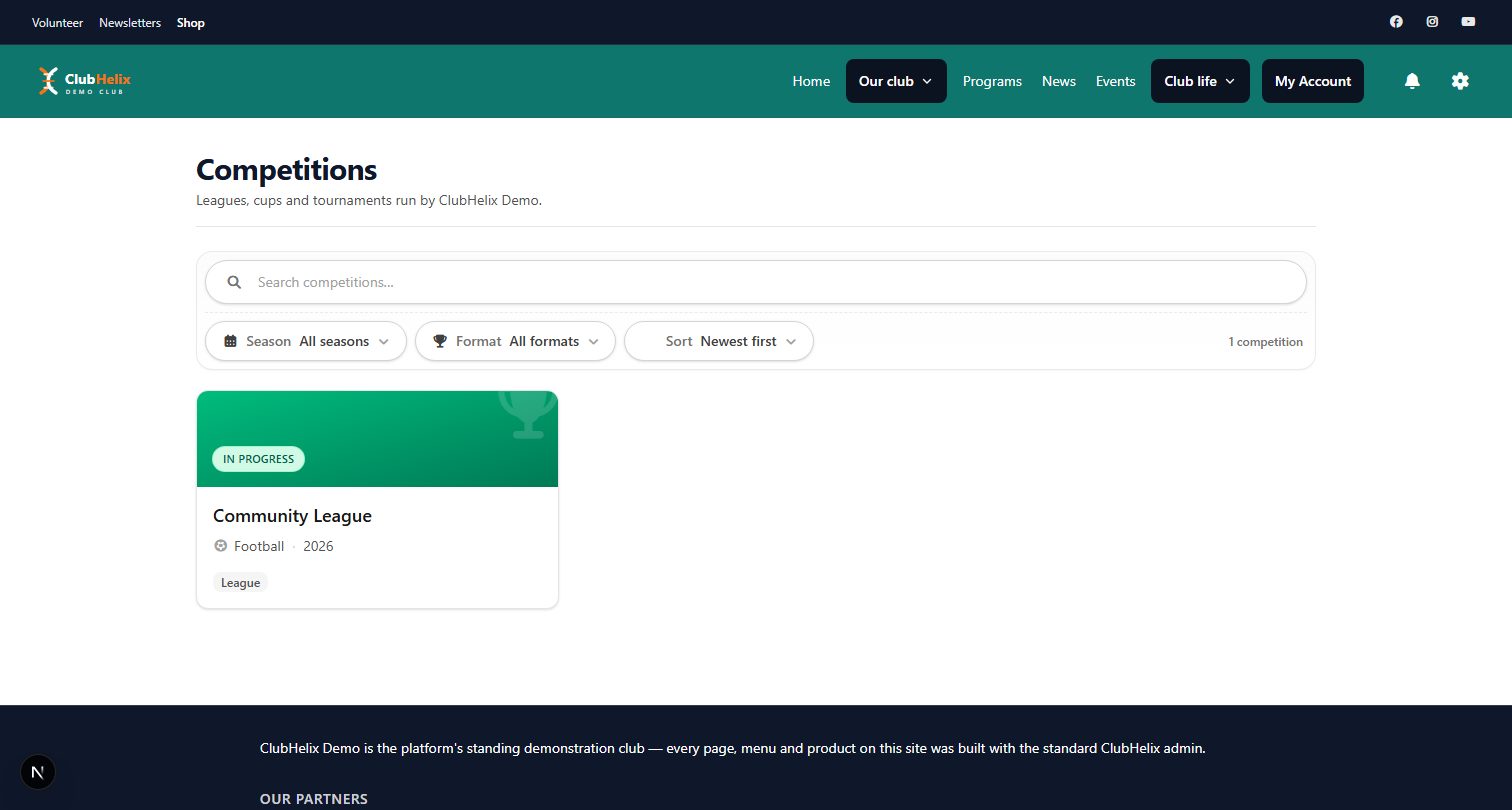
Almost everything in this guide is a communication problem wearing a competition costume — a draw that has to reach everyone, a status call that has to land before people drive, results that people want before they have dried off, and a points table nobody can find. ClubHelix puts it on one club site: competitions with divisions, draws, results and season standings so the points table updates itself, a live match centre for posting heat results as they come in, SMS for the 5.30am call, and an installable mobile app experience with push notifications so members get the alert on the beach without installing anything from a store.
The website is yours, on your own domain, with the round status, the draw, the standings and the join page all in one place — which is exactly what a member checks at 5.28am in a dark kitchen. There is a free tier to start on, published pricing when the club grows into it, and a committee member can set the site up between two rounds.
Frequently asked questions
How many heats can you run in a club round?
Work it out before you publish a program: total heats multiplied by heat length plus changeover must fit your daylight and tide window. At twenty-minute heats with five-minute changeovers, an eight-hour day gives about nineteen heats, which is roughly three divisions of sixteen. Rotating which divisions run at which round is how most clubs keep the day inside the window.
How should a small club judge its rounds?
Three judges scoring each ride from 0.1 to 10.0, a two-wave total per surfer, and a head judge who manages the panel and calls interference rather than scoring. Judges should not judge heats containing household members or their own students, they should rotate every couple of hours, and scores should be posted publicly after each heat.
Who decides whether a round runs, and when?
One named contest director with a deputy, at a fixed time published before the season, with the message going out at a fixed time shortly afterwards. Keep it to three outcomes — on at the main break, on at a named backup, or postponed to a stated reserve date — and make one place the authoritative record so members know where to look when no message arrives.
How do season points work in a boardriders club?
A published points table by placing, a drop rule so members can miss a round or two without losing the title race, a minimum number of rounds surfed to be eligible, and a written tie-break. Publish all four before the first round, because points disputes settled on presentation night damage clubs far more than the trophy is worth.
What safety cover does a club contest need?
At minimum, dedicated water-safety people whose only job is watching the water — more of them for junior divisions — a stocked first aid kit, a competitor briefing covering hazards, boundaries and signals, and a known plan for calling emergency services. Requirements and permit conditions differ by beach and jurisdiction, so confirm what is expected with the beach's managing authority and your governing body.
Keep reading — the wet weather communication plan generalises the dawn call to any club, and how to run a presentation night covers the evening your whole season points at.


