
What this guide answers
- How much does it cost to run a soccer club?
The big line items are association and league levies, insurance, ground hire and floodlighting, referee fees, kit and equipment.
- What volunteers does a soccer club need?
Beyond president, secretary and treasurer: a registrar, a coaching coordinator, a grounds officer, a canteen coordinator, a junior (small-sided football) coordinator, and a team manager for every team.
- When should we open registration for the season?
Open registration around three months before round one and aim to have most players registered and paid a month out, so grading and team nominations aren't guesses.
- Do we need soccer club management software or just a website?
Ideally they're the same thing: a website that also handles registration, payments, rosters, fixtures and communication.
New Zealand edition. This guide is written for volunteer-run clubs in New Zealand. Where rules differ — grants, tax, incorporation, safeguarding — follow the New Zealand-specific pointers below or check with your national body.
Soccer is one of the biggest participation team sports going, and almost all of it runs on volunteers. Whether your club fields three junior teams at a public park or a dozen sides across community leagues and a semi-professional pathway, the job is the same underneath: register everyone before round one, find enough coaches and managers, keep the pitches playable, and make sure the money that comes in covers the levies going out.
This guide covers the full cycle of football club administration — affiliation, committee, registration and fees, junior formats, the season, grounds and gear, money, communication, and the online presence that ties it all together. It's written for the volunteer secretary or president who inherited the job at the AGM and has round one bearing down.
Get the structure right: affiliation and the season calendar
Community football runs top-down: your club affiliates through one of the regional federations, which sit under the national body. Affiliation is what puts your teams in a competition, sorts insurance arranged through the game, and plugs you into the official registration system. It also comes with obligations — affiliation fees, per-player levies, and deadlines that don't move.
The season shape drives everything. Winter football typically runs April to September, which means the real work happens over summer:
- October–November — AGM, committee handover, and ground allocation requests to the council.
- December–February — set fees, open registration, recruit coaches and managers, order kit, book pre-season friendlies.
- March — grading games, final team entries, coach course checks, and police vetting confirmed for anyone in a children's role.
- April — round one. If registrations aren't done by now, players can't take the field.
Write those dates down somewhere the whole committee can see them. A club that starts planning a month out has already lost the pre-season; a good pre-season checklist run from the week the previous season ends makes round one boring — which is exactly what you want.
The committee and volunteers that make it work
A soccer club's committee looks like any club committee at the top — president, secretary, treasurer — but the sport adds a layer of roles that are worth naming explicitly, because unnamed jobs don't get done.
| Role | What they actually do |
|---|---|
| Registrar | Owns the national registration system, chases unregistered players, resolves ID photo and clearance issues |
| Coaching coordinator | Recruits and supports coaches, tracks accreditation, runs the grading process |
| Team managers (one per team) | Match cards, availability, parent comms, canteen and ground duty rosters |
| Grounds officer | Line marking, nets, corner flags, wet-weather calls, council liaison |
| Canteen coordinator | Rosters, stock, float, food safety basics |
| Junior program coordinator | Runs the small-sided junior program and the come-and-try days that feed it |
The single most effective thing you can do for volunteer recruitment is to break jobs into small, named pieces. "Help out at the club" gets no takers; "run the canteen roster for the under-9s, one hour a week from your phone" gets a yes. Our guide to committee roles and responsibilities has position descriptions you can adapt.
Registration, membership and fees
Registration is the sharpest pain point in soccer club administration, because two systems have to agree: the governing body's registration platform (which makes a player eligible to play) and your own records (who has actually paid you, which team they're in, whose parent is contactable). Clubs that track this on spreadsheets spend the whole pre-season reconciling the two by hand.
Fees deserve a deliberate committee decision, not a rollover of last year's number. A typical junior fee has to cover the association and federation levies, insurance, referee fees, kit, ground hire and line marking — and the levies alone are often more than half of it. Publish a transparent breakdown on your website; parents accept a fee far more readily when they can see that more than half of it leaves the club before it keeps a cent. Offer instalments for families with three kids playing, and decide your refund policy before the season, not during the first dispute — see our guide on how much membership should cost.
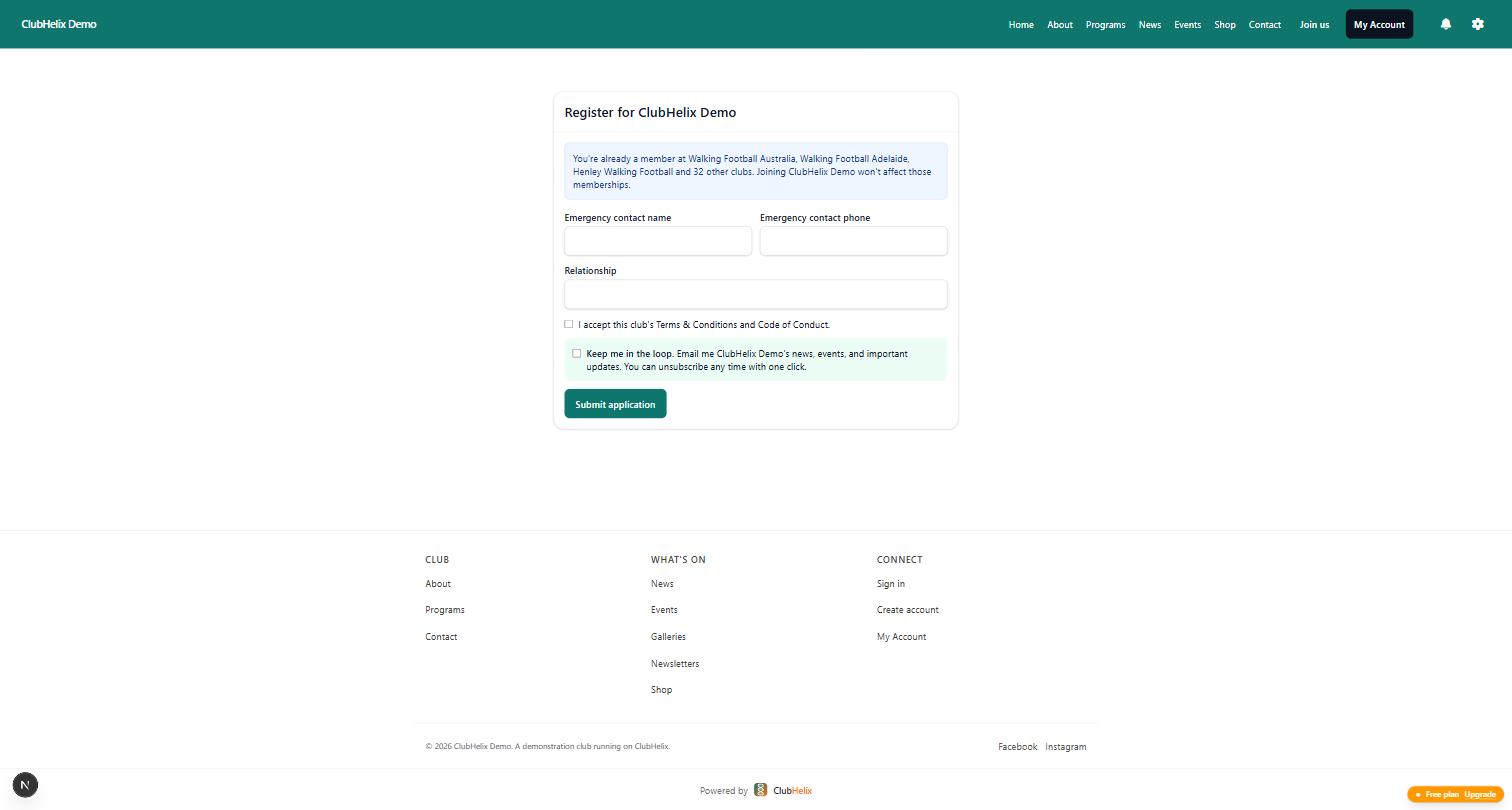
This is where soccer club management software earns its keep. With ClubHelix, online registration takes payment (card, with instalment options), collects the fields you actually need, and writes the player straight into your roster with a paid-until date — so your registrar reconciles exceptions, not everyone. A well-run registration day then becomes a welcome event rather than a data-entry marathon.
Juniors: small-sided formats and the pathway
Junior soccer everywhere now uses small-sided formats for the youngest age groups — think 4v4 on tiny fields for the under-6s and 7s, stepping up through 7v7 and 9v9 before kids reach full-field 11v11 in their early teens. No competition tables at the youngest ages, short halves, roll-on substitutions. The point is touches on the ball, not ladders.
For the club, small-sided football changes the logistics: one full-size pitch subdivides into several mini-fields, which means more games per Saturday morning, more parent volunteers as game leaders instead of qualified referees, and pop-up goals that someone has to set out at 7:30am and pack away at noon. Put field setup on the duty roster like any other job.
The junior program is also your growth engine. A well-run under-6 intake this year is your under-12s squad in six years and your senior club in fifteen. Run come-and-try sessions in term one, keep first-year fees low, and make the first experience friendly — our guide on increasing junior participation goes deeper.
The season: fixtures, training and match day
Once the season starts, the rhythm is weekly and relentless. Fixtures come from the association — usually published before round one and revised all season as washouts pile up. Your job is distribution: every fixture change has to reach the right team's players and parents the same day, or you get half a team at the wrong ground.
Training nights are a Tetris problem. Most clubs get two floodlit weeknights of council allocation and have to fit every squad into them, sharing pitch thirds. Publish the training grid before the season and resist mid-season reshuffles.
Match day itself runs on team managers: match cards or team sheets submitted through the competition system, ID checks for seniors, a ground marshal in a vest for home games, respect protocols around referees — many of whom are fourteen years old and doing their first season. A club that looks after young referees keeps its referees; a club that doesn't will spend every season begging the association for appointments.
Grounds, gear and the wet-weather call
Community soccer means mud. Most clubs play on public grounds, and the relationship with the council or municipal sports-field officer matters more than almost any other external relationship — they decide allocations, drainage works, and whether the ground closes after three days of rain.
The wet-weather call is a Saturday-morning institution: council closes the ground or the association calls off the round, and the club has ninety minutes to tell three hundred people. Have one channel that is always authoritative — a page on your club website plus a push or SMS blast — and name one person who makes the call. See our wet-weather communication plan for a ready-made process.
Gear is simpler but constant: nets, corner flags, pump and balls per team, bibs, first-aid kits, line-marking paint (or the ground owner's schedule), and a lockable container to keep it all in. Audit it every pre-season; buy in bulk with neighbouring clubs if you can.

Money: canteen, fundraising and sponsors
Registration fees rarely cover everything, and the gap is closed the same way at almost every club: food and drink sales at home games, sponsorship from local businesses, and one or two fundraising events a year.
The canteen alone can clear thousands over a season if it's rostered properly — every home game, every team takes a turn — and a sausage sizzle outside a hardware store or at home games remains winter sport's spiritual heart. A quiz night fills the clubrooms in the off-season.
Sponsorship works best as packages: shirt-front for the majors, ground signage and website logos for the rest, invoiced once a year with a genuine thank-you attached. Track who's paid and who's due for renewal like you track player registrations — sponsors lapse from neglect far more often than from dissatisfaction.
Communication that keeps parents onside
Most complaints at a soccer club are really communication failures: nobody told the under-10s the ground changed; the fee reminder went to an old email; the grading policy lived in one coach's head. Fix the channels and most of the friction disappears.
A workable stack is: the club website as the single source of truth (fixtures, training grid, policies, wet-weather status), email broadcasts for whole-club news, and team-level messaging for the day-to-day. ClubHelix keeps these in one place — team management with per-team messaging, club-wide broadcasts, and SMS for the urgent stuff — so a fixture change is one update, not six group chats.
Your soccer club website
A proper soccer club website does jobs a social page can't: it's findable on Google when a new family searches "soccer club near me", it takes registrations and payments at 9pm on a Tuesday, and it shows fixtures, results and ladders without anyone re-typing them. It's also your public face for sponsors and the council.
ClubHelix is built for exactly this: a club website builder plus the management layer behind it — registration and payments, competitions with fixtures and ladders, team management, broadcasts and a members' app — with a free tier to start on (pricing here). See the soccer club management software page for how clubs like yours set it up, or create your club site in an afternoon.
Frequently asked questions
How much does it cost to run a soccer club?
The big line items are association and league levies, insurance, ground hire and floodlighting, referee fees, kit and equipment. Most community clubs set junior fees to cover them, with levies typically the largest single component — publish the breakdown so families can see it.
What volunteers does a soccer club need?
Beyond president, secretary and treasurer: a registrar, a coaching coordinator, a grounds officer, a canteen coordinator, a junior (small-sided football) coordinator, and a team manager for every team. Small, named roles are far easier to fill than one giant "helper" role.
When should we open registration for the season?
Open registration around three months before round one and aim to have most players registered and paid a month out, so grading and team nominations aren't guesses. Online registration with payment at the point of sign-up removes most of the chasing.
Do we need soccer club management software or just a website?
Ideally they're the same thing: a website that also handles registration, payments, rosters, fixtures and communication. Separate tools mean re-typing the same data all season — a combined platform means the registrar, treasurer and coaches all look at one source of truth.


