
What this guide answers
- What does a service club actually do?
It brings members together around service to the community — delivering projects, raising money for causes beyond the club, and providing volunteers to partner organisations.
- Should a service club keep charitable funds separate from club funds?
Yes. Money raised from the public should sit in a separate account and be spent only on community purposes, while members' subscriptions fund the club's own running costs like meals, venues and affiliation.
- How does a service club choose projects?
Score candidate projects against consistent criteria — evidence of need, fit with what the club does well, available volunteer hours, funding, how long it will run, what remains afterwards, risk, and whether a delivery…
- How do you attract younger members to a service club?
Fix the practical barriers first — meeting times that assume a flexible workday, subscriptions bundled with compulsory meals, attendance rules written for a different era — then create an obvious way to serve at a…
- How should a service club measure its impact?
Track three things together and report them monthly — money raised and spent, volunteer hours by project, and the outcome in plain language with an honest number attached.
USA edition. This guide is written for volunteer-run clubs in the United States. Where rules differ — grants, tax, incorporation, safeguarding — follow the USA-specific pointers below or check with your national body.
At an AGM a few years into a club's life, someone stands up and asks a fair question: we raised a lot last year, so what did we buy? There is a pause. The treasurer can produce a total. The secretary can produce a list of events. Nobody in the room can name, in one sentence, what changed in the community because this club exists.
Service clubs rarely die of apathy. They die of vagueness. The members are willing — that is why they showed up in the first place — but willingness needs a visible result, and a club that fundraises energetically without being able to say what the money did will lose its best people to something that can. The clubs that stay strong for decades all share the same unglamorous habits: they keep two ledgers, they run a portfolio of projects they can actually finish, and they report impact to their own members as rigorously as they would to a grant funder.
This guide is for the committee or board of a community service club — the kind that runs projects, raises money for causes beyond itself, and depends entirely on volunteer hours. It covers choosing and delivering projects, separating charitable funds from club funds, building a fundraising calendar that does not exhaust everyone by August, and the membership question every service club is quietly worrying about. Where money, tax and screening rules come up, treat it as general information and confirm the detail with your parent organisation, your regulator or your own adviser.
The two ledgers, and why they never touch
The founding discipline of service club finance is simple to state and easy to erode: money raised from the public is held for the community, and money contributed by members runs the club. Two accounts, two ledgers, two sets of minutes-recorded decisions. One direction of travel — members can vote to move their own funds into the service account, never the other way.
| Cost | Which ledger | Why |
|---|---|---|
| Grants and donations paid out to a cause | Service account | The purpose the public gave for |
| Materials for a community project | Service account | Direct project delivery |
| Fundraising event costs | Service account | Netted against the funds that event raises |
| Meeting meals, venue hire, social nights | Administration | A member benefit, funded by member subscriptions |
| Affiliation or parent organisation dues | Administration | The cost of belonging, not of serving |
| Insurance for a public fundraising event | Service account | A direct cost of the activity |
| Website, software, banking fees | Administration | Running the club, though many clubs split this by usage |
| Awards, badges, member recognition | Administration | Members' own money, spent on members |
Three habits protect the discipline. Have two signatories on any payment out of the service account, and never the same person who counts the cash at the event. Reconcile every fundraiser individually — gross takings, costs, net, and the resolution that allocated the net — so the number in the annual report can be traced to an event and a decision. And publish the split. A club whose website says plainly that every dollar raised from the public goes to community projects while members fund the club's own running costs has just answered the first question every prospective donor and every new member asks.
Choosing projects you can actually finish
The typical service club has more project ideas than volunteer hours by a factor of five, and the ideas that get chosen are usually the ones proposed most passionately rather than the ones the club can deliver. A one-page scoring rubric, applied at the meeting where projects are chosen, changes that in a single year.
| Criterion | Ask this | Score 1-5 |
|---|---|---|
| Need | Has someone outside the club asked for this, with evidence? | |
| Fit | Does it match what this club is known for and good at? | |
| Volunteer hours | Do we have the hours, from people who are not already carrying three jobs? | |
| Money | Is it funded, or funded by a fundraiser we have actually scheduled? | |
| Duration | Can it be finished inside twelve months, or does it become permanent? | |
| Legacy | Will anything still be there in five years, and who maintains it? | |
| Risk | Does it involve children, vulnerable people, heights, food or roads? | |
| Partner | Is there a delivery partner who owns the outcome after we leave? |
Anything scoring low on volunteer hours and high on duration is the project that will still be limping along in three years, quietly consuming the club's capacity. Anything scoring low on legacy is not necessarily bad — a one-off working bee is a fine thing — but a club whose entire portfolio scores low on legacy will struggle to explain itself to funders.
The portfolio shape that works for most clubs across a year: one flagship project big enough to be the thing you are known for, three small projects that can each be delivered by two or three people in a weekend, and one ongoing commitment — a monthly meal service, a regular tutoring session, a maintenance arrangement — that gives members somewhere to serve between the big pushes. Anything beyond that is ambition rather than a plan.
Give each approved project a one-page brief before work starts: the need in two sentences, the outcome in one, the named project lead and deputy, the budget and where it comes from, the delivery partner, the start and end dates, the volunteer hours estimate, the risks, and how you will know it worked. Projects without a brief drift; projects with a brief get finished by people who were never at the meeting where it was approved.

Delivering without losing the volunteers
Delivery is where good intentions meet a Saturday morning. Four practices keep projects on the rails and volunteers coming back.
Split the roles. A project lead who coordinates, a deputy who can run it if the lead is away, and a separate person handling money. Combining all three in one enthusiastic member is how clubs lose enthusiastic members.
Publish the roster, do not phone around. The single biggest predictor of whether a working bee has enough people is whether the shifts were visible three weeks out with names attached. An open roster where members claim a slot beats a coordinator ringing the same twelve people every time — and it exposes early that only twelve people were ever asked. Our guide on recruiting club volunteers covers making the roles small enough to say yes to.
Check risk before the day, not after. Ask the four questions that change everything: does this involve children or vulnerable adults, does it involve food, does it involve heights or machinery, and does it involve public roads or crowds. Any yes means a conversation with your insurer or parent organisation, a written safety briefing on the day, and a sign-in sheet.
Capture the evidence as you go. Photographs with consent recorded, volunteer hours logged shift by shift, receipts scanned the day they are issued, and a short note of what changed. Doing this during the project takes minutes; reconstructing it six months later for a grant acquittal takes an evening and produces worse material. Tracking volunteer hours for grants explains why those hours are worth logging even when nobody has asked yet.
Reporting impact so members keep showing up
Members do not renew because of a bank balance. They renew because they can see the thing they helped make. Report impact in three currencies at once, every month, in a five-minute standing slot at the meeting.
- Money — raised, allocated, paid out, and what remains committed but unspent. Unspent commitments are where clubs lose credibility fastest.
- Hours — volunteer hours by project, which is the number that impresses funders and the number members recognise themselves in.
- Outcomes — the thing that changed, in plain language, with a number attached where one honestly exists.
An illustrative monthly slide, using made-up figures for shape rather than as a benchmark:
| Project | Volunteer hours this month | Delivered | Status |
|---|---|---|---|
| School breakfast club | 48 | 12 sessions, roughly 60 students a session | Ongoing, roster half filled |
| Park shelter rebuild | 96 | Frame complete, roofing next month | On schedule, funded |
| Emergency relief fund | 6 | 9 grants assessed, 7 approved | Fund at a third of target |
| Youth mentoring pilot | 22 | 8 pairs matched, 3 sessions each | Under review at year end |
Once a year, turn the same three currencies into a one-page impact statement for members, donors, sponsors and grant applications alike. Lead with one story about one person or place — told with permission, and without turning a beneficiary into a prop — then the totals, then the projects table, then a short honest paragraph on what did not work. That last paragraph is what makes the rest believable, and it is the section most clubs are too nervous to write.
Apply the "so what" test to every line before it goes out. "We ran a sausage sizzle" is an activity. "We ran six barbecues and funded a defibrillator that is now mounted at the netball courts" is an outcome. Members can only be proud of the second one.
The fundraising calendar
Service club fundraising fails in a predictable way: one flagship event grows every year, absorbs every willing volunteer, and becomes so exhausting that the club has no capacity left for the projects the money was raised for. The fix is a deliberate portfolio, planned twelve months out and published so members can plan their year.
| Slot in the year | Type | Lead time | Volunteer load | Reaches |
|---|---|---|---|---|
| One per year | Flagship community event | 6 months | Very high | The whole town |
| Twice a year | Ticketed dinner, auction or quiz | 3 months | Medium | Members, sponsors, friends |
| Three or four | Barbecue, stall or car boot sale | 4 weeks | Low | Passing public |
| Continuous | Raffle, appeal or regular giving | Rolling | Very low | Supporters at a distance |
| Opportunistic | Grant applications | Per round | Low but skilled | Funders |
A few rules of thumb that survive contact with reality. Budget every event at net, not gross, and record the costs honestly — a big event with a big gross and a thin margin is a volunteer-hours disaster dressed as a success. Retire an event when its net per volunteer hour has been falling for three years, no matter how traditional it is; something new will earn more and bring new people. Keep at least one continuous, low-effort income line — an ongoing appeal or a regular giving option on your website — because it earns while nobody is working, and it is the only line that grows without costing hours. For formats, club fundraising ideas and raffle versus auction fundraiser are worth a read before you commit the calendar.
Bringing in younger members without pushing out the founders
Every service club knows its average age. Fewer are willing to have the honest conversation about why, because the answers implicate things the founders love. Start with a diagnosis rather than a recruitment drive, because a recruitment drive into an unchanged club just produces a shorter list of resignations.
The barriers are usually mundane:
- Timing. A weekday lunch meeting excludes anyone with a job that does not permit long lunches. An evening meeting excludes anyone doing bedtime. Alternating, or running a satellite group on a different schedule, addresses more than any brochure.
- Cost. A subscription that bundles a compulsory meal every fortnight is a significant annual commitment for someone with a mortgage and young children. Separating the sub from the meals lets people belong at a price they choose.
- Attendance rules. Rules that made sense when members lived and worked within two kilometres of each other now read as a reason not to try. Consider a participation expectation measured in service hours a year rather than in meetings attended.
- Formality. Protocol, badges and toasts are meaningful to those who grew up with them and mystifying to those who did not. You do not have to abolish them; you do have to explain them, and to be able to say why each one still earns its place.
- The way in. Younger prospects almost never join first and serve later. They serve at one project, enjoy it, come to a second, and only then consider membership. Design an obvious "come and serve" path with no commitment attached, and make sure someone follows up afterwards.
Run a ritual audit once, with the founders in the room and leading it — this works when it is their idea, and fails when it feels like a takeover.
| Practice | Verdict |
|---|---|
| Formal opening and toasts | Keep — but shorten them, and explain what they mean to anyone new |
| Compulsory meal with the meeting | Adapt — make the meal optional and price it separately from the subscription |
| Fortnightly attendance expectation | Adapt — convert it to a service-hours commitment measured across the year |
| Nomination and vetting to join | Keep — and publish the process on the website so it stops being a mystery |
| Titles and honours | Keep — and add categories that recognise project delivery, not just longevity |
| Paper-only newsletter | Retire — publish it online and email it, and keep printed copies on request |
Two more things make the difference. Pair every new member with an experienced one for their first year — a named person, not a general offer of help. And give newer members a real project to lead within six months. Nothing retains a new volunteer like being trusted with something, and nothing loses one faster than three years of setting up chairs while waiting for a turn.
The founders are not the problem, and treating them as one is both unkind and self-defeating: they hold the relationships, the institutional memory and usually the sponsorship contacts. Frame the change as succession rather than replacement, and give the long-serving members the role they are best at — mentoring, opening doors, and telling the club's story to the community. See club succession planning for the handover mechanics.
Governance, money handling and screening
Service clubs handle public money and often work directly with children or vulnerable people, which puts them in a more regulated position than a social club. The specifics differ by market, so treat the following as general information and confirm the detail with your own regulator, your parent organisation or an adviser. Start with what your supporters can claim, because the answer shapes every appeal you write and every receipt you issue.
Deductibility for donors in the United States follows 501(c)(3) status granted by the IRS, and there are substantiation rules setting out what a written acknowledgement must say for larger gifts before a donor can rely on it. Charitable solicitation registration is handled state by state and is required in most states before you fundraise there, so check with your state attorney general or secretary of state as well as the IRS.
Games of chance are the other regulated area service clubs walk into regularly.
Raffles and charitable gaming in the United States are regulated at state level, and a few states restrict them heavily or prohibit them for some organisation types. Registration, reporting and limits on prize value vary widely, so check your state's charitable gaming rules and any local ordinance before selling a single ticket.
Screening for anyone working with children or vulnerable adults is not optional, and it is the compliance area where clubs are most likely to assume their parent organisation has handled it.
Background check requirements in the United States vary by state and often by the partner organisation you are working through — a school district or youth agency will usually specify what it requires. Many national service organisations mandate their own screening standard as well, so check both the legal requirement and the partner's policy.
Making generosity easy to give, and easy to prove
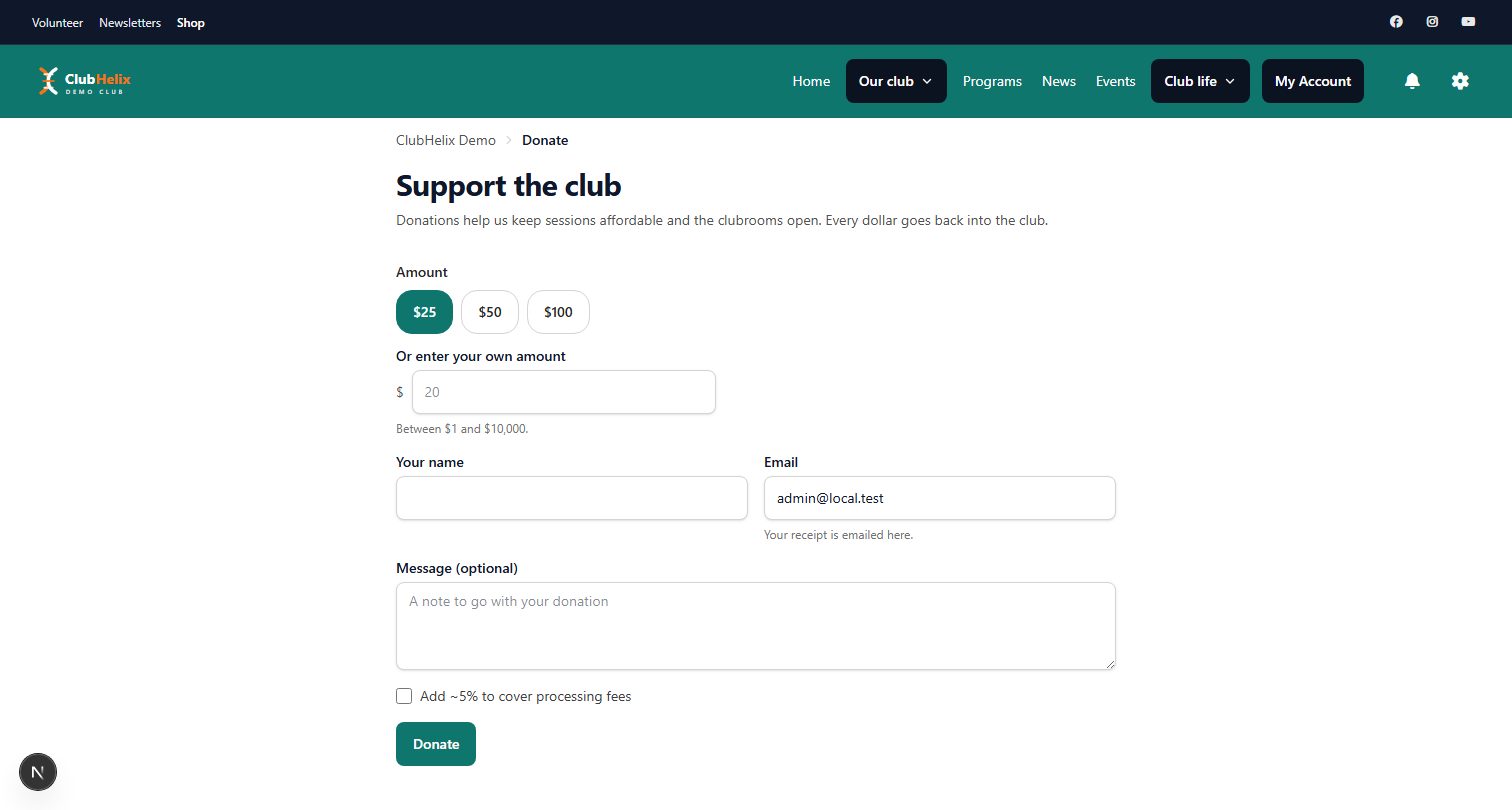
The administrative load in a service club is unusually spread out — donations arriving four different ways, raffle tickets on a clipboard, working bee rosters in a group chat, project receipts in a shoebox, and a treasurer trying to hold two ledgers apart with a spreadsheet. ClubHelix pulls it into one place your committee actually shares: online donations with one-off and recurring giving against a named appeal, raffles sold and drawn properly, volunteer rostering so shifts are claimed rather than phoned around, and reports that turn all of it into the numbers your impact statement needs.
Start on the free tier and move one thing across — the donations page is usually the one that pays for itself first. The pricing is published with no per-member surprises, and a committee member with a spare evening can create your club's site and have an appeal taking donations before the next meeting.
Frequently asked questions
What does a service club actually do?
It brings members together around service to the community — delivering projects, raising money for causes beyond the club, and providing volunteers to partner organisations. The club also functions as a social and professional network for its members, which is what sustains the volunteering, and most clubs belong to a wider parent organisation or district that supplies programs, standards and connections.
Should a service club keep charitable funds separate from club funds?
Yes. Money raised from the public should sit in a separate account and be spent only on community purposes, while members' subscriptions fund the club's own running costs like meals, venues and affiliation. Reconcile each fundraiser individually, require two signatories for payments out of the service account, and record the allocation decision in the minutes.
How does a service club choose projects?
Score candidate projects against consistent criteria — evidence of need, fit with what the club does well, available volunteer hours, funding, how long it will run, what remains afterwards, risk, and whether a delivery partner will own the outcome. Then aim for a balanced portfolio rather than a single flagship, and give every approved project a written one-page brief with a named lead and deputy.
How do you attract younger members to a service club?
Fix the practical barriers first — meeting times that assume a flexible workday, subscriptions bundled with compulsory meals, attendance rules written for a different era — then create an obvious way to serve at a project without joining first. Pair every new member with a mentor, give them a real project to lead within six months, and involve the long-serving members in leading the change rather than defending against it.
How should a service club measure its impact?
Track three things together and report them monthly — money raised and spent, volunteer hours by project, and the outcome in plain language with an honest number attached. Once a year, combine them into a one-page impact statement that leads with a single story, includes the totals, and says honestly what did not work. Members renew for outcomes, not for turnover.
Keep reading — club fundraising ideas when the calendar needs a new format, and volunteer appreciation ideas for keeping the people who make it all happen.

