
What this guide answers
- What does it cost to run a rugby league club?
The main costs are competition and insurance levies, ground hire and floodlights, accredited trainer coverage, playing kit and equipment, and travel in country competitions.
- What safety requirements does a league club have?
Competitions mandate accredited sports trainer coverage at every game, a ground manager at home venues, strict head-injury and return-to-play protocols, and correct team sheets for eligibility.
- How many players make a viable league squad?
Senior sides field thirteen with interchange, so plan on 20–22 registered and paid players per grade to survive injuries and unavailability.
- Does a small league club really need a website?
Yes — it's how new families find you, how registration money arrives without chasing, and where draws, teams and wet-weather calls live.
UK edition. This guide is written for volunteer-run clubs in the UK. Where rules differ — grants, tax, incorporation, safeguarding — follow the UK-specific pointers below or check with your national body.
Community rugby league runs deepest where it's run best: a junior club with a packed Saturday of mini and mod footy, a senior side in the local A-grade, a canteen queue ten deep and a committee that has quietly done a hundred jobs before the first whistle. None of it is complicated, but all of it is relentless — league club management is a weekly cycle of registration, safety compliance, team sheets, rosters and money that resets every Tuesday.
This guide lays out the whole operation for a volunteer committee: affiliation and season shape, the safety and trainer roles league mandates, registration and fees, the junior pathway from mini footy up, tag formats, match day, the canteen economy, and the rugby league club website that keeps three hundred families pointed the same direction.
Affiliation, the district and the season
Affiliation is what enters your teams in the draw, covers players under the sport's registration and insurance scheme, and binds you to the competition's rules: team nomination deadlines, judiciary processes, ground standards, and — in many senior competitions — player points or eligibility systems designed to keep the comp even. Read your competition's handbook every year; the rules move.
Your club affiliates through its league to the community game's governing body. Two structural facts shape everything here. First, the sport's community strength is regionally concentrated, so how far you travel for fixtures depends enormously on where you sit — clubs outside the heartlands routinely build a season around long away trips, and that belongs in the budget from day one. Second, the community game is largely a summer sport, running roughly February to September, which puts you in direct competition with cricket and other summer codes for pitches and players rather than with the union code.
The playing season runs for about six months (earlier for pre-season knockouts in some areas), which makes the off-season the real working season for the committee:
- Straight after the season — AGM and handover, ground allocation with council, team nominations.
- Three to four months out — registration opens, coach and trainer accreditations renewed, working-with-children checks verified, gear audit.
- The month before round one — trials and grading, final squads, volunteer roster locked for round one.
Country and regional clubs add travel to the list: long away trips, shared buses, and billeting for carnivals. Budget travel as a real line item, not an afterthought.
Safety roles: trainers, ground managers and head-injury protocols
Rugby league is a collision sport and its governing bodies treat safety as licence-to-operate. Your competition will mandate some version of the following at every match, and the committee's job is making sure they exist before the season, not scrambling on Saturday:
| Role | What the competition expects |
|---|---|
| Accredited sports trainers | Qualified first-aid/trainer coverage for every team, every game — identified on the sideline, usually by designated shirts |
| Ground manager | A named person running the home venue: sideline behaviour, dressing rooms, officials' welfare, incident escalation |
| Head-injury management | Players showing concussion signs come off and stay off, with return-to-play rules governed by the competition's protocols |
| Team sheets and eligibility | Correct, submitted on time, with age and points rules observed — finals eligibility disputes start here |
Track accreditations like assets: who holds what, when it expires, and who's rostered where. ClubHelix's accreditation tracking and volunteer rostering handle exactly this, and our risk management guide covers the broader safety picture. Incidents should be written up the day they happen — a simple incident report habit protects players and the club alike.
Registration, membership and fees
Every player must be registered through the sport's national registration system before playing — and the club separately needs to know who has paid, which team they're graded into, and which parent to call. The registrar who reconciles those two lists by hand in February is the most overworked volunteer in the club.
Fees in league typically bundle the competition levy, insurance, shorts and socks or a training shirt, and sometimes a season canteen contribution. Families with three kids playing footy feel it, so structure deliberately: family caps, instalment plans, and early-bird pricing that pulls registrations forward to the weeks when you actually need the numbers for team nominations. Publish the fee breakdown on your website — transparency kills the "where does the money go?" grumbling before it starts.
With ClubHelix, online registration takes the payment at sign-up, supports instalments, and writes each player into your roster with a paid-until date — so club records stop being a spreadsheet nobody trusts. Growth compounds from there; see our guide on growing club membership.
The junior pathway: mini, mod and international footy
Junior league uses modified formats that scale the game to the age group: small-field, tackle-limited footy for the youngest players, a modified mid-size game through the primary years, and the full international rules from the early teens. Fewer players per side, shorter halves, no ladders at the youngest ages — the design goal is touches, tries and confidence.
For the club this means a Saturday-morning machine: multiple small fields marked on one ground, games rotating every forty minutes, parent volunteers as sideline officials, and a canteen doing its biggest trade of the week. It also means your coaching pool is largely parents — get them accredited early through the governing body's junior coaching courses and hand every one of them a season plan.
Tag formats are league's fastest-growing arm — non-tackling versions that bring in girls, women and social players who'd never sign up for collision footy. A tag program isn't a side project: it's new members, new volunteers and new canteen customers, often in a summer window that keeps the club alive between winter seasons.
Match day: the weekly production
A home Saturday is the club's shop window. The run sheet barely changes week to week, which is exactly why it should be written down and rostered rather than carried in the president's head: fields marked and pads on, dressing rooms open, trainers present and identified, ground manager on duty, team sheets in, canteen and barbecue staffed, gate or raffle running, and someone photographing the day for the website and socials.
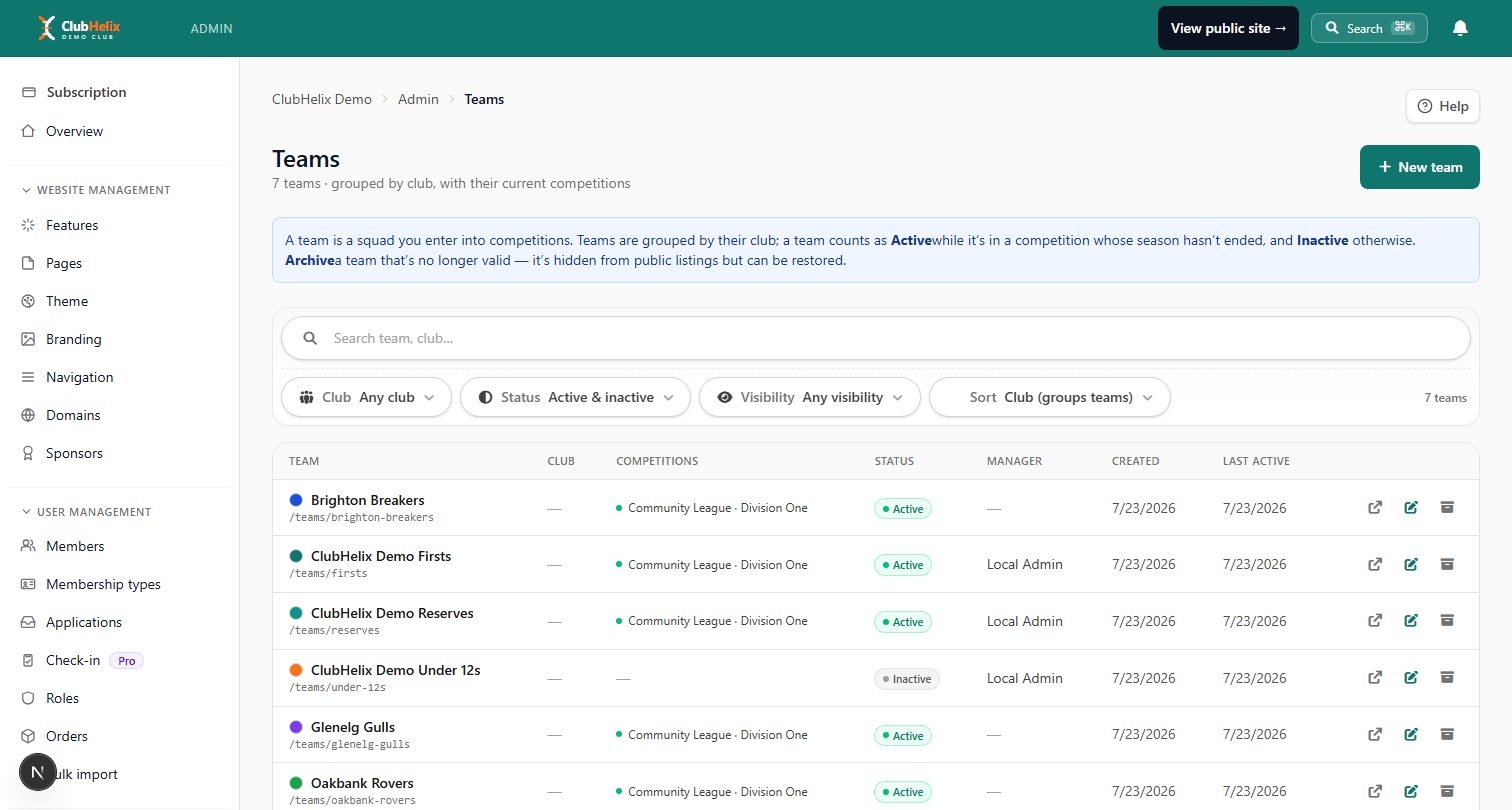
The information layer matters as much as the physical one. Availability by Thursday, teams announced Friday, ground changes and washouts broadcast the moment they're known. ClubHelix's team management runs availability and selections, RSVPs and attendance covers training numbers, and SMS messaging reaches every parent in minutes when the ground floods at 7am — one update instead of thirteen group chats.
Money: canteen, barbecue, sponsors and raffles
League clubs traditionally run on four revenue streams beyond fees: the canteen, the barbecue, local sponsorship and raffles. The canteen is the big one — over a season of home games it can out-earn registration surplus, but only if it's rostered (every team takes a turn), stocked deliberately and priced like a business. Our club canteen guide covers rosters, food safety basics and margins.

Sponsorship in league country is deeply local — the pub, the butcher, the earthmoving contractor. Package it (jersey, signage, website, major-raffle naming), invoice annually, thank publicly and often. Raffles and player-sponsor boards close the gap in tough years, and a simple online club shop sells hoodies and caps year-round without a committee member manning a table.
Your rugby league club website
When a new family moves to town and searches for junior footy, the club they find first gets the kid. A proper rugby league club website is findable on Google, takes registrations and payments around the clock, shows teams, draws and training times without anyone re-typing them, and gives sponsors a public home worth paying for.
ClubHelix is a club website builder with the management engine underneath — registration, payments, rosters, team sheets, comms and a members' app in one place, with a free tier to start (pricing). See the rugby league club management software page for how league clubs set it up, or create your club's site before the season starts.
Frequently asked questions
What does it cost to run a rugby league club?
The main costs are competition and insurance levies, ground hire and floodlights, accredited trainer coverage, playing kit and equipment, and travel in country competitions. Most clubs balance the books through canteen and barbecue trade, sponsorship and raffles on top of player fees.
What safety requirements does a league club have?
Competitions mandate accredited sports trainer coverage at every game, a ground manager at home venues, strict head-injury and return-to-play protocols, and correct team sheets for eligibility. Track accreditations and expiry dates centrally and roster coverage before the season, not week to week.
How many players make a viable league squad?
Senior sides field thirteen with interchange, so plan on 20–22 registered and paid players per grade to survive injuries and unavailability. Junior mod and mini teams need fewer per side, but you'll want deep squads because Saturday availability swings wildly.
Does a small league club really need a website?
Yes — it's how new families find you, how registration money arrives without chasing, and where draws, teams and wet-weather calls live. A social page alone isn't searchable, doesn't take payments, and buries last week's information within days.


