
What this guide answers
- What roles does a public speaking club meeting need?
At minimum a chair to run the agenda, a speech coordinator to book speakers ahead, someone to run the impromptu round, an evaluator for each prepared speech, and a timekeeper.
- How do speaking clubs get new members?
Almost entirely from guests who visit, are looked after well, and come back.
- How long should a speaking club meeting be?
Two hours is the usual length, including a break, and finishing on time matters more than the exact structure.
- Should a speaking club charge membership fees?
Yes, even a small one. Fees cover the room and materials, but more importantly they create commitment — a person who has paid turns up.
- How do you keep members once the initial nerves wear off?
Give them something to aim at and something to see. A contest calendar published a year ahead, a mentoring pairing for every new member, and a written record of speeches given, roles taken and goals set — reviewed in a…
Canada edition. This guide is written for volunteer-run clubs in Canada. Where rules differ — grants, tax, incorporation, safeguarding — follow the Canada-specific pointers below or check with your national body.
Wednesday, ten past seven, a meeting room with a whiteboard and eighteen stacking chairs. Fourteen members are in, and three people are standing near the door who have never been before — one sent by a manager, one who saw the listing that afternoon, one who has been reading the website for four months and finally came. The person who was going to chair tonight has flu. The timer is in someone's bag at home. The meeting starts anyway, and it starts on time, because the agenda does not depend on anybody in particular.
That last sentence is the whole craft of running a speaking club. Almost every other kind of club has an activity that happens whether or not the administration is good — the game gets played, the choir sings. A speaking club has nothing but its meeting. If the meeting is loose, late and improvised, there is no product. If the meeting is tight, warm and predictable, people come back for years and bring other people with them.
This guide is for whoever is trying to keep a public speaking or debating club running well — a committee of three or four, usually, in a room somebody lends you. It covers the meeting structure and the rotating roles that make it self-driving, the guest experience that is your only real growth mechanism, and the contests, mentoring and progress tracking that give members a reason to stay after the initial fear wears off.
Two models, and the trade-off between them
Before anything else, know which kind of club you are running, because it changes your fees, your calendar and your obligations.
| Affiliated network club | Independent club | |
|---|---|---|
| Program | A ready-made curriculum and speech projects | You design the path yourself |
| Calendar | Contest ladder and events set externally | Entirely your own |
| Fees | Per-member dues to the network, plus club fees | Only what you need to cover costs |
| Recognition | A name and credential people already know | Unknown until you build a reputation |
| Flexibility | Constrained by the network's format | Total — adapt to your members |
| Admin | Membership reporting and renewals on a fixed cycle | Whatever you choose to run |
Neither is better. Affiliated clubs get structure and a contest pathway for free, which matters enormously when your committee turns over every year. Independent clubs keep every dollar in the room and can shape the format around, say, a workplace, a professional field, second-language speakers or a debating format — which is exactly why many of the best small clubs are independent.
What both need is the same: a published meeting format, a roster, a guest process, and someone answering the enquiries that arrive at eleven at night from a person who has decided this is the year they stop being terrified.
The meeting that runs itself
A good speaking meeting is a machine with interchangeable parts. Every job has a name, every name has a card or a one-paragraph description, and any member can pick up any part with a fortnight's notice. That is what lets you lose the chair to flu and still start on time.
The standard shape
Two hours is the common length, with a break in the middle. The specific timings matter less than the fact that they exist, are published, and are enforced by a timekeeper.
| Time | Segment | Who runs it | Purpose |
|---|---|---|---|
| 19:00 | Doors, tea, guest welcome | Guest host | Nobody stands alone; guests are greeted by name |
| 19:15 | Opening and housekeeping | Chair | Start on time even with four people in the room |
| 19:20 | Guest introductions | Chair | Thirty seconds each, low stakes, warmly done |
| 19:25 | Prepared speeches | Speech coordinator | Two or three speeches, five to seven minutes each |
| 19:55 | Break | Everyone | The conversion happens here, not in the speeches |
| 20:10 | Impromptu round | Impromptu master | Everyone speaks — including guests who want to |
| 20:35 | Evaluations | Evaluators | One per speech, structured, specific, kind |
| 20:50 | Reports — timing, language | Timekeeper, others | Numbers, not opinions |
| 20:55 | Guest feedback and close | Chair | Ask the guests what they thought, in front of everyone |
| 21:00 | Finish | Chair | Ending on time is the promise you never break |
Two of those rows do more work than the rest. The break is where guests decide — it is the moment they either talk to three members or stand looking at their phone. And guest feedback at the close is worth more than any survey, because a guest saying out loud "that was not what I expected, it was much friendlier" persuades the other two guests in the room.
The roles, and what each one really does
| Role | The actual job | Good for |
|---|---|---|
| Chair | Runs the agenda, keeps energy up, fills gaps gracefully | Confident members, rotated often |
| Speech coordinator | Books speakers weeks ahead and chases replacements | The organised, quietly reliable |
| Impromptu master | Prepares topics, calls names, watches who has not spoken yet | Anyone with a sense of the room |
| Evaluator | Gives one speaker specific, usable feedback | Experienced members; the hardest role |
| Timekeeper | Signals and reports times honestly | A brand new member's first job |
| Grammarian or wordsmith | A word of the day and a note on language used well | Members who like detail |
| Guest host | Greets, seats, explains, follows up afterwards | Your warmest member, always |
The timekeeper role is the most underrated tool a speaking club has. It is the ideal first job for a brand new member — it requires no speaking beyond reading three numbers, it puts them at the front of the room in week two, and it gives them a reason to be there rather than an obligation to perform.
Filling the roster four weeks ahead
Rosters fail for one reason: they are filled by one person asking people individually. Publish a four-week grid where members claim their own slots, send a reminder three days before the meeting listing who is doing what, and keep a short substitutes list for each role. Names on a shared page create quiet accountability that a group chat never manages, and it means a new chair can see the shape of the next month at a glance rather than reconstructing it. Running the roster and the meeting sign-ups as RSVPs and attendance on your club's own site means the roster, the attendance record and the guest list are the same list rather than three.

Guests are the entire growth model
Speaking clubs do not grow through advertising. They grow because a nervous person visits, is treated well, comes back twice more and joins. Everything else is decoration. So treat the guest journey as your most important process and design each stage deliberately.
Before they arrive
Most guests decide whether to come from your website, alone, at night. It has to answer, without a phone call: where exactly the meeting is including the door and the parking, what time it starts and finishes, what happens in a meeting, whether they have to speak (no), what it costs to visit (nothing), what to wear, and whether they can just turn up. Add a photo of the actual room and actual members. Vagueness reads as a closed group.
Take a simple online registration for visitors, not because you need to gatekeep, but because it gives you a name and an email address — the two things that make the follow-up possible. One field for "what brought you here" is worth having: the answers are your marketing copy, written by the people you are trying to reach.
The night itself
Assign a guest host each meeting, and give them a script:
- Meet the guest at the door, learn their name, and introduce them to two members by name and one shared thing.
- Sit with them, and quietly explain each segment thirty seconds before it happens.
- Make it explicit at the start that they do not have to speak, and equally explicit that they may if they want to.
- Stay with them through the break, and hand them to somebody else rather than abandoning them.
- Ask them at the close what they thought — genuinely, and in front of the room.
- Get their contact details before they leave, and tell them the date of the next meeting.
The follow-up
This is where most clubs lose people. A guest who was welcomed and never heard from again concludes the welcome was a performance.
| When | What goes out |
|---|---|
| Next morning | A short personal message from the guest host, not a template |
| Day three | The next meeting date and what is on, with a link |
| After visit two | An invitation to take the timekeeper role at their next meeting |
| After visit three | The join conversation — cost, what it includes, how to say yes |
| If they go quiet | One warm message a month later, then stop |
Three visits before asking is the pattern that works. Ask on the first night and you interrupt a decision they have not made; wait until the fifth and they have drifted. Track it — a guest register listing name, first visit date, subsequent visits and who is looking after them turns growth from luck into a routine. Our guide to retaining club members covers the same discipline once they are in.
Contests, mentoring and measuring progress
The first six months of a speaking club member's life run on relief and novelty. After that they need to be able to see that they are getting better, or they quietly stop coming. This is where most clubs are thin, and it is entirely fixable.
A contest calendar people can aim at
Contests give the year a shape and a reason for a member to prepare something properly. Two or three internal contests a year is plenty for a small club — a prepared speech contest, an impromptu contest, and either an evaluation contest or a humorous one. Publish the dates twelve months ahead.
Run them properly or not at all. That means written rules distributed in advance, a contest chair who is not competing, a timekeeper with a stopwatch and a signal, three judges who are briefed on the criteria, a tie-break rule agreed before anyone speaks, and a sealed result. A contest decided casually damages a club more than no contest at all.
Debating clubs get the same benefit from a fixed internal competition — a ladder of motions across the term, consistent formats, and a final. Publishing the motions, the draw and the results on your own website is what turns it from an evening into a season.
Mentoring pairs
Pair every new member with an experienced one for their first three months. Write down what the mentor actually does, because "be a mentor" produces nothing: sit with them at their first three meetings, help them plan their first speech, listen to it once beforehand, evaluate it themselves or arrange who will, and check in after it. Six commitments, all small, all finite. Then rotate — a member who has been mentored for three months is usually ready to mentor somebody else within the year, and that is how a club builds depth instead of a single generation of confident people.
Progress that is written down
Give every member a simple record — speeches given with dates and titles, roles taken, contests entered, and one goal they set themselves. Review it with them twice a year in a ten-minute conversation. The conversation matters more than the record: "you have given four speeches, you have chaired twice, and you told me in March you wanted to stop reading from notes" is the kind of thing that keeps a person in a club for a decade.
Keep those records on the member's own record in the club's system rather than in a book that leaves with the secretary. It is also what makes a fair, transparent job of choosing who represents the club at anything external.
Venue is the one real fixed cost. In Canada, speaking clubs commonly meet in a public library meeting room, a municipal community or recreation centre, a legion or service club hall, a hotel meeting room, or a workplace boardroom after hours. Library and municipal rooms are often free or low cost for a not-for-profit community group, though many limit how far ahead you can book. Expect anywhere from nothing to around $50 an evening for a paid room. Two winter-specific notes worth planning for — decide in advance what weather cancels a meeting and how it is announced, and pick a venue with reliable parking and transit access in the dark months.
Money, structure and the quiet obligations
A speaking club is one of the cheapest organisations to run. Fixed costs are usually the room, a timing light or a stopwatch, a lectern if you want one, printing, and whatever your website costs. Income is member fees and occasionally a small charge for a workshop or a contest night supper.
That simplicity is exactly why clubs neglect the structure — until the day the treasurer moves away and nobody can access the account, or a member asks who is responsible if someone trips over a cable. Three things are worth doing properly even for a club of twenty:
- Two signatories on the bank account, always, and a written record of who they are.
- A one-page set of rules covering membership, fees, the committee, elections and what happens to any funds if the club winds up.
- A published fee and refund position so nobody has to negotiate it individually.
Collect fees online rather than in cash at meetings. Online joining and renewals mean the treasurer reconciles a list instead of carrying an envelope, and the club never again loses a renewal because the person who collects money was away for a month.
Most small speaking clubs in Canada operate as unincorporated associations, which is simple but offers officers no liability protection. Incorporating provincially as a not-for-profit gives the club its own legal identity and makes a bank account in the club's name straightforward, which is usually the practical trigger for doing it. Commercial general liability coverage is often a condition of a municipal room booking. Membership fees at community speaking clubs commonly sit somewhere around $80 to $200 a year. This is general information — check the requirements with your provincial registry and take advice before filing.
The meeting calendar has a natural shape. The dark half of the year is your strongest recruiting season, because a warm room on a cold weeknight is genuinely appealing and people are actively looking for something to do. The summer is the danger point — attendance thins across the holiday weeks, and a club that simply stops has to rebuild momentum in September. The clubs that handle it well run a reduced summer program of two or three lighter or social meetings, publish the return date before the break, and reopen with a deliberately guest-friendly meeting. Have a written policy for what weather cancels a meeting and how that decision is announced.
Committee, elections and knowing whether the club is healthy
Keep the committee small — a president, a secretary, a treasurer, and a vice-president or membership officer who owns guests. Elect annually, and make the handover a real one: a written list of what each role does, access to the bank account and the website transferred on the day, and the outgoing officer available for a term. Our club AGM guide covers running the meeting itself, and the committee handover checklist covers the transfer.
Then measure four things monthly, and put them at the top of every committee agenda:
- Members attending per meeting, as an average over the last three.
- Guests per month, and how many were second or third visits.
- Roles filled a week in advance, as a proportion of roles needed.
- Speeches given per member per year, which is your real measure of whether people are progressing.
If guests are healthy but conversion is poor, the problem is your follow-up. If attendance is healthy but speeches per member are low, you have a comfortable audience rather than a speaking club. Those two diagnoses cover most of what goes wrong.
Set permissions so the work can be shared. Your secretary should be able to publish the agenda, your membership officer should see the guest list, and neither should need the president's password. Proper roles and permissions mean the club keeps running when one person is away, and nothing important is trapped in a single inbox.
One place for the roster, the guests and the fees
The administration of a speaking club is small but relentless — the roster, the guest register, the follow-ups, the fees, the contest dates, and the website that answers the questions people ask at midnight. ClubHelix puts all of it on one site your committee controls, with roles and permissions so several officers can share the load safely, RSVPs and attendance for the meeting roster and the register, events for contests and workshops, and online joining so fees collect themselves.
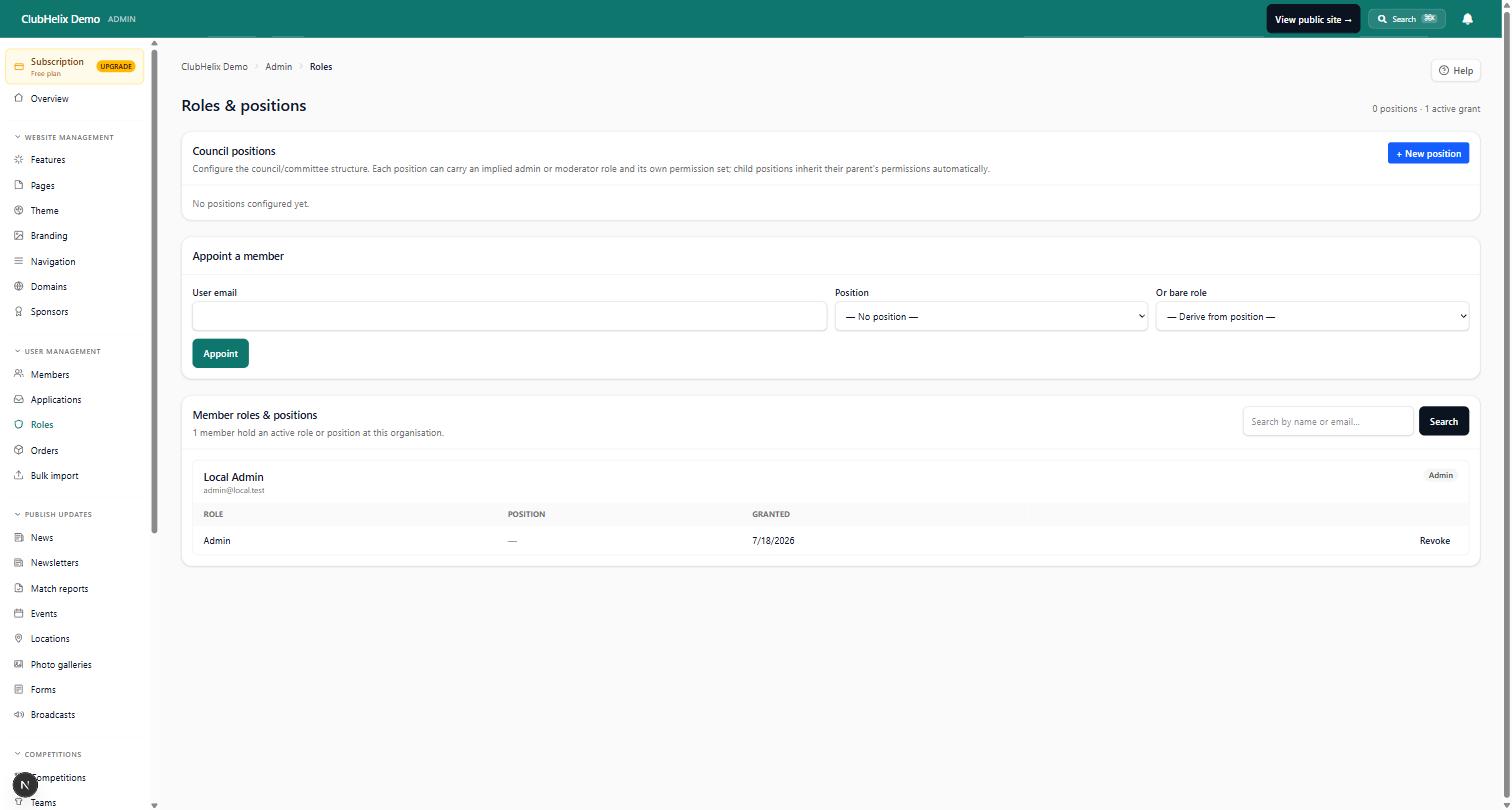
The free tier is genuinely enough for a club of this size, the pricing is published in full if you outgrow it, and there is no setup fee and no contract. You can create your club's website, publish the next four meetings and open a visitor registration form before your next Wednesday.
Frequently asked questions
What roles does a public speaking club meeting need?
At minimum a chair to run the agenda, a speech coordinator to book speakers ahead, someone to run the impromptu round, an evaluator for each prepared speech, and a timekeeper. Larger clubs add a guest host and a language or grammar role. Write a short description of each so any member can pick one up, and publish the roster four weeks ahead so gaps are visible early.
How do speaking clubs get new members?
Almost entirely from guests who visit, are looked after well, and come back. That makes the guest process your growth strategy — a website that answers every practical question, a named person greeting visitors at the door, an explicit reassurance that nobody has to speak, and a personal follow-up the next morning. Most people join on their third visit, so build the follow-up around three visits rather than asking on the first night.
How long should a speaking club meeting be?
Two hours is the usual length, including a break, and finishing on time matters more than the exact structure. A published agenda with times against each segment, enforced by a timekeeper, is what lets members plan their evening around the meeting — and a club that reliably ends when it says it will is one people keep coming back to.
Should a speaking club charge membership fees?
Yes, even a small one. Fees cover the room and materials, but more importantly they create commitment — a person who has paid turns up. Keep visits free so cost never stops someone walking in, collect fees online rather than in cash, and publish both the amount and what happens if someone joins mid-year so nobody has to negotiate it individually.
How do you keep members once the initial nerves wear off?
Give them something to aim at and something to see. A contest calendar published a year ahead, a mentoring pairing for every new member, and a written record of speeches given, roles taken and goals set — reviewed in a ten-minute conversation twice a year — turn a vague sense of improvement into visible progress. Members leave when they stop being able to tell they are getting better.
Keep reading — how to start a social club covers the setup side, and how to retain club members goes deeper on the year-two drop-off.


